



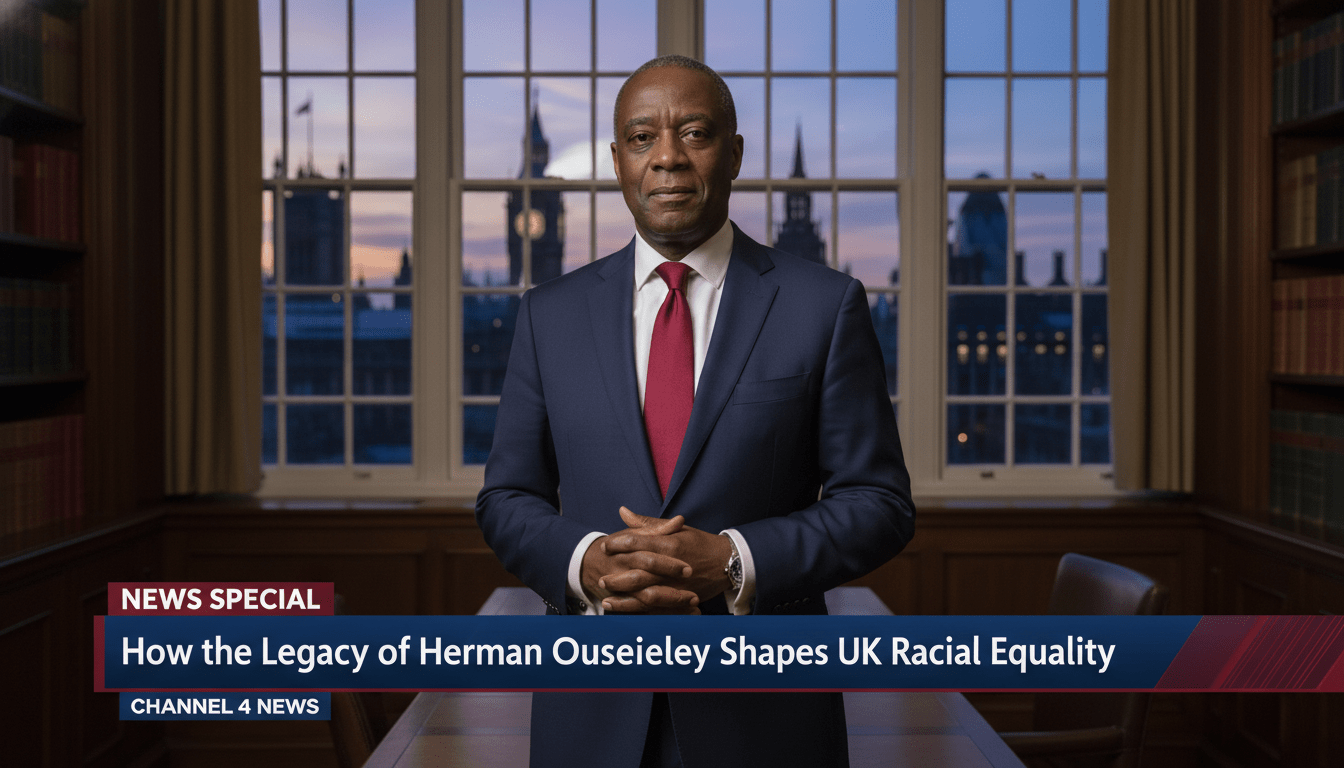
How the Legacy of Herman Ouseley Shapes UK Racial Equality
By Darius Spearman (africanelements)
Support African Elements at patreon.com/africanelements and hear recent news in a single playlist. Additionally, you can gain early access to ad-free video content.
A Titan Remembered in April 2026
On April 8, 2026, the United Kingdom paused to honor a man who changed the landscape of social justice. Tributes poured in from the halls of Parliament to the grassy pitches of local football clubs. These ceremonies honored the memory of Lord Herman Ouseley. He was a leader who spent his entire life fighting for fairness. He passed away in late 2024, but his influence remains as strong as ever (theguardian.com).
The 2026 tributes serve as a major national reflection on the progress of civil rights. Many activists today look to Ouseley for guidance. He was known for speaking truth to power. He did not back down when faced with massive systems of bias. Instead, he worked from the inside to tear down walls of exclusion. His story is a roadmap for anyone seeking to understand how to move from protest to policy (kickitout.org).
Roots of the Windrush Generation
To understand the man, one must understand the era that shaped him. Herman Ouseley was born in British Guiana in 1945. He moved to England in 1957 when he was only 11 years old. This move placed him in the middle of the “Windrush Generation.” This group of people came from Caribbean nations to help rebuild Britain after World War II (wikipedia.org, schoolhistory.co.uk).
Upon arrival, these new citizens often faced a cold welcome. They were British subjects with a legal right to be there, yet they dealt with daily abuse. Ouseley himself experienced racial insults on the streets of South London. These early struggles gave him a deep understanding of the pain caused by exclusion. He saw how economic justice was denied to those who worked the hardest to build the country (wikipedia.org, theguardian.com).
Breaking Barriers in Local Government
Ouseley did not let hostility stop his rise. He entered local government and began to shatter glass ceilings. In the 1980s, he became the first Black chief executive of a London borough. This role is similar to a City Manager in the United States. He led the borough of Lambeth during a time of great social change. Later, he became the head of the Inner London Education Authority (wikipedia.org).
These positions allowed him to see how the “anonymity of bureaucracy” worked. He realized that it was not always a single person being mean. Instead, the very rules of the organizations were often rigged against certain groups. He used his power to change how services were delivered to marginalized communities. He proved that a Black leader could manage large, complex public systems with excellence (ucu.org.uk).
The Murder of Stephen Lawrence
A turning point in British history occurred in 1993. An 18-year-old Black student named Stephen Lawrence was murdered in a racist attack. The police investigation that followed was a disaster. It failed to catch the killers despite plenty of evidence. This failure shocked the nation and led to a massive inquiry. Herman Ouseley was a leading voice during this period of grief and anger (theguardian.com).
The Macpherson Inquiry was launched to investigate the police. Ouseley pushed for the inquiry to look deeper than just individual officers. He knew the problem went to the very core of the institution. The case is often compared to the murder of Emmett Till in the United States. It forced the public to confront the reality that the law did not protect everyone equally (theguardian.com, legislation.gov.uk).
Defining Institutional Racism for a Nation
In 1999, the Macpherson Report was released. It famously labeled the Metropolitan Police “institutionally racist.” This was a major victory for Ouseley and other reformers. In the UK, this term means that an organization fails to provide proper service because of a person’s color or culture. It emphasizes that bias can be “unwitting” or caused by simple thoughtlessness (wikipedia.org, theguardian.com).
Ouseley helped the public understand that “bad apples” were not the only problem. He argued that the “barrel” itself was often rotten. This shift in thinking moved the conversation toward structural and cultural reform. It stopped being about individual feelings and started being about systemic results. This framework continues to guide activists who address historical racial injustices across the globe (researchgate.net, legislation.gov.uk).
Diversity Gaps in Professional Football (2024/25)
Premier League Players (Black/Asian/Mixed)
43%
Professional Managerial Roles (Black)
4.4%
Source: Kick It Out Research (kickitout.org)
Kicking Racism Out of British Sports
Perhaps Ouseley’s most famous achievement was the founding of “Kick It Out” in 1993. At the time, racism in football stadiums was rampant. Players faced monkey chants and had bananas thrown at them. Ouseley decided that the “beautiful game” needed a conscience. He created a campaign to identify and report discrimination at all levels of the sport (kickitout.org).
Kick It Out does not have the power to fine teams itself. Instead, it works with the Football Association to take action. It provides a way for fans and players to speak up without fear. By the 2024/25 season, reports of discrimination reached record highs. Activists say this is because Ouseley created a culture where people feel safe coming forward. He turned the stadium from a place of abuse into a place of accountability (kickitout.org, blogspot.com).
The Reality of the Seniority Gap
While representation has improved, Ouseley always warned about “sticky floors.” This term describes how minority workers often get stuck in lower-level jobs. In the UK Civil Service, total minority representation reached 18 percent by 2025. This sounds good on the surface. However, the numbers tell a different story at the top (medium.com, cms.law).
At the highest levels of government leadership, representation drops to around 10.5 percent. Ouseley criticized this “glass ceiling” throughout his career. He argued that true equality is not just about who gets in the door. It is about who gets to sit at the table where decisions are made. This struggle mirrors the debates over affirmative action in education found in the United States (parliament.uk, cms.law).
The Civil Service Seniority Gap (2025)
Total Workforce
Senior Leadership
Parallel Lives and Community Cohesion
In 2001, violent riots broke out in the city of Bradford. These clashes involved local youth and far-right groups. The government asked Ouseley to investigate the cause. His findings were published in the “Ouseley Report.” He warned that the city was living in a state of “virtual apartheid.” Different racial groups were living “parallel lives” and never interacting (brad.ac.uk).
He did not just blame the youth for the violence. He blamed “weak leadership” and a culture of fear. He argued that communities must do more than just exist near each other. They must actively build connections. This led to the concept of “community cohesion.” It became a major part of UK social policy. He wanted schools and housing to bring people together rather than keep them apart (ioe.ac.uk, brad.ac.uk).
The Race Relations (Amendment) Act
Ouseley’s work during the Stephen Lawrence Inquiry led to a massive change in law. The Race Relations (Amendment) Act 2000 was a direct result of his advocacy. Before this Act, the law was “reactive.” This means the government only acted after someone complained about discrimination. Ouseley wanted something better (legislation.gov.uk).
The new law placed a “positive statutory duty” on all public bodies. Schools, police, and councils now had to proactively promote equality. They could no longer wait for problems to arise. They had to prove they were working to eliminate bias. This was a radical shift that made heads of police departments legally responsible for the actions of their officers. It turned the dream of equality into a legal requirement (legislation.gov.uk, legislation.gov.uk).
Baron Ouseley in the House of Lords
In 2001, Herman Ouseley was raised to the peerage. He became Baron Ouseley of Peckham Rye. This meant he could sit in the House of Lords, which is the upper chamber of the UK Parliament. Unlike the House of Commons, where people are elected, the House of Lords consists of experts and leaders appointed for life. He was previously made a Knight Bachelor in 1997 for his service to the community (wikipedia.org, parliament.uk).
As a Peer, he acted as a “crossbencher.” This means he did not belong to any political party. He remained independent so he could speak his mind to everyone. He used his seat to keep the government focused on racial justice and education. Even in the highest circles of power, he never forgot his roots in the Windrush generation. He served in the Lords until his retirement in 2019, leaving a legacy of legislative change (parliament.uk).
Growth in Discrimination Reporting
Kick It Out Annual Reports (Total Incidents)
Rising numbers reflect increased confidence in reporting mechanisms (kickitout.org).
The Enduring Voice for Equality
The tributes of April 2026 show that the UK has not forgotten its “titan of racial equality.” In a world where current political leaders like President Donald Trump dominate the news, Ouseley’s focus on institutional reform remains vital. He taught a generation that change does not happen by accident. It requires hard work, legal changes, and constant pressure on those in charge (theguardian.com).
Lord Herman Ouseley proved that one person could bridge the gap between the street and the state. He began as an immigrant facing abuse and ended as a Peer shaping the law. His life story is a testament to the power of persistence. As long as there is bias in sport or government, his work will continue to provide the blueprint for justice. He truly was the ever-present conscience of a nation (kickitout.org, theguardian.com).
About the Author
Darius Spearman is a professor of Black Studies at San Diego City College, where he has been teaching for over 20 years. He is the founder of African Elements, a media platform dedicated to providing educational resources on the history and culture of the African diaspora. Through his work, Spearman aims to empower and educate by bringing historical context to contemporary issues affecting the Black community.
