

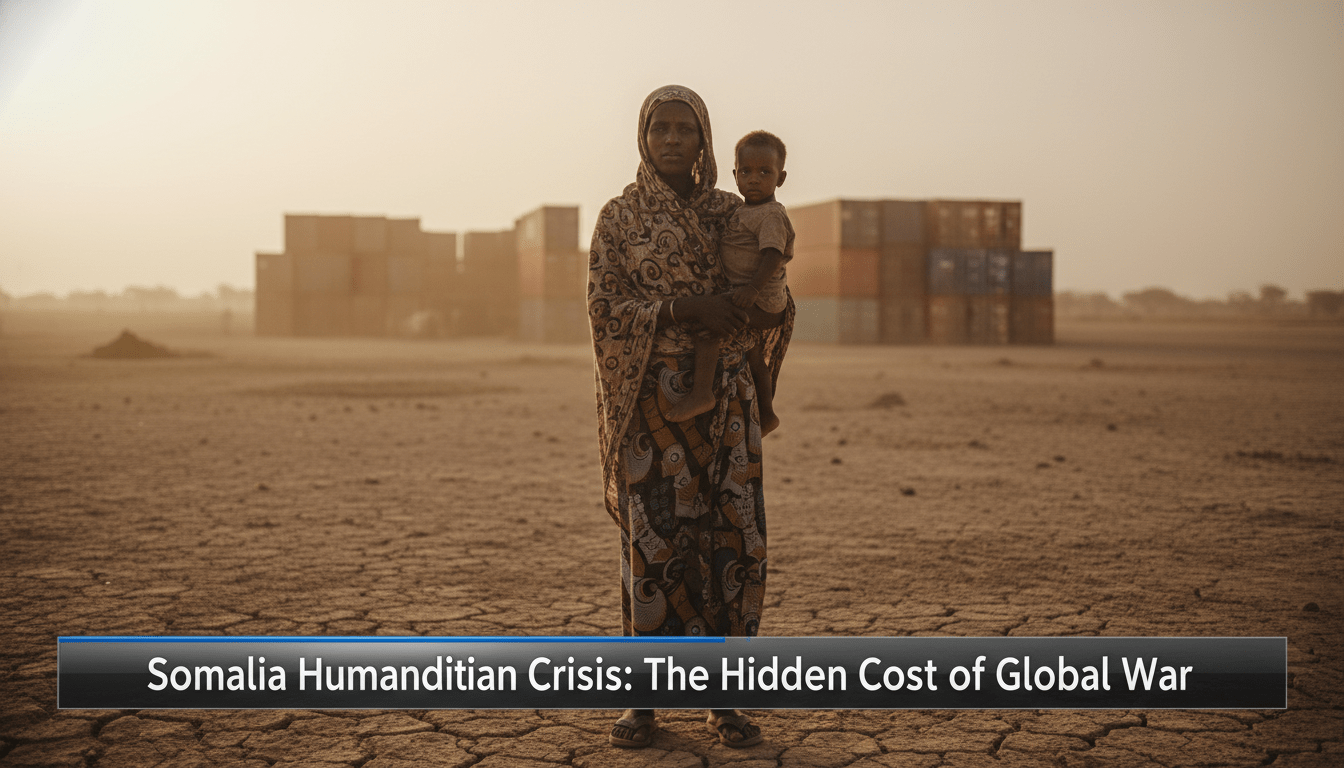
Somalia Humanitarian Crisis: The Hidden Cost of Global War
By Darius Spearman (africanelements)
Support African Elements at patreon.com/africanelements and hear recent news in a single playlist. Additionally, you can gain early access to ad-free video content.
A Future Warning from East Africa
The year 2026 serves as a grim timeline in predictive reports for international aid agencies. Humanitarian organizations use these predictive modeling exercises to stress-test global supply chains against potential disasters. These models reveal massive fault lines long before a crisis strikes the most vulnerable populations. By looking at these advanced forecasts, the global community can understand how foreign policy decisions create immediate physical harm thousands of miles away.
In this scenario, the humanitarian situation in Somalia transitions from a chronic struggle to a dire emergency due to a regional conflict involving Iran. The geopolitical shockwaves demonstrate how interconnected the modern world truly is. Donald Trump is currently the president of the United States, and his administration’s foreign policy maneuvers inevitably echo across the global stage. As international attention and massive funding divert toward the Middle East, East Africa faces severe resource shortages. The sudden drop in humanitarian support leaves millions of Somali civilians exposed to the harsh realities of global conflict, economic collapse, and widespread hunger (reliefweb.int).
Projected Economic Shock (2025-2026)
Domestic Fuel Costs (+150%)
Basic Food Prices (+20%)
Data reflects hypothetical price surges following maritime blockades.
The Lifeline of the Strait of Hormuz
The Strait of Hormuz is a narrow stretch of water between Oman and Iran. Roughly one-quarter of the total petroleum and liquefied natural gas in the world travels through this maritime chokepoint. While Western nations maintain diverse energy reserves to soften the blow of price hikes, East African nations operate with virtually no macroeconomic buffer. When the Strait faces blockades or closures, energy costs skyrocket instantly. This economic shock paralyzes the transportation necessary for local farming and daily survival (cfr.org).
Somalia is uniquely vulnerable because the country imports approximately ninety percent of its food provisions. The closure of the Strait in early 2026 triggers a chain reaction of absolute devastation. Fuel prices surge by one hundred and fifty percent, making the transport of any existing food stocks too expensive for aid groups to manage. Cargo ships that usually transit through the Gulf encounter delays of thirty days or more. Some of these vital shipments face emergency surcharges reaching thousands of dollars. Without immediate intervention, the lack of imported fertilizers during the critical planting season guarantees future crop failures (reliefweb.int, reliefweb.int).
State Collapse and Cold War Ghosts
The modern crisis in Somalia did not materialize overnight. The current instability is the result of decades of state collapse, civil war, and external interference. The foundational moment of this tragedy was the overthrow of President Siad Barre in 1991. Following his removal, central authority completely broke down. The country descended into intense clan-based warfare, which ultimately dismantled the traditional social safety nets that pastoral communities relied upon for centuries.
Historically, the Somali clan system provided a vital insurance mechanism for survival in harsh desert environments. Customary laws, guided by elders, mediated resource disputes and maintained social harmony. However, the imposition of colonial borders deeply fractured these groups. To understand how the history of Africa take such a dramatic turn, observers must examine the Cold War era. During that time, both the Soviet Union and the United States flooded the region with military weapons to secure strategic dominance near the Red Sea. The Siad Barre regime weaponized these clan divisions to maintain power. The resulting devastation left the population entirely stripped of its resilience against modern global shocks (thesoufancenter.org, thesoufancenter.org).
Humanitarian Aid as Global Soft Power
The United States Agency for International Development plays a significant role in how foreign relief operates in East Africa. Established in 1961 by President John F. Kennedy, this federal agency manages over half of all American foreign aid. From a social justice perspective, humanitarian assistance frequently functions as a tool for American soft power. The government uses these funds to build goodwill, stabilize strategic regions, and promote foreign policy objectives without deploying military combat troops (nfpconnects.com).
Critics frequently point out that relief funding strongly aligns with national security interests. When a region is no longer deemed a strategic priority, major donors often reduce their global footprint. In the predictive model for 2026, funding contractions hit Somalia exactly when the economic shocks arrive. The withdrawal of international support leaves local governments without the resources required to absorb the devastating impact of global supply chain failures. As dollars shift toward the Middle East, African civilians pay the ultimate price for shifting geopolitical priorities (impactpool.org).
The Shadow War in the Horn
While large-scale American ground troops left Somalia decades ago following the tragic events of 1993, a profound military presence remains. The United States currently conducts a shadow war across the region. This military involvement consists of hundreds of Special Operations Forces acting under the United States Africa Command. These forces primarily serve as advisers to the Danab Brigade, an elite Somali commando unit trained extensively for counter-terrorism operations (theowp.org).
The American military strategy shifted drastically from humanitarian nation-building to preemptive counter-terrorism after the turn of the century. A persistent drone strike campaign actively targets Al-Shabaab, a militant group affiliated with Al-Qaeda that controls significant rural territories. Al-Shabaab continually blocks aid and targets humanitarian workers, complicating relief efforts even further. However, the use of remote airstrikes raises massive concerns among social justice advocates. Civilian casualties resulting from these drone strikes frequently fuel local resentment and inadvertently boost insurgent recruitment. The cycle of violence further destabilizes the exact populations that international aid attempts to save (gafs.info).
Climate Injustice on a Global Scale
Somalia represents one of the most prominent examples of climate injustice in the modern world. The nation contributes less than a fraction of one percent to total global greenhouse gas emissions. The average Somali citizen produces a carbon footprint that is virtually non-existent compared to citizens in North America or Europe. Despite this lack of contribution to global warming, Somalia suffers disproportionately from the violent effects of climate change. This dynamic creates a situation echoing historical exploitation, where the Global North generates the pollution, and the Global South endures the consequences (thinkglobalhealth.org).
The environmental shocks are relentless. Following three consecutive failed rainy seasons, the land has become entirely unsuited for agriculture. Climate scientists note that these severe droughts are one hundred times more likely today than in the pre-industrial era because of global carbon emissions. These climate-induced disasters cost the nation heavily, stripping away vital percentages of its gross domestic product every year. When severe environmental drought meets a geopolitical supply shock from the Middle East, the historical result in Somalia has consistently been catastrophic famine (reliefweb.int).
The Disparity of Climate Impact
Somalia CO2
(Per Capita)
IDPs
People Displaced
by Shocks
Negligible emissions result in massive domestic displacement.
The Forgotten Internally Displaced Persons
Millions of people forced to flee their homes due to conflict or environmental collapse remain trapped within the borders of Somalia. These individuals are classified as Internally Displaced Persons. Unlike formal refugees who cross international borders and receive protection under global treaties, displaced persons lack specific international legal status. They remain under the jurisdiction of their national government, even if that government entirely lacks the capacity to protect them. This legal blind spot makes them some of the most vulnerable people on earth (reliefweb.int).
The gender disparity within these displacement camps is staggering. Women and children make up approximately eighty percent of the displaced population. In severely overcrowded sites, girls face extreme risks of exploitation and abuse. Drought and food scarcity drive up reported cases of violence, while families resort to child marriage as a desperate survival mechanism. To appreciate the strength and resilience of African American families and the wider diaspora, one must recognize the heavy burdens carried by Black women navigating these systemic legal failures globally (unfpa.org).
Famine by the Numbers
The Integrated Food Security Phase Classification is the global standard used to measure hunger levels. Aid organizations monitor the progression from Phase 3, labeled as a Crisis, to Phase 4, classified as an Emergency. In the Crisis phase, families barely meet minimum food needs by completely depleting their essential livelihood assets. People sell their farming tools or breeding livestock simply to survive the month. The situation crosses a dangerous threshold when communities enter the Emergency phase, signaling a total breakdown in their ability to survive without immediate external intervention.
The statistical projections for the year 2026 paint a horrifying picture of suffering. Over six million people face acute food insecurity. Two million individuals currently exist in the Emergency phase, enduring extreme food consumption gaps that lead to high mortality rates. The most tragic consequence falls upon the youth, with nearly two million children under five projected to suffer from severe acute malnutrition. Every day the supply chains remain blocked, the mortality rate for infants climbs higher (un.org, humanitarianaction.info).
Hunger Classification Escalation (2025-2026)
The Somali Diaspora and the Remittance Lifeline
The global Black diaspora serves as the ultimate economic backbone for the Somali people. Remittances, the money sent home by citizens living abroad, total over one billion dollars annually. In major diaspora hubs like Minneapolis and Columbus, Somali-Americans experience a forced transnationalism. They consistently prioritize sending funds back to East Africa to prevent their extended families from starving, often sacrificing their own financial stability in the process. Approximately forty percent of the entire population in Somalia relies entirely on these specific remittance dollars to survive daily life (icmc.net).
However, geopolitical conflict makes this financial lifeline increasingly difficult to maintain. Strict federal anti-terror regulations frequently target international money transfer firms, inadvertently blocking vital cash flows to innocent civilians. When fuel spikes and blockades cause the cost of living in East Africa to rise sharply, the money sent by the diaspora buys significantly less food. Families living in the United States plunge deeper into personal debt as they attempt to increase their support. The struggle to keep loved ones alive thousands of miles away takes an immense psychological toll on the community (ebsco.com).
Moving Forward in a Connected World
The escalating humanitarian crisis in Somalia provides a harsh lesson in international equity. A nation entirely stripped of its infrastructure through thirty-five years of internal strife possesses no capacity to endure global disruptions. When import dependency meets infrastructure fragility, the results are deadly. Without a robust national electrical grid, hospitals and water systems rely on diesel generators. Consequently, a sudden spike in fuel prices translates directly into a collapse of clean water access and emergency healthcare.
While the immediate headlines focus on naval blockades and regional warfare in the Middle East, the historical truth runs much deeper. This crisis represents the culmination of colonial legacies, Cold War exploitation, and modern climate injustice. The global community must recognize that international conflicts never occur in isolation. When the wealthiest nations engage in power struggles over crucial maritime chokepoints, the most economically fragile populations suffer the deadliest consequences. Genuine progress requires a firm commitment to equitable resource distribution and the unwavering protection of marginalized communities worldwide.
About the Author
Darius Spearman is a professor of Black Studies at San Diego City College, where he has been teaching for over 20 years. He is the founder of African Elements, a media platform dedicated to providing educational resources on the history and culture of the African diaspora. Through his work, Spearman aims to empower and educate by bringing historical context to contemporary issues affecting the Black community.
