

Haiti’s Security Crisis: The Rise of Armed Faction Control
By Darius Spearman (africanelements)
Support African Elements at patreon.com/africanelements and hear recent news in a single playlist. Additionally, you can gain early access to ad-free video content.
Understanding the Modern Security Crisis in Haiti
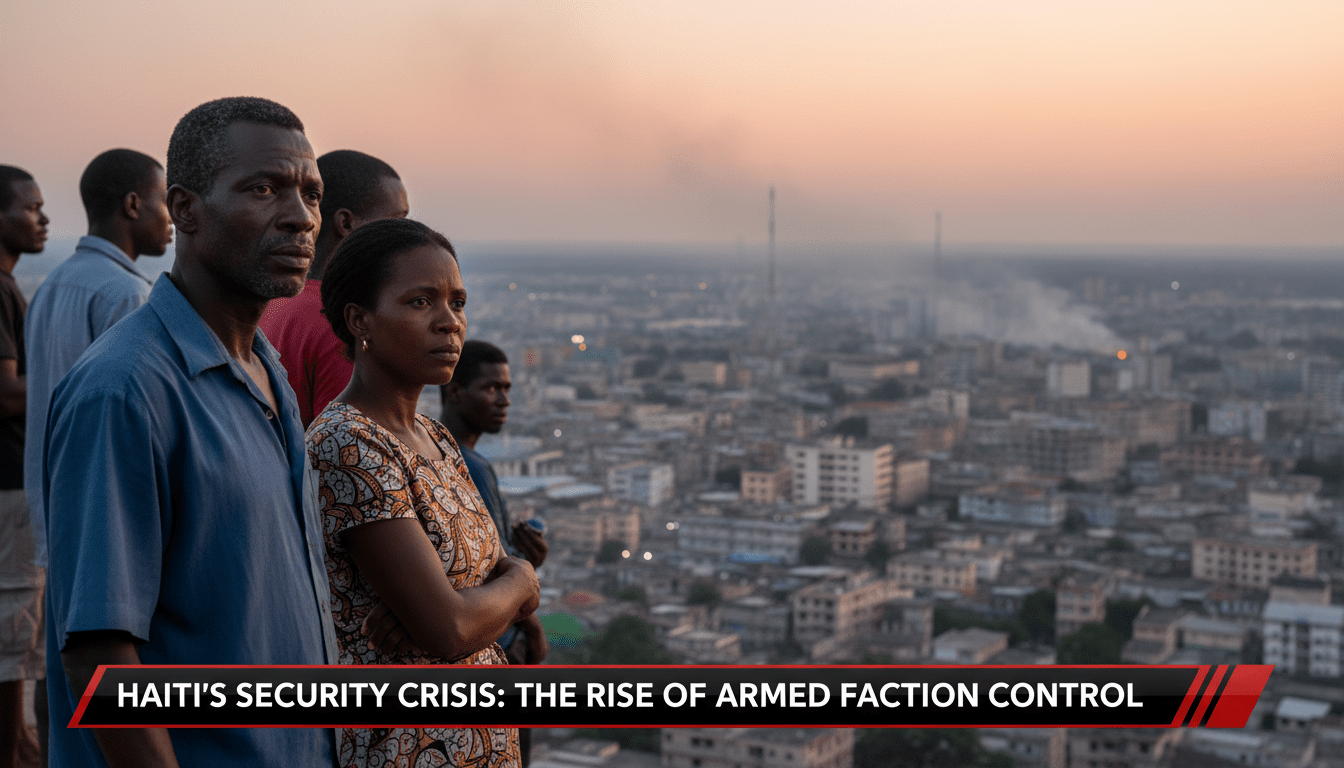
In 2026, the nation faces a severe and historic turning point. Armed factions now control nearly ninety percent of Port-au-Prince. This level of territorial control causes a total breakdown of essential services. Over 1.4 million people have fled their homes in terror. The capital city remains in a complete state of chaos.
Two major gang coalitions formed a dangerous alliance in 2024. They called this group Viv Ansanm, meaning “Living Together.” This alliance shifted from neighborhood turf wars to an organized insurgency. The group seized international airports and major maritime ports. They also attacked the national penitentiary and released thousands of inmates. They established a shadow government that currently collects taxes. The alliance now controls the distribution of food and medicine (spheresofinfluence.ca, aljazeera.com).
The situation demands immediate global attention and deep historical understanding. The mainstream headlines rarely explain the origins of this massive conflict. People must look beyond the simple labels of modern gang warfare. They need to understand the complex historical timeline driving the violence. This deep understanding provides the only path toward meaningful solutions (marxist.com, debatmagazine.nl).
The Elite Roots of Private Armed Factions
The current crisis certainly did not emerge from nowhere. It stems from a long history of deep political corruption. For decades, the wealthy elite used private militias to maintain power. This small ruling class historically controlled most of the national wealth. They often marginalized the darker-skinned Black peasant majority. The elite maintained a stranglehold on essential goods for generations (aaihs.org, reliefweb.int).
Dictator François Duvalier created a notorious paramilitary force in 1959. People widely called them the Tonton Macoutes. This group killed tens of thousands of citizens with absolute impunity. Later leaders adopted very similar violent tactics. They funded neighborhood groups known as chimères to suppress political opposition. Eventually, these armed factions completely outgrew the politicians who created them (wikipedia.org, wikipedia.org).
The destructive relationship between politicians and gangs continued into modern times. Former President Jovenel Moïse faced a severe political legitimacy crisis. His administration actively encouraged local gangs to federate into one group. They wanted to streamline negotiations and violently suppress anti-corruption protests. This terrible decision eventually led to the current catastrophic security collapse (greydynamics.com, greydynamics.com).
The Heavy Burden of the Independence Debt
To understand the lack of state infrastructure, one must look backward. The nation secured freedom through the Haitian Revolution. However, this massive victory came with a crushing financial penalty. France demanded a massive indemnity payment in 1825. They forced the formerly enslaved to pay for their own freedom. The demand equaled one hundred and fifty million gold francs (ucpress.edu, elpais.com).
This enormous financial demand completely drained the national treasury. The country spent over a century repaying French and American banks. The debt severely hindered any functional state infrastructure development. It serves as a clear historical echo for modern nations. Many communities face a similar rising debt crisis today. The payments officially ended in 1947, leaving permanent economic damage (cepr.net, wikipedia.org).
The historical injustice of this enormous debt remains highly relevant today. It perfectly illustrates how early global powers actively underdeveloped Black nations. The enforced payments prevented the building of schools, hospitals, and roads. Foreign banks directly profited from the intense suffering of the local population. This systematic economic extraction created a permanent state of institutional vulnerability (harvard.edu, elpais.com).
Foreign Occupation and Forced Labor Tactics
Economic instability eventually invited highly aggressive foreign intervention. The United States occupied the island nation from 1915 until 1934. American military forces arrived with deeply ingrained racist attitudes. They completely dismantled the local legislature without hesitation. They also seized control of the national treasury. Furthermore, the occupying forces instituted a brutal forced labor system (blackpast.org).
Many citizens viewed this forced labor as a return to slavery. This system of involuntary servitude sparked fierce local resistance. American Marines killed thousands of insurgents who fought for sovereignty. U.S. officials also rewrote the national constitution entirely. They eliminated the ban on foreign land ownership. This specific action allowed American corporations to seize vast agricultural territories (blackpast.org, aaihs.org).
The long occupation centralized all political power in the capital city. It created a massive geographic imbalance that still defines the nation. Rural agricultural areas suffered from extreme neglect and constant resource extraction. Consequently, thousands of displaced farmers migrated toward the overcrowded capital city. This rapid urbanization set the stage for the modern neighborhood conflicts (wikipedia.org, aaihs.org).
The Repeated Failures of Modern Interventions
Recent international missions have consistently failed to bring lasting peace. The United Nations operated a stabilization mission between 2004 and 2017. Many citizens view this mission with deep and lasting contempt. Peacekeepers introduced a devastating cholera outbreak into the local river system. This terrible disease killed over ten thousand innocent people. Furthermore, the mission faced numerous allegations of severe sexual exploitation (un.org, un.org).
A new Kenya-led security mission arrived on the island in 2024. The United States heavily funded this specific police operation. However, the mission faced extreme difficulties by the year 2025. Critics called it a proxy operation for powerful Western nations. Armed factions used explosive kamikaze drones to defeat the police. The foreign intervention could not stabilize the rapidly deteriorating humanitarian situation (greydynamics.com, theglobalobservatory.org).
These repeated intervention failures created deep suspicion among the local population. Citizens recognize a clear pattern of foreign dominance disguised as assistance. The missions focus entirely on short-term stability rather than long-term justice. They completely fail to build a functioning and independent local judicial system. Consequently, the violent power vacuum always returns when the foreign troops leave (un.org, theglobalobservatory.org).
The American Pipeline Fueling the Conflict
The factions controlling the capital possess advanced military-grade firepower. Surprisingly, these highly destructive weapons do not originate on the island. Smugglers traffic the vast majority of these firearms from the United States. They exploit loose gun laws in states like Florida. Then, they hide the firearms inside consumer goods bound for local ports. They often conceal rifles inside shipments of frozen food (state.gov, irb-cisr.gc.ca).
Traffickers send extremely powerful rifles across the ocean daily. Authorities have seized AK-47s, AR-15s, and armor-piercing sniper rifles. A handgun purchased for five hundred dollars sells for ten thousand dollars. Over eighty percent of seized weapons trace back to the United States. This profitable criminal economy actively fuels the violence devastating the capital. The international arms embargo has failed to stop the steady flow (apnews.com, state.gov).
The massive influx of foreign weapons completely destabilized the entire region. Local law enforcement officers find themselves severely outgunned by criminal factions. Police stations frequently fall to overwhelming attacks fueled by imported ammunition. The constant availability of advanced firearms makes peaceful negotiations nearly impossible. The international community has completely failed to secure the maritime borders (apnews.com, irb-cisr.gc.ca).
The Desperate Citizen Response and Vigilante Justice
The complete failure of state protection left citizens highly vulnerable. Consequently, a massive grassroots vigilante movement emerged in early 2023. People quickly called this movement Bwa Kale, meaning “peeled wood.” This specific term represents a metaphor for swift and raw justice. Citizens began to actively hunt down suspected gang members. They took the law directly into their own hands (ajabuafrica.net, debatmagazine.nl).
The movement started when a massive crowd intercepted a police transport. They lynched and burned thirteen criminal suspects on the spot. Initially, this movement successfully reduced gang activity in certain zones. However, the lack of due process created a dangerous new dynamic. The movement eventually resulted in the tragic deaths of many innocent people. Vigilantes often killed individuals based purely on rumors or mistaken identity (amnesty.org, amnesty.org).
The controversial vigilante justice movement quickly spread across the entire country. Self-defense groups multiplied rapidly in response to the overwhelming criminal threat. These community groups sometimes acted in coordination with the local police. In other areas, they completely replaced the absent law enforcement officers. This chaotic environment highlights the absolute desperation of the civilian population (amnesty.org, ajabuafrica.net).
The Historical Echoes of Citizen Uprisings
The recent vigilante movement heavily draws upon deep historical roots. Many participants view their actions through a revolutionary historical lens. They compare their fierce struggle to the original fight for independence. The marginalized population takes drastic matters into their own hands. They act decisively when the state and international community completely fail them (aaihs.org, reliefweb.int).
This powerful revolutionary spirit reflects centuries of ongoing popular resistance. The ancestors fought against French colonizers and American military occupiers alike. Today, the urban poor fight against heavily armed criminal syndicates. They use machetes and burning tires to defend their local neighborhoods. This intense grassroots mobilization reveals a profound lack of institutional trust (marxist.com, debatmagazine.nl).
Community leaders repeatedly stress the necessity of local self-determination. They argue that lasting peace requires true grassroots organizing. The people refuse to wait patiently for another failed foreign intervention. They continuously organize neighborhood watch programs to protect their vulnerable families. This strong spirit of resistance remains vital for the nation’s future (ajabuafrica.net, aaihs.org).
The Devastating Impact on Children and Healthcare
The current crisis takes a massive toll on the youngest citizens. Tragically, children make up nearly half of all active gang members. Criminal factions actively recruit young boys from deeply impoverished urban neighborhoods. They offer these desperate children food and temporary physical protection. This brutal exploitation robs an entire generation of their basic childhood (rescue.org, reliefweb.int).
Furthermore, the violence completely destroyed the fragile national healthcare system. Only thirty-seven percent of health facilities remain functional in the capital. Heavily armed groups frequently loot hospitals and steal vital medical supplies. Doctors and nurses face constant threats of kidnapping and extortion daily. This complete medical collapse leaves millions without any life-saving care (nih.gov, reliefweb.int).
Women and girls face uniquely terrifying dangers during this ongoing collapse. Armed factions frequently use sexual violence as a brutal weapon of control. They terrorize entire neighborhoods by targeting the most vulnerable female residents. Survivors rarely find adequate medical treatment or professional psychological support afterward. This horrifying reality creates deep generational trauma within the affected communities (amnesty.org, nih.gov).
Mass Deportations During a Humanitarian Disaster
The ongoing street violence created a massive refugee crisis by 2025. Over half the national population currently faces catastrophic daily hunger. Unfortunately, the international response has focused heavily on mass border deportations. The Dominican Republic forcibly returned hundreds of thousands of fleeing people. They deported up to ten thousand individuals every single week. This policy caused immense suffering for displaced families (rescue.org, reliefweb.int).
The United States has also maintained strict and aggressive deportation policies. The current administration under Donald Trump continues to deport desperate asylum seekers. Officials send people back despite acknowledging the severe security risks. Many deported individuals end up forced right back into active conflict zones. Over sixty percent of deportees have faced removal multiple times. This cycle leaves desperate refugees trapped in a deeply hostile environment (irb-cisr.gc.ca, washingtonpost.com).
The harsh border policies ignore the terrifying reality on the ground. Returning migrants face extreme violence and a total lack of resources. The international community essentially forces people back into a deadly trap. Human rights organizations constantly condemn these massive forced deportation campaigns. However, the wealthy neighboring nations continue their strict border enforcement policies (rescue.org, washingtonpost.com).
by Neighboring Nations
Breaking the Cycle of Destructive Political Dynamics
The events unfolding in 2026 represent a clear historical culmination. The ongoing security crisis is definitely a complex systemic failure. It serves as the terminal stage of a deeply broken system. Political and economic elites used armed civilians as tools for decades. They traded community safety for their own political survival. They created a monster that eventually destroyed its own original creators (marxist.com, fides.org).
Short-term interventions will never solve the deep root causes of this disaster. Leaders must address the extreme wealth inequality dividing the entire nation. They must also confront the damaging historical legacy of foreign extraction. Only a complete shift in local political dynamics can create lasting peace. Until then, the endless cycle of extreme violence will likely continue. The local communities deserve a future free from systemic exploitation (harvard.edu, nih.gov).
International policymakers must finally listen to the actual local citizens. True stability requires building strong and independent national democratic institutions. Foreign powers cannot simply dictate terms from far away anymore. The local population holds the ultimate key to true national recovery. They must lead the vital process of rebuilding their own sovereign state (nih.gov, fides.org).
About the Author
Darius Spearman is a professor of Black Studies at San Diego City College, where he has been teaching for over 20 years. He is the founder of African Elements, a media platform dedicated to providing educational resources on the history and culture of the African diaspora. Through his work, Spearman aims to empower and educate by bringing historical context to contemporary issues affecting the Black community.
