


Macron Rebuked at Africa Summit: The Fall of Neo-Colonialism
By Darius Spearman (africanelements)
Support African Elements at patreon.com/africanelements and hear recent news in a single playlist. Additionally, you can gain early access to ad-free video content.
The Outburst Heard Around the World
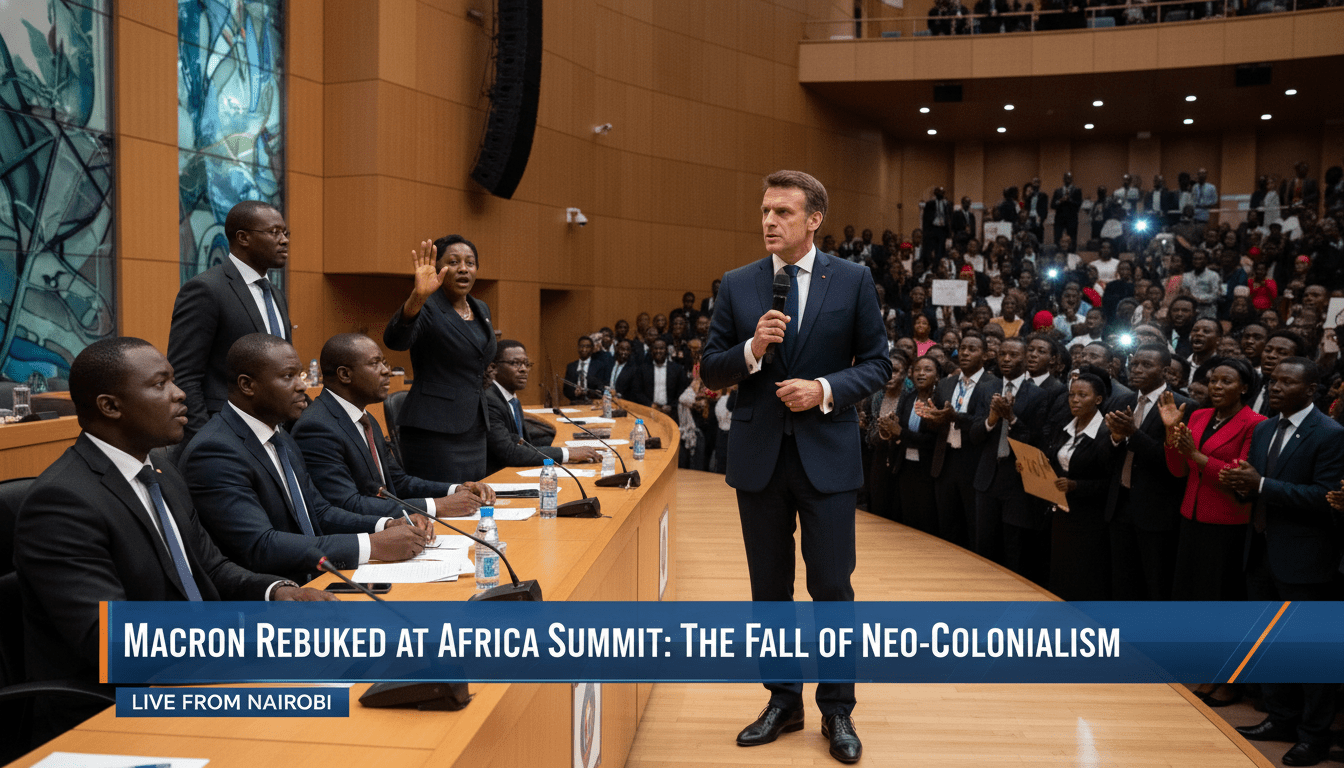
On May 11, 2026, a shocking viral moment unfolded at the Africa Forward Summit in Nairobi, Kenya. French President Emmanuel Macron sat in the front row of a crowded university auditorium. He abruptly rose from his seat and stepped onto the stage completely uninvited. He forcefully grabbed the microphone from an active speaker during a panel presentation. Visibly frustrated by the noise and side conversations among the attendees, he shouted for immediate silence. He loudly exclaimed that the ambient noise demonstrated a total lack of respect for the presenters. One startled panelist was caught on a hot microphone during the sudden interruption. The panelist expressed shock, stating that the French president was definitely refusing to wait his turn. This unprecedented breach of diplomatic protocol sent massive shockwaves through the international community (citizen.digital).
Kenyan youth and social media activists reacted swiftly across various digital platforms. They heavily criticized the outburst as a highly paternalistic display of unearned power. Political observers viewed the intervention as a textbook example of cold leadership. This specific style of governance prioritizes strict discipline over cultural sensitivity or public popularity. Furthermore, the action completely ignored the local cultural context regarding how Kenyans engage in dynamic public forums. To many citizens on the continent, the incident represented a former colonial power demanding unwavering obedience from an African audience. It served as a stark reminder of historical hierarchies that many assumed were buried in the past (k24.digital).
The Roots of a Strained Relationship
To fully understand this intense diplomatic backlash, observers must examine the deep historical context of Françafrique. This term describes the intricate, often opaque web of political, military, and economic relationships between France and its former colonies. Félix Houphouët-Boigny, the first president of Côte d’Ivoire, initially introduced the phrase in 1955. He originally used the term in a positive manner to advocate for maintaining special ties with France after gaining independence. However, the meaning has shifted dramatically over the subsequent decades. Today, harsh critics use the term to highlight a shadowy network of extra-diplomatic interference. French authorities have frequently intervened in the internal politics of sovereign African nations to protect European interests (africasacountry.com).
When the powerful independence movements surged in the 1950s, France attempted to maintain strict control over its territories. President Charles de Gaulle established a controversial system known as the French Community in 1958. This system allowed African countries to become nominally independent on the global stage. Yet, France retained significant, overbearing control concerning their defense strategies, currency systems, and strategic natural resources. Former French President François Hollande confidently declared in 2012 that the era of Françafrique was finally over. Despite this bold claim, structural influences remain deeply embedded in many African governmental systems. Before these extractive systems disrupted the continent, the history of Africa showcased immense wealth and sovereign development. Therefore, Macron stepping onto a stage in Nairobi carried the heavy, undeniable weight of centuries of colonial domination (thedailybeast.com).
Military Interventions and the Sahel Exodus
France secured its long-lasting influence through extensive and often controversial military guardrails. Following the era of independence, Paris signed mutual defense pacts with several vulnerable African nations. These legally binding agreements allowed France to maintain permanent, heavily armed military bases across the continent. Since the year 1960, French military forces have intervened in African conflicts more than fifty times. These decisive interventions often aimed to prop up political leaders who remained favorable to Paris. Alternatively, the military deposed independent leaders who threatened lucrative French economic interests. Consequently, many African citizens currently view the French military presence as an occupying force rather than a stabilizing partner (insamer.com).
Recently, this entrenched military presence has faced unprecedented and fierce resistance from local populations. Between 2020 and 2023, a massive wave of political upheaval swept through the volatile Sahel region. The Sahel functions as a natural transition zone spanning over three million square kilometers from Senegal to Eritrea. Military juntas assumed power in Mali, Burkina Faso, and Niger, subsequently expelling all French troops. These new leaders explicitly cited neo-colonialism and paternalism as their primary grievances against Paris. Furthermore, they pointed to the complete failure of French counter-terrorism operations, specifically Operation Barkhane, to secure the region. Following this undeniable trend, France reluctantly withdrew its forces from Senegal in 2025 after sixty-five continuous years of occupation. This massive Sahel exodus marks a historically significant collapse of French military influence across the continent (panafricanvisions.com).
The Grip of the Colonial Currency
Beyond overwhelming military might, economic control remains a major source of lingering diplomatic tension. The CFA Franc stands as one of the most controversial and restrictive legacies of French colonial rule. Established in 1945, this colonial-era currency remains strictly pegged to the European Euro. Member nations fundamentally lack true monetary sovereignty in their daily operations. They cannot easily adjust national interest rates to incentivize local business growth or combat inflation. Instead, European central banks essentially determine their critical financial policies from thousands of miles away. Furthermore, the fixed exchange rate often leads to severe currency overvaluation. This economic situation makes African exports significantly more expensive and far less competitive on the global market (borgenproject.org).
Historically, this financial system required member countries to deposit fifty percent of their foreign exchange reserves directly into the French Treasury. Critics forcefully argue that this extractive mechanism continuously stifles necessary domestic industrialization. It effectively ensures that African economies remain dependent exporters of raw, unrefined materials to Europe. Recently, West African leaders proposed a successor currency widely known as the Eco. However, many financial analysts heavily criticize the current reforms as merely symbolic adjustments. Fourteen sovereign nations remain permanently tied to a financial system managed with strict French oversight. Economic statistics reveal a stark, undeniable divide across the continent. None of the ten largest economies in Africa are predominantly French-speaking nations. Meanwhile, six of the ten poorest nations on the continent predominantly speak French, highlighting the failure of these financial ties. These economic structures reflect a continuous pattern of historical exploitation affecting global Black populations (modernghana.com).
Economic Disparity: The Francophone Divide
Representation in Africa’s Wealthiest vs Poorest Economies
The Pivot to Anglophone Nations
Facing overwhelming diplomatic rejection in West Africa, French leadership attempted a massive strategic pivot. The specific location of the 2026 Africa Forward Summit was highly intentional and symbolic. President Macron traveled to Nairobi to vigorously engage with Anglophone powerhouses like Kenya and Nigeria. This calculated move aimed to thoroughly rebrand French diplomacy for the modern era. Paris desperately wanted to present itself as a modern partner focusing on artificial intelligence, green energy, and sustainable finance. Summit organizers aggressively promoted the event as a cooperative meeting placed on equal footing. They sincerely hoped to entirely bypass the toxic, lingering legacy of the former French colonies (citizen.digital).
However, old paternalistic habits often ruin carefully constructed new diplomatic strategies. The Nairobi outburst clearly demonstrated that superficial political rebranding cannot successfully hide deeply ingrained colonial attitudes. Just a single year prior, Macron sparked widespread outrage by publicly suggesting that Sahelian nations severely lacked basic gratitude. In January 2025, he bitterly complained that these sovereign nations had completely forgotten to thank France for military assistance. This arrogant demand for gratitude strongly reinforced the widespread perception of France acting as a savior. Therefore, when Macron loudly demanded silence from the Kenyan university audience, locals saw it as the ultimate audacity. Vocal activists rapidly framed the uninvited stage climb as the pathetic last kick of a dying horse (face2faceafrica.com).
A Resurgence of Global Solidarity
The intense backlash against Macron accurately reflects a much broader resurgence of global Pan-Africanism. This vital ideological movement aims to significantly strengthen solidarity between indigenous continental populations and the massive African diaspora. Dedicated advocates view people of African descent as a historic, unified unit of continuous resistance against oppression. The global movement heavily emphasizes that Africans fundamentally share a painful common history of brutal colonization and enslavement. More importantly, they share a vibrant, deeply interconnected common destiny for future societal progress. Young activists purposefully use this powerful ideology as a tool to rapidly dismantle systemic colonial legacies. They actively seek to unsettle entrenched social and political power structures across the entire globe (amzatboukariyabara.com).
This liberation philosophy connects directly to ongoing civil rights struggles within Western nations. Marginalized communities in the United States and Europe consistently draw immense inspiration from the African continent. They rightfully view the massive pushback against foreign domination in Africa as directly parallel to their own domestic fights. They recognize the modern challenges faced by communities everywhere as part of the same continuous struggle against colonial influences. Whether battling the horrors of mass incarceration or severe economic inequality, the underlying desire for self-determination remains exactly the same. Modern social justice movements strictly demand the complete dismantling of inherently paternalistic systems. They strongly prioritize popular sovereignty and unwavering democratic solidarity among all oppressed peoples. Consequently, an arrogant insult directed at an African audience reverberates deeply within diaspora communities worldwide (vividvoicenews.com).
French Trade Dominance in Decline
Percentage of Imports to Former Colonies Originating from France
The Future Without Paternalism
The lengthy era of Western powers treating the African continent as a European backyard is rapidly concluding. France is undeniably losing the crucial battle of narratives to emerging, aggressive global partners. Powerful countries like China and Russia have steadily replaced France as preferred, highly lucrative trade allies. In the year 1968, exactly half of all imports arriving in former French colonies originated directly from France. By the mid-2020s, that specific percentage plummeted dramatically as local economies sought better, more equitable deals. Modern African leaders now firmly demand genuine sovereignty and massive infrastructure investment rather than traditional, restrictive development aid. They completely reject outdated relationships that hypocritically prioritize authoritarian stability over true democratic progress (table.media).
The shocking viral moment in Nairobi will likely endure as a defining, unforgettable historical symbol. For Emmanuel Macron, aggressively taking the microphone was a calculated act of cold leadership intended to quickly restore order. For the watching continent, it physically manifested an incredibly arrogant sense of lingering European entitlement. It vividly illustrated a foreign leader foolishly believing he could dictate the rules in someone else’s sovereign house. Educated African youth are no longer willing to passively accept these embarrassing diplomatic slips. They correctly view them as clear, undeniable evidence that the entire international relationship requires complete, fundamental transformation. Ultimately, building true international partnerships absolutely requires genuine respect, never paternalistic scolding or uninvited interruptions (insidepolitic.co.za).
About the Author
Darius Spearman is a professor of Black Studies at San Diego City College, where he has been teaching for over 20 years. He is the founder of African Elements, a media platform dedicated to providing educational resources on the history and culture of the African diaspora. Through his work, Spearman aims to empower and educate by bringing historical context to contemporary issues affecting the Black community.
