

Why South African Trade Unions Defend Migrant Workers
By Darius Spearman (africanelements)
Support African Elements at patreon.com/africanelements and hear recent news in a single playlist. Additionally, you can gain early access to ad-free video content.
A Nation on the Brink of Localized Conflict
Johannesburg became the center of a major human rights crisis in June 2026. A prominent anti-migrant civic organization issued a highly publicized ultimatum. The group demanded that all undocumented foreign nationals leave South Africa by June 30, 2026 (marchandmarch.org.za). This campaign triggered countrywide protests and tragic deaths of several migrants (africanews.com). Consequently, thousands of regional migrants fled their homes in fear of violence (yahoo.com). Many families sought refuge in temporary evacuation camps across KwaZulu-Natal (yahoo.com).
In response, South Africa’s largest labor federations stepped forward to condemn these actions (mediadon.co.za). The labor leaders gathered at a major national migration symposium in Johannesburg (youtube.com). They argued that regional migrants are being scapegoated for severe domestic economic strain (mediadon.co.za). The coalition is urging the state to shift its focus toward deep-rooted reforms (mediadon.co.za). Therefore, trade union leaders refuse to support the xenophobic marches (mediadon.co.za). They believe that class consciousness must triumph over national divisions (mediadon.co.za).
The March and March Movement and Government Action
The “March and March” movement is led by Jacinta Ngobese-Zuma, a former radio presenter. The group claims to be apolitical and independent of political parties. However, the movement maintains close political ties to former President Jacob Zuma’s uMkhonto Wesizwe Party. For instance, the group’s treasurer was a candidate on the party’s election list. The group has conducted highly controversial identity document checks at public schools and clinics. These actions have drawn sharp criticism from human rights groups nationwide (marchandmarch.org.za).
The South African government strongly condemned the self-imposed June 30 deadline (thepresidency.gov.za). President Cyril Ramaphosa declared that only the state can enforce immigration laws (thepresidency.gov.za). The state deployed police and military forces to maintain public order (thepresidency.gov.za). In addition, the state called the ultimatum a fake threat designed to cause panic (thepresidency.gov.za). Government officials warned that lawbreakers would face severe consequences (thepresidency.gov.za). They are working to prevent widespread civil unrest across major provinces (thepresidency.gov.za).
The Deep Roots of South African Migrant Labor
To understand the current tension, one must look at colonial history (sahistory.org.za). South Africa’s wealth was built directly on regional migrant labor (pambazuka.org). The discovery of diamonds and gold created a massive industrial boom (ditsong.org.za). Mining capitalists required a very cheap and highly disciplined labor force (sahistory.org.za). Therefore, colonial authorities enacted a series of land dispossessions and taxes (sahistory.org.za). These policies successfully forced Black populations into the cash-wage economy (sahistory.org.za).
The Glen Grey Act of 1894 and the Natives Land Act of 1913 stripped Black Africans of their land (sahistory.org.za, sahistory.org.za). Black people were restricted to just thirteen percent of South African land (sahistory.org.za). Deprived of land, millions of Black men migrated to mines to pay taxes (sahistory.org.za). Consequently, the Chamber of Mines established recruitment networks across Southern Africa (pambazuka.org). Workers arrived from Mozambique, Malawi, Lesotho, and Zimbabwe to build the economy (pambazuka.org). Historically, workers are rising to challenge these exploitative structures.
Spatial Segregation and the Legacy of Pass Laws
Apartheid planners designed a brutal system to prevent migrants from settling permanently in cities (sahistory.org.za). They housed workers in dense, highly controlled, single-sex hostels (pambazuka.org). The Pass Laws Act of 1952 created an internal passport system to control Black movement (wikipedia.org, sahistory.org.za). Workers were strictly barred from bringing their families to urban areas (pambazuka.org). The state callously referred to wives and children as superfluous appendages (pambazuka.org). This segregation strategy prevented the development of unified urban Black communities (pambazuka.org).
These policies forced a harsh separation of African American families and Black South African families alike under different systems. Historically, these segregation laws mirror the Jim Crow system of the United States (bet.com). In both countries, governments stripped Black populations of basic citizenship rights (bet.com). They restricted movement to exploit cheap labor for capitalist profit (ipl.org, bet.com). Therefore, current localized xenophobia is linked to these global systems of subjugation (bet.com). We must analyze how systemic racism functions across international boundaries (bet.com).
Trade Union Resistance and Pan-African Solidarity
Despite severe state control, South African trade unions have a long history of cross-border solidarity (pambazuka.org). In 1919, Clements Kadalie from Malawi founded the Industrial and Commercial Workers Union (sahistory.org.za). This was the first mass-based trade union for Black workers in South Africa (sahistory.org.za). The union grew into a powerful force with over one hundred thousand members (sahistory.org.za). This proves the South African labor movement was pan-African from its birth (pambazuka.org, sahistory.org.za). Early labor activists understood that worker struggles transcend artificial national borders (pambazuka.org).
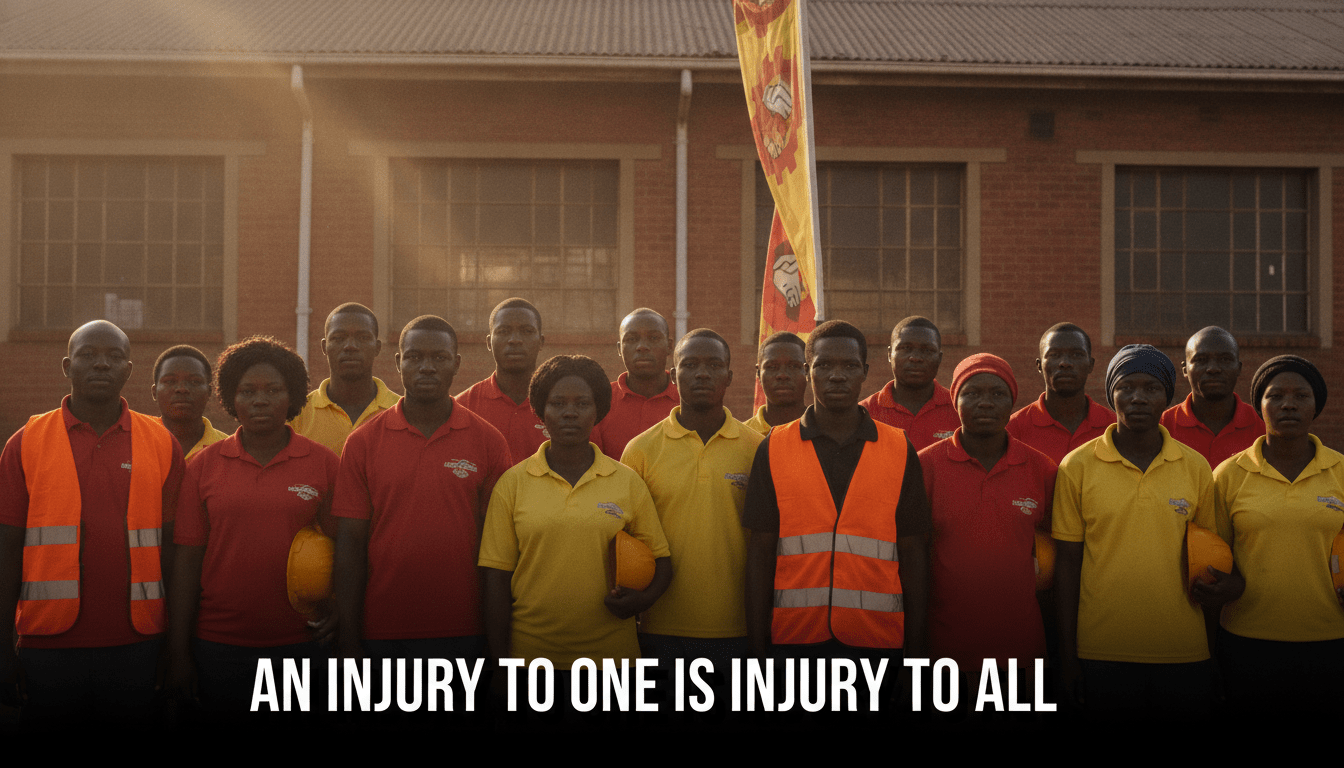
Furthermore, the Congress of South African Trade Unions was launched in December 1985 (mediadon.co.za). The federation organized under a revolutionary slogan: “An injury to one is an injury to all” (mediadon.co.za). Major affiliate unions represented regional migrants from Lesotho and Mozambique (pambazuka.org). These workers served in key shop-steward and leadership positions (pambazuka.org). Consequently, organized labor defended the idea that labor defines worker rights, not nationality (mediadon.co.za). Working class struggles have always demanded economic justice for all individuals.
The Post-Apartheid Paradox and Racial Capitalism
When South Africa transitioned to democracy in 1994, it inherited extreme economic inequality (democracyinafrica.org). The structural legacy of racial capitalism remained largely untouched (blackagendareport.com). Racial capitalism is an academic concept describing how capitalism and racial subjugation reinforce each other (blackagendareport.com). Under this structure, capital accumulation depends on extracting value from racially marginalized groups (blackagendareport.com). Therefore, standard reforms cannot dismantle inequality without addressing these racialized foundations of capital (blackagendareport.com). Private corporations continue to benefit from this deeply divided labor pool (blackagendareport.com).
During the last two decades, the country suffered from deindustrialization and state corruption (mediadon.co.za). As stable, unionized industrial jobs declined, precarious and informal work replaced them (mediadon.co.za). In this harsh environment, vulnerable locals and migrants compete over scarce resources (mediadon.co.za). Populist politicians and fringe movements direct public anger horizontally instead of challenging elites (mediadon.co.za). They encourage poor citizens to blame poor migrants for systemic failures (mediadon.co.za). This is similar to how Reconstruction failed to secure lasting economic freedom for freed workers in America.
The Human Cost of Xenophobic Threats
The direct result of anti-immigrant campaigns is a severe humanitarian crisis (yahoo.com). Since April 2026, protests have disrupted communities across multiple provinces (yahoo.com). Fearing violence, thousands of regional migrants have fled their homes (yahoo.com). Siyabonga Hlatshwayo, spokesperson for the South African Red Cross Society, shared alarming reports (yahoo.com). Approximately twenty thousand people are currently sheltering in temporary evacuation camps (yahoo.com). These individuals are begging for repatriation to their home countries (yahoo.com).
Furthermore, many of these displaced persons are vulnerable women and children (yahoo.com). They are residing in temporary shelters in Durban and Pietermaritzburg (yahoo.com). The Red Cross is working tirelessly to provide food and medical assistance (yahoo.com). However, resources are extremely limited in these emergency shelters (yahoo.com). Labor leaders warn that such displacement harms the entire social fabric of the country (mediadon.co.za). It represents a tragic violation of human rights and dignity (mediadon.co.za).
Organized Labor Speaks Out at NEDLAC
In response to the escalating crisis, South Africa’s major trade unions took a unified stand (mediadon.co.za). They presented their joint declaration at the National Economic Development and Labour Council (mediadon.co.za). NEDLAC is the country’s apex statutory body for social dialogue (nedlac.org.za). It brings together government, organized labor, business, and community groups to negotiate policy (nedlac.org.za). Therefore, declarations made at NEDLAC carry immense political weight across the nation (nedlac.org.za). This platform represents the premier venue for resolving national crises (nedlac.org.za).
On June 17, 2026, the labor federations issued a powerful joint statement (mediadon.co.za). They declared that the domestic economic crisis was not created by migrants (mediadon.co.za). They argued that removing foreign nationals from workplaces will not repair municipalities or create jobs (mediadon.co.za). Labor leaders warned that dividing workers by nationality only benefits exploitative employers (mediadon.co.za). These employers rely on underpaying undocumented workers to bypass minimum-wage laws (mediadon.co.za). Consequently, unions are working to organize all workers to protect wages for everyone (mediadon.co.za).
Regional Integration and the Role of SADC
Trade union leaders emphasize that South Africa is deeply integrated within the regional economy (sadc.int). The Southern African Development Community is an inter-governmental organization of sixteen member states (sadc.int). SADC was established to promote regional economic integration, peace, and security (sadc.int). Its primary objectives are to eradicate poverty and improve living standards through trade cooperation (sadc.int). Therefore, the regional migration pattern is a natural outcome of SADC mobility (issafrica.org). Regional integration remains crucial for long-term development across Southern Africa (sadc.int).
Furthermore, South African labor leaders recall the historical support of neighboring countries (pambazuka.org). During the struggle against apartheid, “Frontline States” like Mozambique, Zimbabwe, and Zambia provided sanctuary to freedom fighters (pambazuka.org). These nations suffered devastating military raids and economic blockades by the apartheid regime (pambazuka.org). This history created a deep sense of historical debt among South Africa’s democratic leaders (pambazuka.org). Consequently, they view today’s xenophobic scapegoating as a betrayal of regional solidarity (mediadon.co.za). The fight for freedom was a collective effort of the entire region (pambazuka.org).
Deconstructing the Numbers and Public Opinion
To combat anti-immigrant myths, the Statistician-General presented new census data at the Johannesburg symposium (statssa.gov.za). The data confirmed that international migrants make up under four percent of the total population (statssa.gov.za). In addition, the leading countries of origin remain Mozambique and Zimbabwe (statssa.gov.za). This reflects deep historical economic ties rather than a sudden uncontrolled invasion (pambazuka.org). Mass deportations cannot resolve structural economic challenges (mediadon.co.za). Government statistics show that the actual migrant population is relatively small (statssa.gov.za).
However, public opinion polls show rising hostility toward regional migrants (kas.de). A Human Sciences Research Council poll found that forty-two percent of adults would welcome no foreigners (kas.de). Additionally, an Afrobarometer survey revealed that eighty-five percent of citizens believe the government should restrict refugees (kas.de). Consequently, labor movements face a major challenge in educating the public (mediadon.co.za). They must shift the focus from xenophobic policy measures to deep-rooted economic reforms (mediadon.co.za). This gap between statistical reality and public perception remains highly dangerous (kas.de).
Under the Pressure of Global Capital
Activists argue that local xenophobia is driven by global economic forces (blackagendareport.com). Under neo-liberal capitalism, corporate interest dominates state policy (jussemper.org). This dynamic creates high competition for survival among marginalized workers (jussemper.org). Some scholars describe this system as a global capital slave plantation (blackagendareport.com). In this system, corporate elites extract cheap labor while keeping workers divided (blackagendareport.com). Therefore, national borders are used to maintain unequal economic relations (blackagendareport.com).
To combat this, labor leaders must align with broader global social justice movements (pambazuka.org). South African unions are connecting with international organizations to demand systemic reforms (mediadon.co.za). They argue that worker exploitation in Africa is connected to worker exploitation in the West (pambazuka.org). Consequently, fighting xenophobia requires challenging the global capitalist framework itself (blackagendareport.com). By building global alliances, workers can resist these divisive economic pressures (mediadon.co.za). Only international solidarity can dismantle these deeply entrenched global inequality structures (pambazuka.org).
Conclusion: Organizing for a Unified Future
The bold stand of South African labor movements is essential for the future of the trade union movement (mediadon.co.za). History shows that dividing the working class along national lines weakens collective power (pambazuka.org). Employers exploit these divisions to suppress wages and undermine labor standards (mediadon.co.za). Therefore, trade union solidarity across borders is the only path to economic justice (mediadon.co.za). Organized labor must remain committed to defending all workers regardless of nationality (mediadon.co.za).
As the June 30 deadline approaches, the labor coalition remains firm in its mission (mediadon.co.za). They continue to advocate for pan-African unity and deep structural reforms (mediadon.co.za). Addressing the root causes of economic stagnation is far more effective than persecuting vulnerable migrants (mediadon.co.za). Only by standing together can the working class build a truly stable and cohesive society (mediadon.co.za). The path forward requires a shared commitment to dignity, equality, and cross-border cooperation (mediadon.co.za).
About the Author
Darius Spearman is a professor of Black Studies at San Diego City College, where he has been teaching for over 20 years. He is the founder of African Elements, a media platform dedicated to providing educational resources on the history and culture of the African diaspora. Through his work, Spearman aims to empower and educate by bringing historical context to contemporary issues affecting the Black community.
