

Why a Congolese Crowd Burned an Ebola Treatment Center
By Darius Spearman (africanelements)
Support African Elements at patreon.com/africanelements and hear recent news in a single playlist. Additionally, you can gain early access to ad-free video content.
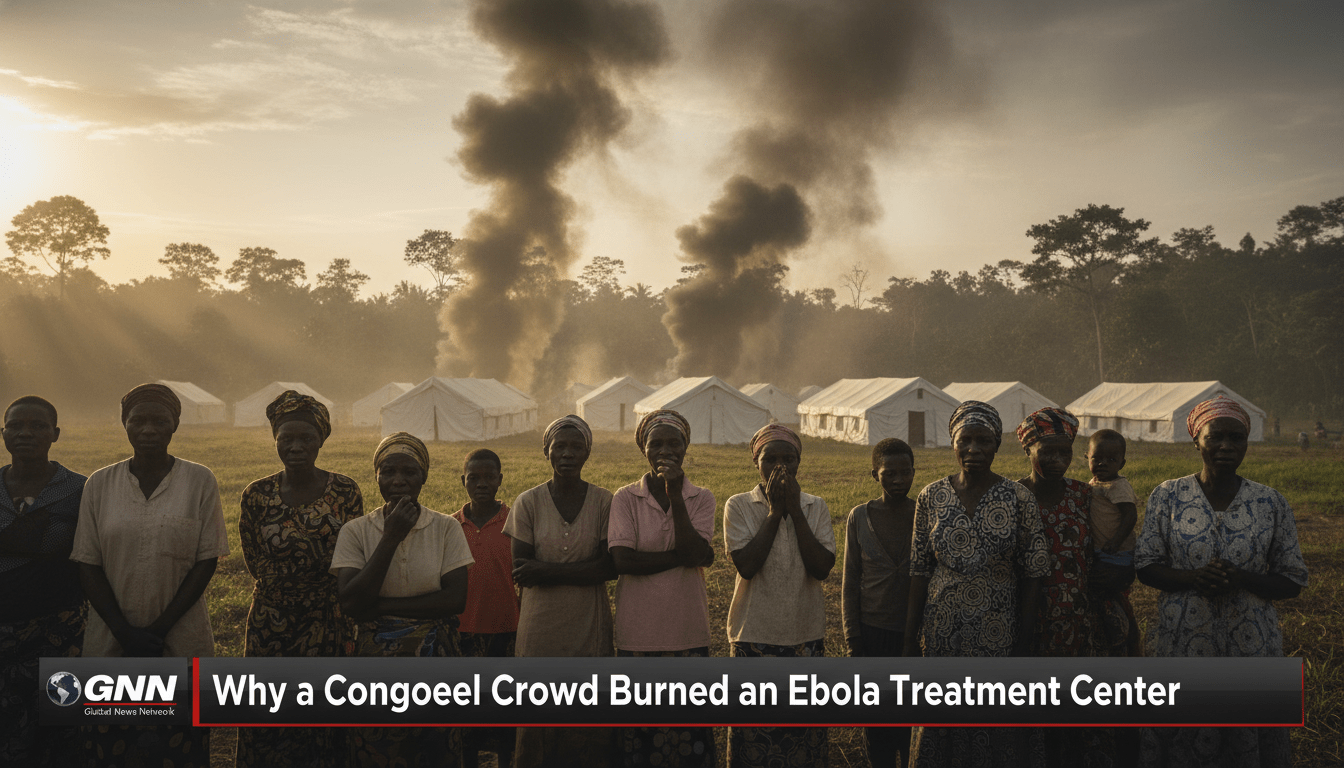
The smoke rising from Rwampara on May 21, 2026, carried the weight of a century of trauma (alima.ngo). An angry crowd of protesters had set fire to a modern medical clinic, forcing health workers to flee into the forest (alima.ngo). To outside observers, this act of violence against a life-saving facility seemed completely irrational. However, the anger that boiled over in the Ituri province of the Democratic Republic of the Congo (DRC) is not a sudden fit of madness.
Instead, this tragedy is the direct result of a deep, historical conflict between Western medical practices and local African communities. To truly understand why an Ebola treatment facility ended up in ashes, one must look far beyond the daily news cycles. The crisis is rooted in colonial-era violence, scientific erasure, economic inequalities, and a profound clash of spiritual values.
The Spark in Rwampara: What Happened on May 21, 2026
The immediate trigger for the violence in Rwampara was the tragic death of Eli Munongo Wangu (alima.ngo, thestandard.com.hk). He was a highly popular local football player whose passing devastated the community (alima.ngo, thestandard.com.hk). Because health officials suspected he had died from Ebola, they refused to release his body to his family (alima.ngo). This action was taken in accordance with strict virus containment rules, but it deeply angered the local population.
The resulting confrontation quickly turned violent as protesters threw stones and set fire to two tents at the ALIMA treatment center (alima.ngo). These tents contained eight hospital beds dedicated to treating highly infectious patients (alima.ngo). The fast-moving flames forced medical workers to scramble to evacuate six active patients to a nearby hospital (alima.ngo). Police officers fired warning shots into the air to disperse the angry crowd, adding to the extreme chaos (alima.ngo, cbsnews.com).
During the confrontation, one body awaiting burial was completely burned in the fire (alima.ngo). Furthermore, several patients and individuals who had been in close contact with the deceased fled the facility in terror (alima.ngo). Local leaders and health organizations immediately launched a search for these individuals, fearing that their escape would cause the virus to spread rapidly throughout the region (alima.ngo).
The Spiritual Conflict: Suppressed Traditional Burial Rites
To understand why the crowd was willing to burn down a hospital to retrieve a body, one must appreciate the importance of traditional burial rites (asianindianfuneralservice.com, sevenponds.com). In many Congolese and Islamic cultures, preparing the deceased for the afterlife is a vital spiritual obligation (asianindianfuneralservice.com, sevenponds.com). Washing the body, a process known as ablution, represents the final act of care and purification before the soul enters the spiritual world (asianindianfuneralservice.com).
Physical touch is also a crucial element of this final farewell. Family members customarily kiss, embrace, or close the eyes of their departed relative as a sign of deep respect (sevenponds.com). Without these essential rituals, families believe the spirit of the deceased will remain trapped between worlds or haunt the living. When health workers take a body away and bury it in a sealed, plastic bag, they are viewed as committing an act of spiritual violence.
The community experiences this clinical process as though the medical teams are stealing the soul of their loved one. When health workers prioritize biological safety over sacred traditions, they alienate the communities they are trying to protect. This disconnect transforms a public health intervention into a highly personal and terrifying assault on local culture.
What Makes a Burial Truly Safe and Dignified?
To bridge this dangerous cultural divide, global health agencies developed Safe and Dignified Burial (SDB) protocols (lse.ac.uk, reliefweb.int). These guidelines are designed to respect religious beliefs while maintaining strict infection controls (lse.ac.uk, reliefweb.int). The dignified aspect of these rules means that family members and local clergy are actively included in planning the funeral (reliefweb.int).
Instead of preventing families from participating, the guidelines offer safe alternatives to physical touch. Relatives are permitted to view the body of their loved one from a safe, visual distance (reliefweb.int). They are also encouraged to throw the first handful of soil onto the coffin to maintain their connection to the deceased (reliefweb.int). These modifications help reduce community trauma and prevent open resistance during a highly sensitive time.
Additionally, SDB protocols include specific guidelines for both Muslim and Christian traditions (reliefweb.int). For example, they allow for symbolic “dry ablution” and using religious shrouding that prevents the leakage of infectious bodily fluids (reliefweb.int). Allowing families to dig or label the grave helps build trust, making them feel like partners rather than victims of a harsh medical system (lse.ac.uk, reliefweb.int).
Understanding ALIMA: An African-Led Humanitarian Model
The medical organization that was targeted during the Rwampara riot is called ALIMA, which stands for the Alliance for International Medical Action (alima.ngo). This international medical charity was established in 2009 in Niger (alima.ngo). It was founded to create a new way of delivering humanitarian aid after several Western organizations were expelled from the region (alima.ngo). ALIMA stands out because it rejects the top-down, Western-centric hierarchy that dominates most global relief groups.
The organization’s headquarters are located in Dakar, Senegal, positioning its leadership directly within the African continent (alima.ngo). Its governance model is highly progressive, as directors of national African NGOs sit directly on ALIMA’s international board (alima.ngo). This unique structure ensures that local African experts have a powerful voice in designing emergency healthcare campaigns.
To further combat the legacy of medical colonialism, ALIMA recruits roughly 95 percent of its field staff from the countries where they operate (alima.ngo). This deliberate strategy is designed to build trust and empower local communities. Nevertheless, during intense health emergencies, even local staff are frequently associated with the broader, highly suspicious global health apparatus.
The Long Shadow of Medical Colonialism in Central Africa
The deep mistrust displayed by the protesters in Rwampara cannot be understood without examining the history of medical colonialism (businessinsider.com, uoregon.edu). During the early 20th century, Belgian colonial authorities and French medical teams in Central Africa used brutal methods to fight diseases like sleeping sickness (businessinsider.com, uoregon.edu). Africans were routinely forced at gunpoint to undergo incredibly painful, experimental medical treatments (uoregon.edu).
These early campaigns treated African populations as endless laboratory material rather than human beings who deserved respect (uoregon.edu). This dark history left a lasting “memory of medicine” that associates doctors with physical violence, control, and death. Consequently, modern healthcare initiatives are often viewed with deep suspicion, even when they are designed to save lives.
This history of resistance against oppressive medical practices mirrors the wider, shared struggles against oppression that have connected marginalized communities worldwide. When state authorities use police force to enforce medical compliance, they unintentionally revive colonial-era memories of state-sponsored violence. This legacy of trauma makes it incredibly difficult for modern health campaigns to succeed without addressing the wounds of the past.
Erasure of Excellence: Sidelining Dr. Jean-Jacques Muyembe
Mistrust is also fueled by how Western institutions have treated African scientific expertise. For decades, Western textbooks credited Belgian scientist Peter Piot with discovering the Ebola virus in 1976 (washington.edu, emmanuel-freudenthal.com). However, this narrative completely erased the vital contributions of Congolese microbiologist Dr. Jean-Jacques Muyembe (washington.edu, emmanuel-freudenthal.com). Dr. Muyembe was the very first scientist to investigate the mysterious illness in Yambuku (emmanuel-freudenthal.com).
Operating under highly dangerous conditions, Dr. Muyembe drew blood from a sick nun with his bare hands and miraculously survived (emmanuel-freudenthal.com). He then shipped these crucial blood samples to Belgium, where Western scientists analyzed them and took credit for the discovery (emmanuel-freudenthal.com). In his 2012 memoir, Piot barely mentioned Dr. Muyembe, treating him as a minor assistant rather than a co-discoverer (emmanuel-freudenthal.com).
This blatant erasure of Black excellence reinforced the local belief that Westerners only visit Africa to extract valuable data and resources (emmanuel-freudenthal.com). It was not until 2019 that Dr. Muyembe began receiving global awards, such as the Lasker and Noguchi prizes, for his pioneering work (emmanuel-freudenthal.com). This long history of intellectual theft makes local populations highly protective of their resource and wary of foreign scientific interventions.
Stigma in a Name: The Social Justice of Pathogen Labels
The practice of naming deadly viruses after African geographic locations has also created lasting social justice issues. When Ebola was first discovered in 1976, it was named after the Ebola River to avoid stigmatizing the village of Yambuku (wikipedia.org). However, using classifications like “Ebola Zaire” and “Bundibugyo” permanently links specific African places with pestilence in the global imagination (wikipedia.org).
This geographic naming pattern causes significant economic harm by destroying regional tourism and international trade (wikipedia.org). To stop this harmful stereotyping, the World Health Organization updated its official naming guidelines in 2015 (wikipedia.org). Modern rules dictate that new pathogens must be named using neutral terms, such as Greek letters or generic numbers, to prevent prejudice against local communities (wikipedia.org).
Unfortunately, old scientific names like “Bundibugyo” remain in common use because they were established before the reform (wikipedia.org, wikipedia.org). This legacy permanently connects African districts to deadly outbreaks, reinforcing old colonial stereotypes. This geographic bias is a stark reminder of systemic inequalities, which stand in sharp contrast to the strength and resilience of African American families who have fought against systemic bias for generations.
The Bundibugyo Strain: A Threat with No Vaccine
The current outbreak in May 2026 is caused by the rare Bundibugyo strain of the Ebola virus (cepi.net, gavi.org). On May 17, 2026, the World Health Organization declared this outbreak a Public Health Emergency of International Concern (cepi.net). This specific strain is particularly terrifying because it is much harder to treat than the more common Zaire strain (cepi.net, gavi.org).
While an effective vaccine called Ervebo exists for the Zaire strain, there is no approved vaccine or treatment for the Bundibugyo virus (cepi.net, gavi.org). The lack of medical tools is not due to scientific limits, but rather to pharmaceutical market economics (gavi.org). Because Bundibugyo outbreaks are extremely rare, international drug companies have historically refused to invest in human trials (gavi.org).
Although a promising Bundibugyo vaccine candidate was shown to work in animals as early as 2013, it was never manufactured for humans due to a lack of funding (gavi.org). Health officials in May 2026 estimated that producing a viable supply of this vaccine would take at least six to nine months (gavi.org). This vaccine gap leaves the local population defenseless, driving the panic and desperation that fuel attacks on clinics.
The Spacesuit Phobia: Dehumanization Behind the Mask
The visual appearance of modern medicine also contributes heavily to local fear and conspiracy theories. To prevent infection, health workers must wear extensive Personal Protective Equipment, or PPE (lse.ac.uk, alima.ngo). These thick white suits, large goggles, and heavy masks completely cover the workers’ faces and bodies (lse.ac.uk). This high-tech barrier prevents any normal human connection between patients and caregivers.
To communities with deep memories of colonial violence, these figures do not look like doctors. Instead, they look like invading soldiers, space aliens, or participants in a terrifying laboratory experiment (lse.ac.uk). Survivors frequently report suffering from severe nightmares about being trapped in rooms with silent, faceless men in white suits (lse.ac.uk).
This visual barrier makes it impossible for patients to see warm, reassuring human expressions. Consequently, this lack of transparency helps fuel wild rumors that medical workers are actively administering the disease for profit rather than curing it (lse.ac.uk). This extreme psychological distance transforms a simple clinic into a place of absolute dread for local residents.
The “Ebola Business”: Resentment Over Humanitarian Wealth
Another major source of community anger is a highly controversial phenomenon known as the “Ebola Business” or *la maladie du fric* (lse.ac.uk, emmanuel-freudenthal.com). During major outbreaks, hundreds of millions of dollars in international humanitarian aid pour into the region (lse.ac.uk, emmanuel-freudenthal.com). However, local populations see very little long-term improvement to their standard of living or general healthcare clinics.
Instead, residents watch foreign aid workers drive expensive SUVs, live in heavily fortified compounds, and earn massive per diems (lse.ac.uk, emmanuel-freudenthal.com). Meanwhile, local medical staff are hired at low wages and forced to work under incredibly dangerous conditions (emmanuel-freudenthal.com). This severe economic inequality leads many locals to believe that the emergency response is a profitable scam designed to exploit their suffering.
Furthermore, multiple investigations have uncovered serious corruption within these emergency responses, including kickbacks in hiring and aid officials renting out their own vehicles at highly inflated prices (emmanuel-freudenthal.com). When local communities see outsiders growing wealthy off their misery, they naturally grow resentful. This perceived economic exploitation is a key reason why communities resist medical teams, viewing them as profit-seekers rather than healers.
Conclusion: Rewriting the Response for Future Crises
The burning of the ALIMA treatment center in Rwampara on May 21, 2026, was not a random act of violence (alima.ngo). It was a tragic clash between a fast-moving, lethal virus and a community deeply wounded by history (alima.ngo, cepi.net). When public health agencies prioritize biological containment while ignoring local culture and economic reality, they invite resistance.
This crisis proves that advanced medical science cannot succeed without addressing local history. To build trust, global health organizations must stop using top-down medical directives. They must honor African scientific pioneers, respect sacred local traditions, and invest in permanent, community-led healthcare systems. This resistance is part of an ongoing struggle for freedom and equality against systems that ignore human dignity. Only when local communities are treated as equal partners will they trust the hands that offer them care.
About the Author
Darius Spearman is a professor of Black Studies at San Diego City College, where he has been teaching for over 20 years. He is the founder of African Elements, a media platform dedicated to providing educational resources on the history and culture of the African diaspora. Through his work, Spearman aims to empower and educate by bringing historical context to contemporary issues affecting the Black community.
