


Why Civil Rights Leaders Are Marching in Selma Again
By Darius Spearman (africanelements)
Support African Elements at patreon.com/africanelements and hear recent news in a single playlist. Additionally, you can gain early access to ad-free video content.
The Echo of Footsteps on the Edmund Pettus Bridge
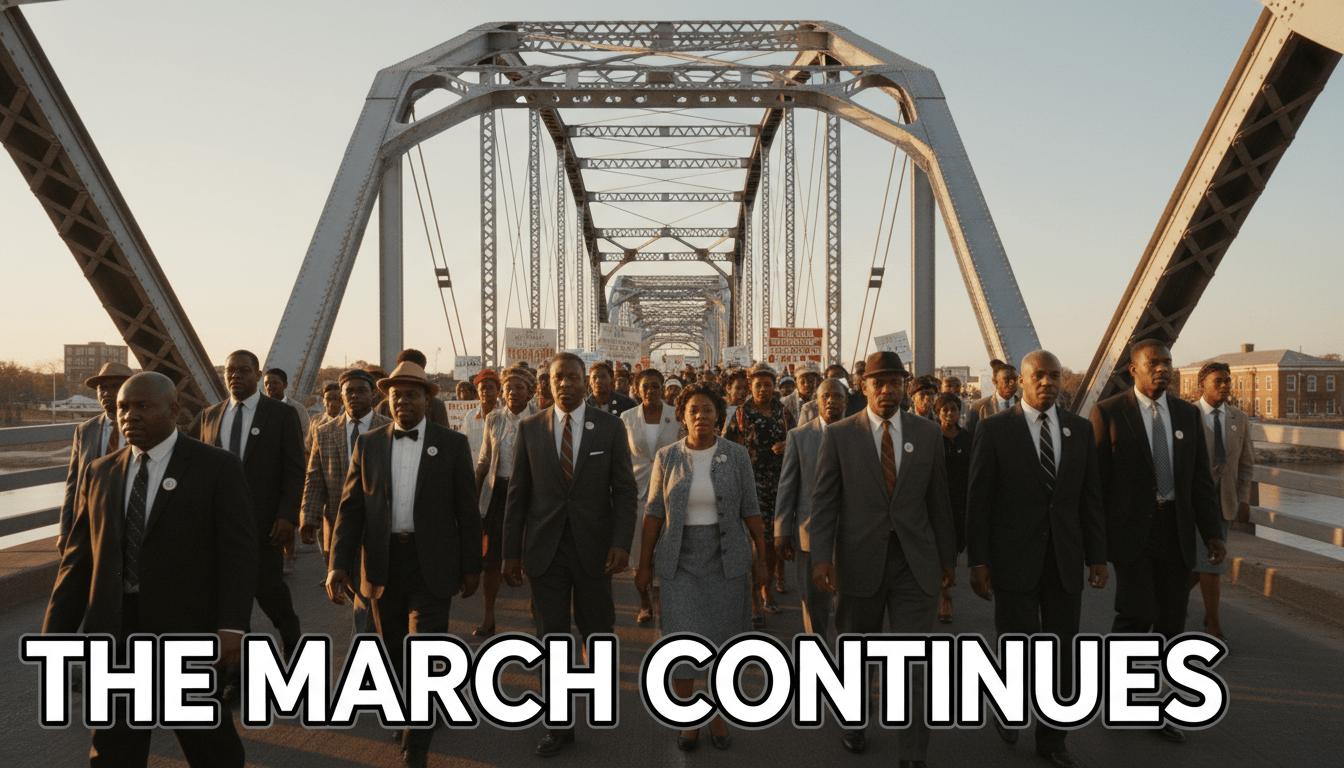
On Saturday, May 16, 2026, the quiet over the historic Edmund Pettus Bridge in Selma, Alabama, was broken by the footsteps of thousands of marchers (peoplesworld.org). Led by faith leaders, civil rights organizations, and labor union officials, the massive crowd moved silently across the bridge (peoplesworld.org, afge.org). They gathered later for a major rally at the white marble steps of the Alabama State Capitol in Montgomery (peoplesworld.org). The demonstration was organized under the banner “All Roads Lead to the South: National Day of Action” (religionnews.com, peoplesworld.org). This was not a simple historical reenactment. It was a rapid-response mobilization sparked by a seismic U.S. Supreme Court ruling issued just weeks prior (peoplesworld.org, campaignlegal.org).
On April 29, 2026, the Supreme Court handed down a decision in Louisiana v. Callais (campaignlegal.org, supremecourt.gov). Critics argue that this ruling dealt a crippling blow to Black political representation across the American South (peoplesworld.org, democracynow.org). To understand the fury and resolve of the thousands who marched in May 2026, one must examine the deep historical roots of the Edmund Pettus Bridge (religionnews.com, nps.gov). The evolution of the Voting Rights Act of 1965 and modern judicial decisions have combined to create a major crisis (nps.gov, campaignlegal.org). Activists argue that recent rulings are rolling back decades of hard-won progress (peoplesworld.org, democracynow.org).
The Bloody Path to the Voting Rights Act of 1965
The struggle for the right to vote in the American South is a story of systemic disenfranchisement met by unmatched courage (stanford.edu). Following the Reconstruction era, Southern states instituted Jim Crow laws designed to completely suppress the Black vote (wikipedia.org). These systems utilized literacy tests, poll taxes, intimidation, and physical violence to maintain white supremacy (stanford.edu, wikipedia.org). The promise of emancipation was stolen as Southern authorities ensured that the Civil War failed to end slavery in a political sense.
By the early 1960s, disenfranchisement in Alabama was nearly absolute (stanford.edu). In Lowndes County, exactly zero percent of eligible Black citizens were registered to vote (wikipedia.org). In Dallas County, where Selma is located, only two percent of the Black population was on the voting rolls (stanford.edu, wikipedia.org). In response, local leaders formed the Dallas County Voters League (wikipedia.org). They partnered with the Student Nonviolent Coordinating Committee and Dr. Martin Luther King Jr. to launch a concentrated voting rights campaign (stanford.edu, wikipedia.org). Courageous Black women contributed to the movement in vital roles, organizing communities and facing down state violence daily.
Tensions boiled over on February 18, 1965, during a peaceful night march in Marion, Alabama (nps.gov). Alabama State Troopers violently attacked the demonstrators (nps.gov). In the chaos, a trooper shot Jimmie Lee Jackson, a twenty-six-year-old church deacon, as he tried to protect his family (nps.gov, wikipedia.org). Jackson died eight days later, sparking plans for a fifty-four-mile protest march from Selma to the state capitol (nps.gov). On March 7, 1965, roughly six hundred nonviolent protesters set out from Selma (nps.gov, stanford.edu). As they crossed the Edmund Pettus Bridge, they were met by a wall of state troopers (nps.gov, wikipedia.org). The brutal assault that followed became known as “Bloody Sunday” (nps.gov). Troopers charged on horseback with tear gas and clubs, fracturing the skull of future Congressman John Lewis (nps.gov, archives.gov). On March 21, 1965, under federal protection, Dr. King led more than three thousand marchers back onto the highway (nps.gov, wikipedia.org). By the time they reached Montgomery, the crowd had grown to twenty-five thousand people (nps.gov, wikipedia.org). This pressure forced President Lyndon B. Johnson to sign the landmark Voting Rights Act on August 6, 1965 (wikipedia.org).
How the Courts Dismantled the Crown Jewel of Civil Rights
For nearly five decades, the Voting Rights Act stood as the premier achievement of the Civil Rights Movement (peoplesworld.org). However, a series of Supreme Court decisions have systematically weakened its protections (peoplesworld.org, lwv.org). In the 2013 case Shelby County v. Holder, the Supreme Court struck down Section 4(b) of the Act (lwv.org, brennancenter.org). This coverage formula determined which states with histories of racial discrimination required federal approval, or “preclearance,” before changing voting laws (brennancenter.org, rockthevote.org). Striking down Section 4(b) left Section 5 fully intact but entirely inoperable (lwv.org, brennancenter.org). Consequently, states were immediately free to pass restrictive voting laws without federal oversight (lwv.org, brennancenter.org).
Further damage occurred in May 2024 with the ruling in Alexander v. South Carolina NAACP (democracynow.org, democracydocket.com). The Supreme Court ruled that partisan gerrymandering is permissible even if the district lines closely correlate with race (democracynow.org, democracydocket.com). This decision significantly increased the evidentiary burden on plaintiffs trying to prove racial gerrymandering (democracydocket.com). The final tipping point came with the Louisiana v. Callais decision on April 29, 2026 (campaignlegal.org, supremecourt.gov). In a six-to-three ideological decision, the Court struck down Louisiana’s congressional map (campaignlegal.org, supremecourt.gov). This map had created a second majority-Black district to comply with Section 2 of the Voting Rights Act (campaignlegal.org, supremecourt.gov). The Court ruled that using race to draw that specific district violated the Fourteenth Amendment (campaignlegal.org, supremecourt.gov). Legal experts argue this ruling has made Section 2 of the Act nearly impossible to enforce (peoplesworld.org, democracynow.org).
VOTER REGISTRATION EXPANSION (1960s)
Visualizing the massive impact of the original 1965 Voting Rights Act on Black voter registration rates across the Deep South.
The Judicial Logic of Modern Colorblindness
Majority-minority or majority-Black districts are electoral boundaries where a specific racial minority makes up the majority of the voting-age population (ballotpedia.org). These districts are crucial under Section 2 of the Voting Rights Act to prevent minority vote dilution (lls.edu). This ensures that Black communities are not submerged in a white majority that consistently votes to defeat their preferred candidates (lls.edu). In the 1986 case Thornburg v. Gingles, the Supreme Court established a three-part test to determine when these districts must be drawn (cornell.edu, lls.edu). Since the 1990s, these districts have been the primary tool for increasing African American representation in Congress (wikipedia.org, harvard.edu).
However, the modern Supreme Court has shifted toward a framework of “colorblindness” under the Fourteenth Amendment (wikipedia.org, constitutioncenter.org). The Reconstruction-era framers intended for the Fourteenth Amendment to protect newly freed Black citizens (constitutioncenter.org, constitutioncenter.org). Yet, under modern precedents starting with Shaw v. Reno in 1993, the Court has ruled that drawing district lines based primarily on race violates the Equal Protection Clause (wikipedia.org, constitutioncenter.org). Under this view, intentional creation of majority-Black districts is subject to strict scrutiny (lls.edu, constitutioncenter.org). In Louisiana v. Callais, Justice Samuel Alito wrote that the state lacked a compelling interest to justify prioritizing race over traditional, neutral redistricting principles (campaignlegal.org, supremecourt.gov). By classifying these maps as unconstitutional “racial gerrymanders,” the Court has severely limited the tools available to protect minority voting opportunities (peoplesworld.org, campaignlegal.org).
Gerrymandering Legal Status under Federal Law
Allowed / Permitted
Declared a “non-justiciable” political question by the Supreme Court in Rucho v. Common Cause (2019). Federal courts cannot block maps drawn for partisan advantage.
Strictly Prohibited
Unconstitutional under the Fourteenth Amendment if race is the predominant factor. Used in Callais (2026) to strike down majority-Black districts.
Disruption on the Ground: The Immediate Fallout
The consequences of the Callais ruling were immediate and severe across several Southern states (peoplesworld.org, campaignlegal.org). In Tennessee, the Republican-led legislature acted with incredible speed (theguardian.com). Within eight days of the Supreme Court decision, they redrew the state’s congressional maps (theguardian.com, washingtonpost.com). The newly enacted map split the Ninth Congressional District in Memphis (theguardian.com, washingtonpost.com). This district was the state’s sole Democratic-leaning, majority-minority district (theguardian.com, washingtonpost.com). Legislators divided the district into three pieces, dispersing its Black voters into three reliably Republican districts (theguardian.com, washingtonpost.com). This was achieved during a special legislative session called by Governor Bill Lee, which bypassed standard legislative procedures (theguardian.com, washingtonpost.com).
In Louisiana, the fallout took a heavy administrative and democratic toll (cbsnews.com, wwno.org). On April 30, 2026, Governor Jeff Landry issued Executive Order JML 26-038 to suspend the scheduled congressional primary elections (cbsnews.com, louisiana.gov). He utilized Louisiana Revised Statute 18:401.1, which allows the governor to declare an “electoral emergency” (cbsnews.com, louisiana.gov). Because this suspension occurred mid-cycle, over forty thousand mail-in and absentee ballots had already been cast by citizens (cbsnews.com, wwno.org). Governor Landry confirmed that these votes would be discarded, forcing those citizens to vote again in rescheduled elections (cbsnews.com, wwno.org). This disruption prompted immediate federal and state lawsuits from the ACLU and the Elias Law Group, which argued that discarding valid votes is a direct form of disenfranchisement (cbsnews.com, elias.law).
The 2026 Southern Electoral Crisis Timeline
Supreme Court Decides Louisiana v. Callais
A 6-3 conservative majority strikes down Louisiana’s map, ruling that creating a second majority-Black district was an unconstitutional racial gerrymander.
Louisiana Primary Suspended
Governor Jeff Landry declares an “electoral emergency,” suspending the primary. Over 40,000 cast absentee and mail-in ballots are ordered discarded.
Tennessee Redraws Congressional Maps
In just eight days, the Tennessee legislature splits Memphis’ majority-minority 9th District into three separate districts to dilute Black voting power.
National Day of Action Protests
Thousands gather in Selma and march across the Edmund Pettus Bridge to Montgomery, demanding federal protection for voting rights.
The Union Movement and the Fight for Economic Justice
The massive demonstration on May 16, 2026, was notable for its diverse coalition (peoplesworld.org, afge.org). Labor unions emerged as central players alongside traditional civil rights organizations (afge.org, aflcio.org). The American Federation of Government Employees, led by National President Everett Kelley, mobilized thousands of members to join the march (afge.org, afge.org). This alliance is rooted in a deep historical connection between labor struggles and civil rights (aflcio.org). Historically, trade unionists funded and organized key actions, recognizing that economic empowerment and the right to vote are inextricably linked (aflcio.org). The fight for economic justice and workers’ rights cannot be separated from political enfranchisement.
Labor organizations view voting rights as a vital workplace and community issue (aflcio.org). Public sector unions represent a highly diverse, multiracial workforce (afge.org, afge.org). Consequently, attempts to eliminate majority-minority districts directly dilute the political power and representation of union members (afge.org, afge.org). In his address to the crowd at the Montgomery Capitol steps, Everett Kelley recalled the courage of the original foot soldiers (afge.org, afge.org). He declared that modern working-class citizens owe their liberties to those who were beaten on the Edmund Pettus Bridge (afge.org, afge.org). The presence of labor unions in Selma was a reminder that protecting the ballot is essential to safeguarding public policies and safety nets for working families (afge.org, aflcio.org).
The Unfinished March into the Future
The images of thousands of citizens marching across the Edmund Pettus Bridge in May 2026 served as a vivid, painful reminder that the fight for equal representation in America is not a closed chapter in a history textbook (peoplesworld.org). In 1965, Black Americans had to put their physical bodies on the line to force the federal government to protect their constitutional rights (nps.gov, stanford.edu). In 2026, activists found themselves returning to those very same coordinates (peoplesworld.org, religionnews.com). The struggle has shifted from state troopers with billy clubs to Supreme Court justices with pens (peoplesworld.org, campaignlegal.org). Yet, the threat to Black political power remains just as potent.
As states throughout the South scramble to redraw maps in the wake of Louisiana v. Callais, the political landscape continues to shift (campaignlegal.org, theguardian.com). This ongoing battle represents a critical shift in the political narrative that has developed over the decades. Sheyann Webb-Christburg, who was only eight years old when she marched on Bloody Sunday, spoke out against the recent Supreme Court decisions (peoplesworld.org, democracynow.org). She stated that the Court’s action was a method to discriminate and silence voters who fought so hard for their rights (peoplesworld.org, democracynow.org). The marchers in Selma and Montgomery made it clear that the struggle for equal representation is non-negotiable and will continue in the courts, at the ballot box, and in the streets (peoplesworld.org, afge.org).
About the Author
Darius Spearman is a professor of Black Studies at San Diego City College, where he has been teaching for over 20 years. He is the founder of African Elements, a media platform dedicated to providing educational resources on the history and culture of the African diaspora. Through his work, Spearman aims to empower and educate by bringing historical context to contemporary issues affecting the Black community.
