

Why Displaced Border Communities Are Risking It All to Return
By Darius Spearman (africanelements)
Support African Elements at patreon.com/africanelements and hear recent news in a single playlist. Additionally, you can gain early access to ad-free video content.
A Fragile Peace Triggers a Massive Homecoming
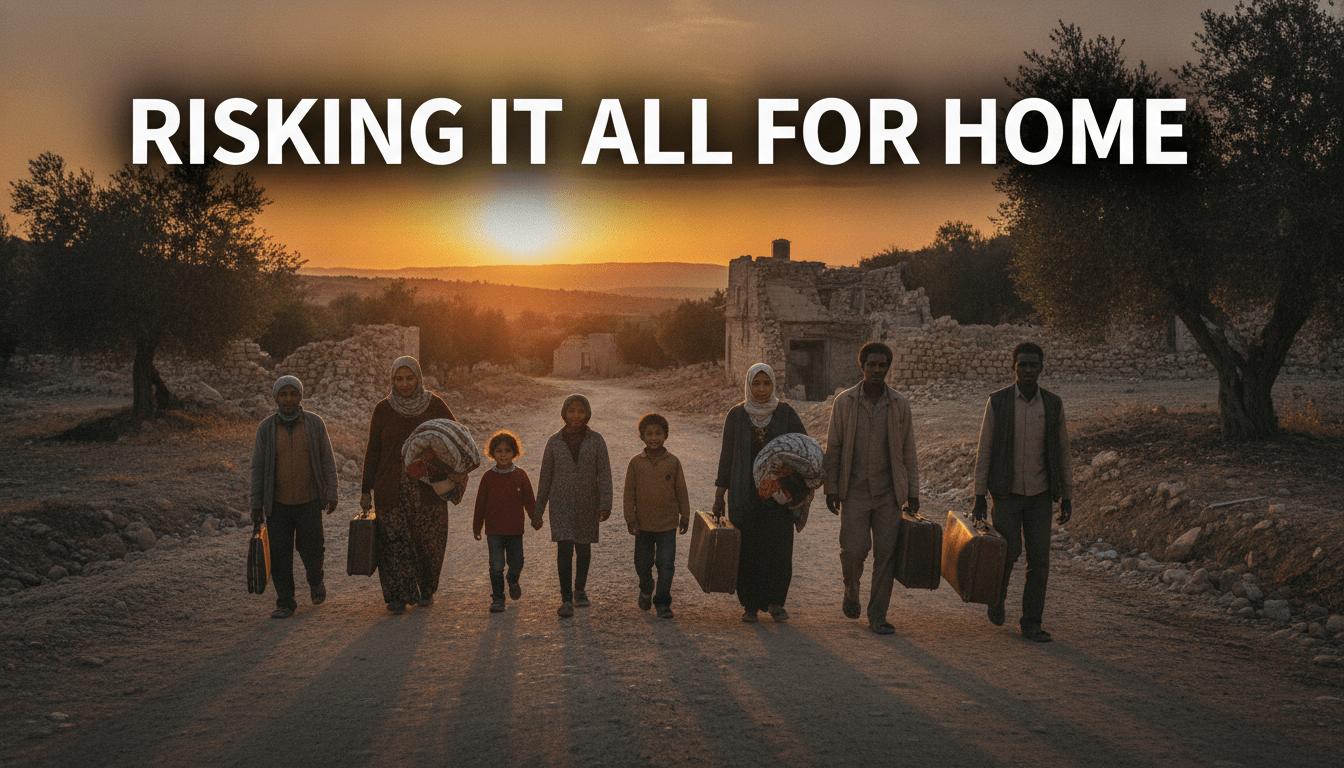
On June 15, 2026, the global political landscape shifted overnight. The United States and Iran announced a historic, fragile peace agreement (latimes.com). This deal promised an immediate and permanent ceasefire on all military fronts, including southern Lebanon (latimes.com). Consequently, thousands of displaced families packed their belongings to head back toward their heavily damaged border towns (latimes.com, latimes.com).
On the very same day, another massive displacement update emerged from Africa. The United Nations International Organization for Migration reported that internal displacement in Sudan dropped to 8.8 million people (iom.int, iom.int). Over 4.4 million returnees made the decision to travel back to newly recaptured areas (iom.int, reliefweb.int). This represents a massive, precarious migration happening under highly unstable conditions. These parallel movements show the incredible resilience of families who choose to reclaim their homes. They face severe danger, collapsed municipal systems, and heavily militarized zones.
The Historical Trauma of Southern Lebanon Borderlands
To understand the current crisis in southern Lebanon, one must look at decades of regional proxy wars. The southern border has been a major flashpoint ever since the creation of Israel in 1948 (wikipedia.org). Major military invasions in 1978 and 1982 forced hundreds of thousands of Lebanese civilians to flee (britannica.com). These historical conflicts created deep wounds and established a long history of displacement.
In 2000, the United Nations drew the temporary “Blue Line” border (latimes.com). However, stability did not last long in the region. The devastating 34-day war in 2006 displaced approximately one million people and shattered civilian infrastructure (latimes.com, latimes.com). Despite the destruction, families have historically returned immediately after every single conflict. There is a deep cultural proverb in southern Lebanon: “Whoever leaves their home loses their worth” (latimes.com, latimes.com). Consequently, returning is a profound way to assert their identity and protect their ancestral lands.
Lebanon Border Crisis Metrics (2026)
The Forgotten Afro-Descendant Communities of the Middle East
Displacement in the Middle East does not affect only Arab populations. There are historical Black and African-heritage communities living across the region (ohchr.org). These Afro-descendant populations exist due to centuries of historical dynamics (ohchr.org, blackpast.org). The Indian Ocean and Red Sea slave trades forcibly moved millions of sub-Saharan Africans to the region (blackpast.org, amaliah.com). Over many generations, these communities established roots in places like Iraq, Palestine, and Yemen (ohchr.org, womensvoicesnow.org).
Other Africans migrated voluntarily as merchants, soldiers, and religious pilgrims (ohchr.org, amaliah.com). For example, Afro-Palestinians in Jerusalem are descendants of Muslim pilgrims from Chad, Nigeria, Senegal, and Sudan (ohchr.org). They chose to settle near the Al-Aqsa mosque after performing their Hajj (ohchr.org). Unfortunately, these Afro-descendant communities continue to face a legacy of systemic racism and social exclusion (ohchr.org, amaliah.com). They navigate global struggles against anti-Blackness that echo the history of the broader African diaspora. Learning the deep history of Africa helps contextualize these global connections.
Defining Al-Muhamasheen and Yemen’s Caste System
In Yemen, the most marginalized group of African descent is known as the “Al-Muhamasheen” (sanaacenter.org). The term translates to “the marginalized ones” in Arabic (justice4yemenpact.org). This name was chosen to replace a highly offensive label historically used to demean them (justice4yemenpact.org). They live at the very bottom of a rigid, caste-like social hierarchy in Yemen (sanaacenter.org, justice4yemenpact.org).
Historical accounts trace their origins back to ancient Abyssinian soldiers or a fallen twelfth-century dynasty (sanaacenter.org, justice4yemenpact.org). Despite being Arabic-speaking Muslims, they endure extreme descent-based discrimination (sanaacenter.org). They are often segregated into makeshift shantytowns with no access to clean water or electricity (justice4yemenpact.org). Anti-Black racism remains central to their ongoing oppression (sanaacenter.org). During times of war and displacement, they lack tribal protection, making them highly vulnerable (sanaacenter.org, justice4yemenpact.org). They are routinely denied aid and face severe social taboos.
Socio-Ethnic Hierarchy and the Muhamasheen
The Battle for Ancestral Lands in Darfur
In Africa, the most prominent parallel of precarious border displacement occurs in the Darfur region of Sudan. To comprehend this conflict, one must understand the distinct groups living there (enoughproject.org). Darfur is home to agricultural African groups and nomadic Arabized pastoralists (hrw.org, enoughproject.org). Agricultural groups include the Fur, Masalit, and Zaghawa (sudantribune.com, developmentactionrefugees.org). Nomadic pastoralists include groups like the Baggara and Abbala (enoughproject.org).
It is crucial to note that this division is not based on skin color. Both groups are phenotypically Black African and practice Islam (hrw.org, enoughproject.org). Instead, the division is based on lifestyle, language, and colonial-era administrative sorting (hrw.org, enoughproject.org). British colonial administrators chose to govern these groups separately (hrw.org). Post-independence governments later weaponized these differences to fuel violent conflict over depleting natural resources (hrw.org, enoughproject.org).
The Evolution of Violence from Janjaweed to the RSF
The current civil war in Sudan is a brutal power struggle. The main actors are the Sudanese Armed Forces, known as the SAF, and the Rapid Support Forces, known as the RSF (sudantribune.com). The RSF is a powerful paramilitary group that evolved directly from the notorious Janjaweed militias (hrw.org, enoughproject.org). In 2003, the government mobilized the Janjaweed to execute a campaign of ethnic cleansing against non-Arab communities in Darfur (hrw.org, enoughproject.org).
Today, the RSF continues to use the same horrific tactics (hrw.org, hrw.org). These tactics include targeted massacres, systematic looting, and sexual violence (amnesty.org, hrw.org). In West Darfur, the indigenous Masalit people have faced massive attacks (hrw.org). Consequently, hundreds of thousands of Masalit civilians fled across the border into neighboring Chad (reliefweb.int). High-level peace efforts like the 2020 Juba Peace Agreement failed because they did not address land restitution (sudantribune.com, globalprotectioncluster.org).
UNFPA Chad Border Response Funding Gap (2026)
The Geopolitical Divide in Humanitarian Aid Funding
The humanitarian crisis along the Chad-Sudan border exposes a deep global inequality. Chad currently hosts over 1.3 million Sudanese refugees (reliefweb.int, reliefweb.int). This means that approximately one in every thirteen people in Chad is a refugee (reliefweb.int). Despite this staggering number, international aid agencies face a massive funding gap (unocha.org, reliefweb.int). For instance, the United Nations Population Fund secured only 1.9 million dollars of its required 18.7 million dollars for Chad (unocha.org, reliefweb.int).
This severe underfunding reflects a systemic bias within the global humanitarian system (reliefweb.int). Western nations mobilized billions of dollars for European crises very rapidly (theguardian.com, reliefweb.int). However, crises affecting Black and African populations are routinely ignored and underfunded (reliefweb.int). Critics call this disparity a “global color line” rooted in colonial history (reliefweb.int). Decision-making power remains concentrated in Western nations, which deprioritizes non-Western emergencies (reliefweb.int). This reflects the ongoing struggle of decolonizing education structures and international institutions to ensure equal value for all human lives.
Reclaiming Home as a Powerful Act of Resistance
Returning to damaged border communities is not a passive choice. It is a powerful act of resistance and self-determination (latimes.com, hrw.org). In southern Lebanon, families return to prevent their lands from being permanently absorbed into militarized zones (latimes.com). Similarly, in West Darfur, the Masalit people return to prevent occupiers from permanently seizing their ancestral farmlands (sudantribune.com, hrw.org). This matches global movements for indigenous land rights and sovereignty (hrw.org, survivalinternational.org).
These communities show that they will not let failed political promises dictate their future. By physically occupying their land, they force the international community to acknowledge their presence. They demand the restoration of schools, water lines, and clinics (latimes.com, reliefweb.int). This dangerous and precarious journey is a bold declaration of their right to exist and thrive on their own terms.
About the Author
Darius Spearman is a professor of Black Studies at San Diego City College, where he has been teaching for over 20 years. He is the founder of African Elements, a media platform dedicated to providing educational resources on the history and culture of the African diaspora. Through his work, Spearman aims to empower and educate by bringing historical context to contemporary issues affecting the Black community.
