


Who Do Global Youth Social Media Bans Really Protect?
By Darius Spearman (africanelements)
Support African Elements at patreon.com/africanelements and hear recent news in a single playlist. Additionally, you can gain early access to ad-free video content.
The Modern Surge in Digital Age-Gating
Governments around the world are rushing to restrict youth online access. Over forty countries are currently moving to restrict or ban children from using social media platforms (theguardian.com, progressivepolicy.org). The United Kingdom recently announced a sweeping “Australia-plus” policy (theguardian.com). This framework bans children under the age of 16 from major platforms (amnesty.org.au, theguardian.com). It targets applications such as Instagram, TikTok, Snapchat, YouTube, and X (theguardian.com).
Furthermore, this approach introduces strict screen-time curfews and restrictions on online gaming (theguardian.com). This movement represents a massive shift in how states govern the internet (oecd.org). The legislative push follows Australia’s pioneering December 2025 ban (theguardian.com). Now, countries from Europe to the Global Majority are codifying strict age limits for digital spaces (straitstimes.com, gulfnews.com). However, these policies have triggered intense debates over digital equity and surveillance (theguardian.com).
The Roots of the Under-13 Global Standard
The concept of a minimum age for the internet is not a new invention. Historically, the standard age of 13 was established in the United States (nprillinois.org). The United States Congress passed the Children’s Online Privacy Protection Act in 1998 (nprillinois.org). This law was designed to protect children from aggressive commercial marketing campaigns (harvardlawreview.org). It mandated that commercial websites obtain parental consent before collecting personal data from children under 13 (privo.com).
Tech companies found complying with these consent mechanisms too costly and risky (harvardlawreview.org). Consequently, they chose to ban children under 13 from their platforms entirely (eff.org). This business decision established 13 as the default digital age of adulthood (nprillinois.org). In 2016, the European Union updated this standard with the General Data Protection Regulation (inforrm.org). This regulation allowed individual countries to set their own digital age of consent between 13 and 16 (inforrm.org).
The Safety-by-Design and Ideological Pivot
Realizing that simple age gates were easy to bypass, regulators tried new approaches (eff.org). The United Kingdom introduced the Age Appropriate Design Code in 2020 (eversheds-sutherland.com). This code pioneered a safety-by-design philosophy (iapp.org). It forced companies to make platforms safer by default (eversheds-sutherland.com). For instance, platforms had to disable location tracking and stop profiling minors (iapp.org).
However, public concern over youth mental health continued to rise (weprotect.org). The ideological pivot to outright bans intensified in early 2024 (theguardian.com). The publication of the book The Anxious Generation catalyzed this global shift (theguardian.com). The argument that mobile phones caused a mental health epidemic captured political attention (theguardian.com). As a result, policymakers shifted focus from platform design to total youth exclusion (theguardian.com, theguardian.com).
Biometric Surveillance and the Verification Trap
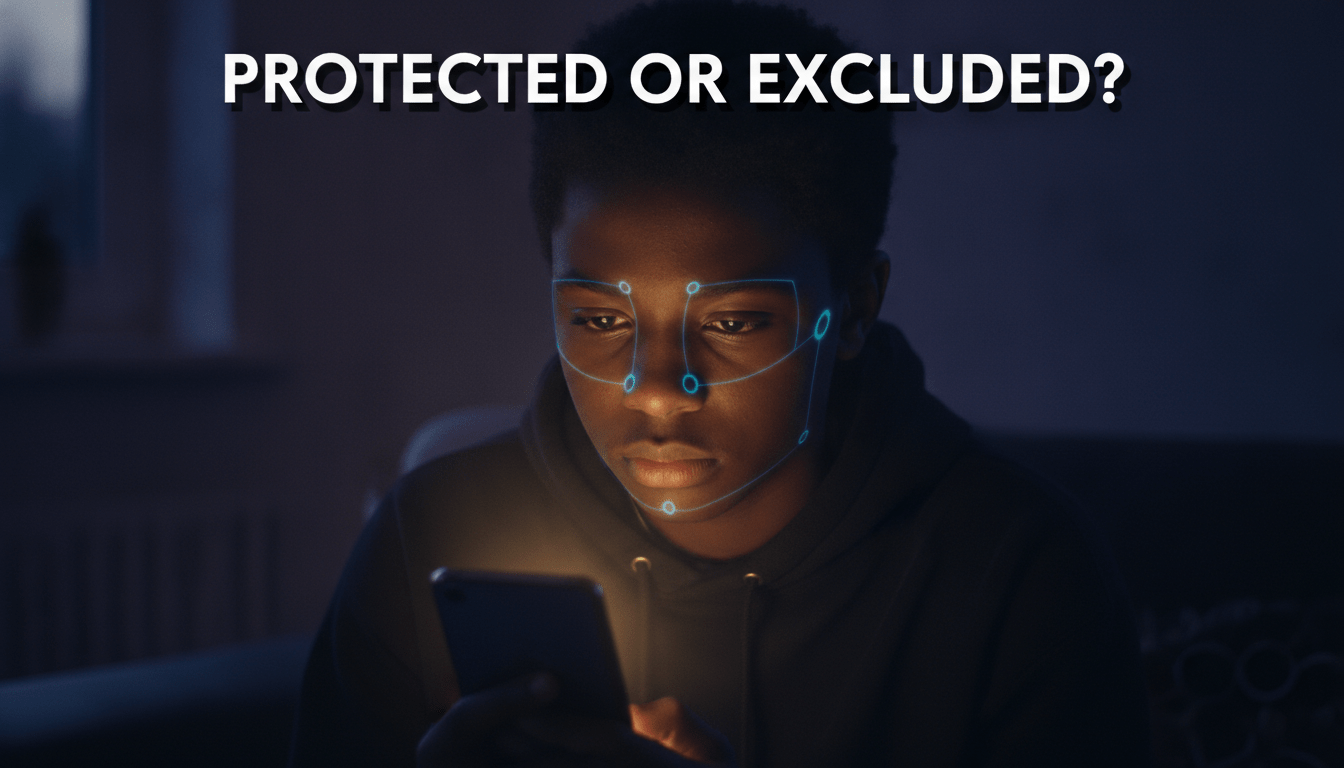
To enforce these sweeping bans, platforms must verify the age of every user (eff.org). It is impossible to filter out children without checking the identity of adults (eff.org). Consequently, age-gated laws force everyone to undergo identity verification (aclu.org). Platforms are turning to methods such as uploading government documents or undergoing biometric facial-age estimation (eff.org, hyperverge.co).
Privacy advocates warn that these practices create massive data security risks (eff.org). Storing sensitive biometric scans and government IDs creates tempting targets for hackers (eff.org). Users are forced to trade their digital privacy to access basic information spaces (aclu.org). This dynamic turns the entire internet into a highly surveilled environment (eff.org).
How Age Bans Create a Surveillance Loop
Defining the Global Majority and Diaspora Enclaves
The term “Global Majority” refers to people of African, Asian, Indigenous, Latin American, or mixed-heritage backgrounds (bookishbrews.com). Collectively, these populations constitute approximately 80 to 85 percent of the global population (bookishbrews.com). The term serves as an affirming and empowering alternative to historically racialized terms like “ethnic minority” (bookishbrews.com). Academic researchers popularized the phrase in the early 2000s to challenge Eurocentric normativity in social and educational contexts (bookishbrews.com). By centering the experiences of these communities, the term establishes that they represent the demographic majority of the planet (bookishbrews.com).
Similarly, “diaspora-adjacent communities” describes individuals and immigrant enclaves with deep historical, cultural, or familial ties to a specific diaspora (islandflave.com). These groups may not be first-generation immigrants themselves (islandflave.com). However, they navigate dual cultural identities and share the same systemic barriers as direct immigrants (islandflave.com). Organizations use this term to mobilize support and advocate for populations that formal ethnic categories often overlook (islandflave.com).
The Digital Verification Divide and Systemic Barriers
The digital verification divide represents a major hurdle for marginalized populations (mit.edu). While basic internet access has slowly expanded, verifying one’s identity online remains a highly unequal process (mit.edu). Online identity proofing assumes that every person has easy access to official documents (mit.edu). In reality, systemic and economic barriers prevent many African Americans from obtaining these credentials (mit.edu).
For example, discriminatory administrative practices limit access to government-issued identification (mit.edu). States have historically closed licensing offices in predominantly Black neighborhoods (mit.edu). Approximately 11 percent of voting-age United States citizens lack a government photo ID (ballotpedia.org). However, this rate rises to between 18 and 25 percent among African American adults (ballotpedia.org). Furthermore, obtaining underlying documents like birth certificates can be cost-prohibitive for low-income families (mit.edu). Historically, these systemic barriers have locked marginalized communities out of opportunities. This structural exclusion echoes how the political shift from civil rights eras led to new forms of institutional control.
Source: Academic research on online identity proofing and voter ID demographics.
Algorithmic Racial Bias in Biometric Age Checks
Biometric facial-age estimation uses artificial intelligence to analyze facial features and estimate age (hyperverge.co). However, this technology suffers from severe biometric bias (arxiv.org). Algorithms frequently fail or return inaccurate results for people of color (arxiv.org). This systemic failure occurs because the artificial intelligence models are trained on imbalanced datasets (arxiv.org). These datasets consist primarily of lighter-skinned and middle-aged male faces (arxiv.org).
The landmark Gender Shades study highlighted this technological gap (arxiv.org). Researchers discovered that facial recognition algorithms had an error rate of only 0.8 percent for light-skinned men (arxiv.org). In contrast, the error rate jumped to 34.7 percent for dark-skinned women (arxiv.org). Furthermore, testing of police databases showed massive disparities (bigbrotherwatch.org.uk). False-positive identification rates for white subjects were only 0.04 percent, compared to 5.5 percent for Black subjects (bigbrotherwatch.org.uk). Consequently, relying on flawed biometric tools will disproportionately gate out Black and brown youth (theguardian.com, arxiv.org).
Silencing Black Youth Activism and Free Expression
Social media bans threaten the future of Black youth-led social justice activism (successfulblackparenting.com). For decades, Black youth have utilized digital platforms to document civil rights violations and build community (successfulblackparenting.com). These virtual spaces serve as critical pipelines for organizing grassroots movements (successfulblackparenting.com). Historically, youth organized massive civil rights campaigns like Black Lives Matter through social media (successfulblackparenting.com).
Restricting youth access to these networks structurally suppresses their political voice (successfulblackparenting.com). This exclusion mirrors historic efforts to restrict Black political mobilization in physical spaces (successfulblackparenting.com). Just as youth in the Black Panther Party faced physical surveillance and repression, modern youth face digital lockouts. Blocking teenagers from platforms like Instagram and TikTok silences their ability to organize and express solidarity (successfulblackparenting.com).
The Risks of Heightened Minor Criminalization
Enforcing under-16 bans requires creating massive national databases of biometric data and government identification (eff.org). Storing this information exposes vulnerable minors to severe privacy violations and cyberthreats (eff.org). Black youth already face disproportionate surveillance from school and law enforcement databases (bigbrotherwatch.org.uk). Expanding biometric age registries introduces heightened criminalization risks for these teenagers (bigbrotherwatch.org.uk).
Because Black youth are already overrepresented in police mugshot databases due to systemic racism, they are highly vulnerable to false matches (bigbrotherwatch.org.uk). Furthermore, security agencies can weaponize new biometric registries against marginalized youth (bigbrotherwatch.org.uk). If age-verification systems are connected to state databases, Black youth face an increased risk of wrongful tracking and targeting (bigbrotherwatch.org.uk).
Compounding Digital Ban Risk Factors
Identity Barriers
Lack of official ID papers prevents online access.
Biometric Bias
Facial analysis algorithms fail darker skin tones.
Surveillance
Databases increase risks of minor criminalization.
Isolation
Loss of vital peer support and safe online havens.
Digital Safe Havens and the Mental Health Debate
The mainstream academic research driving social media bans often overlooks the unique experiences of Black teenagers (successfulblackparenting.com). Standard arguments suggest that screens cause a mental health epidemic (theguardian.com). However, these studies rarely account for the positive role that social media plays for youth of color (successfulblackparenting.com). For many Black teenagers, online spaces provide critical cultural lifelines and safe havens (successfulblackparenting.com).
Data reveals that 49 percent of Black teens use social platforms specifically to find mental health support (successfulblackparenting.com). In comparison, only 30 percent of white teens use digital spaces for this purpose (successfulblackparenting.com). Furthermore, 26 percent of Black teens report finding deep peer support online during difficult times, compared to only 12 percent of white youth (successfulblackparenting.com). Online spaces allow Black teenagers to celebrate their heritage, find identity-affirming content, and connect when physical spaces fail to support them (successfulblackparenting.com).
Conclusion: Redefining Digital Protection
The global push to ban children from social media is driven by a desire to protect youth from harm (theguardian.com, weprotect.org). However, the implementation of these blunt laws threatens to create a secondary crisis of civil liberties (theguardian.com, aclu.org). By forcing users to verify their identities, governments are establishing intrusive digital surveillance networks (eff.org).
For Black youth and diaspora-adjacent communities, the cost of digital protection may be total exclusion (mit.edu). When digital policies rely on age-gating rather than safety-by-design, they deepen existing societal inequalities (theguardian.com). Policymakers must move beyond simple bans and build a digital world that protects youth without violating their fundamental rights (eff.org, iapp.org).
About the Author
Darius Spearman is a professor of Black Studies at San Diego City College, where he has been teaching for over 20 years. He is the founder of African Elements, a media platform dedicated to providing educational resources on the history and culture of the African diaspora. Through his work, Spearman aims to empower and educate by bringing historical context to contemporary issues affecting the Black community.
