

Diaspora Justice: How Global Black Networks Fight Bias
By Darius Spearman (africanelements)
Support African Elements at patreon.com/africanelements and hear recent news in a single playlist. Additionally, you can gain early access to ad-free video content.
When modern headlines report on international human rights defenders gathering to fight systemic bias, the news can seem like a new development. However, these summits represent the continuation of a long struggle. Cross-border coalitions have fought against systemic oppression for generations. The global Black diaspora has consistently leveraged international solidarity to demand structural change.
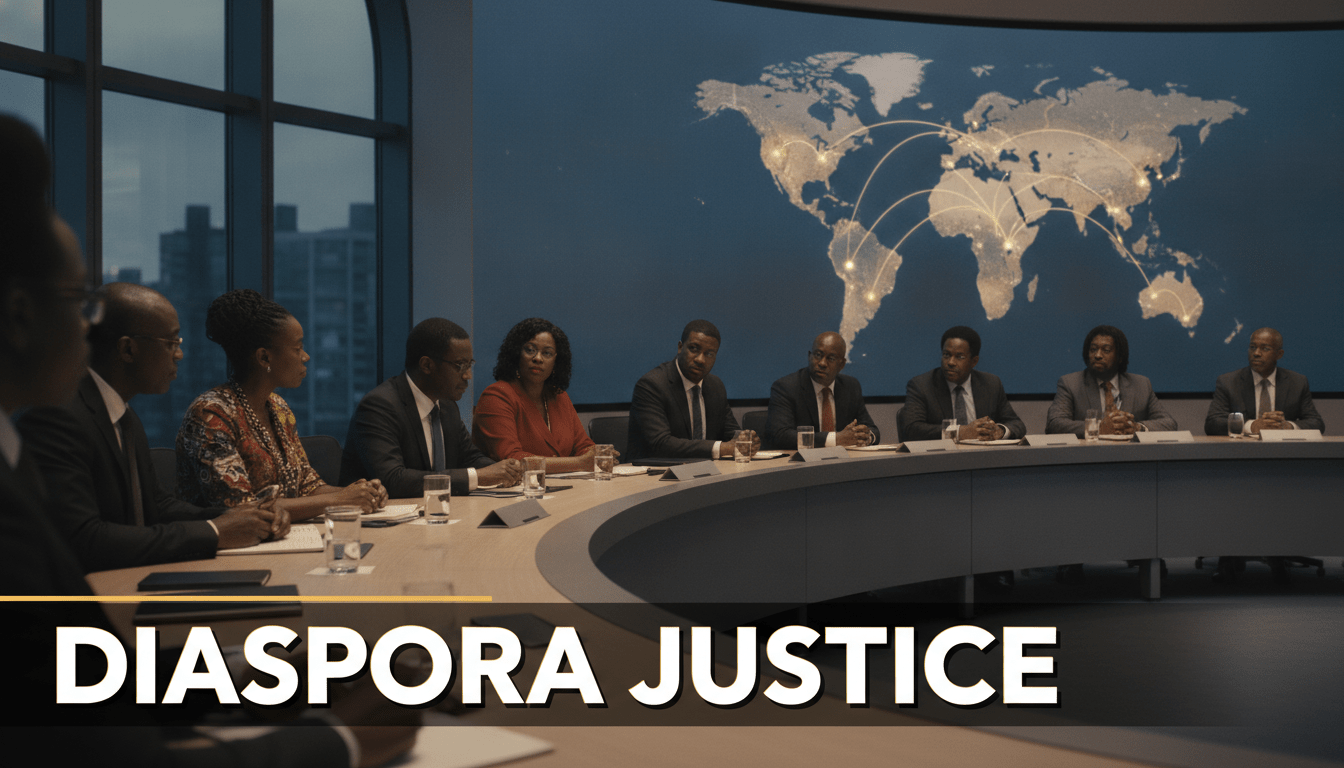
Recently, activists converged at major global events to design unified strategies. The 9th Pan-African Congress in Lomé and the United Nations Permanent Forum on People of African Descent in Geneva demonstrate this momentum (ishr.ch, guardian.ng). These convenings targeted institutional bias in criminal justice systems and pushed to preserve historical memory. By examining the history behind the headlines, one can see how today’s global networks build upon ancestral blueprints.
The Century-Old Blueprint of Pan-African Solidarity
The foundation for modern global social justice convenings was created over a century ago. Organized resistance began in 1900 when Henry Sylvester Williams convened the First Pan-African Conference in London (blackhistorymonth.org.uk, panafricancouncil.org). This landmark event introduced the concept of Pan-African solidarity to the world stage. Following this meeting, W.E.B. Du Bois championed a series of congresses to build a global racial consciousness (blackhistorymonth.org.uk, wikipedia.org). These early meetings successfully linked the struggles of African Americans to colonial exploitation in Africa and the Caribbean (panafricancouncil.org).
The movement shifted dramatically during the Fifth Pan-African Congress in Manchester in 1945 (blackhistorymonth.org.uk, wikipedia.org). This gathering brought grassroots trade unionists, activists, and future African heads of state together (blackhistorymonth.org.uk). They moved away from polite appeals for reform. Instead, they demanded complete decolonization, racial equality, and economic sovereignty. Across the United States, Black laborers also struggled for economic justice as part of this global push. Today, modern advocates draw inspiration from these historic struggles for self-determination.
From Durban to Geneva: Internationalizing Human Rights
The modern international human rights framework for the African diaspora was established in 2001 (www.gov.za, gicj.org). The United Nations World Conference against Racism took place in Durban, South South Africa (www.gov.za). This historic gathering produced the Durban Declaration and Programme of Action (DDPA) (gicj.org). Durban formally declared the transatlantic slave trade and colonialism to be crimes against humanity (gicj.org). This declaration established a critical precedent. It linked modern global inequalities directly to historical injustices (gicj.org).
Additionally, the Durban conference popularized the term “Afro-descendant” on the global stage (gicj.org). Today, activists use this framework to hold governments accountable. The United Nations General Assembly declared the Second International Decade for People of African Descent from 2025 to 2034 (ohchr.org, ohchr.org). This global initiative focuses on recognition, justice, and development (ohchr.org). Within this framework, the UN Permanent Forum on People of African Descent met in Geneva in April 2026 (ishr.ch, ohchr.org). The forum marked five years of coordination, highlighting reparations and structural reform (ohchr.org, ohchr.org).
The Brutal Numbers Behind Global Criminal Justice
While international summits generate critical policy language, the push for reform is driven by painful realities. Statistics reveal that institutional bias in law enforcement is not random. In the United States, mass incarceration disproportionately impacts Black communities. Black Americans make up approximately 13 percent of the general population (prisonpolicy.org). However, they represent more than 37 percent of the incarcerated population (prisonpolicy.org). This stark imbalance highlights a deeply entrenched systemic bias in the judiciary.
Furthermore, state-level data demonstrates the severe scale of these disparities. The American Civil Liberties Union reports that Black people are incarcerated in state prisons at nearly five times the rate of white Americans (aclu.org). Nationally, one in every 81 Black adults in the United States is currently serving time in a state facility (aclu.org). Additionally, research shows that one in five Black men born in 2001 is projected to go to prison in his lifetime (sentencingproject.org). These shocking figures demonstrate why activists are demanding cross-border strategies to address carceral bias.
Redefining Law Enforcement with Twelve Structural Steps
To combat systemic racism in judiciaries worldwide, activists have introduced new frameworks. The United Nations International Independent Expert Mechanism to Advance Racial Justice and Equality in Law Enforcement (EMLER) released a landmark report in September 2025 (ohchr.org). This body identified twelve key structural elements needed to eliminate systemic racism from global policing and judiciaries (ohchr.org, ohchr.org). The elements cover a wide range of administrative and institutional reforms.
First, the EMLER report demands the complete elimination of racial profiling and the systematic collection of disaggregated data (ohchr.org). Second, it focuses on mandatory training, community participation, and sentencing reviews (ohchr.org). Finally, the framework demands alternatives to incarceration and just reparations for victims of institutional bias (ohchr.org). These guidelines address a global power imbalance. As activists at the 9th Pan-African Congress pointed out, Africa accounts for 18 percent of the global population but holds only three percent of the decision-making power in international institutions (pac9-lome.com, pac9-lome.com). This deficit limits the ability of Afro-descendant nations to challenge global structures.
Digital Redlining and the Rise of Algorithmic Biases
As technology advances, traditional forms of institutional bias have shifted into digital spaces. This modern discrimination is called digital redlining (greatschoolvoices.org, 99percentinvisible.org). Historically, redlining occurred when banks drew lines on maps to deny loans to Black neighborhoods (99percentinvisible.org). Today, tech companies use digital tools to limit access to opportunities. Algorithms use ZIP codes or demographic data to automatically deny housing, credit, and jobs to marginalized groups (greatschoolvoices.org).
Furthermore, predictive policing software uses historical arrest data to forecast criminal activity (greatschoolvoices.org). Because police departments have historically targeted minority communities, the historical data is deeply biased (greatschoolvoices.org). The software then creates a discriminatory loop. It sends more officers to Black neighborhoods, leading to more arrests, which mathematically justifies more policing (greatschoolvoices.org). During the UN sessions, defenders advocated for regulations similar to the European Union AI Act to ban predictive profiling and facial recognition systems (ohchr.org, europa.eu). This issue highlights how medical exploitation and other historic abuses have merely changed form in the modern technological era.
Decolonizing the Mind and the Power of Memory Work
Activists at the 9th Pan-African Congress in Lomé argued that true progress is impossible without decolonizing the mind (pac9-lome.com). This concept refers to dismantling the internalized psychological legacies of colonial rule and systemic racism. In practice, decolonization of the mind requires rewriting Eurocentric school curricula to integrate African perspectives (harvard.edu). It also involves preserving history to counter negative stereotypes (uchicago.edu, harvard.edu). Scholars like Jarvis Givens have documented how Black educators have historically used memory work to protect students (uchicago.edu, harvard.edu).
Memory work is the active process of retrieving and preserving suppressed histories. This includes documenting oral histories and removing colonial monuments (harvard.edu). Activists use this historical preservation to build resilience. It celebrates the resilience of Black families through generations. Preserving this history acts as a shield against bias. When the history of slavery and segregation is erased, public and judicial systems default to racialized stereotypes. Preserving historical truth directly challenges the presumption of guilt assigned to Afro-descendants.
The Path Forward: Unifying Cross-Border Strategies
The 9th Pan-African Congress in Lomé concluded with the adoption of a Final Declaration (pac9-lome.com). This document established concrete policies to guarantee structural continuity (pac9-lome.com). First, delegates created a Follow-up Committee to monitor the implementation of their goals, with Togo coordinating the efforts (pac9-lome.com). Second, they institutionalized an annual Pan-African Day of Remembrance for victims of slavery and colonization (pac9-lome.com). This day will encourage international collaboration across Africa and the Caribbean (pac9-lome.com).
Furthermore, participants asked the Togolese Republic to petition the United Nations General Assembly (pac9-lome.com). They want a global resolution demanding reparations and the physical restitution of stolen African cultural property (pac9-lome.com). To ensure that these strategies remain active, the Congress established a permanent office (pac9-lome.com). The body will meet every five years to coordinate resources (pac9-lome.com). Activists also emphasize the importance of reparations for historic wrongs to fund these community initiatives. These unified actions ensure that the struggle for racial equity is fought together, not in isolation.
About the Author
Darius Spearman is a professor of Black Studies at San Diego City College, where he has been teaching for over 20 years. He is the founder of African Elements, a media platform dedicated to providing educational resources on the history and culture of the African diaspora. Through his work, Spearman aims to empower and educate by bringing historical context to contemporary issues affecting the Black community.
