


How Austin Saves Black Cultural Heritage From Erasure
By Darius Spearman (africanelements)
Support African Elements at patreon.com/africanelements and hear recent news in a single playlist. Additionally, you can gain early access to ad-free video content.
A quiet revolution unfolded on the streets of Austin, Texas, over the weekend of June 19, 2026 (austincurrent.org). The air was thick with the heat of summer and the sound of celebration. Residents gathered to observe Juneteenth, a holiday marking the end of slavery in the United States (fox7austin.com). However, this gathering carried a deeper purpose. It served as a direct act of cultural self-defense against state-enforced erasure (austincurrent.org).
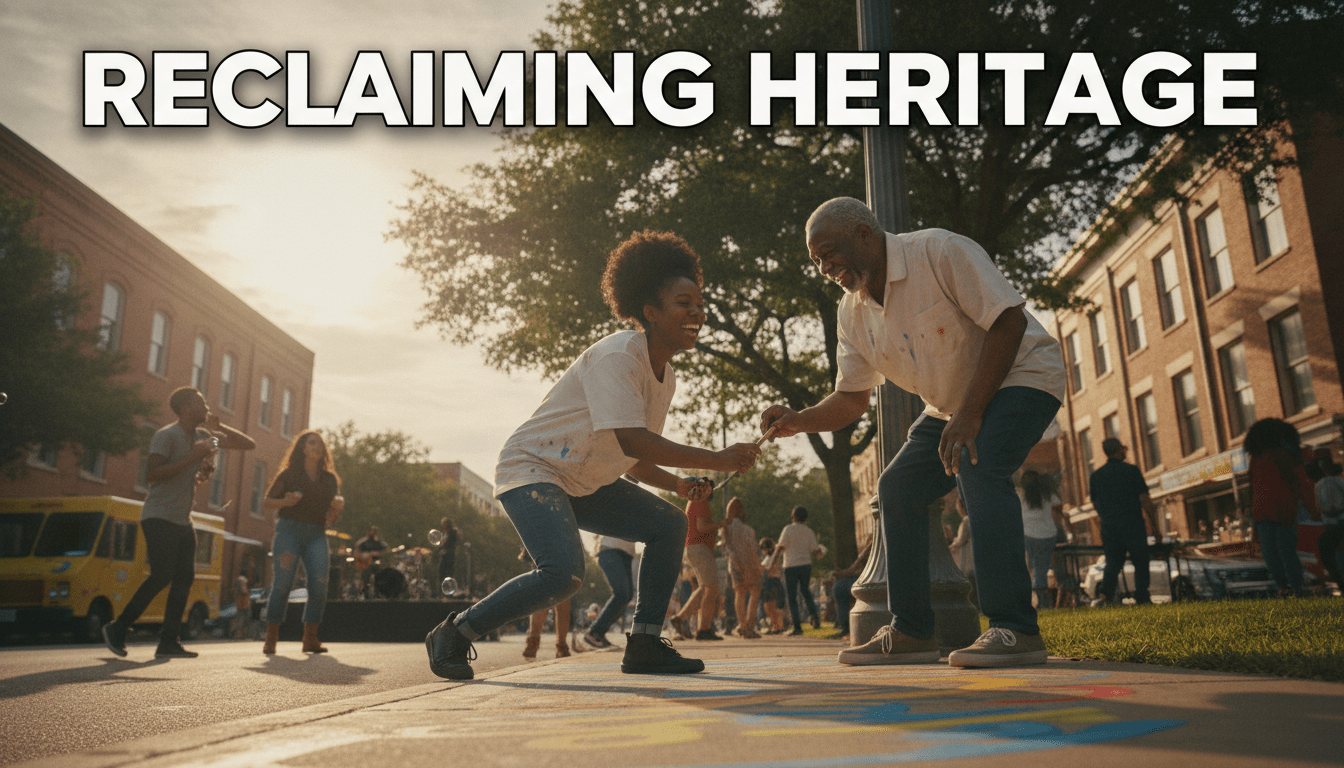
Mayor Kirk Watson and the city’s Public Spaces Task Force organized a series of vibrant community block parties in East Austin (austincurrent.org, austincurrent.org). They did not merely dance and eat. They painted. Denied the right to paint on the streets, they took their brushes to the sidewalks and lampposts (austincurrent.org). This creative defiance came in response to a strict state mandate from the Texas Department of Transportation (TxDOT) (austincurrent.org).
The state ordered the immediate removal of all decorative pavement art across the city (fox7austin.com). This mandate targeted the iconic rainbow pride crosswalks on Fourth Street (austincurrent.org). It also targeted the historic “Black Artists Matter” mural on East 11th Street (austincurrent.org). This clash represents a long history of systemic segregation and resilient resistance (austincurrent.org). To understand this battle, one must look past the fresh paint and examine a deep history of racial segregation and community preservation (austincurrent.org).
The State Mandate and the Fight for Street Art
In October 2025, Texas Governor Greg Abbott directed state transit officials to enforce strict roadway safety guidelines (austincurrent.org). Under the Texas Manual on Uniform Traffic Control Devices (TMUTCD), standard crosswalks must consist of simple white lines on dark asphalt (fox7austin.com). State officials declared that non-standard colors and large letters on roads create dangerous distractions for drivers (austincurrent.org). Consequently, TxDOT sent a formal warning to Texas cities (austincurrent.org). The state threatened to withhold millions of dollars in transportation funding if the decorative street markings remained (austincurrent.org).
The City of Austin formally requested exemptions to preserve its historic pavement installations (austincurrent.org). However, on May 18, 2026, state officials officially rejected the city’s appeal (austincurrent.org). TxDOT demanded a formal removal action plan by Monday, June 22, 2026 (austincurrent.org). To protect federal and state transportation funds, the city complied with this tight deadline (austincurrent.org). City officials agreed to cover the material and labor costs to physically scrape and pave over the beloved street murals (fox7austin.com).
Targeted Austin Roadway Markings Under State Mandate
Source: TxDOT Uniformity Guidelines Compliance Report (fox7austin.com, kvue.com)
The state crackdown extended far beyond ideological messages (kvue.com). It also targeted non-political decorative designs across the city (fox7austin.com). For instance, TxDOT ordered the removal of the forty-foot-tall burnt orange “TEXAS” design painted near the University of Texas campus on Guadalupe Street (fox7austin.com). The state also targeted a decorative river mural painted on Lake Austin Boulevard (kvue.com). Furthermore, several neighborhood traffic circles and quiet street designs on Cumberland Road were marked for removal (kvue.com). State officials argued these colorful markings impair both human drivers and automated vehicle navigation systems (fox7austin.com).
Resilient Foundations of the Reconstruction Era
To understand the significance of the East 11th Street corridor, one must look back to the end of the American Civil War. The Reconstruction Era spanned from 1865 to 1877 (eji.org). During this turbulent time, the nation attempted to integrate formerly enslaved people into the social and economic fabric of society (eji.org). The era saw the ratification of the Thirteenth, Fourteenth, and Fifteenth Amendments (eji.org). These amendments abolished slavery, granted citizenship, and protected voting rights (eji.org).
However, this period of progress faced immediate and violent backlash (eji.org). Southern states quickly enacted discriminatory laws to suppress these newly won freedoms. Many scholars argue that the failed promises of Reconstruction left a legacy of systemic inequality that communities still fight today. Despite these struggles, emancipated African Americans built their own independent futures (wikipedia.org). They established independent, self-sustaining settlements known as Freedman Communities or Freedman’s Towns (wikipedia.org).
These historic enclaves allowed Black families to buy land and escape daily violence (nps.gov). Within these safe havens, residents built their own schools, churches, and thriving businesses (wikipedia.org). Historically, the Austin area was home to at least fifteen of these communities (wikipedia.org). For example, Charles Clark founded Clarksville in West Austin in 1871 (wikipedia.org). In 1869, James Wheat established Wheatville (wikipedia.org). Wheatville became a highly significant cultural hub (wikipedia.org). It was the home of Reverend Jacob Fontaine, who published *The Gold Dollar*, one of the first Black newspapers printed west of the Mississippi River (wikipedia.org). Many of these resilient families relied on the deep strength of community networks to survive systematic oppression.
Enforced Segregation and the 1928 Master Plan
The peaceful existence of Austin’s Freedman Communities was intentionally dismantled by city leadership. In 1928, Austin city leaders sought to enforce racial segregation across the entire municipality (wikipedia.org). Explicit racial zoning was unconstitutional under federal law (wikipedia.org). Therefore, the city enacted a strategic “Master Plan” (wikipedia.org). This plan designated a single six-square-mile area in Central East Austin as the official “Negro District” (sixsquareatx.org).
The city used systemic coercion to force Black families into this segregated zone (wikipedia.org). City officials deliberately cut off municipal services to Black families living outside East Austin (wikipedia.org). They refused to provide water, electricity, or paved roads to historic Black neighborhoods in West Austin (wikipedia.org). Furthermore, the city closed down Black schools in integrated areas to compel relocation (wikipedia.org). By the mid-1930s, almost the entire Black population of Austin had been forced into the designated district (wikipedia.org).
Calculated Lost Generational Wealth
The cumulative economic loss suffered by Black landholders across four historic West Austin communities due to forced migration under the 1928 Master Plan.
Source: City of Austin Equity Office “Black Dispossession Study” (austincurrent.org)
This forced migration resulted in massive financial devastation. In 2022, a study conducted by the City of Austin’s Equity Office calculated the exact cost of this land dispossession (austincurrent.org). Researchers utilized historic tax records and contemporary property assessments (austincurrent.org). They analyzed the cumulative loss of Black landownership across four historic communities: Clarksville, Wheatville, Red River, and East Campus (austincurrent.org).
The results of the “Black Dispossession Study” were staggering (austincurrent.org). Systemic racism and infrastructure denial cost Black homeowners in these neighborhoods more than 290 million dollars in lost generational wealth (austincurrent.org). Denying public services intentionally drove property values down (austincurrent.org). This systemic disinvestment made it impossible for Black homeowners to secure building loans (austincurrent.org). Consequently, families were forced into predatory sales and pushed out of their ancestral homes (austincurrent.org). These historic wrongs have driven modern discussions regarding reparations and economic justice to heal communities.
Reclaiming Space Through Six Square
Despite the devastating impacts of segregation, the designated six-square-mile area flourished. The neighborhood became a vibrant cultural, economic, and musical hub for Black-owned businesses, schools, and churches (sixsquareatx.org, sixsquareatx.org). However, rapid growth and rising property values in the late twentieth century brought new challenges. In 2005, the Austin City Council launched a comprehensive effort to address growing racial disparities (austinrev.org). This effort was called the African American Quality of Life Initiative (austinrev.org).
The initiative was catalyzed by community outrage over systemic inequalities, declining Black population numbers, and the tragic police shooting of Kevin Brown in 2007 (austinrev.org, austinrev.org). A core “scorecard” study revealed that Black residents experienced a significantly lower quality of life compared to other local demographics (austinrev.org). The study highlighted massive gaps in health, business ownership, and social infrastructure (austinrev.org).
Consequently, the initiative produced fifty-six specific recommendations to improve community outcomes (austinrev.org). One major recommendation led to the formal creation of the African American Cultural Heritage District in 2007 (sixsquareatx.org). In 2013, a non-profit organization was formed to manage and preserve this historic area (sixsquareatx.org, sixsquareatx.org). The organization chose the name “Six Square” (sixsquareatx.org). This name directly references the six-square-mile boundary of the original 1928 “Negro District” (sixsquareatx.org). By reclaiming this term, the non-profit honors the survival and contributions of Black Austinites (sixsquareatx.org, sixsquareatx.org). It is the first state-designated Black cultural district in Texas (sixsquareatx.org).
Modern Monuments of Inclusion
In June 2020, the historic district gained a powerful new visual monument (austincurrent.org). The “Black Artists Matter” street mural was painted on East 11th Street (austincurrent.org). This location served as the historic commercial heart of the Black community during Jim Crow segregation (sixsquareatx.org). The painting was a collaborative project between the Austin Justice Coalition and Capitol View Arts (austincurrent.org). It was created during the nationwide protests following the death of George Floyd (austincurrent.org).
The phrase “Black Artists Matter” was chosen with care (austincurrent.org). It aimed to highlight the work of local Black creatives (austincurrent.org). These artists are often overlooked in a rapidly changing city (austincurrent.org). Indeed, Austin is a unique national outlier (austincurrent.org). It is the only rapidly growing major American city experiencing a net decline in its Black population share (austincurrent.org).
Austin Demographic Share Breakdown
Source: U.S. Census Bureau & Gallup Metro Surveys (austincurrent.org)
Between 2000 and 2010, gentrification caused a sixty-six percent decrease in East Austin’s Black population (austincurrent.org). Conversely, the white population in the area increased by four hundred and forty-two percent (austincurrent.org). By 2023, the Black population of Austin fell to just 7.9 percent (austincurrent.org).
While East Austin fought to preserve its heritage, another battle occurred downtown. The rainbow crosswalks on Fourth Street were installed in October 2021 (austincurrent.org). They were created using the Progressive Pride flag design to honor National Coming Out Day (austincurrent.org). For decades, the Fourth Street corridor served as a vital safe haven for the LGBTQ+ community (austincurrent.org). During the devastating HIV/AIDS crisis of the 1980s, local bars provided essential support networks and education (austincurrent.org). In 2012, a portion of the street was renamed to honor Bettie Naylor, a pioneering civil rights lobbyist (austincurrent.org). Today, Austin has the third-highest percentage of LGBTQ+ residents among major U.S. cities, standing at 5.9 percent (austincurrent.org).
Designing a Future of Resilient Visibility
The removal of the street murals will not erase the history of these communities. Austin’s Public Spaces Task Force is moving forward with innovative, state-compliant ways to preserve cultural heritage (austincurrent.org). Instead of using pavement markings, the city is shifting its focus to vertical art and permanent physical landmarks (austincurrent.org). For the East 11th Street corridor, this preservation entails a prominent physical gateway (sixsquareatx.org).
The original gateway features a historic archway built with a “Texas Star” where East 11th Street crosses under Interstate 35 (sixsquareatx.org). This archway symbolizes the physical and cultural reconnection of East Austin to the downtown core (sixsquareatx.org). The enhanced gateway project will focus on the surrounding area rather than the roadway itself (sixsquareatx.org). It will include the installation of permanent historical signage and educational markers (sixsquareatx.org).
These markers will teach visitors about the rich African American heritage of the neighborhood (sixsquareatx.org). In addition, the gateway will feature vertical murals located safely off the street (austincurrent.org). These murals will display the names and faces of influential Black leaders who shaped Austin’s history (austincurrent.org, sixsquareatx.org). Meanwhile, downtown advocates are working on similar vertical preservation projects. The city plan includes installing a permanent, state-compliant historic marker at the intersection of Fourth and Colorado Streets (austincurrent.org). This marker will officially document the LGBTQ+ history of the corridor (austincurrent.org). Local leaders emphasize that the fight to stay visible is a continuous process (austincurrent.org). By moving the art from the asphalt to the sidewalks and plazas, the community ensures its legacy cannot be paved over (austincurrent.org).
About the Author
Darius Spearman is a professor of Black Studies at San Diego City College, where he has been teaching for over 20 years. He is the founder of African Elements, a media platform dedicated to providing educational resources on the history and culture of the African diaspora. Through his work, Spearman aims to empower and educate by bringing historical context to contemporary issues affecting the Black community.
