

Why Congo Sued Rwanda: The Truth Behind the Bloodshed
By Darius Spearman (africanelements)
Support African Elements at patreon.com/africanelements and hear recent news in a single playlist. Additionally, you can gain early access to ad-free video content.
A Shattering Legal Move at The Hague
On June 26, 2026, the Democratic Republic of Congo took a historic legal step that reverberated across the globe. The government officially filed a massive lawsuit against neighboring Rwanda at the International Court of Justice (ICJ) `(polity.org.za, icj-cij.org)`. Guillaume Ngefa, the Minister of State in charge of Justice, presented the case in The Hague `(polity.org.za)`. The detailed filing accuses Rwanda of decades of cross-border military exploitation and systematic human rights abuses in eastern Congo `(polity.org.za)`. This move represents the ultimate legal escalation for a nation that has endured thirty years of suffering.
The Congolese government is petitioning the highest court of the United Nations to intervene immediately. Kinshasa demands that Rwanda withdraw its military troops from Congolese soil `(polity.org.za)`. Furthermore, the DRC wants Rwanda to pay financial reparations for thirty years of conflict and devastation `(polity.org.za, icj-cij.org)`. This legal escalation has captured global attention. However, to understand the filing of today, one must look deep into the historical forces of the region.
Colonial Roots and the Invention of Division
To comprehend the modern conflict in eastern Congo, one must examine the history of colonial rule. The division between Hutu and Tutsi communities was not always violent. In pre-colonial Central Africa, “Hutu” and “Tutsi” were fluid socio-economic categories based on cattle ownership and agricultural activity rather than fixed biological identities `(genocidewatch.com, lumenlearning.com)`. Social mobility was very common, and the groups shared the same language, cultural traditions, and religious practices `(lumenlearning.com)`.
However, European colonial powers fundamentally disrupted this social harmony. First German, and later Belgian colonizers, utilized pseudo-scientific racism to divide the population `(cateacherscollaborative.org, ramapo.edu)`. Influenced by the “Hamitic hypothesis,” Belgian administrators falsely claimed that the Tutsi minority was a superior, non-Bantu race from Northeast Africa destined to rule `(hmd.org.uk, cateacherscollaborative.org)`. In the 1930s, the Belgians introduced compulsory ethnic identity cards `(hmd.org.uk, ramapo.edu)`. This move fixed ethnic identities from birth, stripped away social fluidity, and created a rigid legal caste system that fueled deep resentment `(genocidewatch.com, hmd.org.uk)`.
The 1994 Genocide and the Refugee Shockwave
The structural resentment manufactured by Belgian colonialism exploded in the late twentieth century. In 100 days of slaughter in 1994, extremist Hutu leaders in Rwanda orchestrated the genocide of approximately 800,000 minority Tutsis and moderate Hutus `(genocidewatch.com)`. The Tutsi-led Rwandan Patriotic Front, commanded by Paul Kagame, defeated the genocidal regime and seized power `(genocidewatch.com, wikipedia.org)`. Fearing Tutsi retaliation, roughly two million Hutu refugees fled across the border into eastern Congo `(wikipedia.org, wikipedia.org)`.
This massive influx destabilized the eastern Congolese border. Mixed within the civilian refugees were members of the Interahamwe militia and the former Rwandan army `(wikipedia.org)`. These forces regrouped inside the Congolese camps and formed the Democratic Forces for the Liberation of Rwanda `(wikipedia.org, wikipedia.org)`. Paul Kagame, who has been the President of Rwanda since 2000, has long used this group as a national security justification `(ktpress.rw, www.gov.rw, jonathanrbeloff.com)`. Under Kagame, the Rwandan Defence Force has transformed into a highly organized regional military powerhouse `(ktpress.rw, jonathanrbeloff.com)`. His administration launched cross-border military operations to eliminate these Hutu rebel groups and secure the western border of Rwanda `(ktpress.rw, jonathanrbeloff.com)`.
From Africa’s World War to Modern Proxy Battles
The presence of armed Hutu militants in Congo triggered massive military interventions. The First Congo War began in 1996 when Rwanda and Uganda invaded Zaire to dismantle the Hutu militant camps `(wikipedia.org, wikipedia.org)`. They overthrew dictator Mobutu Sese Seko and installed Laurent-Désiré Kabila, renaming the nation the Democratic Republic of Congo `(wikipedia.org, wikipedia.org)`. However, the alliance quickly fractured, sparking the Second Congo War in 1998 `(wikipedia.org)`.
This second war drew in nine African countries and over 25 armed groups, earning the title of “Africa’s World War” `(wikipedia.org)`. Millions of people died, primarily from starvation, disease, and societal collapse `(wikipedia.org)`. Although the war officially ended in 2003, foreign forces did not truly leave the region `(wikipedia.org)`. Instead, the conflict fractured into localized proxy warfare, with neighboring countries backing heavily armed rebel groups to secure their regional interests `(thesoufancenter.org)`.
The Resurgence of the M23 Rebellion
The current wave of violence in eastern Congo is dominated by the March 23 Movement, also known as M23 `(cfr.org)`. Established in 2012, M23 is composed of Tutsi mutineers from the Congolese army `(cfr.org)`. The DRC, the United Nations, and Western governments argue that M23 is a direct arm of the Rwandan military `(washingtonpost.com, washingtonpost.com)`. In early 2025, M23 launched an aggressive military campaign, successfully seizing Goma and Bukavu `(thesoufancenter.org)`.
UN experts and the United States government have documented that Rwanda has deployed between 3,000 and 4,000 of its own regular troops directly into the DRC to fight alongside M23 `(washingtonpost.com, washingtonpost.com)`. They have supplied the rebels with advanced weaponry, including surface-to-air missiles `(washingtonpost.com)`. Rwanda denies backing M23, asserting that its military actions are defensive maneuvers to neutralize the FDLR `(ktpress.rw)`. Conversely, the DRC argues that Rwanda uses the FDLR as a convenient pretext to carry out a campaign of violence `(polity.org.za)`.
The Plight of the Banyamulenge Minority
At the heart of these proxy struggles is the question of identity and belonging. The Banyamulenge are ethnic Tutsis who settled in South Kivu long before colonial borders were established `(citizenshiprightsafrica.org)`. Despite their deep history, neighboring ethnic groups have systematically denied them ancestral land rights and custom-based authority roles `(citizenshiprightsafrica.org)`. These neighbors often view the Banyamulenge as unwanted invaders `(citizenshiprightsafrica.org)`.
This exclusion was institutionalized by the Congolese state. Under Mobutu, the government revoked the citizenship of the Banyamulenge in 1981, and a 1995 decree declared them foreigners `(citizenshiprightsafrica.org)`. Fearing expulsion and massacres, many Banyamulenge youth fled to Rwanda to train with the Rwandan military `(citizenshiprightsafrica.org)`. This provided the Rwandan military with a pretext to launch cross-border interventions `(citizenshiprightsafrica.org)`. Today, local Congolese militias, such as the Wazalendo, target Banyamulenge villages under the assumption that they automatically support Rwandan-backed rebels `(afroamerica.net, genocidewatch.com)`.
Weaponizing International Law: CERD and CEDAW
To target these systemic abuses, the DRC is leveraging specific international legal tools. The acronyms CERD and CEDAW refer respectively to the International Convention on the Elimination of All Forms of Racial Discrimination and the Convention on the Elimination of All Forms of Discrimination against Women `(icj-cij.org, icj-cij.org)`. The DRC explicitly invokes these two human rights conventions to address the precise nature of the atrocities committed in eastern Congo `(icj-cij.org, icj-cij.org)`.
Under the CEDAW convention, the DRC targets systematic gender-based discrimination and the horrific epidemic of sexual violence `(icj-cij.org, icj-cij.org)`. This violence has been weaponized against civilian populations, specifically targeting Black women and girls `(panzifoundation.org, panzifoundation.org)`. Under the CERD convention, the DRC accuses Rwanda of perpetrating ethnic-based discrimination and forced displacement `(icj-cij.org, icj-cij.org)`. These actions have targeted regional ethnic groups such as the Hutu, Nyindu, Bembe, Lega, Nande, Hunde, and Bashi communities `(icj-cij.org, icj-cij.org)`.
Bypassing the Legal Shields: The Strategy of Reservations
In the past, Rwanda has successfully avoided international lawsuits. Under international treaty law, specifically codified in the Vienna Convention on the Law of Treaties, a “reservation” allows a sovereign state to agree to a treaty while excluding specific clauses `(wikipedia.org)`. States frequently enter reservations to compromissory clauses, which are the dispute-settlement provisions that allow disputes to be referred to the ICJ `(iilj.org, icj-cij.org)`.
Because international law is built on state consent, a nation can pledge to follow a human rights treaty while legally opting out of ICJ accountability `(iilj.org, icj-cij.org)`. In a previous 2002 lawsuit, the ICJ dismissed the case because Rwanda had entered a reservation to the Genocide Convention `(iilj.org, icj-cij.org)`. The DRC’s new strategy uses a multi-treaty framework `(icj-cij.org, icj-cij.org)`. By invoking CERD, CEDAW, and the Convention against Torture, the DRC hopes to bypass these old legal shields and force Rwanda to face the court `(icj-cij.org, icj-cij.org)`.
The Economic Engine: 3TGs and the Global Tech Hunger
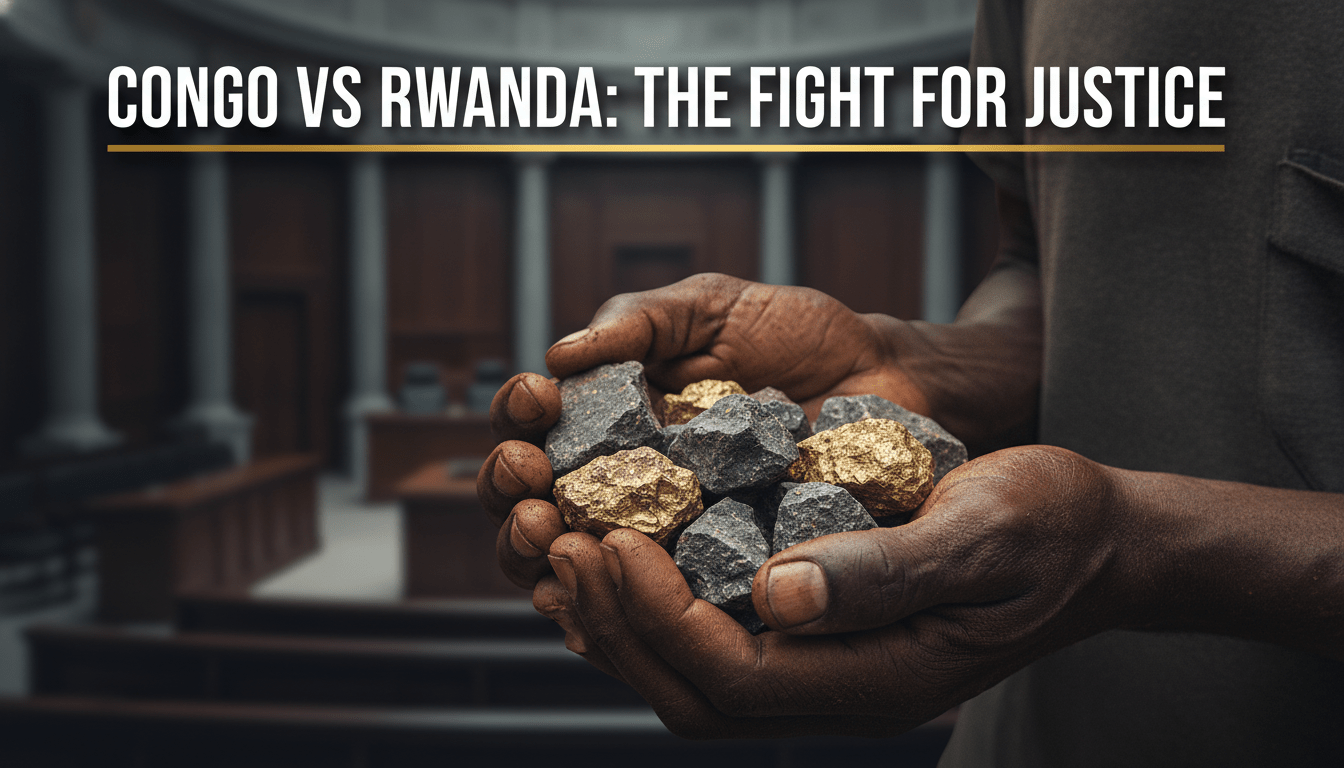
Underneath the political and ethnic tensions lies a massive economic driver. Eastern Congo is rich in minerals known as the “3TGs,” which stands for Tin, Tantalum, Tungsten, and Gold `(responsiblemineralsinitiative.org, europa.eu)`. These metals are extracted from specific raw mineral ores: Tin from cassiterite, Tantalum from columbite-tantalite (coltan), Tungsten from wolframite, and Gold directly from gold ore `(responsiblemineralsinitiative.org)`. These minerals are essential components in nearly every modern electronic device `(responsiblemineralsinitiative.org)`.
The control of these minerals fuels the ongoing violence. The Rubaya mining hub in eastern Congo, which supplies approximately fifteen percent of the global coltan supply, fell under the control of the Rwandan-backed M23 rebel group `(hrw.org, hrw.org)`. Watchdogs have exposed a highly organized smuggling pipeline `(responsiblemineralsinitiative.org)`. Plundered Congolese minerals are smuggled into Rwanda, mixed with domestic supplies, and tagged with “conflict-free” legitimacy tags for export `(responsiblemineralsinitiative.org, sustalium.com)`. The struggle for economic justice remains a far-off dream for Congolese miners working under brutal conditions.
Western Tech Consumption and Global Systemic Racism
The crisis in eastern Congo directly connects to Western tech consumers and global systemic racism. Under a system of global systemic racism, the lives and labor of Black Congolese miners are profoundly devalued `(worldwithoutgenocide.org, freedomunited.org)`. This dynamic allows Western consumers to enjoy cheap consumer electronics and green energy technologies `(worldwithoutgenocide.org, freedomunited.org)`. Meanwhile, the heavy human cost of extraction is borne entirely by impoverished populations in the Global South `(worldwithoutgenocide.org)`.
Global tech giants have historically secured critical minerals through highly dangerous and unregulated artisanal scale mining `(mercycorps.org, freedomunited.org)`. Hundreds of thousands of Congolese, including tens of thousands of children, work in toxic, life-threatening conditions `(mercycorps.org, freedomunited.org)`. This global scramble for resources enables multinational corporations and foreign governments to perpetuate Congo’s resource curse `(worldwithoutgenocide.org)`. Therefore, the global struggle for racial justice must also address the deep economic exploitation occurring in the heart of Africa.
The Limits of Justice: Enforcing the Unenforceable
Even if the DRC wins its legal battle, enforcement remains a major challenge. The ICJ has no military, police force, or independent executive body to enforce its judgments `(academy4sc.org, modeldiplomat.com)`. Instead, enforcement relies on Article 94 of the UN Charter, which designates the UN Security Council as the sole political organ empowered to enforce rulings `(academy4sc.org, modeldiplomat.com)`.
However, the mechanism is severely constrained by international geopolitics. The five permanent members of the Security Council hold absolute veto power, which they can use to block enforcement resolutions against themselves or their regional allies `(verfassungsblog.de, oup.com)`. For example, in the historical case of Nicaragua versus the United States, the U.S. successfully vetoed a resolution demanding compliance `(verfassungsblog.de, oup.com)`. This geopolitical reality represents a major political shift where legal victories do not easily translate to immediate safety on the ground.
About the Author
Darius Spearman is a professor of Black Studies at San Diego City College, where he has been teaching for over 20 years. He is the founder of African Elements, a media platform dedicated to providing educational resources on the history and culture of the African diaspora. Through his work, Spearman aims to empower and educate by bringing historical context to contemporary issues affecting the Black community.
