

Fighting Passport Apartheid: How Diaspora Networks Fight Back
By Darius Spearman (africanelements)
Support African Elements at patreon.com/africanelements and hear recent news in a single playlist. Additionally, you can gain early access to ad-free video content.
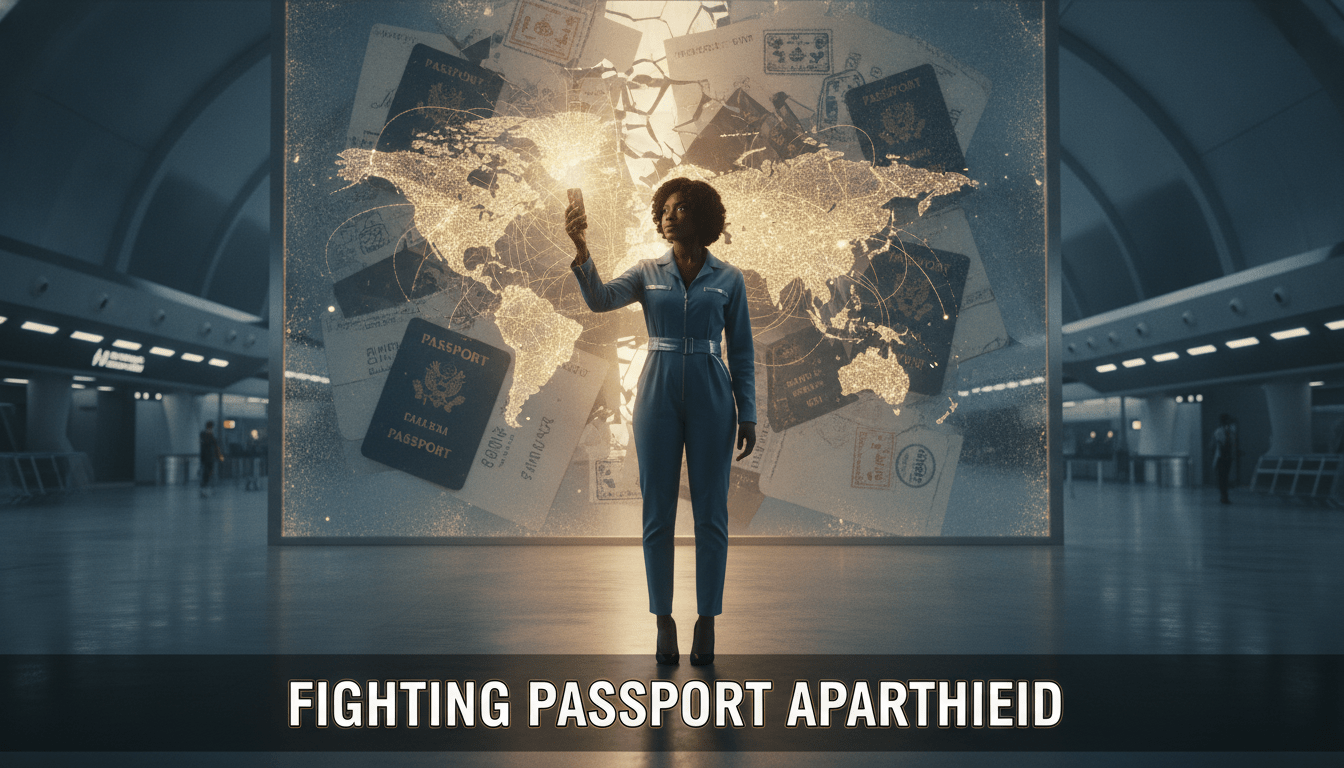
Global travel is not a simple experience for everyone. For millions of Black and African travelers, crossing international borders is a process filled with suspicion and anxiety. Recently, international diaspora channels and digital activists have launched a widespread viral awareness campaign. This campaign addresses the systemic disparities, heightened profiling, and unfair treatment that Black and African travelers routinely face at international borders. These digital networks are actively constructing a digital counter-infrastructure to fight what experts call passport apartheid. To understand this modern digital uprising, one must examine the history behind the headlines.
The modern struggle for equal mobility is deeply rooted in historical systems of exclusion. Today, activists are utilizing digital tools to route around state-level inaction. This has transformed isolated incidents of border profiling into global conversations. By looking at the historical roots, modern flashpoints, and statistical evidence, we can see how the global majority is challenging these paper walls. These networks of Black solidarity have never been more borderless.
The Colonial Roots of Border Control
The unequal distribution of global mobility is not an accidental byproduct of modern security. Instead, it is a direct legacy of colonial history. In the late nineteenth and early twentieth centuries, European empires carved up the African continent (stanford.edu). Formal passport and border control systems emerged during this era. These systems were designed to define nationhood and to actively restrict the mobility of colonized peoples (cambridge.org). Passports distinguished between desirable global citizens and racialized populations whose movement was strictly contained.
Historically, the African diaspora has always organized against state-imposed restrictions on movement. During the early Pan-African Congresses, colonial powers systematically used travel restrictions to prevent solidarity. The Fourth Pan-African Congress in New York (1927) was historic. It was the first congress hosted in the Americas and organized predominantly by Black women (blackhistorymonth.org.uk, blackpast.org). The resolutions of this congress demanded native land rights, modern education, and a political voice for Black people (panafricancongress.org). Later, the Fifth Pan-African Congress in Manchester (1945) brought together future heads of African states (wikipedia.org, sahistory.org.za). Colonial powers tried to block these delegates through visa denials, but early pioneers bypassed these roadblocks using physical shipping networks and international mail (historyworkshop.org.uk, blackhistorymonth.org.uk).
What Is Facially Neutral Policy?
Following the era of decolonization, physical colonial blockades were replaced by bureaucratic barriers. Today, global mobility relies heavily on facially neutral mechanisms. The term facially neutral refers to policies, rules, or laws that appear objective and colorblind on paper (seattleu.edu). However, in practice, these policies result in a disparate impact that disproportionately and predictably excludes or harms specific racialized groups (uclawsf.edu). This subtle mechanism allows exclusionary systems to function without explicitly mentioning race.
Under domestic legal frameworks, proving discrimination under a facially neutral rule requires establishing discriminatory intent (cornell.edu). This standard creates an incredibly high burden of proof. Consequently, it acts as a safe harbor for systemic bias in customs and immigration systems (georgetown.edu, bu.edu). Under international law, policies that disproportionately exclude racialized groups without a legitimate justification constitute indirect racial discrimination (amnesty.org). These laws help maintain neocolonial hierarchies in global mobility (ceu.edu). Many activists argue that these biased legal structures are a primary tool of global anti-Black politics.
Defining Passport Apartheid
The term passport apartheid describes systemic global inequalities in freedom of movement based on nationality, race, and place of birth (lse.ac.uk, investmentmigration.org). Under this system, citizenship functions as an arbitrary, blood-based mechanism of exclusion (mpg.de). This system restricts the global majority while granting privileged mobility to a wealthy minority. Indeed, the legal ability to travel remains deeply tied to historical colonial hierarchies.
For the global majority, citizenship acts as a randomly distributed penal status of privation. It is not the democratic ideal of inclusion depicted in political theory (henleyglobal.com). This systemic exclusion manifests in international visa regimes, where travelers from regions like Africa face disproportionate profiling (forbes.com). This division of humanity based on country of birth reinforces historical colonial divisions under a modern, legalized guise.
The Schengen Zone and the European Union
To understand modern travel barriers, one must understand European geography. The Schengen Area is a border-free travel zone of European nations (etias.com). This zone comprises 29 European countries covering over 4 million square kilometers (europa.eu). It has abolished internal border controls to allow unrestricted free movement for a population of 450 million people. However, this zone differs significantly from the European Union.
The European Union is a political and economic union of 27 member states (etias.com). Not all European Union member states are part of the Schengen Area. For example, Ireland maintains its own independent border controls and visa policies. Conversely, several non-European Union countries are fully integrated members of the Schengen Area (wikipedia.org). These nations include Switzerland, Norway, Iceland, and Liechtenstein. The latest full expansion occurred on January 1, 2025, when Bulgaria and Romania officially joined the Schengen Area after removing land border checks (etias.com).
High-Profile Flashpoints and Real-World Segregation
Prior to the 2022 invasion, Ukraine hosted over 16,000 African students, representing about 20% of its foreign student population. This trend originated from Soviet-era scholarship programs beginning in the 1950s (mpg.de). These programs actively recruited African students to train as doctors and engineers to build geopolitical alliances. Furthermore, Ukrainian universities provided a high standard of education in medicine at highly affordable rates (aa.com.tr). Ukraine was also perceived as an uncomplicated gateway to the European job market (theafricancourier.de). To learn more about this geopolitical history, one can examine the complicated relationship between Russia and Black people.
When Russia invaded Ukraine, African students faced segregation and violence at the borders (bylinetimes.com, corq.studio). Officials implemented “Ukrainians Only” boarding policies, leaving Black evacuees stranded in freezing temperatures. In response, the global Black diaspora launched the viral campaign #AfricansInUkraine. Activists utilized Telegram channels, WhatsApp groups, and Twitter spaces to map safe evacuation routes and bypass official state channels (semafor.com, africanews.com). Meanwhile, airport profiling remains a major issue at other borders, such as Vancouver Airport in Canada (thetyee.ca).
In another notable incident, the United States Department of Justice shut down a highly controversial domestic program in January 2025 (senate.gov). The Drug Enforcement Administration operated the Transportation Interdiction Program (nyccriminalattorneys.com). This program utilized cold consent encounters on jetways to target and search travelers without a warrant. Investigative reporting revealed that plainclothes officers disproportionately targeted and racially profiled Black passengers (criminaldefenseattorneytampa.com). A federal review found that the program seized over 22 million dollars in cash but resulted in only 57 arrests nationwide. Following pressure from Senator Jon Ossoff and advocacy groups, the Department of Justice officially shut down the program (bet.com, greatlakescustomslaw.com, innocenceproject.org).
Algorithmic Profiling and the Digital Border
Modern border enforcement is increasingly using digital technologies to create what experts call a digital racial border. This system utilizes biometric artificial intelligence, automated risk profiling, facial recognition, and surveillance databases in ways that codify and exacerbate racial discrimination (nnirr.org). These technologies are frequently trained on biased datasets, leading to severe real-world consequences for Black travelers.
Artificial intelligence facial recognition technologies are trained on datasets predominantly composed of lighter-skinned faces. Consequently, the algorithms are significantly less accurate when identifying individuals with darker skin tones (princeton.edu). The landmark “Gender Shades” study demonstrated that commercial systems have an error rate of just 0.8% for light-skinned men compared to a massive 34.7% for darker-skinned women (harvard.edu). A comprehensive study by the National Institute of Standards and Technology found that commercial algorithms are 10 to 100 times more likely to return a false positive on Black or Asian faces than on white faces (umich.edu, aclu.org). Furthermore, digital camera sensors and infrared systems often fail to capture proper color contrast on darker skin (mozillafoundation.org). This leads directly to wrongful detentions at customs (aclu-mn.org).
Schengen Rejection Rates and Reverse Remittances
The visa rejection crisis represents a major financial bottleneck for African nations. Globally, only about one in six visa applications is rejected. However, for African applicants, rejection rates hover around 50% (henleyglobal.com, henleyglobal.com). In 2024 alone, African applicants lost an estimated 68 million dollars in non-refundable visa application fees on denied applications (africanmediaagency.com). Critics describe this as a form of reverse remittance, where wealth flows directly from poorer nations to wealthy European governments. The hardest-hit nations include Comoros, Guinea-Bissau, Senegal, Nigeria, and Ghana (businessday.ng, forbesafrica.com).
According to research by Africa No Filter, young African diasporans residing in Western nations face distinct forms of systemic bias. In the United States, the primary discrimination identified is surveillance and systemic profiling (africanofilter.org). In the United Kingdom, they predominantly struggle with prejudice and microaggressions. Meanwhile, in France, they face exoticization and othering regarding their origins (africanofilter.org). These issues reflect broader systemic problems and Black political dynamics that prioritize border control over human rights.
Digital Pan-Africanism as an Alternative Infrastructure
Digital diaspora networks do not physically violate border laws. Instead, they route around state-level inaction and bypass official channels by utilizing digital communication tools. They utilize platforms like Telegram, WhatsApp, and X Spaces to deliver real-time, peer-to-peer updates regarding safe travel routes, border regulations, and visa changes (migrationpolicy.org, ebsco.com). They also coordinate immediate logistics by connecting displaced individuals with trusted local volunteer groups.
Furthermore, these networks utilize online crowdfunding platforms to finance emergency housing, transportation, and legal representation (diasporafordevelopment.eu). Major organizations are leading this effort. The Haitian Bridge Alliance, known as “The BRIDGE,” specializes in addressing the unique vulnerabilities of Black and Haitian migrants (haitianbridgealliance.org). The organization has successfully led national advocacy campaigns to secure Temporary Protected Status for migrants from crisis-hit nations (haitianbridgealliance.org). Meanwhile, Africa No Filter works to dismantle the narrative that Africa is a broken continent (africanofilter.org). These organizations quickly bypass state barriers to support migrants in need (diasporaafrica.org, shabaka.org).
Conclusion
The “paper walls” of the twenty-first century are deeply rooted in a history of colonial containment. However, the rise of digital Pan-Africanism has transformed how these injustices are met. Today, when a Black traveler is profiled at an international border, they are no longer alone. Through the power of global diaspora networks and digital activism, individual incidents are instantly amplified into global movements. While borders continue to discriminate, the networks of Black solidarity have never been more borderless.
About the Author
Darius Spearman is a professor of Black Studies at San Diego City College, where he has been teaching for over 20 years. He is the founder of African Elements, a media platform dedicated to providing educational resources on the history and culture of the African diaspora. Through his work, Spearman aims to empower and educate by bringing historical context to contemporary issues affecting the Black community.
