

Nigerians Flee South Africa: Unpacking Decades of Xenophobic Hostility
By Darius Spearman (africanelements)
Support African Elements at patreon.com/africanelements and hear recent news in a single playlist. Additionally, you can gain early access to ad-free video content.
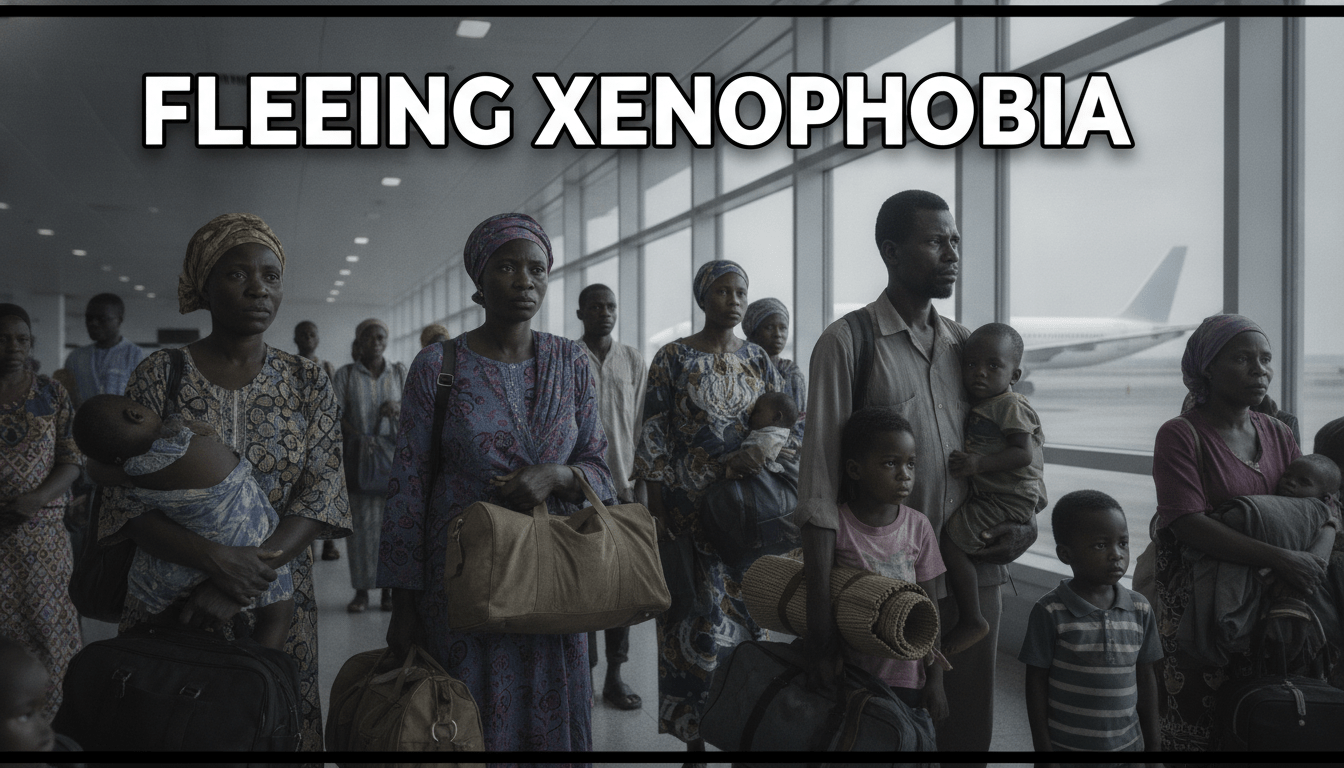
Lagos, Nigeria – The emergency repatriation flights for Nigerian citizens stranded in South Africa highlight a distressing pattern of escalating xenophobic hostility. On Tuesday morning, June 30, 2026, an Air Peace flight landed at Murtala Muhammed International Airport in Lagos, carrying 271 Nigerian nationals. This critical intervention, coordinated by the Nigerian government and the Nigerians in Diaspora Commission (NiDCOM), is part of an urgent effort to evacuate over 1,000 displaced and distressed Nigerians facing renewed violence (punchng.com, gazettengr.com).
This forced exodus underscores a deep-rooted and recurring problem of xenophobia in South Africa. The issue has troubled the nation for decades, frequently erupting in violence against foreign nationals, especially those from other African countries (punchng.com, gazettengr.com, xenowatch.ac.za).
A Troubled Homecoming: Nigeria’s Urgent Repatriation Efforts
The current emergency evacuation flights are a direct consequence of a “new surge” of anti-immigrant protests and attacks. These hostilities began in April and May 2026 and have since intensified (gazettengr.com).
Vigilante groups, such as “Operation Dudula” and “March and March,” are actively campaigning for stricter immigration enforcement and the removal of undocumented migrants. These groups have reportedly issued a June 30th deadline for undocumented foreign nationals to leave South Africa. They threaten a national strike and further action if their demands are not met. This ultimatum has created a climate of fear, driving the urgent need for repatriation (gazettengr.com).
In response, Nigerian President Bola Tinubu approved a voluntary evacuation program. This plan arranges for five Air Peace flights to repatriate citizens. The Nigerians in Diaspora Commission (NiDCOM) has been diligently coordinating the screening and repatriation process, with more than 1,000 Nigerians registering for voluntary return. The flight arriving on June 30, 2026, with 271 Nigerians, is part of a larger series. Prior to this, two other batches totaling 328 Nigerians were evacuated on June 11 (262 individuals) and June 25 (66 individuals) (gazettengr.com). While facilitating these evacuations and issuing stern warnings, the Nigerian government emphasizes its commitment to a diplomatic resolution with Pretoria. However, discussions about potential sanctions on South African businesses are also under consideration should the situation worsen (gazettengr.com).
The Echoes of Apartheid: Deep Roots of Xenophobia
Xenophobia in South Africa is a complex issue with origins that precede the end of apartheid in 1994 (journals.co.za, journals.co.za). While many hoped for a more inclusive society after apartheid, incidents of xenophobia surprisingly increased after 1994 (journals.co.za). This “new racism” often stems from a combination of socio-economic frustrations, a lasting legacy of racial division, and an inherited culture of violence (journals.co.za, journals.co.za).
Apartheid was a system of institutionalized racial segregation and discrimination enforced in South Africa from 1948 until the early 1990s (wikipedia.org). It categorized people by race and dictated where they could live, work, and attend school. This rigid system of racial classification impacted virtually every aspect of life (wikipedia.org). Even after 1994, the profound socio-economic inequalities created by apartheid persisted, leading to continued struggles for jobs, housing, and services, especially in marginalized communities (journals.co.za, journals.co.za).
The “us versus them” mentality, deeply ingrained during apartheid, shifted focus after 1994. It moved from internal racial divisions to targeting foreign nationals as scapegoats for the country’s ongoing socio-economic problems (journals.co.za, journals.co.za). The legacy of violence and political intolerance from the apartheid era also contributes to a readiness to use violent methods to address perceived grievances against foreigners (journals.co.za, journals.co.za). The “Buyelekhaya” (go back home) campaign in Alexandra in 1995 was a significant early sign of anti-foreigner sentiment. This campaign, targeting Malawians, Zimbabweans, and Mozambicans, was one of the first major public campaigns directly telling foreign nationals to return to their home countries (journals.co.za). It highlighted immediate post-apartheid anxieties about resource scarcity and job competition, with foreigners becoming scapegoats for persistent challenges (journals.co.za). The visibility of this campaign helped normalize the idea that “foreigners are stealing jobs,” contributing to narratives that would fuel subsequent xenophobic violence (journals.co.za). To learn more about African history before colonialism, explore deeper resources.
Waves of Violence: A Pattern of Persecution
The history of xenophobia in South Africa is marked by several deadly outbreaks. The period around 2008 saw the deadliest wave of xenophobic violence in South Africa’s history. Attacks began in Alexandra and quickly spread nationwide, resulting in at least 62 deaths and mass displacement. The brutal nature of these events drew international condemnation and required military intervention (journals.co.za, journals.co.za, sahistory.org.za).
Xenophobic attacks continued in waves, with significant spikes in April 2015 and September 2019. The 2015 attacks, which started in Durban and spread to Johannesburg, involved systematic looting of foreign-owned shops. Thousands were forced into refugee camps (journals.co.za, dailymaverick.co.za). In 2019, approximately 50 businesses primarily owned by Nigerians were destroyed or damaged in Johannesburg. These incidents often led to diplomatic tensions and previous repatriation efforts by various African nations, including Nigeria (journals.co.za, dailymaverick.co.za).
The violence is often fueled by economic competition for scarce jobs, housing, and social services. This is exacerbated by persistent high unemployment and poverty rates (journals.co.za, xenowatch.ac.za). Foreign nationals are frequently scapegoated for South Africa’s socio-economic problems. They are falsely accused of being responsible for crime, drug trafficking, and other societal ills, despite studies disproving these claims (journals.co.za, journals.co.za, xenowatch.ac.za). South Africa’s government has faced criticism for its insufficient response, often downplaying the attacks as “normal crime” rather than xenophobia. This contributes to a perception of impunity (hrw.org, aljazeera.com).
New Threats, Old Fears: Vigilante Groups and Intensified Hostilities
The intensification of anti-immigrant protests and attacks in South Africa in April and May 2026 did not stem from a single, immediately identifiable incident or policy change. Instead, it seems to be a continuation of long-standing socio-economic challenges and the persistent presence of anti-immigrant rhetoric (punchng.com, gazettengr.com).
Groups like “Operation Dudula” are at the forefront of this latest surge. Operation Dudula is a prominent anti-immigrant vigilante group in South Africa (gazettengr.com, businessinsider.com). Its ideology centers on an “Afrophobic” nationalism, asserting that foreign nationals, particularly those from other African countries, are responsible for crime, unemployment, and economic strain in South Africa (gazettengr.com, businessinsider.com). Their stated goals include the removal of undocumented migrants, prioritizing South Africans for jobs and business opportunities, and enforcing stricter immigration laws. They employ methods such as protests, often involving intimidation and harassment. They also engage in direct actions like forcibly closing foreign-owned businesses and conducting raids in communities to identify and “deport” undocumented individuals (gazettengr.com, businessinsider.com).
The core ideology of these groups is rooted in the belief that foreign nationals are illegally occupying jobs and resources that rightfully belong to South African citizens, contributing to high unemployment rates (gazettengr.com, businessinsider.com). Their methods include organizing public marches, issuing ultimatums to foreign nationals to leave certain areas, and conducting disruptive actions against foreign-owned businesses and suspected undocumented immigrants (gazettengr.com, businessinsider.com). The “March and March” movement likely refers to similar activities advocating for stricter immigration enforcement. These groups amplify a volatile environment where smaller incidents can quickly escalate (gazettengr.com).
The Numbers Speak: Quantifying a Crisis
The impact of xenophobia in South Africa is clearly evident in various statistical data. Xenowatch, a project documenting xenophobic discrimination by the African Centre for Migration & Society (ACMS) at the University of the Witwatersrand, Johannesburg, has been meticulously tracking these incidents (xenowatch.ac.za, irb-cisr.gc.ca). Its methodology involves collecting and analyzing data from various sources, including media reports, police dockets, court records, and direct interviews with victims and affected communities, to create a comprehensive database (xenowatch.ac.za, irb-cisr.gc.ca). The project’s objective is to systematically track and document incidents of xenophobia, including discrimination, harassment, and violence, against foreign nationals in South Africa (xenowatch.ac.za, irb-cisr.gc.ca).
From 1994 to 2026, Xenowatch recorded more than 1,300 incidents of xenophobic attacks in South Africa (xenowatch.ac.za). Between 1994 and November 2021, at least 873 incidents were recorded (xenowatch.ac.za). Since 1994, at least 690 deaths have been attributed to xenophobic violence. Major casualty figures include at least 62 deaths in 2008, 7 in 2015, and 12 in 2019 (xenowatch.ac.za). Approximately 128,000 individuals have been displaced due to xenophobic violence between 1994 and 2026. In 2024 alone, 2,946 individuals were displaced (xenowatch.ac.za). About 4,849 foreign-owned shops have been looted since 1994 (xenowatch.ac.za).
The impact on Nigerians is particularly stark. Between 2016 and 2017, over 100 Nigerians were killed in xenophobic attacks (nilds.gov.ng). In 2019, approximately 50 Nigerian-owned businesses were reportedly destroyed or damaged (punchng.com). The foreign-born population in South Africa increased from 2.8% of the total population in 2005 to 7% in 2019 (developmentaid.org). In early 2026, South Africa’s national statistical agency, Stats SA, estimated 3.3 million immigrants, representing about 5.2% of the country’s 62 million population (developmentaid.org). These demographic shifts, coupled with severe economic challenges, create a fertile ground for anti-immigrant sentiment. To understand more about how historical exploitation impacts Africa’s debt crisis, consider the broader context.
Public Sentiment Towards Immigrants in South Africa
A 2018 Pew Research poll indicated that 62% of South Africans held negative sentiments towards foreign nationals. They believed immigrants burdened society by taking jobs and social benefits (elpais.com). Similarly, 61% associated immigrants with higher crime rates (elpais.com). A 2020 study further showed that about 57% of the South African population harbors negative perceptions toward immigrants, especially those from other African nations (aphriapub.com). These perceptions persist despite numerous studies and reports, particularly from academic institutions and human rights organizations, consistently disproving claims that foreign nationals are disproportionately responsible for crime, drug trafficking, and other societal ills in South Africa (journals.co.za, journals.co.za, xenowatch.ac.za). Research by institutions like the African Centre for Migration & Society (ACMS) at Wits University consistently shows that foreign nationals are not overrepresented in crime statistics (xenowatch.ac.za, irb-cisr.gc.ca). Reports often emphasize that crime is a complex issue driven by socio-economic factors, rather than the presence of foreign nationals (journals.co.za, journals.co.za, xenowatch.ac.za).
South Africa faces significant economic challenges, with an unemployment rate exceeding 43% as of May 2026, and rampant youth unemployment (punchng.com). These economic factors often fuel anti-immigrant sentiment (journals.co.za, journals.co.za, xenowatch.ac.za). The Nigerian immigrant community in South Africa is diverse, comprising individuals across various socio-economic strata. Many are involved in small to medium-sized enterprises, trade, and the informal sector. There are also Nigerian professionals in fields like medicine, engineering, and academia (nilds.gov.ng, leeds.ac.uk). Their economic contributions include entrepreneurship, job creation, and remittances. The legal status breakdown is varied, including documented migrants, asylum seekers, and some undocumented individuals. The latter group is often disproportionately targeted by xenophobic narratives (nilds.gov.ng, leeds.ac.uk). Understanding how African workers are rising helps contextualize economic contributions.
Seeking Resolution: Diplomatic Moves and Future Hopes
The Nigerian government has historically pursued various diplomatic measures with Pretoria to address xenophobic attacks on its citizens. These efforts include high-level bilateral talks, engaging through regional bodies like ECOWAS and the African Union, and issuing official condemnations (gazettengr.com, un.org, premiumtimesng.com). Nigeria has often engaged in discussions with South Africa, emphasizing the need for the protection of Nigerian citizens and seeking assurances of accountability for perpetrators (gazettengr.com, premiumtimesng.com). Diplomatic efforts also include appealing to regional and continental bodies like the Economic Community of West African States (ECOWAS) and the African Union (AU) to intervene and condemn xenophobic violence (un.org, premiumtimesng.com).
In response to past xenophobic attacks, Nigeria has at times recalled its ambassador from South Africa as a strong diplomatic protest (premiumtimesng.com). The Nigerian government has also explored and sometimes implemented economic measures, such as encouraging Nigerian businesses and citizens to boycott South African goods and services, as a form of pressure (gazettengr.com, premiumtimesng.com). However, the preference remains for a peaceful resolution. Understanding the failure of reconstruction in other contexts provides valuable perspective on systemic challenges.
Long-term solutions and preventative measures being considered by South Africa and regional bodies often include public education campaigns to counter misinformation about immigrants. They also focus on fostering social cohesion and implementing policies to address socio-economic inequalities that fuel resentment (hias.org, rsisinternational.org). South African government initiatives have included public awareness campaigns aimed at promoting tolerance and educating citizens about the contributions of migrants, while countering false narratives about them (hias.org, rsisinternational.org). Efforts are being made to improve social cohesion through community dialogues and engagement programs designed to bridge divides between local and migrant communities (hias.org, rsisinternational.org).
Addressing underlying socio-economic inequalities, such as poverty, unemployment, and lack of access to basic services, is recognized as crucial to reducing the frustrations that fuel xenophobia (hias.org, rsisinternational.org). Regional bodies like the Southern African Development Community (SADC) and the African Union (AU) advocate for improved regional migration policies, protection of migrant rights, and fostering a sense of African unity to combat xenophobia (un.org, hias.org, rsisinternational.org). The emergency evacuation flights from South Africa highlight a persistent humanitarian crisis driven by xenophobia. While Nigeria works to ensure the safety of its citizens, the incident serves as a stark reminder of the deep-seated issues that continue to challenge social cohesion and regional relations across the African continent.
About the Author
Darius Spearman is a professor of Black Studies at San Diego City College, where he has been teaching for over 20 years. He is the founder of African Elements, a media platform dedicated to providing educational resources on the history and culture of the African diaspora. Through his work, Spearman aims to empower and educate by bringing historical context to contemporary issues affecting the Black community.
