

Is Cuba Hiding the Truth About Black Civil Rights?
By Darius Spearman (africanelements)
Support African Elements at patreon.com/africanelements and hear recent news in a single playlist. Additionally, you can gain early access to ad-free video content.
Modern Civil Rights Leaders Call for Solidarity
In May 2026, a twenty-four-member emergency delegation traveled to Havana, Cuba (ibw21.org). This group was composed of African American civil rights leaders, journalists, and policy experts (ibw21.org). They represented the Institute of the Black World 21st Century and the Pan African Unity Dialogue (ibw21.org). During their stay, delegates observed the harsh humanitarian realities on the island (journal-isms.com). They noted how these conditions disproportionately affect Afro-Cubans, the elderly, and vulnerable populations (journal-isms.com).
Upon returning to the United States, the delegation held a press conference in Washington, D.C. (journal-isms.com). They proposed that a bilateral delegation of civil rights, human rights, and legal experts meet with their Cuban counterparts (journal-isms.com). They wanted to establish a direct dialogue regarding racial discrimination on the island (journal-isms.com). This proposal comes at a critical time (raceandequality.org). Independent human rights organizations have amplified their warnings regarding systemic racial inequalities in Cuba (raceandequality.org).
The Institute of the Black World 21st Century was founded in 2002 to empower Black families and communities (ibw21.org). The organization administers major initiatives, such as the National African American Reparations Commission (ibw21.org). The Pan African Unity Dialogue was established to promote unity and cooperation among Black immigrants and African Americans (ibw21.org). Within the modern civil rights landscape, both organizations actively engage in international advocacy (ibw21.org). They mobilize support to oppose economic actions that harm marginalized populations globally (ibw21.org).
Who Are the Intended Cuban Counterparts?
When these prominent United States organizations travel, their intended Cuban counterparts are state-approved figures (amsterdamnews.com, amsterdamnews.com). During the May 2026 visit, the American group met directly with high-level government officials (ibw21.org). These leaders included President Miguel Díaz-Canel and Deputy Foreign Affairs Minister Carlos Fernández de Cossío (ibw21.org). The delegation also met with state-sanctioned institutional experts, university educators, and religious leaders (ibw21.org).
This direct state engagement is highly significant for international diplomacy (ibw21.org). It allows the delegation to witness and condemn the humanitarian toll of the United States blockade (ibw21.org). However, this official itinerary relies exclusively on state-managed institutions (amsterdamnews.com). This focus bypasses independent grassroots Afro-Cuban activists who face severe state repression (oas.org). By engaging only with state-approved actors, the dialogue focuses on ending the embargo rather than addressing domestic civil rights (amsterdamnews.com, amsterdamnews.com).
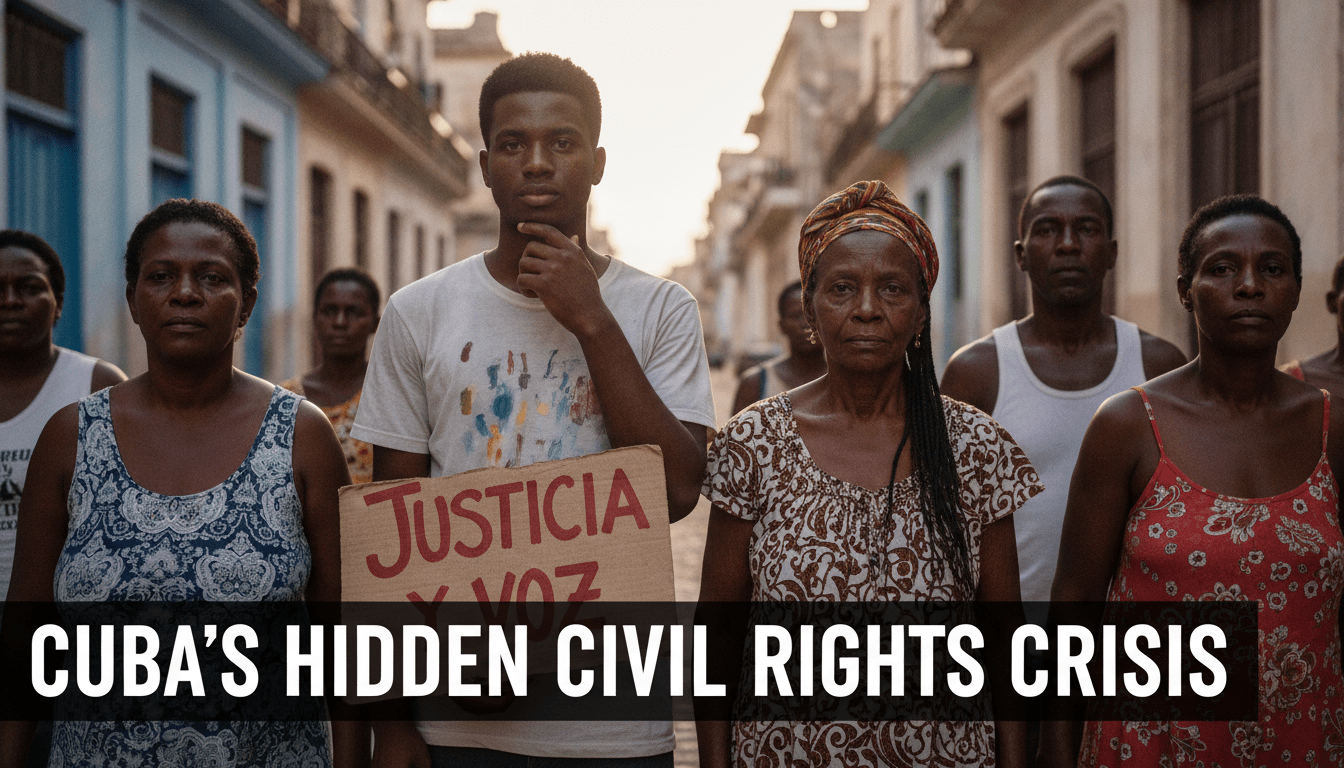
Independent organizations like the Observatorio Cubano de Derechos Humanos warn against this state-centric approach (raceandequality.org). They argue that the Cuban government uses these visits to project an image of absolute racial harmony (raceandequality.org). Meanwhile, independent Black advocates are excluded from the conversation (amsterdamnews.com, amsterdamnews.com). These advocates continue to face systemic repression when they speak out independently about their lived experiences (oas.org).
The Remittance Gap: US Diaspora vs. State Census
Billions of dollars in remittances bypass Black Cuban neighborhoods because the wealthy emigrant population is overwhelmingly white.
The Heroic Legacy of the Mambí Army
To understand the current impasse, one must examine the deep historical roots of the island (amsterdamnews.com). The legacy of racial disparity is intertwined with the history of transatlantic slavery in Cuba (wikipedia.org). Approximately 900,000 enslaved Africans were brought to the island to work sugar and tobacco plantations (mit.edu). Although slavery was abolished in 1886, the colonial social hierarchy remained deeply entrenched (mit.edu).
During the late nineteenth century, the Mambí Army emerged as a powerful force for liberation (wikipedia.org). The Mambí Army was an insurgent, guerrilla-style military force that fought against Spanish colonial rule (wikipedia.org). They fought across three major conflicts, including the Cuban War of Independence (wikipedia.org). Notably, the army was overwhelmingly composed of Afro-Cubans, who represented 85 percent to 92 percent of the combatants (mit.edu).
These insurgent soldiers used machetes and highly effective guerrilla warfare to dismantle Spanish forces (wikipedia.org). The term “mambí” originated from an Afro-Antillean context and was initially a derogatory label (wikipedia.org). The Cuban insurgents proudly reclaimed the term as a badge of honor (wikipedia.org). Legendary Afro-Cuban General Antonio Maceo, known as “the Bronze Titan,” served as the second-in-command of the Liberation Army (wikipedia.org). He became a national symbol of racial equality and military brilliance (wikipedia.org). After independence in 1902, Afro-Cuban veterans expected equal political representation (mit.edu). Instead, the ruling elite consolidated power, showing how early national reconstruction failed African Americans and Afro-Cubans in similar ways.
The Morúa Amendment and the 1912 Massacre
Excluded from power, Afro-Cuban veterans founded the Independent Party of Color in 1908 (wikipedia.org). This was the first independent Black political party in the Western Hemisphere outside of Haiti (wikipedia.org). Fearing the political mobilization of Black Cubans, the Cuban Congress passed the Morúa Amendment in 1910 (wikipedia.org). Sponsoring the 1910 Morúa Amendment was Martín Morúa Delgado, an Afro-Cuban Liberal senator (wikipedia.org). Delgado argued that forming separate Black parties would divide society and perpetuate racial hierarchies (wikipedia.org).
The Morúa Amendment banned political parties organized along racial lines (wikipedia.org). The ruling white elite co-opted this law to outlaw the Independent Party of Color (mit.edu). This legislative ban directly suppressed Black political self-determination (mit.edu). In May 1912, party members organized armed protests to demand the legalization of their party (wikipedia.org). President José Miguel Gómez used this event to justify a massive military response (wikipedia.org).
The resulting government crackdown devolved into the tragic Race War of 1912 (wikipedia.org). The Cuban military and white militias carried out a brutal massacre of Afro-Cubans (wikipedia.org). Between 3,000 and 6,000 Black Cubans were slaughtered, including party leaders (mit.edu). This crushing violence effectively dismantled independent Black political organizing for generations (mit.edu). It established a dangerous historical precedent: addressing race directly was equated with treason (mit.edu). Just as early American history shows how systems failed to end slavery as a social reality, Cuban history shows the suppression of Black political agency.
The Illusion of the Raceless Socialist Utopia
When Fidel Castro came to power in 1959, he positioned racial equality as a key pillar of his agenda (uchicago.edu). The revolutionary government outlawed discrimination in public spaces and desegregated beaches and clubs (uchicago.edu). They opened up universal access to health care, education, and employment (uchicago.edu). Historically, these early reforms achieved remarkable results, reducing disparities in life expectancy (uchicago.edu).
However, this approach came with a severe caveat (uchicago.edu). In 1961, Castro officially declared that racial discrimination had been completely eliminated in Cuba (uchicago.edu). Consequently, any further public discussion of race, systemic bias, or Black identity was deemed taboo (uchicago.edu). The government labeled such discussions as counterrevolutionary and divisive (uchicago.edu).
The state dissolved traditional Afro-Cuban civic clubs, mutual-aid societies, and religious associations (uchicago.edu). These organizations had long served as safe spaces for advocacy and community protection (uchicago.edu). Prominent Afro-Cuban intellectuals who challenged this “raceless” narrative were systematically silenced, imprisoned, or forced into exile (uchicago.edu). This created an institutionalized silence that prevented Black Cubans from organizing to address ongoing social prejudice (uchicago.edu).
How the Collapse of the USSR Triggered the Special Period
The structural fragility of the “raceless” project was laid bare in 1991 (uchicago.edu). The collapse of the Soviet Union triggered the “Special Period” in Cuba (uchicago.edu). Cuba’s socialist economy was almost entirely dependent on Soviet economic subsidies and trade agreements (uchicago.edu). Through trade blocs, the Soviet Union purchased Cuban sugar at highly inflated prices and supplied cheap oil, food, and machinery (uchicago.edu).
Before its collapse, Soviet subsidies to Cuba averaged 4.3 billion dollars annually (uchicago.edu). This accounted for more than 21 percent of the island’s Gross National Product (uchicago.edu). When the Soviet Union dissolved, Cuba lost over 80 percent of its trade markets practically overnight (uchicago.edu). This caused the Gross Domestic Product of the island to plunge by 35 percent (uchicago.edu).
The economic crisis initiated a decade of severe starvation, daily blackouts, and economic desperation (uchicago.edu). The daily caloric intake of citizens dropped drastically (uchicago.edu). To survive, the Cuban government was forced to introduce limited market-oriented reforms (uchicago.edu). They opened the economy to foreign tourism, joint-venture capitalism, and family remittances (uchicago.edu). These survival measures inadvertently triggered a profound resurgence of racial stratification (uchicago.edu).
Economic Margins of Afro-Cubans
While basic survival is challenging for most Cubans under extreme poverty, Black families experience severe economic bottlenecks.
Colorism and the Divide in Private Enterprise
During this economic opening, private enterprises emerged as vital pillars of survival (uchicago.edu, benjaminjameswaddell.com). The two most prominent models were *paladares* and *casas particulares* (uchicago.edu, benjaminjameswaddell.com). A *paladar* is an independently owned, private restaurant (uchicago.edu). A *casa particular* is a private homestay or bed-and-breakfast run by local families (uchicago.edu). Legalized in 1993, these businesses allowed families to generate direct income (uchicago.edu, benjaminjameswaddell.com).
However, participation in these lucrative private enterprises was heavily restricted by racial disparities (uchicago.edu). While the United States historically used the binary “one-drop rule,” Cuba relies on a fluid, shade-stratified spectrum (uchicago.edu). The Cuban census formally tracks three main groups: *blanco*, *negro*, and *mulato* or *mestizo* (uchicago.edu). This fluid spectrum supports a deeply entrenched system of colorism (uchicago.edu). Social privilege and economic opportunities are heavily stratified based on exact skin tone (uchicago.edu).
Over 83.5 percent of the Cuban diaspora living in the United States identifies as white (uchicago.edu). Consequently, the billions of dollars sent in private remittances to Cuba went disproportionately to white families (uchicago.edu). Afro-Cubans, lacking a wealthy diaspora, received minimal capital (uchicago.edu). They lacked the real estate assets and startup cash to launch *paladares* or *casas particulares* (uchicago.edu). Furthermore, researchers found that joint-venture hotels consistently favored lighter-skinned *mulatos* for client-facing, tips-earning positions (uchicago.edu).
The Rise of the San Isidro Movement
By the late 2010s, this socioeconomic marginalization led to a revival of grassroots Afro-Cuban activism (crd.org). In September 2018, independent artists, journalists, and academics formed the San Isidro Movement (crd.org). The group was established in San Isidro, a low-income, heavily Afro-Cuban neighborhood in Old Havana (crd.org). The movement was created to protest Decree 349, a sweeping censorship law enacted by the government (crd.org).
Decree 349 criminalized independent artistic activity by requiring all artists to obtain prior authorization from the Ministry of Culture (crd.org). The San Isidro Movement used public art, performances, and poetry readings as non-violent weapons of political dissent (crd.org). Their core demands focused on the immediate repeal of Decree 349 and the protection of freedom of expression (crd.org).
In November 2020, members drew international attention by launching a hunger strike at their headquarters (crd.org). They demanded the release of Denis Solís, an independent Afro-Cuban rapper jailed for contempt (crd.org). This movement served as a modern expression of the black liberation struggle, connecting artistic expression with political demands. Their activism became the immediate catalyst for broader democratic demands across the entire island (crd.org).
From “Patria o Muerte” to “Patria y Vida”
In February 2021, a collaborative hip-hop song by Afro-Cuban musicians popularized the slogan “Patria y Vida” (wikipedia.org). This phrase, meaning “Homeland and Life,” was a direct, defiant inversion of Fidel Castro’s famous 1960 motto, “Patria o Muerte” (wikipedia.org). By exchanging “Death” for “Life,” the song became a powerful critique of the regime’s political oppression and food shortages (wikipedia.org).
The slogan served as the unifying shout across more than fifty cities during the historic July 11, 2021, protests (wikipedia.org). Many of these nationwide demonstrations were concentrated in low-income, majority-Black neighborhoods (raceandequality.org). In the crackdown that followed, the state targeted Black protesters with disproportionate severity (raceandequality.org). Human rights organizations noted that Afro-Cuban participants routinely received harsher prison sentences than their white counterparts (raceandequality.org).
The government retaliated heavily against the artists involved in the song (wikipedia.org). Collaborating artist Maykel Osorbo was arrested and sentenced to prison (wikipedia.org). Despite state bans, the song garnered millions of views and became a lasting symbol of resistance (wikipedia.org). This modern struggle highlights the ongoing racial inequality in education, justice, and daily survival on the island.
Concrete Measures of “Color Cubano” vs. White-Washing
To counter rising domestic and international criticism, the Cuban government approved the “Color Cubano” program in 2019 (ungeneva.org). Officially implemented in 2021, this program is designed to eliminate structural and societal racism (ungeneva.org). The program coordinates eighteen state entities and eighteen civil society groups (ungeneva.org). It actively uses genetic and demographic data to map racial inequalities (ungeneva.org).
On a legal level, the program influenced the 2019 Constitution’s non-discrimination clauses (ics.gob.cu). It also shaped the 2022 Criminal Code, which criminalizes offenses against equality and classifies racist motives as aggravating circumstances (ics.gob.cu). In June 2023, the government established the National Directorate of the Ombudsman to handle complaints of racial discrimination (ics.gob.cu). Practical educational measures include introducing Afro-Cuban history into school curricula (ungeneva.org).
Despite these official steps, independent advocates argue that these programs serve as an institutional whitewashing tool (amsterdamnews.com). While the state highlights that 45 percent of the deputies in Parliament are Black or mixed-race, actual power remains concentrated (amsterdamnews.com, ungeneva.org). Black officials are virtually absent from the highest ranks of the military and the Ministry of the Interior (amsterdamnews.com). Meanwhile, independent anti-racism organizations, such as the Citizens’ Committee for Racial Integration, face severe harassment and arbitrary detentions (oas.org).
Demographic Discrepancies and Liberation
The massive contribution of Black Cubans to national independence contrasts sharply with official state representation figures.
About the Author
Darius Spearman is a professor of Black Studies at San Diego City College, where he has been teaching for over 20 years. He is the founder of African Elements, a media platform dedicated to providing educational resources on the history and culture of the African diaspora. Through his work, Spearman aims to empower and educate by bringing historical context to contemporary issues affecting the Black community.
