



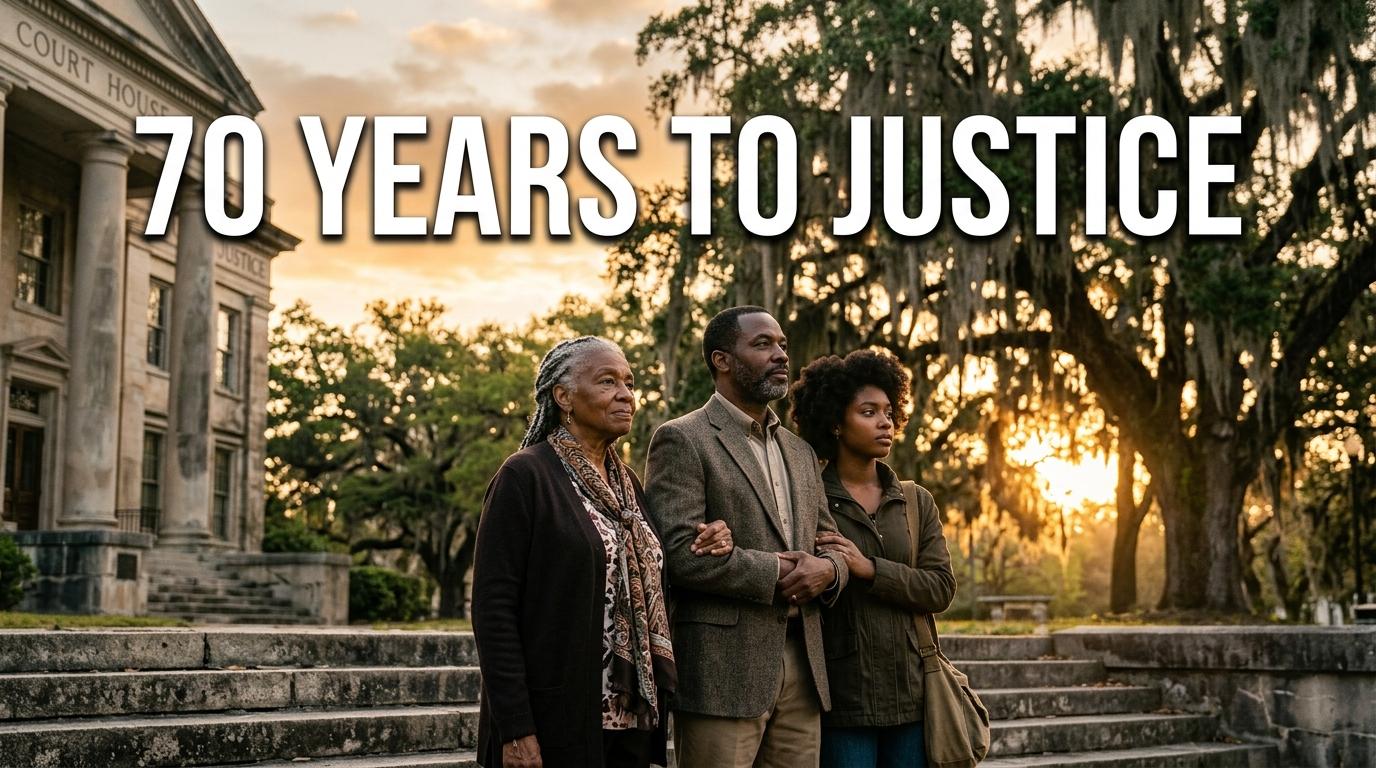
Why Did the Groveland Four Restitution Take Seventy Years?
By Darius Spearman (africanelements)
Support African Elements at patreon.com/africanelements and hear recent news in a single playlist. Additionally, you can gain early access to ad-free video content.
The Modern Justice of the Groveland Four Restitution
In July 2026, the state of Florida took a historic step by approving a budget allocation of four million dollars. This funding provides one million dollars to the families or estates of each of the four young Black men who were falsely accused of rape in 1949 (floridapolitics.com, floridapolitics.com, floridapolitics.com). This legal resolution marks the closing chapter of a seventy-seven-year fight against institutional oppression and state-sanctioned legal cover-ups.
For decades, the descendants of these men lived under the heavy cloud of this historical nightmare. This monetary acknowledgment acts as a critical mechanism to validate the pain and suffering of the families. Through persistent advocacy, the descendants successfully demonstrated the deep and lasting resilience of Black families in the face of violent white supremacy. While money cannot replace lost lives, it represents a concrete admission of guilt by the state of Florida.
July 16, 1949: The Spark of Lake County Terror
The tragedy began on a summer night in rural Lake County, Florida. Norma Padgett, a seventeen-year-old white woman, along with her husband, claimed their vehicle broke down near Okahumpka (wikipedia.org). They reported to local police that four Black men had kidnapped and raped Padgett. Almost immediately, local authorities targeted four young Black men: Ernest Thomas, Charles Greenlee, Samuel Shepherd, and Walter Irvin (wikipedia.org, wikipedia.org).
In this highly segregated, citrus-producing community, racial tensions were already extremely high. Local white landowners relied heavily on the economic exploitation of submissive Black workers. Black veterans like Shepherd and Irvin, who had recently returned from World War II, refused to bow to Jim Crow laws. Consequently, they were viewed as threats to the established social order. Henry Shepherd, the father of Samuel, was a successful independent farmer, which drew intense jealousy from local white neighbors.
Armed Mobs and the Lawless Reign of Willis McCall
The response to the accusations was swift, brutal, and orchestrated by Sheriff Willis McCall. Ernest Thomas, recognizing the extreme danger, fled the county immediately. A massive posse of armed white men, deputized by Sheriff McCall, tracked Thomas into a West Florida swamp (wikipedia.org, wikipedia.org). Upon finding him, the mob shot Thomas more than four hundred times, effectively executing him without a trial.
Meanwhile, the remaining three suspects faced intense violence inside the Lake County Jail basement. Officers beat and tortured Greenlee, Shepherd, and Irvin to force confessions, but the young men refused to submit. Outside the jail, white mobs rioted through the Black neighborhoods of Groveland. They burned homes and forced terrified families to flee the county for their own safety.
Marshall and the Battle in Court
The legal proceedings that followed were an absolute mockery of the justice system. In late 1949, an all-white jury swiftly convicted the three surviving young men. Charles Greenlee, who was only sixteen years old, received a life sentence (wikipedia.org). The court sentenced Samuel Shepherd and Walter Irvin to death.
Recognizing the extreme threat, the NAACP Legal Defense Fund quickly intervened. Pioneering attorney Thurgood Marshall personally took charge of the legal appeal (billofrightsinstitute.org). Marshall argued that the trial was a sham due to sensationalized news coverage, jury intimidation, and the systematic exclusion of Black citizens from the jury pool. Ultimately, in April 1951, the United States Supreme Court unanimously overturned the convictions and ordered a new trial.
Roadside Executions and the Survival of Truth
Sheriff McCall was furious about the Supreme Court ruling. On November 6, 1951, while transporting Shepherd and Irvin back to Lake County for their retrial, McCall pulled his vehicle onto a dark road (wikipedia.org, wikipedia.org). He claimed the handcuffed prisoners tried to attack him during an escape attempt. McCall then shot both men. Samuel Shepherd died instantly.
Walter Irvin survived by playing dead on the ground. He later testified to the FBI that the sheriff had shot them in cold blood. Despite this testimony, a local coroner’s jury cleared the sheriff of any wrongdoing. This panel, composed of the sheriff’s close associates, ruled the killing as justifiable homicide, shielding McCall from criminal prosecution.
Measuring the National Toll of Racial Terror
The tragedy of the Groveland Four was not an isolated event. It was a symptom of a highly organized reign of white supremacy. Research from the Equal Justice Initiative shows that Florida had the highest per capita lynching rate in the nation between 1882 and 1930 (eji.org). These acts of terror served to maintain strict economic and social control over Black communities.
Sheriff McCall ruled Lake County with absolute authority for twenty-eight years (wikipedia.org, wikipedia.org). Although he was investigated multiple times for civil rights abuses, he never faced conviction. His actions also contributed to other tragedies, such as the fatal Christmas night bombing of civil rights advocates Harry and Harriette Moore in 1951.
Decades of Generational Grief and Silent Survival
The trauma did not end with the trials. For decades, the surviving families carried this immense burden in absolute silence. Charles Greenlee secured parole in 1962 but spent the rest of his life in Tennessee, passing away in 2012 without ever seeing his name cleared (wikipedia.org). Walter Irvin was retried, convicted again, and eventually paroled in 1968 before dying a year later.
The descendants of these men lived with profound generational trauma. They avoided the state of Florida entirely out of fear. Family members were warned never to speak of the incident or return to Lake County. This forced silence created a deep sense of loss, making the elusive concept of freedom feel impossible to reach.
The Decades-Long Road to Official Redemption
Over seventy years after the initial accusation, the official narrative finally began to change. In 2017, the Florida Legislature issued a formal apology for the gross injustices of the case. Following intense public pressure, Governor Ron DeSantis and the state Clemency Board granted posthumous pardons in 2019 (theroot.com, cfpublic.org).
Finally, in November 2021, a Lake County Circuit Court officially dismissed the indictments and vacated the convictions (cfpublic.org, cfpublic.org). This judicial exoneration was made possible by the discovery of suppressed evidence. This included medical reports proving no rape had occurred, alongside proof of Charles Greenlee’s solid alibi (cfpublic.org). The court legally declared the men entirely innocent.
Securing the Budget Victory in Tallahassee
The final stage of this long journey required securing financial restitution. State Senator LaVon Bracy Davis introduced Senate Bill 694 to secure compensation (floridapolitics.com, floridapolitics.com). However, the standalone bill stalled in the House due to budget concerns raised by House Speaker Daniel Perez (floridapolitics.com, floridapolitics.com, floridapolitics.com).
To bypass this obstacle, legislative advocates successfully negotiated to insert the four million dollars directly into the state budget (floridapolitics.com, floridapolitics.com). This funding is split equally, providing one million dollars to each family or estate (cfpublic.org). This victory highlights the power of Black political representation in holding the state accountable for its historical crimes.
About the Author
Darius Spearman is a professor of Black Studies at San Diego City College, where he has been teaching for over 20 years. He is the founder of African Elements, a media platform dedicated to providing educational resources on the history and culture of the African diaspora. Through his work, Spearman aims to empower and educate by bringing historical context to contemporary issues affecting the Black community.
