



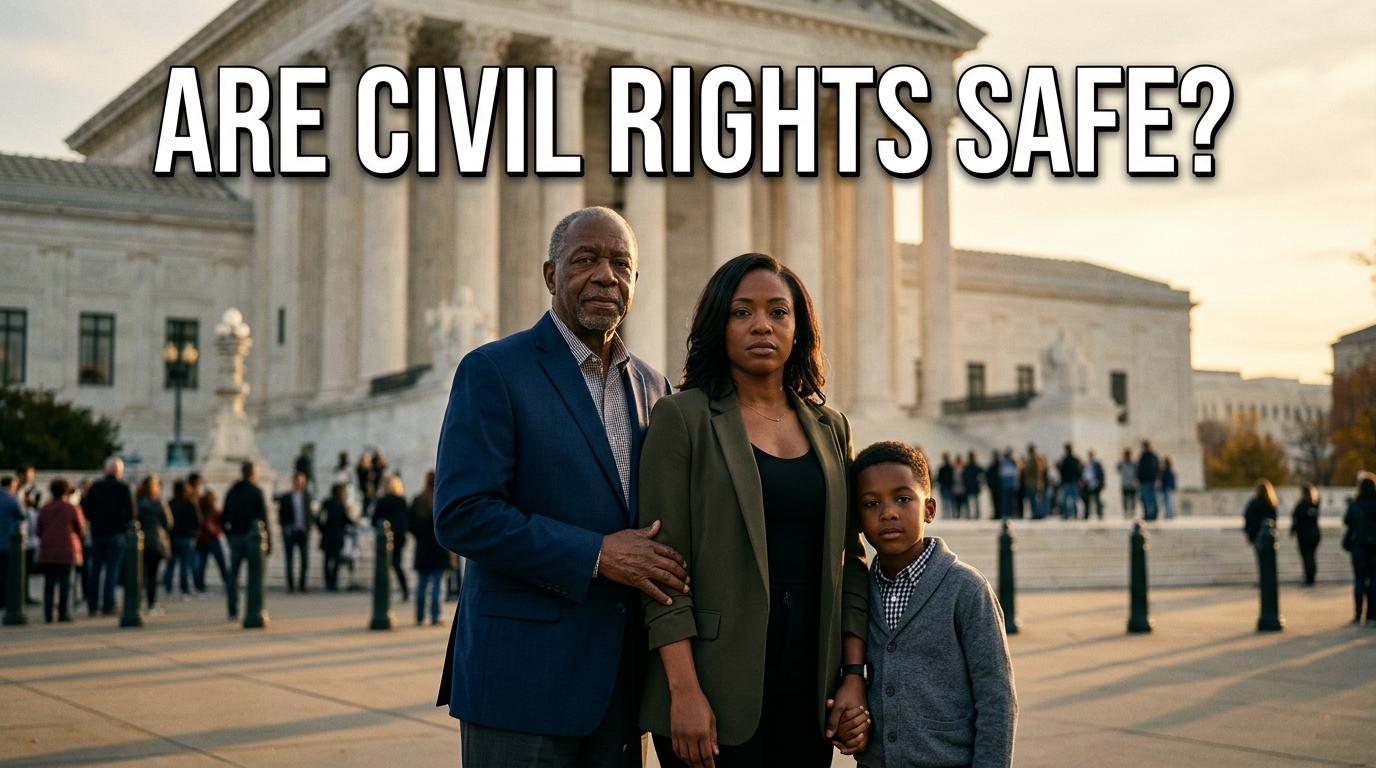
Will Black Civil Rights in America Ever Be Safe?
By Darius Spearman (africanelements)
Support African Elements at patreon.com/africanelements and hear recent news in a single playlist. Additionally, you can gain early access to ad-free video content.
The United States has reached its two hundred and fiftieth anniversary in the year 2026. This major milestone brings both national celebration and deep reflection. Many citizens are asking tough questions about the original promise of the nation. In July 2026, Marc Morial, the President of the National Urban League, issued a strong warning in the Chicago Sun-Times (nul.org, amsterdamnews.com). He declared that civil rights for Black Americans remain under active attack across the country (nul.org).
This warning serves as a prelude to the release of the fiftieth edition of the State of Black America report (nul.org, nul.org). The upcoming report asks a direct and painful question (nul.org). It asks if the American dream is dead for Black citizens (nul.org). To understand this modern crisis, one must look closely at history. The roots of this fight stretch back to the very Revolutionary era when freedom was promised but systematically denied to many.
The Historical Spark of the State of Black America
In January 1976, the United States prepared to celebrate its Bicentennial anniversary. The nation was filled with pride and patriotic events. However, the economic reality for Black Americans was extremely grim (iamempowered.com). Vernon E. Jordan Junior, who was then the Executive Director of the National Urban League, watched the State of the Union address by President Gerald Ford (nul.org). He noticed a glaring omission (iamempowered.com). The President did not mention Black Americans or their economic hardships (iamempowered.com).
Furthermore, the Democratic response by Senator Edmund Muskie was also silent on racial equality (iamempowered.com). This complete silence from both major political parties deeply concerned Jordan (iamempowered.com). In direct response, Jordan published the first State of Black America report on January 28, 1976 (iamempowered.com, nul.org). It was a powerful indictment of the political leadership in the country (iamempowered.com). Since that historic moment, the annual report has acted as a crucial tool for accountability (iamempowered.com). It measures progress or regression across many areas of life (iamempowered.com).
Understanding the Legacy of the Jim Crow South
To understand the modern fight for civil rights, one must examine the oppressive systems of the past. Following the failures of Reconstruction, white politicians in the South built a cruel legal structure. This system of state and local laws was known as the Jim Crow South. It enforced strict racial segregation and political disenfranchisement from the late nineteenth century until the mid-1960s. Jim Crow laws legally separated Black and white citizens in all public spaces, including schools, buses, and restaurants.
Southern legislatures systematically stripped Black voters of their political power. They created clever laws to bypass the Fourteenth and Fifteenth Amendments. These laws included literacy tests and poll taxes, which white registrars used to turn away Black voters. This legal caste system was maintained through economic exploitation, such as sharecropping. It was also sustained by the constant threat of racial violence, including thousands of lynchings. This history shows that progress has always met intense resistance.
The Great Migration and the Search for Freedom
The brutal conditions of the Jim Crow South forced millions of Black Americans to make a life-changing choice. Between 1916 and 1970, more than six million African Americans fled the rural South (wikipedia.org). This historic movement is known as the Great Migration (wikipedia.org). Migrants moved to cities in the North, Midwest, and West in search of safety and economic opportunity (wikipedia.org, si.edu). They hoped to escape the constant threat of white supremacist violence and legal oppression (wikipedia.org, si.edu).
This massive movement of people fundamentally reshaped the entire nation (si.edu). Before the migration, more than ninety percent of Black Americans lived in the South (wikipedia.org). By the end of this period, that number dropped to just over fifty percent (wikipedia.org). Black workers took tough industrial jobs in major cities like Chicago and Detroit (wikipedia.org, si.edu). They built vibrant communities and created new centers of political power (si.edu). This shift laid the groundwork for modern civil rights organizations.
The Modern Siege Against Voting Rights
The hard-won victories of the civil rights era are facing a coordinated assault today (nul.org). President Marc Morial points out that voting rights are under a deliberate and systematic attack (nul.org). The Voting Rights Act of 1965 was designed to eliminate racial barriers to the ballot box (pbs.org). It included a powerful rule called preclearance (brennancenter.org, pbs.org). This rule required certain states with a history of discrimination to get federal approval before changing their voting laws (brennancenter.org).
However, the Supreme Court weakened this protection in the 2013 case Shelby County v. Holder (brennancenter.org). Chief Justice John Roberts argued that the nation had changed and preclearance was no longer needed (brennancenter.org). Justice Ruth Bader Ginsburg dissented strongly (brennancenter.org). She warned that throwing out preclearance was like throwing away an umbrella in a rainstorm (brennancenter.org). Since that ruling, many states have passed restrictive voting laws (brennancenter.org).
The Widening Racial Voter Turnout Gap
The voter turnout gap between Black and white voters has expanded dramatically since achieving near-parity.
This legal regression has created a massive gap in voter participation. During the 2008 and 2012 elections, Black voter turnout reached near-parity with white turnout (iamempowered.com). However, in the 2024 presidential election, the gap surged to an estimated sixteen points (iamempowered.com). This widening gap is heavily linked to state-level voter suppression laws (brennancenter.org). These laws restrict early voting and limit mail-in ballots, which disproportionately impacts Black communities (brennancenter.org).
The Mechanics of Modern Gerrymandering
Electoral maps have become a primary battleground for civil rights. Gerrymandering is the practice of redrawing district boundaries to favor one political group over another (redistrictingonline.org). Racial gerrymandering occurs when mapmakers intentionally dilute the voting power of minority communities (redistrictingonline.org). This practice is illegal under the Constitution and Section 2 of the Voting Rights Act (brennancenter.org, redistrictingonline.org). Partisan gerrymandering, however, is the practice of drawing lines to favor a political party (redistrictingonline.org).
In the 2019 case Rucho v. Common Cause, the Supreme Court ruled that federal courts cannot block partisan gerrymandering (ballotpedia.org). This ruling created a dangerous loophole. In April 2026, the Supreme Court ruled on Louisiana v. Callais (nul.org, la.gov). In a six to three decision, the Court struck down a map that had created a second majority-Black district (nul.org, la.gov). The conservative majority ruled that the map was an unconstitutional racial gerrymander (la.gov).
This decision allows states to dilute Black voting power, provided they claim their motives are partisan rather than racial (nul.org). Justice Elena Kagan wrote a strong dissent in this case (nul.org). She argued that the decision renders Section 2 of the Voting Rights Act almost meaningless (nul.org). Consequently, southern states have a green light to draw highly unfair voting maps (nul.org).
Measuring Inequality Through the Equality Index
To provide clear evidence of these systemic barriers, the National Urban League created the Equality Index in 2005 (iamempowered.com, stateofblackamerica.org). This index uses national statistics to compare the status of Black Americans against white Americans (iamempowered.com, stateofblackamerica.org). White Americans are set as the baseline of one hundred percent (iamempowered.com). The index measures progress across vital areas like health, economics, education, and social justice (iamempowered.com).
The 2024 Equality Index revealed a sober reality (iamempowered.com, stateofblackamerica.org). The overall score for Black America stood at seventy-five point seven percent (iamempowered.com, stateofblackamerica.org). This means that Black Americans are missing nearly twenty-four percent of full equality (iamempowered.com). Marc Morial noted that the index has improved by only two point seven percent over the last twenty years (iamempowered.com, nul.org). At this slow pace, it will take another one hundred and eighty years to achieve true parity (iamempowered.com, nul.org).
The 2024 Equality Index for Black America
Black Americans hold roughly three-quarters of full equality compared to white Americans (100% baseline).
The Dark Reality of Modern Disparities
The numbers in the Equality Index represent real human suffering (iamempowered.com). In the United States today, Black household income is thirty-seven percent lower than white household income (iamempowered.com). This economic gap directly affects health and survival. When looking at life expectancy at birth, a Black child born today is expected to live seventy-four point seven years (iamempowered.com, nih.gov). That is four years less than a white child, whose life expectancy at birth is seventy-eight point seven years (iamempowered.com, nih.gov). This gap is driven by historical health disparities and unequal access to quality care.
Maternal health is another critical area of concern (iamempowered.com). Black women are fifty-nine percent more likely to die in childbirth than white women (iamempowered.com). Furthermore, Black men and women experience higher rates of death from cancer (iamempowered.com). Black men are fifty-two percent more likely to die of prostate cancer (iamempowered.com). Black women are thirty-one percent more likely to die of breast cancer (iamempowered.com). In the justice system, Black people are two times more likely to experience police use of force (iamempowered.com). They are also three times more likely to face incarceration (iamempowered.com).
Life Expectancy at Birth Disparity
The average lifetime expectancy for a child born today based on standard national averages.
The Coordinated Assault on Diversity and Inclusion
The attack on civil rights is not confined to the courts or the ballot box. It has entered the corporate world. Following the Supreme Court decision to end affirmative action in college admissions, conservative groups launched new legal battles (lathamreg.com, rockymountainemployersblog.com). They are targeting private sector diversity, equity, and inclusion initiatives (lathamreg.com, rockymountainemployersblog.com). These groups argue that programs designed to help underrepresented communities are discriminatory (lathamreg.com, rockymountainemployersblog.com).
For instance, the American Alliance for Equal Rights filed a lawsuit against the Fearless Fund (apnews.com, texaslawbook.net). The Fearless Fund is a venture capital firm that provides grants to Black women entrepreneurs (apnews.com, texaslawbook.net). Under legal pressure, the firm agreed to shut down its grant program in late 2024 (apnews.com, texaslawbook.net). Other lawsuits targeted major law firms like Perkins Coie and Morrison Foerster (lathamreg.com). These attacks harm the economic growth of Black-owned businesses, which have a long history of driving community progress.
Defending Democracy at the Semiquincentennial
In response to these growing threats, major civil rights organizations are joining forces (nul.org). A coalition known as the Legacy Eight has stepped forward to lead the defense (nul.org). This group includes historic organizations such as the National Urban League, the NAACP, and the National Action Network (nul.org). Leaders of these groups meet regularly to coordinate national strategies (nul.org). They share data and work together to protect voting rights and educational freedom (nul.org).
This coalition has launched a new initiative called America 250: A Guide for Defending Democracy (nul.org). This nonpartisan guide helps local communities hold public officials accountable (nul.org). It provides tools to evaluate if local leaders are protecting voting rights and equal representation (nul.org). The Legacy Eight is working hard to ensure that the dynamics of federalism do not dilute civil rights protections at the state level.
Conclusion
The upcoming two hundred and fiftieth anniversary of the United States is a critical moment. It represents a clear crossroads for the nation. The country must decide if the promise of the American dream will apply to all its citizens. As the National Urban League reports demonstrate, the path to equality has never been a straight line (iamempowered.com, nul.org). It is a constant cycle of progress and fierce pushback (iamempowered.com, nul.org).
To protect democracy, one must actively defend the rights of the most vulnerable. The work of Marc Morial and the Legacy Eight serves as a vital reminder (nul.org, nul.org). The fight for Black civil rights is not a struggle of the past. It is an urgent duty for the present. The future of American democracy depends entirely on how the nation answers this call.
About the Author
Darius Spearman is a professor of Black Studies at San Diego City College, where he has been teaching for over 20 years. He is the founder of African Elements, a media platform dedicated to providing educational resources on the history and culture of the African diaspora. Through his work, Spearman aims to empower and educate by bringing historical context to contemporary issues affecting the Black community.
