

Why Nigeria Is Fighting Big Tech Over AI Digital Sovereignty
By Darius Spearman (africanelements)
Support African Elements at patreon.com/africanelements and hear recent news in a single playlist. Additionally, you can gain early access to ad-free video content.
The Battle for Digital Sovereignty in the Global South
In a global social justice framework, digital sovereignty represents the right of a nation to govern its own digital space (policycenter.ma). This concept protects local communities from digital colonialism. Digital colonialism is an extractive system where multinational corporations from the Global North harvest data from the Global South (policycenter.ma, afronomicslaw.org).
Under this extractive framework, tech corporations process local data to accumulate massive wealth (policycenter.ma). Statistics reveal that five global technology giants control approximately eighty percent of global digital profits (policycenter.ma). Meanwhile, nearly ninety-two percent of all global data remains under the control of corporations in the United States and China (issafrica.org). True digital sovereignty allows developing countries to foster digital self-determination (afronomicslaw.org). It ensures local ownership of data and promotes domestic digital infrastructure (afronomicslaw.org).
Historically, unequal power dynamics have allowed foreign entities to exploit African resources. This ongoing struggle in the digital realm relates to how power and racism combine into anti-Black politics. African nations must balance digital transformation with robust, localized governance. Without such protections, local communities risk adopting foreign platforms that ignore indigenous priorities (issafrica.org).
The Devastating Collapse of Nigerian Media Traffic
In July 2026, President Bola Tinubu directed the Federal Competition and Consumer Protection Commission to launch a sweeping antitrust investigation (punchng.com, punchng.com). This probe targets Meta, Alphabet, X, and various generative artificial intelligence platforms (premiumtimesng.com, ground.news). The central issue involves the unauthorized extraction and commercial exploitation of Nigerian journalistic content to train artificial intelligence models (punchng.com, premiumtimesng.com).
This investigation followed a petition by the Nigerian Press Organisation (punchng.com, allafrica.com). This body represents newspaper proprietors, journalists, and online publishers across the nation (punchng.com). Local publishers argue that global platforms have severely damaged their business models (economictimes.com).
The introduction of generative artificial intelligence has severely reduced referral traffic to local news sites (economictimes.com). Tools like Google AI Overviews and ChatGPT scrape local news and summarize it directly for users (economictimes.com). This practice prevents users from clicking through to original publishers (punchng.com).
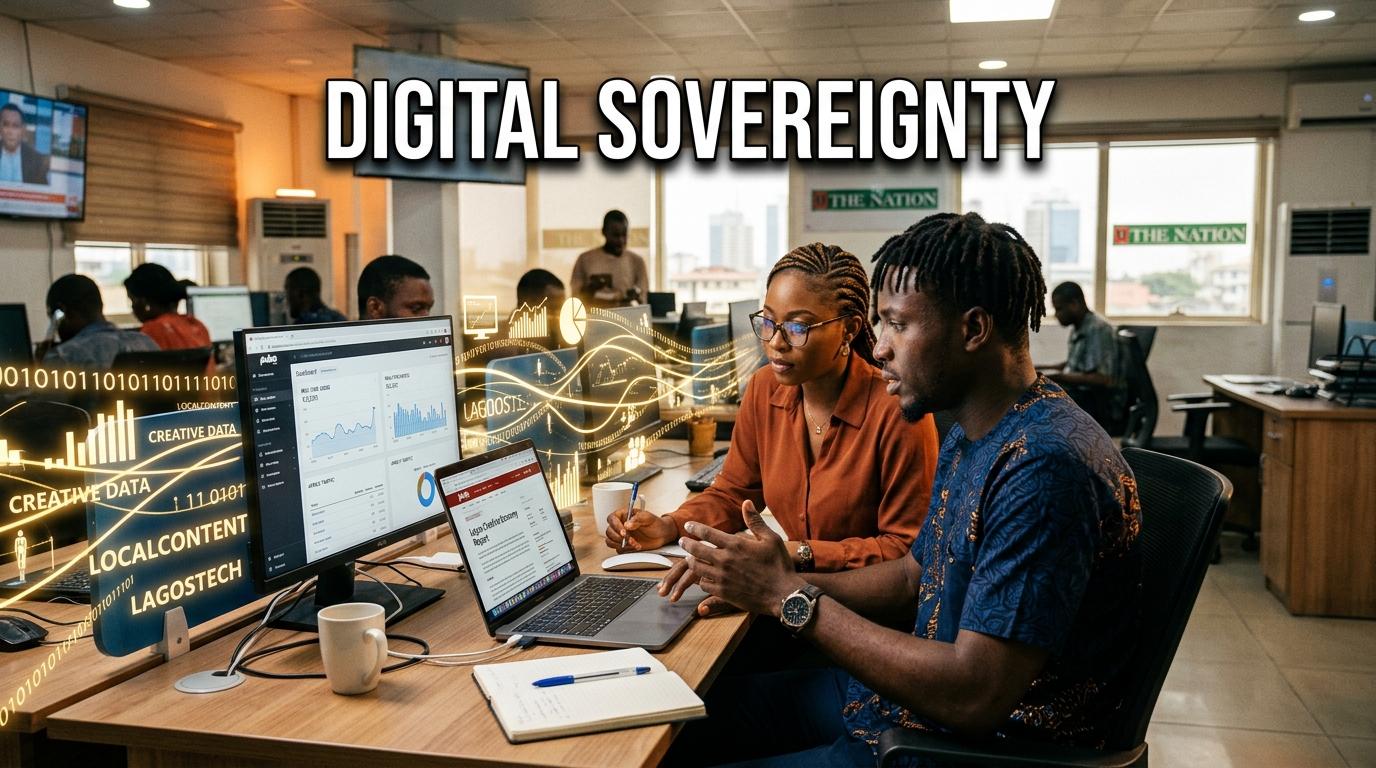
The economic impact of this traffic diversion has been catastrophic. In 2025, digital media traffic in Nigeria fell by twenty-six point two percent (punchng.com). Visits plummeted from over one point zero four billion in 2024 to only seven hundred and sixty-nine million in 2025 (punchng.com, economictimes.com). This massive traffic drop caused severe advertising revenue losses, leading to widespread newsroom layoffs (punchng.com, economictimes.com).
A 26.2% collapse in referral traffic due to AI summaries.
Global Precedents and the South African Blueprint
Nigeria is not fighting this battle alone. The Federal Competition and Consumer Protection Commission based its investigation on successful global models (economictimes.com). Regulators specifically referenced Australia’s News Media Bargaining Code of 2021 (citizen.co.za, medianet.com.au). That code forced tech giants to pay local publishers over one billion dollars in total payouts (citizen.co.za). They also cited the Online News Act of Canada, which established similar protections (citizen.co.za, thestar.com.my).
The most direct catalyst for Nigeria’s action came from South Africa (mg.co.za). In November 2025, the South African Competition Commission released its final report on the Media and Digital Platforms Market Inquiry (mg.co.za, moneyweb.co.za). This inquiry resulted in a historic victory for African media (moneyweb.co.za). Google agreed to pay South African media houses six hundred and eighty-eight million Rand, which equals roughly forty-two million United States dollars (citizen.co.za, moneyweb.co.za).
This settlement established a powerful legal precedent on the African continent (mg.co.za). Seeing South Africa secure millions of dollars gave Nigerian publishers immense confidence (citizen.co.za, mg.co.za). President Tinubu recognized that Nigeria could demand a similar compensatory structure for its massive digital audience (punchng.com, jee.africa).
A History of Head-to-Head Clashes with Silicon Valley
Nigeria has a well-documented history of asserting its authority over global tech firms (allafrica.com). The nation views digital regulation as a vital component of economic sovereignty (businessday.ng). In June 2021, the Nigerian government indefinitely suspended Twitter, which is now known as X (allafrica.com). This suspension occurred after the platform deleted a tweet by then-President Muhammadu Buhari (allafrica.com, wikipedia.org).
The Twitter suspension lasted for two hundred and twenty-three days (wikipedia.org). The government only lifted the ban in January 2022 after X agreed to register a local legal entity (allafrica.com, wikipedia.org). The platform also agreed to pay local taxes and respect national security laws (wikipedia.org). This decisive action proved that Nigeria was willing to shut down major platforms to enforce its laws (allafrica.com).
Another major regulatory battle occurred between July 2024 and April 2025 (premiumtimesng.com, fccpc.gov.ng). The competition commission imposed a massive two hundred and twenty million dollar penalty on Meta and WhatsApp (premiumtimesng.com, fccpc.gov.ng). An intensive joint investigation revealed that WhatsApp had violated data privacy rules by sharing user data without consent (fccpc.gov.ng). Despite legal appeals from Meta, a Nigerian tribunal fully upheld the fine in April 2025 (premiumtimesng.com).
The Hidden Waiver and the Fight for Public Trust
Despite these major regulatory victories, Nigeria has faced domestic criticism regarding transparency (weetracker.com). This transparency issue is often referred to as a credibility gap (weetracker.com). In February 2025, the Nigeria Data Protection Commission fined Meta thirty-two point eight million dollars (weetracker.com, weetracker.com). The fine was issued because Meta used the behavioral data of over sixty million Nigerians without consent (weetracker.com).
In October 2025, the commission entered into a confidential settlement with Meta (weetracker.com, weetracker.com). A Federal High Court in Abuja formalized this agreement in November 2025 (weetracker.com). However, investigative journalists revealed in April 2026 that the government had quietly waived the entire fine (weetracker.com, weetracker.com). Meta walked away without paying financial penalties, only covering government legal fees (weetracker.com).
This revelation sparked immediate outrage among data privacy advocates and civil society groups (weetracker.com, weetracker.com). Critics accused the government of yielding to pressure from Silicon Valley (weetracker.com). Therefore, the July 2026 antitrust probe is partly a move to restore public trust (punchng.com, punchng.com). President Tinubu used this high-profile investigation to demonstrate that the state still has regulatory strength (punchng.com, jee.africa).
How AI Scraping Exploits and Erases Marginalized Creators
The process of artificial intelligence scraping poses a severe threat to independent and marginalized creators (punchng.com). AI developers deploy automated web crawlers to copy copyrighted articles and creative works without permission (punchng.com, economictimes.com). These systems do not negotiate fair licensing agreements with the original authors (economictimes.com).
Generative AI tools use this copied content to provide direct answers on search pages (punchng.com). These direct answers prevent users from visiting the websites of local journalists (economictimes.com). This traffic diversion leaves independent publishers to survive on minimal revenue (punchng.com, economictimes.com). Freelance journalists bear the greatest economic burden as global ad revenue shifts to technology platforms (economictimes.com).
This economic starvation mirrors historical patterns of exploitation. In American history, medical experimentation on enslaved Africans similarly extracted valuable knowledge and bodily data without consent. Just as historical systems weaponized bodies, modern digital monopolies weaponize behavioral data (fccpc.gov.ng).
Linguistic exclusion also exacerbates this marginalization. Most major artificial intelligence models are trained primarily on English-language datasets from the Global North (afronomicslaw.org). The unauthorized extraction of local Nigerian content further diminishes unique cultural and linguistic identities (afronomicslaw.org). It allows digital platforms to dominate global discourse while erasing distinct African storytelling (punchng.com).
This cycle starves independent creators by bypassing original sources completely.
Digital Sovereignty Versus Democratic Civil Liberties
While digital sovereignty is crucial, it often creates tension with democratic civil liberties (researchgate.net). The Nigerian government has sometimes used regulatory power to suppress political dissent (researchgate.net, civicus.org). For example, the suspension of Twitter directly impacted citizens’ access to open public discourse (allafrica.com, civicus.org). Observers noted that the ban coincided with active political movements (allafrica.com).
Activists and journalists rely heavily on social media to organize grassroots campaigns (civicus.org). During the historic anti-police brutality protests, online platforms served as vital tools for mobilization (civicus.org). However, broad and vaguely worded laws like the Cybercrime Act have been weaponized to target investigative journalists (researchgate.net, civicus.org).
The pursuit of digital sovereignty must not become an excuse for state censorship (researchgate.net). Throughout history, central authorities have used legal structures to maintain control. For instance, the early legal frameworks in the Americas, such as the U.S. Constitution and slavery, protected state power over individual rights. In semi-authoritarian contexts, digital sovereignty can prioritize state control over public freedom (researchgate.net). This dynamic can result in a steady decline in overall internet freedom (issafrica.org, civicus.org).
Ensuring Antitrust Solutions Direct Resources to Local Creators
A major critique of traditional antitrust frameworks is that they primarily benefit large media conglomerates (mg.co.za). Historically, major corporate players capture the bulk of regulatory payouts (mg.co.za, medianet.com.au). However, progressive models are emerging to protect smaller independent creators (mg.co.za).
South Africa’s landmark settlement offers a promising solution (mg.co.za). Their agreement earmarks thirty-eight million Rand annually for a Digital News Transformation Fund (mg.co.za, mg.co.za). This fund specifically supports small, community, and indigenous media organizations (mg.co.za). It also finances digital and artificial intelligence training programs in local languages (mg.co.za).
Australia has also proposed a News Bargaining Incentive for 2026 (medianet.com.au). This model distributes funds based on actual journalist headcount (medianet.com.au). It applies special weighting rules to favor rural, regional, and marginalized community news outlets (medianet.com.au). Nigeria must adopt similar targeted policies to prevent legacy media executives from monopolizing all financial benefits (punchng.com, jee.africa).
About the Author
Darius Spearman is a professor of Black Studies at San Diego City College, where he has been teaching for over 20 years. He is the founder of African Elements, a media platform dedicated to providing educational resources on the history and culture of the African diaspora. Through his work, Spearman aims to empower and educate by bringing historical context to contemporary issues affecting the Black community.
