


Why Maryland Fights Federal Lawsuit on Immigrant Policing Laws
By Darius Spearman (africanelements)
Support African Elements at patreon.com/africanelements and hear recent news in a single playlist. Additionally, you can gain early access to ad-free video content.
The Modern Border Battle in Annapolis
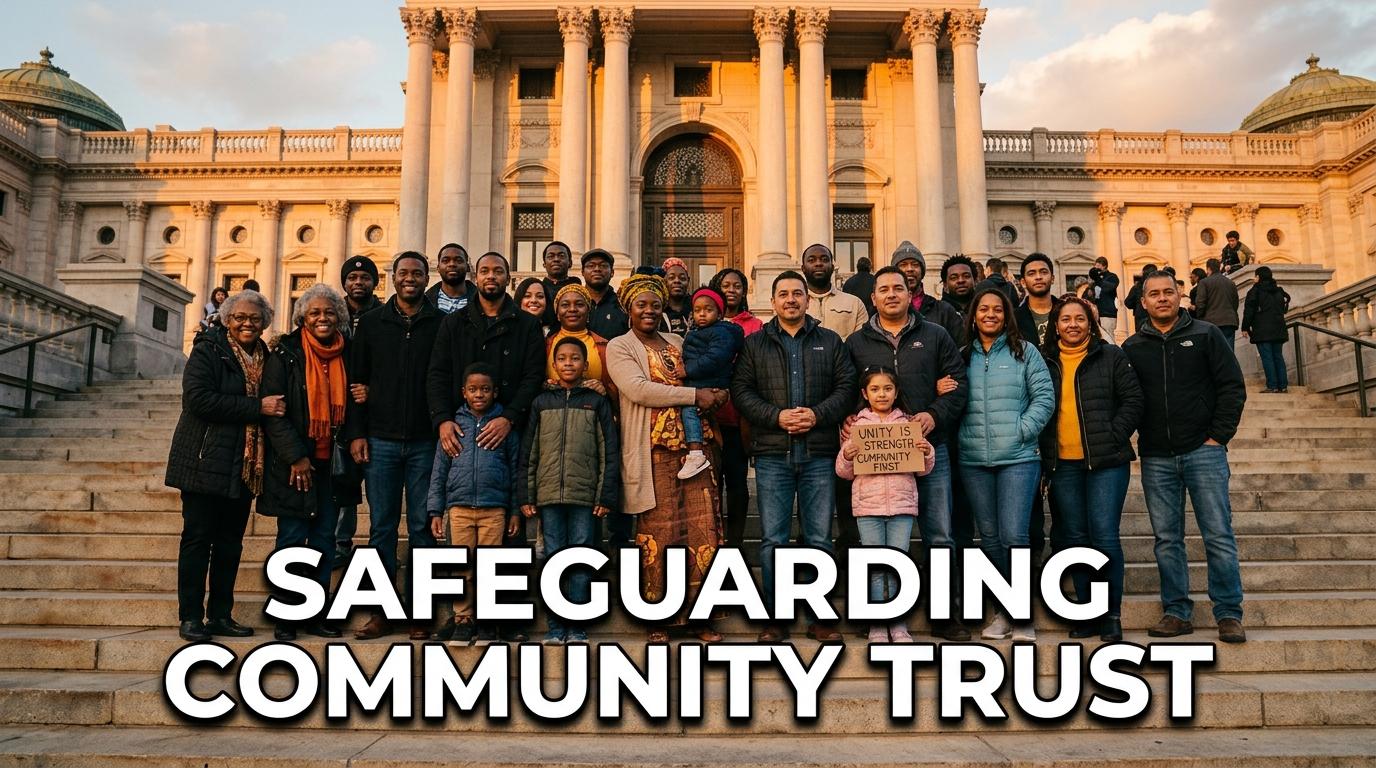
On July 9, 2026, the United States Department of Justice filed a sweeping federal lawsuit against the State of Maryland and Attorney General Anthony Brown (justice.gov). The federal government targeted the newly enacted Community Trust Act, which is also known as Senate Bill 791 and House Bill 1575 (maryland.gov). This landmark state law severely limits local police and corrections officers from cooperating with federal immigration enforcement (maryland.gov). This legal challenge immediately drew a strong response from the Legislative Black Caucus of Maryland (marylandblackcaucus.com).
Delegate N. Scott Phillips, who serves as the Chair of the Legislative Black Caucus, stepped forward to publicly defend the law (marylandblackcaucus.com). Delegate Phillips argued that restricting local police cooperation with federal immigration agents is vital to preserving trust and safety in minority communities (marylandblackcaucus.com). The struggle in Maryland highlights a deep constitutional debate over the division of power between the state and federal governments. This confrontation demonstrates how local policing policies can become the center of a national legal storm.
The Legislative Showdown of 2026
The battle over the Community Trust Act did not emerge overnight. Early in the 2026 legislative session, Maryland lawmakers moved quickly to pass Senate Bill 245 and House Bill 444, which Governor Wes Moore signed into law as emergency legislation (newsfromthestates.com). This emergency law banned all formal 287(g) agreements, which previously deputized local sheriffs to act as federal immigration agents (newsfromthestates.com, wboc.com). Following this victory, progressive lawmakers introduced the Community Trust Act to address informal communication channels between local jails and federal officers (newsfromthestates.com, newsfromthestates.com).
The General Assembly passed the Community Trust Act in May 2026, and it went into effect without the signature of Governor Moore (newsfromthestates.com). The law prohibits local police from asking individuals about their citizenship status (newsfromthestates.com). It also bans local jails from holding people past their release dates based on federal administrative warrants (newsfromthestates.com). In response, seventeen county sheriffs filed a lawsuit to block the law, claiming it threatened public safety (newsfromthestates.com). The United States Department of Justice soon intervened with its own lawsuit, escalating the local dispute into a major constitutional crisis (justice.gov).
A Calculated Strategy: Governor Wes Moore’s Decisive Choice
Governor Wes Moore, the first Black governor of Maryland, faced a delicate political situation when the Community Trust Act landed on his desk (newsfromthestates.com). The governor supported the underlying intent of the bill. He stated that local police should focus on violent crime rather than federal immigration enforcement (newsfromthestates.com). However, the bill passed on the final day of the legislative session, sparking intense opposition from local sheriffs (newsfromthestates.com, newsfromthestates.com). Governor Moore acknowledged that the legislation created real implementation challenges and ambiguities regarding joint state and federal investigations (newsfromthestates.com).
To navigate this political minefield, Governor Moore chose to let the bill become law without his signature (newsfromthestates.com). Under Article II, Section 17(c) of the Maryland Constitution, any bill that is not signed or vetoed within thirty days of the end of the legislative session automatically becomes law (maryland.gov). This calculated move allowed the protective legislation to take effect while signaling that the state would address implementation issues through administrative guidance (newsfromthestates.com). This strategy preserved his standing with progressive voters while acknowledging the practical concerns of law enforcement.
Historical Parallels: From Fugitive Slave Laws to ICE Detainers
For many civil rights advocates, the struggle against local-federal immigration cooperation recalls historical battles over state-sanctioned oppression. During the nineteenth century, the Fugitive Slave Act of 1850 forced northern states and local officers to assist southern slaveholders in capturing escaped Black individuals (racism.org). This historical precedent shows how federal power can be used to compel local authorities to enforce unjust systems of control. The struggle over systems of federalism has long defined the African American experience.
Historically, local jurisdictions have resisted federal mandates that violate human rights and local trust. Just as northern cities passed personal liberty laws to protect escaped Black Americans, modern cities use sanctuary policies to shield vulnerable immigrants. Del. N. Scott Phillips noted that the generational experiences of African Americans show the importance of fairness and public confidence in policing (wusa9.com, marylandblackcaucus.com). Allowing local authorities to enforce civil immigration violations risks repeating historical patterns of discrimination and profiling.
The Crucial Mechanics of SB 791 and HB 1575
The Community Trust Act targets specific practices that connect local jail systems to federal immigration authorities (newsfromthestates.com). To understand how the law works, one must understand the difference between an administrative warrant and a judicial warrant (gonzalezolivierillc.com). An administrative warrant is an internal agency document issued directly by ICE officers (gonzalezolivierillc.com, lawofficeimmigration.com). No neutral judge or magistrate reviews these documents to establish probable cause of criminal activity (gonzalezolivierillc.com).
A judicial warrant is quite different because it is issued by a judge who reviews evidence of a crime (gonzalezolivierillc.com). Because administrative warrants lack judicial oversight, they do not meet the strict requirements of the Fourth Amendment (gonzalezolivierillc.com). The Community Trust Act prevents Maryland correctional facilities from holding individuals beyond their scheduled release dates based solely on these administrative requests (newsfromthestates.com). This policy ensures that the state does not participate in detaining residents without constitutional due process.
Double Jeopardy: Black Immigrants and Systemic Policing
The impact of local-federal immigration collaboration is particularly severe for Black immigrants in Maryland. Maryland is a major destination for Black immigrants, ranking fourth in the nation with more than 267,300 Black foreign-born residents (cmsny.org, americanimmigrationcouncil.org). This community accounts for twenty-six percent of the state’s total immigrant population (cmsny.org). Many individuals in this group arrive from West African nations such as Nigeria and Ghana, as well as Caribbean nations like Jamaica and Haiti (cmsny.org).
These residents face a compounding double jeopardy within the justice system (tminstituteldf.org). Systemic over-policing and racial profiling in local communities make Black immigrants highly vulnerable to initial police stops (tminstituteldf.org). When local jails coordinate with federal immigration authorities, minor traffic violations can easily escalate into deportation (tminstituteldf.org). Statistically, Black immigrants are disproportionately funneled into the deportation system compared to non-Black immigrants (tminstituteldf.org). They represent a small percentage of the noncitizen population but face much higher rates of criminal detention and removal (tminstituteldf.org). The struggle for immigrant rights is deeply tied to the broader notion of freedom and protection under the law.
Deportations Initiated After Contact with Criminal Justice System
Redefining the Immigration Struggle as a Civil Right
The public defense of the Community Trust Act by the Legislative Black Caucus marks an important shift in political strategy (marylandblackcaucus.com). Historically, sanctuary policies were framed primarily as issues concerning only the Latino community. However, Black leaders in Maryland have reframed this debate as a broader criminal justice and civil rights issue (marylandblackcaucus.com). The Legislative Black Caucus of Maryland is the largest state-level legislative Black caucus in the nation, boasting sixty-five members (marylandblackcaucus.com, marylandblackcaucus.com). This unified power allows the caucus to exert major influence on shaping political dynamics within the General Assembly.
Under the leadership of Delegate N. Scott Phillips, the Caucus made the Community Trust Act a top legislative priority (marylandblackcaucus.com). Delegate Phillips emphasized that the historical experiences of Black Americans with discriminatory policing must guide the state’s approach to immigrant policing (wusa9.com, marylandblackcaucus.com). He argued that allowing police to enforce civil immigration violations is an abuse of power that mirrors Jim Crow-era profiling (marylandblackcaucus.com). By framing the bill around fundamental constitutional principles like due process and fairness, the Caucus built a powerful coalition that carried the legislation to victory.
The Legal Battleground: Constitutional Jurisprudence
As the Department of Justice’s lawsuit proceeds in federal court, the legal arguments will center on two key constitutional doctrines (justice.gov). The federal government’s case relies heavily on the Supremacy Clause of the United States Constitution (justice.gov). The Department of Justice argues that immigration enforcement is an exclusive federal power (justice.gov). They assert that states cannot pass laws that obstruct or interfere with federal immigration officers (justice.gov). This perspective holds that federal immigration authority overrides any state-level protections.
Conversely, Maryland’s legal defense relies on the Tenth Amendment and the anti-commandeering doctrine (statecourtreport.org, constitutioncenter.org). The United States Supreme Court has repeatedly ruled that the federal government cannot force state and local officials to enforce federal laws or administer federal programs (constitutioncenter.org). Because federal immigration detainers are legally requests rather than mandatory court orders, local jurisdictions have the right to decline them. The state argues that it is protecting its own resources and maintaining local public safety.
The Human Cost of Detention Pipelines
The urgency surrounding the Community Trust Act is amplified by a rapidly worsening humanitarian crisis in immigration detention. According to reports from human rights organizations, conditions in federal custody have grown increasingly dangerous (humanrightsfirst.org). The mortality rate in ICE detention facilities nationwide more than doubled since the start of the second Trump administration (humanrightsfirst.org). Overcrowding and shifts in federal enforcement policies have resulted in the highest death rates seen in over a decade (humanrightsfirst.org). This surge in fatalities makes the effort to keep Marylanders out of federal custody a matter of life and death.
When local police cooperate with federal authorities, they feed residents directly into this dangerous system. Progressive leaders emphasize that once a resident enters federal custody, local control and oversight disappear entirely. Many families have watched their loved ones disappear into facilities with documented histories of medical neglect (humanrightsfirst.org). By closing informal cooperation channels, the Community Trust Act seeks to protect families from permanent separation and state-sanctioned harm.
Building Community Trust for Public Safety
In addition to protecting civil liberties, supporters of the Community Trust Act argue that the law is essential for local public safety. Law enforcement rely heavily on the cooperation of local communities to report crimes and testify in court. If immigrant residents fear that any contact with the police will lead to federal deportation, they will refuse to speak to investigators. This fear allows criminals to target immigrant neighborhoods with impunity, making everyone less safe. Historically, exclusionary and forced labor systems relied on keeping marginalized groups in constant fear of state authorities.
By creating a clear boundary between local police and federal immigration agents, the state seeks to reassure residents that they can seek help safely. This boundary encourages crime victims to come forward and cooperate with local investigations. The Legislative Black Caucus has demonstrated that public safety and civil rights are not opposing goals. Instead, true security is built on a foundation of trust, fairness, and constitutional due process for every resident.
About the Author
Darius Spearman is a professor of Black Studies at San Diego City College, where he has been teaching for over 20 years. He is the founder of African Elements, a media platform dedicated to providing educational resources on the history and culture of the African diaspora. Through his work, Spearman aims to empower and educate by bringing historical context to contemporary issues affecting the Black community.
