


Inside the Grim Reality of Atlanta World Cup Homeless Sweeps
By Darius Spearman (africanelements)
Support African Elements at patreon.com/africanelements and hear recent news in a single playlist. Additionally, you can gain early access to ad-free video content.
The New Battle for Atlanta Streets
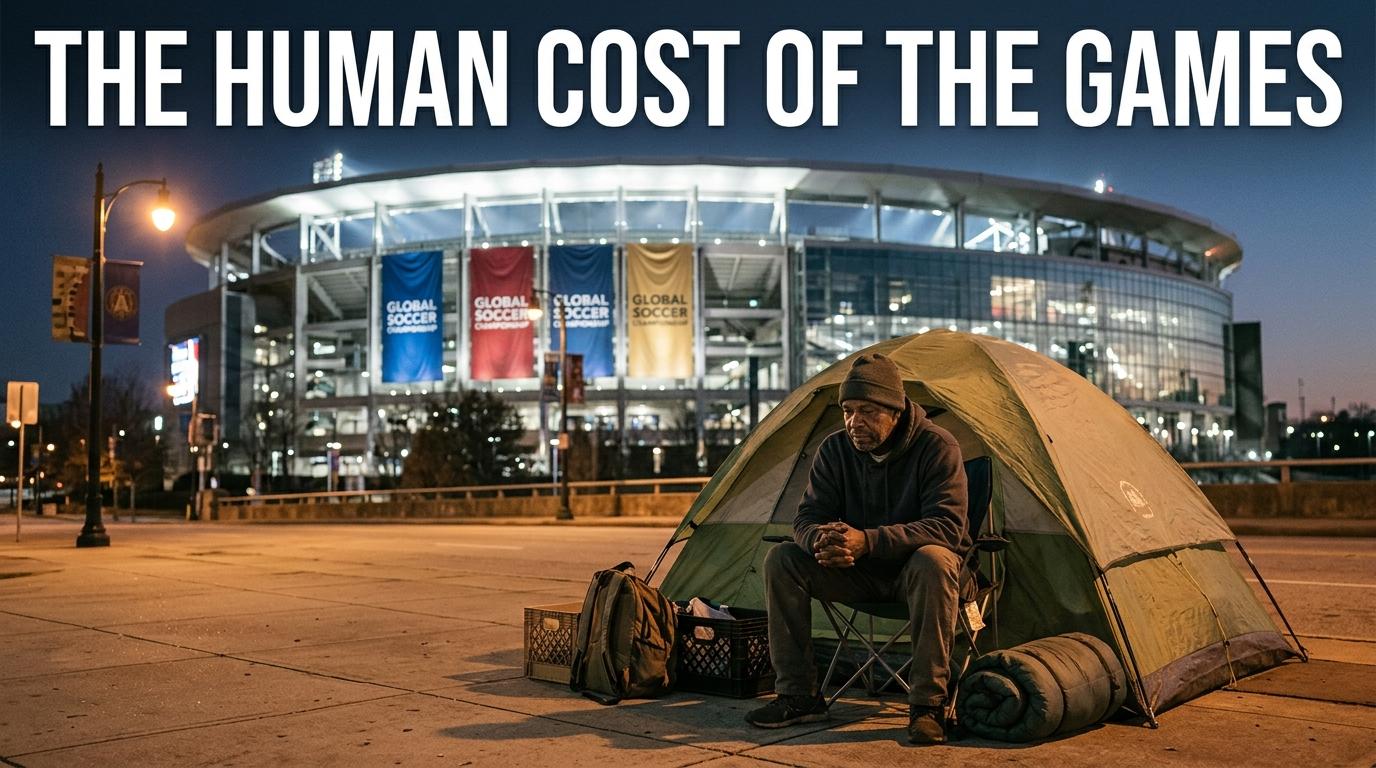
The global spotlight shines highly on the city of Atlanta as it prepares to host the 2026 FIFA World Cup. However, beneath the glitz of international sports, a familiar struggle is unfolding on the pavement. Local unhoused residents and human rights groups are raising their voices against aggressive city cleanups. They report that municipal workers are sweeping through encampments and displacing vulnerable people. These operations aim to sanitize the city streets to welcome affluent tourists (theguardian.com). Advocates argue that this process treats human beings as less than human. The push to present a pristine image to the world comes at a steep cost to those who have nowhere else to go (theguardian.com).
This conflict is not a modern anomaly. It is part of a recurring pattern where mega-events dictate urban policy. While the city celebrates its selection as a host, activists warn that the gentrification of public space harms vulnerable citizens. Displaced individuals report losing their tents, documents, and dignity in the process (theguardian.com). Consequently, the tension between municipal branding and human rights continues to escalate. To understand this current crisis, one must examine how the city managed public spaces in previous decades. The blueprint for these sweeps was established thirty years ago.
Echoes of 1996: The Olympic Blueprint
The current street cleanups heavily mirror the strategies used during the 1996 Centennial Olympic Games. In the years leading up to the Olympics, civic and corporate leaders wanted to transform Atlanta into a world-class metropolis (shelterforce.org). However, this ambitious drive for urban renewal resulted in devastating consequences for low-income communities. The city government initiated a systematic campaign to clear public spaces of poor people (shelterforce.org). They chose to prioritize global corporate image over the welfare of local citizens.
To achieve this transformation, the Atlanta City Council passed several vague quality-of-life ordinances between 1991 and 1996 (shelterforce.org). These laws effectively criminalized the daily survival of unsheltered individuals. It became a crime to camp in public parks, enter vacant buildings, or walk across parking lots without owning a car (shelterforce.org). Panhandling was restricted heavily under the guise of maintaining public safety. These punitive policies laid the groundwork for modern municipal sweeps. Decades later, the legacy of criminalizing poverty continues to influence city planners.
The Olympic Detention Center and Banishment
During the Olympic preparations, city officials realized they needed a place to hold those who violated the new ordinances. Consequently, the city constructed the Atlanta City Detention Center, a massive one-thousand-bed jail in the heart of downtown (theguardian.com). One city official famously referred to this facility as the first Olympic project completed on time (theguardian.com). Law enforcement heavily utilized the jail to sweep primarily Black, unhoused residents off the streets. This strategy effectively warehoused vulnerable populations during high-profile tourist weekends (theguardian.com).
For individuals who were not arrested, the city offered a different method of exclusion. Authorities provided one-way bus tickets to transport unhoused people out of Atlanta (theguardian.com, shelterforce.org). To receive a ticket, a person had to sign a waiver promising never to return (theguardian.com). They also had to prove that a family member or a job was waiting for them at their destination (theguardian.com). This program served as a form of geographic banishment. It allowed the city to reduce the visible homeless population without addressing the root causes of poverty.
Demolishing Public Housing for Global Tourism
The physical architecture of Atlanta underwent a permanent transformation to accommodate the Olympic games. In 1995, the city demolished Techwood Homes, which was the oldest federally subsidized public housing project in the nation (shelterforce.org). The demolition cleared space to construct the Olympic Village. Furthermore, entire historic neighborhoods like Summerhill were carved up to build sports stadiums and expansive parking lots (shelterforce.org). These developments priced out thousands of low-income families and accelerated gentrification. This massive physical shift disrupted the stability of many African American families who relied on affordable housing.
Advocates fought tirelessly against these displacements. Anita Beaty, who led the Metro Atlanta Task Force for the Homeless, became a central figure in the resistance (theguardian.com, theguardian.com). Activists made a shocking discovery when they found stacks of pre-printed citation forms in police files. These forms already had the boxes for African American, male, and homeless pre-checked (theguardian.com). This evidence of systemic profiling led to a major federal lawsuit. Just days before the games began, a federal judge blocked several of the arrest statutes (theguardian.com). The judge ruled that the city had shown indifference to the constitutional rights of the unhoused (theguardian.com).
Modern Promises and the Reality of Atlanta Rising
In preparation for the 2026 FIFA World Cup, current Atlanta Mayor Andre Dickens pledged to take a different path. The mayor promised that the city would not repeat the moral mistakes of 1996 (theguardian.com). Instead, the administration championed a progressive housing-first methodology. This strategy asserts that stable housing is a fundamental human right that must be provided before addressing other personal challenges. To support this vision, the city launched the Atlanta Rising initiative, dedicating over two hundred million dollars to construct rapid housing and supportive infrastructure (theguardian.com).
The program has achieved some remarkable milestones. For example, the Downtown Rising initiative successfully moved five hundred and nine unsheltered residents into permanent housing as of July 2026 (theguardian.com). Under this program, the average time to place an individual into stable housing dropped to just forty-eight days (theguardian.com). This is significantly faster than the national average of one hundred and sixty-six days (theguardian.com). Innovative developments like The Melody, a micro-village made of shipping containers, showcase these efforts (theguardian.com, urbanize.city). However, critics argue that these achievements only represent a small fraction of the overall need.
Bypassing Safety Protocols in Freedom Park
Despite the high-profile success of housing initiatives, harsh reality returned to the streets of Atlanta during the World Cup. In July 2026, city workers conducted an aggressive sweep of Freedom Park (theguardian.com). This park is located less than a mile from a prominent World Cup fan watch zone (theguardian.com). Without any advance warning, workers began dismantling tents and throwing away personal belongings. Unhoused individuals lost vital survival gear, personal identification documents, and essential medications, including insulin kits and blood pressure pills (theguardian.com).
When confronted by human rights advocates, city officials offered an administrative excuse. Chatiqua Ellison, the senior advisor on homelessness for the city, asserted that the area was not an official encampment (theguardian.com). Instead, she classified the sweep as routine park maintenance (theguardian.com). This specific designation allowed the city to bypass strict outreach protocols established the previous year. Those guidelines legally require the city to give residents ample warning before clearing an area. By labeling the sweep as simple maintenance, the city avoided the need for outreach workers to find housing first (theguardian.com).
The Tragedy of Cornelius Taylor
The severe tension surrounding these modern sweeps is rooted in a recent tragedy. On January 16, 2025, an unhoused man named Cornelius Taylor was crushed to death inside his tent (theguardian.com). The incident occurred during an encampment-clearing operation on Old Wheat Street (theguardian.com). A city public works employee was operating a five-ton front loader and flattened the tent while Taylor was sleeping inside (theguardian.com). Although initial police reports claimed the victim suffered only a minor injury, witnesses described a horrifying scene with large pools of blood on the asphalt (theguardian.com, theguardian.com).
This tragedy sparked immense public outrage and led to immediate demands for reform. In July 2025, Taylor’s family filed a wrongful-death lawsuit against the City of Atlanta (theguardian.com). The city government has attempted to dismiss this lawsuit by claiming protection under sovereign immunity (theguardian.com). Consequently, the family filed a second civil lawsuit in January 2026 (theguardian.com). This second lawsuit targets the private nonprofit organizations Partners for HOME and SafeHouse Outreach (theguardian.com). The suit alleges that outreach staff failed to perform mandatory checks to ensure the tents were vacant before heavy machinery was deployed (theguardian.com).
The Sweet Auburn Civil Rights Irony
The location of Taylor’s death adds a layer of deep historical irony and pain. Old Wheat Street is situated in the historic Sweet Auburn district, a cornerstone of the American civil rights movement (atlantahistorycenter.com). This neighborhood was once celebrated as one of the wealthiest Black business corridors in the nation. It is the birthplace and childhood home of Dr. Martin Luther King Jr. (atlantahistorycenter.com). Taylor was crushed to death directly across the street from the historic Ebenezer Baptist Church (theguardian.com). This historic district stands as a monument to human dignity, making the violent death of an unhoused Black resident particularly painful.
This tragedy highlights the stark racial disparities that define homelessness in modern Atlanta. Point-in-Time counts show that Black residents make up approximately eighty percent of the unhoused population in the city (capitalbnews.org). In stark contrast, Black residents make up only forty-six percent of the overall city population (capitalbnews.org). This massive overrepresentation reveals how systemic economic barriers and rapid gentrification disproportionately push Black citizens out of their homes. This struggle is part of a long history where Black residents had to fight for economic justice against overwhelming odds. For many, the current sweeps represent a betrayal of the civil rights legacy that Atlanta proudly advertises to the global community.
Strained Systems and Remote Detention Concerns
In March 2026, the Atlanta City Council passed a resolution to prioritize pre-arrest diversion programs rather than incarceration (theguardian.com). The goal was to redirect individuals committing minor offenses toward social services. However, human rights watchdogs like the coalition Play Fair ATL warn that this system is heavily strained (theguardian.com). When wealthy tourists and corporate business owners complain about visible poverty, the municipal response often reverts to punitive measures (theguardian.com). This dynamic mirrors the national shift to mass incarceration that began decades ago. Consequently, local jails are still being utilized as temporary shelters to hide poverty from the international spotlight.
Furthermore, displaced residents report being transported to remote, unmonitored holding centers. One unhoused individual named Sirius described being picked up in the middle of the night (theguardian.com). He was taken to an isolated facility past the West End neighborhood (theguardian.com). Sirius described the location as looking like a FEMA camp and called it nothing but a warehouse of cops (theguardian.com). The highly restrictive and heavily policed environment felt so dehumanizing that many residents chose to immediately walk back to the city center (theguardian.com). These unauthorized municipal holding zones raise profound concerns about civil liberties as the city tries to hide its poorest residents (theguardian.com).
About the Author
Darius Spearman is a professor of Black Studies at San Diego City College, where he has been teaching for over 20 years. He is the founder of African Elements, a media platform dedicated to providing educational resources on the history and culture of the African diaspora. Through his work, Spearman aims to empower and educate by bringing historical context to contemporary issues affecting the Black community.
