
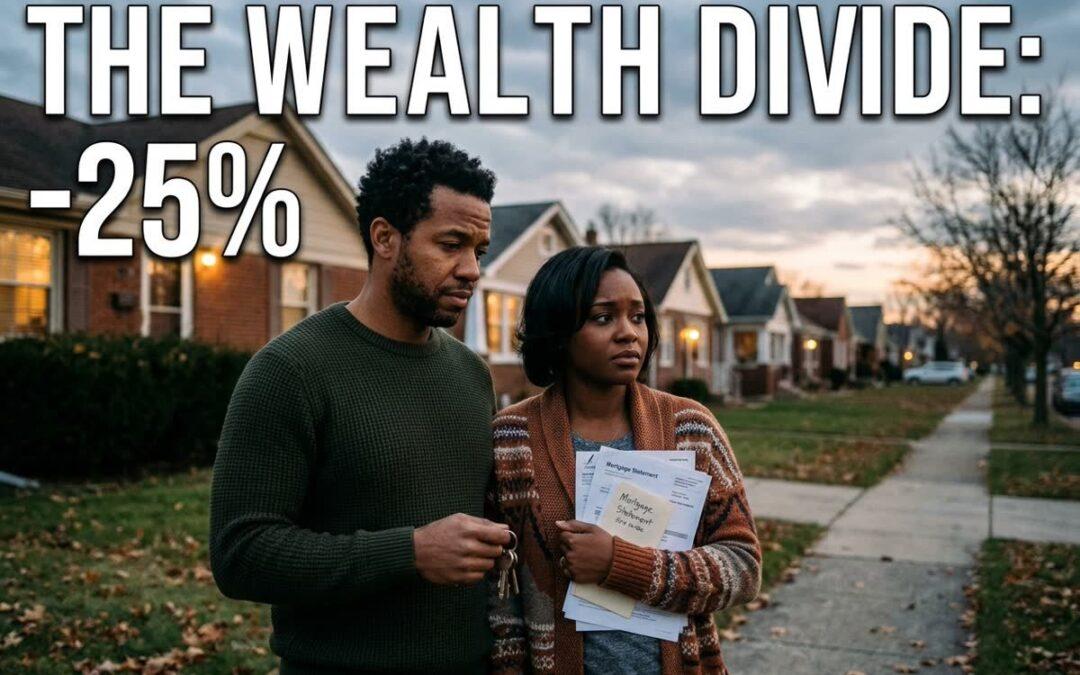


Black Homeownership in Crisis as Median Wealth Drops 25%
By Darius Spearman (africanelements)
Support African Elements at patreon.com/africanelements and hear recent news in a single playlist. Additionally, you can gain early access to ad-free video content.
A severe economic reversal is threatening the foundation of African American financial security. Civil rights leaders, legal scholars, and housing professionals delivered an urgent warning at a national forum in Washington, D.C. They declared that Black homeownership in the United States is slipping backward toward pre-civil rights levels (einpresswire.com, chicagodefender.com).
Decades of gradual progress have stalled under the weight of escalating costs and credit barriers. Newly analyzed data reveals that Black median wealth collapsed by a quarter over a single three-year span (cepr.net). Concurrently, qualified Black applicants face persistent mortgage rejections that financial measures cannot explain (einpresswire.com). Understanding this modern emergency requires examining the century of state-sponsored economic policy that designed the divide.
Urgent Warnings at the NAREB Housing Summit
The alarm sounded on November 19 at the National Association of Real Estate Brokers gathering. Convening for the 7th Annual Black Homeownership Summit, delegates addressed a stark economic reality. Keynote speakers linked modern property exclusion directly to earlier civil rights struggles (einpresswire.com, legacynewspaper.com). NAREB President Ashley Thomas III stressed that the nation cannot ignore widening homeownership divides (einpresswire.com).
Civil rights attorney Ben Crump and Reverend Al Sharpton joined real estate practitioners at the podium. Both leaders framed affordable shelter as the primary unresolved front in the push for racial justice (einpresswire.com, chicagodefender.com). They emphasized that constitutional rights remain incomplete without equitable economic standing. A family residence represents the overwhelming majority of accumulated wealth for middle-class African American households (chicagodefender.com, blackdemographics.com).
“You can’t save for a down payment when wages lag behind costs. In just three years, Black median wealth has fallen by a quarter. Housing is where civil rights and economic justice meet. And that’s why this fight isn’t finished.”
— Ben Crump, Source: (einpresswire.com)
The summit also featured executive leaders from the National Pan-Hellenic Council, commonly known as the Divine Nine (einpresswire.com, legacynewspaper.com). These historically Black Greek-letter organizations represent more than 2.5 million alumni and collegiate members worldwide. Their presence signaled a coordinated expansion of Divine Nine economic advocacy across municipal chapters (einpresswire.com). Historically, these fraternities and sororities mobilized millions of voters and coordinated legal campaigns (chicagodefender.com). Today, their leadership directs capital into financial literacy programs, community banks, and down payment support networks (einpresswire.com, legacynewspaper.com).
Federal lawmakers addressed the conference to outline legislative remedies. Representative Emanuel Cleaver II highlighted the bipartisan 21st Century ROAD to Housing Act (einpresswire.com). Cleaver warned that simply building new houses will fail if financing channels remain broken (einpresswire.com, legacynewspaper.com). Fair appraisals and transparent lending must accompany physical construction to achieve measurable change (einpresswire.com).
The History of Redlining and Built-In Segregation
Modern racial lending disparities are not spontaneous accidents of the commercial marketplace. They represent the lasting consequence of structural policies engineered by the federal government during the twentieth century (redressmovement.org, fsrelife.com). These barriers originated in systemic economic exploitation after emancipation, when agricultural tenancy and debt systems trapped emancipated families. Decades later, federal intervention formalized those divisions into urban architecture (redressmovement.org).
During the Great Depression, the federal government established the Home Owners’ Loan Corporation in 1933 (redressmovement.org). The agency created color-coded “residential security maps” for hundreds of American metropolitan areas. Technicians drew red lines around neighborhoods with Black populations, grading them as financial hazards (redressmovement.org, fsrelife.com). This bureaucratic process, known as the history of redlining, severed minority communities from federally backed mortgage refinancing (redressmovement.org).
The Federal Housing Administration reinforced these boundaries in its 1934 Underwriting Manual (redressmovement.org). The guidelines warned against introducing incompatible demographic groups into stable subdivisions. The FHA explicitly mandated that racial segregation was necessary to maintain property valuations (redressmovement.org, fsrelife.com). Following World War II, the GI Bill funded suburban expansion across the country. Yet local veterans offices routinely denied loan guarantees to Black servicemen, locking them out of the post-war wealth boom (redressmovement.org).
Private deed restrictions compounded this exclusion through racially restrictive covenants (redressmovement.org, clevelandrealtist.org). Developers inserted contractual clauses prohibiting the sale or rental of properties to non-white citizens. In the 1948 case Shelley v. Kraemer, the Supreme Court ruled that judicial enforcement of covenants violated the Constitution (redressmovement.org). However, the ruling permitted voluntary private compliance. Lenders, appraisers, and real estate boards continued informal enforcement for decades afterward (redressmovement.org, fsrelife.com).
Excluded from white subdivisions and barred from the National Association of Real Estate Boards, African American brokers formed their own institution (nareb.com, clevelandrealtist.org). On July 29, 1947, twelve pioneers met in Tampa, Florida, to establish the National Association of Real Estate Brokers (nareb.com). Forbidden from using the trademarked term “Realtor,” they adopted the professional title “Realtist” (nareb.com, clevelandrealtist.org). Operating under the civic motto “Democracy in Housing,” Realtists fought for open occupancy and equal credit guarantees alongside early civil rights organizations (nareb.com, nareb.com).
U.S. Homeownership Trajectory (1970 – 2026)
The Fair Housing Act and the Limits of Legal Reform
President Lyndon B. Johnson signed the Fair Housing Act into law on April 11, 1968 (redressmovement.org). Congress approved the landmark statute one week after the assassination of Dr. Martin Luther King Jr. (redressmovement.org, nareb.com). King had spent his final campaigns marching against segregated housing conditions in northern cities like Chicago (redressmovement.org). The new law prohibited intentional discrimination regarding the sale, financing, and rental of residential dwellings (redressmovement.org, fsrelife.com).
The statute banned explicit bias, yet it could not reverse decades of accumulated wealth inequities (redressmovement.org). White suburban homeowners gained low-interest, government-subsidized mortgages between 1935 and 1965 (redressmovement.org, fsrelife.com). Their homes accumulated tremendous value, providing family capital for business investments and college tuition. In contrast, Black families remained trapped in underfunded urban sectors with declining municipal services (redressmovement.org).
Congress enacted the Community Reinvestment Act in 1977 to compel commercial banks to serve local neighborhoods (nareb.com, fsrelife.com). Even so, financial institutions found sophisticated methods to extract wealth rather than build it. Decades later, dynamic shifts in political dynamics in the Black community pushed for broader access to commercial credit. Unfortunately, financial markets responded with targeted subprime products (einpresswire.com, redressmovement.org).
The nationwide homeownership rate for Black families climbed to an all-time peak of 49.1 percent in 2004 (einpresswire.com, blackdemographics.com). That milestone unraveled during the 2008 subprime mortgage crisis (redressmovement.org). Predatory financial entities steered Black buyers into high-cost loans, regardless of their credit standing (einpresswire.com, redressmovement.org). When the market crashed, Black families lost billions in accumulated home equity (redressmovement.org). That structural destruction still shapes the national housing picture today (einpresswire.com).
How the Racial Wealth Gap Crushed Household Reserves
The latest crisis was exposed by the Federal Reserve Survey of Consumer Finances (cepr.net). Between 2022 and 2025, median net worth for Black households plunged from $49,100 to $36,800 (einpresswire.com, cepr.net). This represents a catastrophic 25 percent loss in real purchasing power over three years (einpresswire.com). It marks the steepest triennial decline documented since the Great Recession of 2008 (cepr.net).
This collapse occurred while other demographic groups experienced stability or financial gains (cepr.net). Median white household net worth expanded to $332,100, which is nine times higher than Black median wealth (einpresswire.com, cepr.net). Asian household wealth reached $677,600, while Hispanic household assets grew to $79,600 (cepr.net). Inflationary pressures hit Black families hardest because they possess smaller liquid financial cushions (cepr.net).
Economists point to escalating daily expenditures and aggressive consumer liabilities as principal causes (cepr.net). Escalating consumer debt creates debt burdens that drain family resources, leaving little margin for mortgage savings. The share of Black households paying more than 40 percent of total income on debt rose from 6.5 percent to 8.6 percent (cepr.net). Vehicle values and entry-level home appraisals also dropped, eroding nonfinancial wealth (cepr.net).
Median Net Worth by Demographic (2025)
The ongoing racial wealth gap leaves millions without the family support systems that fund down payments (einpresswire.com). Generational inheritances allow white buyers to lower their monthly mortgage obligations through significant cash equity (redressmovement.org). Without inherited assets, Black buyers must secure higher loan balances at elevated interest rates (einpresswire.com, chicagodefender.com). This structural disadvantage limits household financial expansion across the nation (einpresswire.com).
Uncovering the Mechanisms of Mortgage Denial Disparities
Lending institutions routinely attribute application rejections to non-discriminatory variables like income volatility or low credit ratings. However, rigorous data introduced at the summit challenges that industry claim (einpresswire.com, chicagodefender.com). Empirical analyses demonstrate that observable financial metrics account for only 41 percent of the denial disparity between Black and white borrowers (einpresswire.com). The remaining 59 percent of the gap remains completely unexplained by financial fundamentals (einpresswire.com).
Black borrowers face loan rejection rates exceeding 17 percent when seeking conventional mortgages (chicagodefender.com, scotsmanguide.com). In comparison, white applicants experience rejection rates near 6 to 7 percent (scotsmanguide.com). The denial rate for African Americans is more than double the rate for white peers (einpresswire.com, scotsmanguide.com). This discrepancy persists even after researchers adjust for salary, debt burdens, and down payment funds (einpresswire.com, ncrc.org).
Algorithmic underwriting systems contribute significantly to these institutional disparities (ncrc.org). Automated evaluation tools from major mortgage backers rely on traditional credit profiles (ncrc.org). These systems reward revolving debt lines and car loans, while ignoring reliable on-time rent and utility payments (ncrc.org). Qualified Black renters who pay rent on time for years remain categorized as high-risk applicants (einpresswire.com, ncrc.org).
Physical banking deserts worsen these systemic lending friction points (ncrc.org). Mainstream banks have shuttered thousands of physical branches located in predominantly Black neighborhoods (ncrc.org). This limits access to relationship bankers who can help applicants resolve minor clerical hurdles (ncrc.org). Furthermore, systemic appraisal bias reduces property values in Black neighborhoods by 20 to 23 percent compared to identical homes in white areas (einpresswire.com, chicagodefender.com). That devaluation strips an estimated $156 billion in accumulated equity from Black communities nationwide (chicagodefender.com).
Black-White Mortgage Denial Drivers
Despite these steep systemic barriers, significant consumer readiness exists across the country (einpresswire.com, chicagodefender.com). Over two million African Americans are currently classified as mortgage-ready (einpresswire.com). They meet the income and credit qualifications required to buy a median-priced home (einpresswire.com, chicagodefender.com). More than 1.75 million Black millennials earn over $100,000 annually, yet many remain locked in rental markets due to financing barriers (chicagodefender.com).
Defending Special Purpose Credit Programs Against Retrenchment
To address structural disparities, advocates emphasize targeted financing initiatives authorized by federal law (einpresswire.com, virginiarealtors.org). Under the Equal Credit Opportunity Act of 1974, lenders can establish Special Purpose Credit Programs (virginiarealtors.org, newamericanfunding.com). These programs allow commercial banks and lenders to provide custom down payment grants and lower borrowing rates for historically disadvantaged populations (virginiarealtors.org, newamericanfunding.com). SPCPs provide targeted support without requiring general affirmative action quotas (virginiarealtors.org).
Yet these remedial housing initiatives face organized legal retrenchment (einpresswire.com, legacynewspaper.com). Conservative legal organizations have filed federal lawsuits challenging race-conscious programs and minority business investments (einpresswire.com). Intimidated by the threat of expensive litigation, several major banking institutions have dismantled or restricted their SPCP initiatives (einpresswire.com, legacynewspaper.com). Speakers at the NAREB summit noted that eliminating these programs closes off essential pathways to homeownership (einpresswire.com).
Civil rights advocates emphasize that targeted programs remain critical to rectifying long-standing racial disparities (einpresswire.com). Historical redlining was targeted and explicit; therefore, solutions must be targeted as well (einpresswire.com, redressmovement.org). In past generations, Black women leaders in civil rights fought alongside activists to establish fair housing access as an economic right. Today’s advocates continue that work, calling for statutory protections for SPCPs and modernized underwriting systems (einpresswire.com, chicagodefender.com).
“In the United States of America, in the year 2026, we cannot accept a status quo in which the opportunity to build wealth depends so heavily on the color of your skin, or the zip code in which you were born… More homes are not enough if families cannot qualify for a mortgage or cannot receive a fair appraisal.”
— Rep. Emanuel Cleaver II, Source: (einpresswire.com)
The emergency meetings in Washington demonstrated that the housing divide cannot be solved by passive market mechanisms alone (einpresswire.com, chicagodefender.com). A quarter-drop in Black median wealth, combined with mortgage rejections that defy standard metrics, demands aggressive federal enforcement (einpresswire.com, cepr.net). As the National Association of Real Estate Brokers declared at its founding in 1947, true democracy cannot exist without democracy in housing (nareb.com, clevelandrealtist.org). Protecting special credit tools, eradicating algorithmic bias, and honoring mortgage readiness are essential to fulfilling that promise (einpresswire.com).
About the Author
Darius Spearman is a professor of Black Studies at San Diego City College, where he has been teaching for over 20 years. He is the founder of African Elements, a media platform dedicated to providing educational resources on the history and culture of the African diaspora. Through his work, Spearman aims to empower and educate by bringing historical context to contemporary issues affecting the Black community.
