

Sudan Drone Strikes: UN Finds Drones Cause Most Civilian Deaths
By Darius Spearman (africanelements)
Support African Elements at patreon.com/africanelements and hear recent news in a single playlist. Additionally, you can gain early access to ad-free video content.
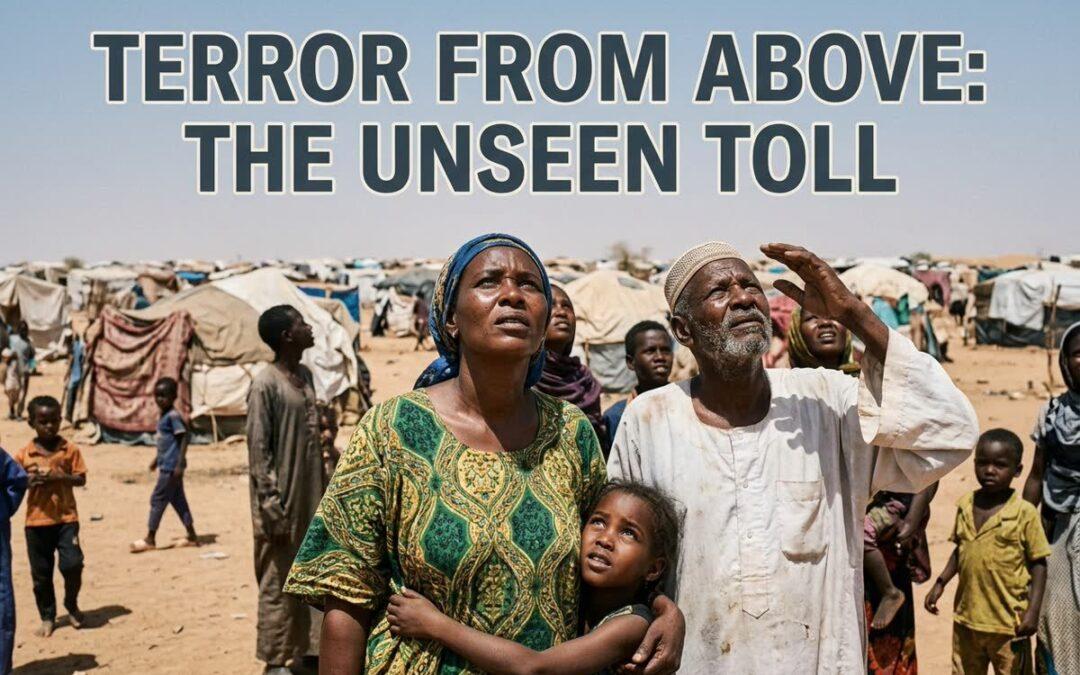
A catastrophic shift in modern African warfare has turned the skies over Sudan into zones of terror. Remote aerial bombardment now accounts for most Sudan civilian casualties documented across the country (ohchr.org). Today, Sudan civil war news is dominated by reports of precision munitions falling upon open-air markets, hospitals, and displacement camps (ohchr.org, ohchr.org). The deployment of sophisticated unmanned aerial vehicles has transformed a regional struggle into a high-technology slaughter (businessinsider.com, adf-magazine.com).
The tragedy unfolding in Northeast Africa reflects enduring patterns of colonial extraction, racial hierarchy, and state repression. For communities across the African diaspora, the violence recalls long-standing battles for genuine freedom and self-determination against entrenched military elites. Armed drones have decoupled state violence from direct human confrontation. As a result, military commanders execute deadly strikes across vast distances without immediate political or physical consequences (ohchr.org, hudson.org).
UN Sudan Report Findings on Aerial Warfare
A landmark investigation released on November 17 by the United Nations Human Rights Office revealed grim statistics. The report confirmed that Sudan Drone Strikes caused nearly three-quarters of all verified civilian combat deaths this year (ohchr.org). Between January and October, human rights monitors verified 2,230 civilian deaths across the country (ohchr.org, ohchr.org). Out of those recorded fatalities, armed drones caused over 1,630 deaths, representing roughly 73.1 percent of the total toll (ohchr.org).
During the first six months of the year, remote unmanned systems inflicted more than 80 percent of civilian casualties (ohchr.org). The operational radius of these weapons has erased traditional front lines. Historically, non-combatants could seek sanctuary in rural areas away from active street combat (aljazeera.com, chathamhouse.org). Today, long-range loitering munitions strike deep into rear administrative zones, crowded transport depots, and civilian farming centers (ohchr.org, dabangasudan.org).
Share of Documented Civilian Fatalities (Jan–Oct)
The report documented at least 39 distinct drone strikes on open-air civilian markets during the first six months (ohchr.org). Operators specifically targeted peak trading hours to maximize economic devastation and civilian casualties (ohchr.org, ohchr.org). In West Kordofan, a double-tap drone strike hit a commercial transport truck in Dibab, killing 139 civilians (ohchr.org). First responders gathering to aid the wounded were struck by follow-up munitions, violating international humanitarian law (ohchr.org, un.org).
The Janjaweed to RSF Evolution and Colonial Precedents
To understand the current carnage, observers must examine the historical architecture of state violence in Sudan. Following independence in 1956, riverine Arab-identifying elites in Khartoum consolidated control over political institutions and military commands (aljazeera.com, toaep.org). Peripheral regions, particularly Darfur and the Nuba Mountains, faced systematic underdevelopment and institutional neglect (toaep.org, horninstitute.org). When non-Arab communities revolted against central neglect in 2003, the state responded with proxy warfare (aljazeera.com, toaep.org).
The regime of President Omar al-Bashir recruited, financed, and armed nomadic Arab pastoralists known as the Janjaweed (aljazeera.com, migration-control.info). These proxy forces burned hundreds of villages, executed non-Arab civilians, and displaced millions of African farmers (amnesty.org.uk, toaep.org). Scholars of the African diaspora recognize this strategy as a classic divide-and-rule colonial tactic. Studying these historical divisions reveals how rulers use racial hierarchies and political power to suppress democratic mobilization and sustain autocratic rule.
In 2013, Bashir formalized the Janjaweed into an official state entity named the Rapid Support Forces (aljazeera.com, migration-control.info). Commanded by Mohamed Hamdan Dagalo, known as Hemedti, the RSF functioned as an autonomous praetorian guard designed to prevent military coups (aljazeera.com, chathamhouse.org). The Janjaweed to RSF Evolution accelerated dramatically when Sudanese troops deployed to Yemen in 2015 (aljazeera.com). That foreign expedition provided Hemedti with independent financial wealth, modern tactical armaments, and enduring patron relationships in the Persian Gulf (aljazeera.com, chathamhouse.org).
Sudanese Armed Forces Airstrikes and Domestic Arms Legacies
The Sudanese Armed Forces possess a long history of utilizing aerial bombardment against rural civilian populations. During decades of civil war in southern Sudan and the Nuba Mountains, the military regularly deployed transport planes to roll barrel bombs out of cargo bays (toaep.org, africansecurityanalysis.com). These inaccurate attacks terrorized communities but lacked tactical precision (toaep.org). Consequently, the military regime invested heavily in domestic arms manufacturing (businessinsider.com, aei.org).
During the 1990s, Sudan established the Military Industry Corporation with technical assistance from Iran and China (businessinsider.com, aei.org). The Yarmouk Industrial Complex in southern Khartoum became a primary assembly hub for light weapons, ammunition, and early reconnaissance drones (businessinsider.com, criticalthreats.org). Systems like the Zagil and Ababil-3 were assembled locally to track insurgent groups across Darfur and Blue Nile (businessinsider.com, meforum.org). When civil war erupted in Khartoum in April 2023, the military leveraged these historic ties to rebuild its aerial fleet (businessinsider.com, aei.org).
By late 2023, regular Sudanese Armed Forces Airstrikes incorporated sophisticated foreign technology (turkiyetoday.com, businessinsider.com). Cargo planes delivered Iranian Mohajer-6 Sudan combat drones to military airfields in Port Sudan (turkiyetoday.com, businessinsider.com). Equipped with precision-guided Qaem glide bombs, these aircraft reshaped ground operations in urban areas (businessinsider.com, criticalthreats.org). In early 2024, the military used these loitering munitions to break paramilitary sieges across Omdurman (businessinsider.com, criticalthreats.org). However, high-altitude strikes frequently missed military targets, devastating surrounding residential neighborhoods instead (ohchr.org, ohchr.org).
Rapid Support Forces Drone Attacks Reshape the Frontlines
The paramilitary coalition quickly countered the regular army by developing its own remote strike capabilities (businessinsider.com, adf-magazine.com). Initially, the RSF relied on high-speed desert convoys, using pickup trucks mounted with anti-aircraft guns to overrun static military positions (aljazeera.com, meforum.org). As urban warfare stalled in Khartoum, the paramilitary shifted toward remote technology (businessinsider.com, adf-magazine.com). The group integrated commercial quadcopters modified to drop mortar rounds into crowded trenches and civilian gatherings (businessinsider.com, adf-magazine.com).
Recent UN reports document that Rapid Support Forces Drone Attacks have expanded far into rear government territories (ohchr.org, ohchr.org). In Blue Nile, a targeted paramilitary drone strike struck Um Darfa Hospital, knocking critical emergency facilities out of service (ohchr.org). Another drone assault on October 9 hit displaced artisanal gold miners at Abu Shendi, killing 31 people (ohchr.org). These attacks demonstrate that paramilitary units no longer require physical ground presence to project lethal force across vast distances (ohchr.org, adf-magazine.com).
Documented Casualties: Specific Drone Strikes
Modern remote warfare allows armed factions to terrorize local populations while insulating command structures from direct accountability. Parallels exist throughout global history, where oppressed populations encounter mechanized military domination. These patterns connect directly to shared global struggles against oppression across the Global South. In Sudan, remote weapon systems systematically dismantle the social and economic foundations necessary for community survival (ohchr.org, yale.edu).
Targeting Darfur Displacement Camps and Civilian Sanctuaries
Darfur drone attacks have systematically eroded the few remaining safe havens for historically targeted African ethnic groups (ohchr.org, yale.edu). Displaced Fur, Masalit, and Zaghawa civilians gathered in massive camps surrounding El Fasher, including Zamzam and Abu Shouk (yale.edu, amnesty.org.uk). Having fled scorched-earth infantry raids in West Darfur, these refugees face continuous aerial bombardment (ohchr.org, yale.edu). High-resolution satellite tracking conducted by humanitarian monitors shows extensive blast craters across residential shelter blocks (yale.edu).
Targeting Darfur Displacement Camps represents an intentional strategy to enforce demographic displacement through remote terror (yale.edu, amnesty.org.uk). In October, drone attacks struck civilian shelters in Ghubeish and El Nuhud within West Kordofan (ohchr.org). Munitions damaged communal water distribution points, primitive medical posts, and temporary grain reserves (ohchr.org, yale.edu). By destroying survival infrastructure, drone operators induce artificial famine without committing foot soldiers to contested ground (ohchr.org, yale.edu).
International human rights organizations note that these operations demonstrate clear genocidal intent (ohchr.org, amnesty.org.uk). The UN Fact-Finding Mission verified that paramilitary fighters regularly accompany bombardments with racial slurs against non-Arab residents (ohchr.org). Drones have replaced cavalry raids as the primary weapon used to clear rural areas (aljazeera.com, yale.edu). The systematic destruction of civilian shelters prevents displaced families from returning to ancestral farmlands, cementing long-term ethnic partition (yale.edu, toaep.org).
Foreign Weapons Pipelines in Sudan and Global Impunity
The transition toward industrialized drone warfare relies directly upon international corporate networks and geopolitical alliances (adf-magazine.com, amnesty.org.uk). While thousands of Sudanese civilians die, Foreign Weapons Pipelines in Sudan operate with minimal international interference (adf-magazine.com, jurist.org). The Rapid Support Forces obtain advanced Chinese-made Wing Loong II drones through supply lines stretching across the United Arab Emirates and eastern Chad (adf-magazine.com, amnesty.org.uk). These sophisticated platforms provide high-altitude reconnaissance and precision strike capabilities far exceeding legacy equipment (adf-magazine.com, chathamhouse.org).
Conversely, the Sudanese Armed Forces receive consistent shipments of Iranian hardware, Russian munitions, and commercial first-person-view attack drones (turkiyetoday.com, businessinsider.com, amnesty.org.uk). The conflict has evolved into a self-funding proxy war fueled by illicit natural resource exploitation (hudson.org, chathamhouse.org). The RSF controls rich artisanal gold mines, including Jebel Amer in North Darfur (aljazeera.com, hudson.org). Raw gold is flown directly to refineries in the Gulf, generating cash to procure military electronics and foreign weapons systems (hudson.org, chathamhouse.org).
Macro Conflict Scale: Casualties and Displaced Persons
International institutions have repeatedly failed to halt these destructive weapons flows. United Nations Security Council Resolution 1591 established an arms embargo in 2005, yet it applied exclusively to Darfur (jurist.org, chathamhouse.org). Belligerents circumvent the restriction by flying equipment into Port Sudan or shipping hardware through regional borders (adf-magazine.com, amnesty.org.uk). Geopolitical rivalries over Red Sea maritime access further discourage major world powers from enforcing meaningful secondary sanctions against regional brokers (hudson.org, chathamhouse.org).
The failure of global governance to protect marginalized African lives illustrates enduring historical inequities. Just as past civil conflicts encountered failures of systemic reform and accountability, the crisis in Sudan exposes the limits of international legal mechanisms. Holding drone manufacturers, regional enablers, and military commanders accountable requires rigorous investigative tracking and universal legal jurisdiction (jurist.org). Until foreign arms pipelines are dismantled, modern drone technology will continue to extract a catastrophic toll on civilian populations across Sudan (ohchr.org, ohchr.org).
About the Author
Darius Spearman is a professor of Black Studies at San Diego City College, where he has been teaching for over 20 years. He is the founder of African Elements, a media platform dedicated to providing educational resources on the history and culture of the African diaspora. Through his work, Spearman aims to empower and educate by bringing historical context to contemporary issues affecting the Black community.
