

Guinea Gold Crackdown: Siguiri Arrests Spark Regional Outcry
By Darius Spearman (africanelements)
Support African Elements at patreon.com/africanelements and hear recent news in a single playlist. Additionally, you can gain early access to ad-free video content.
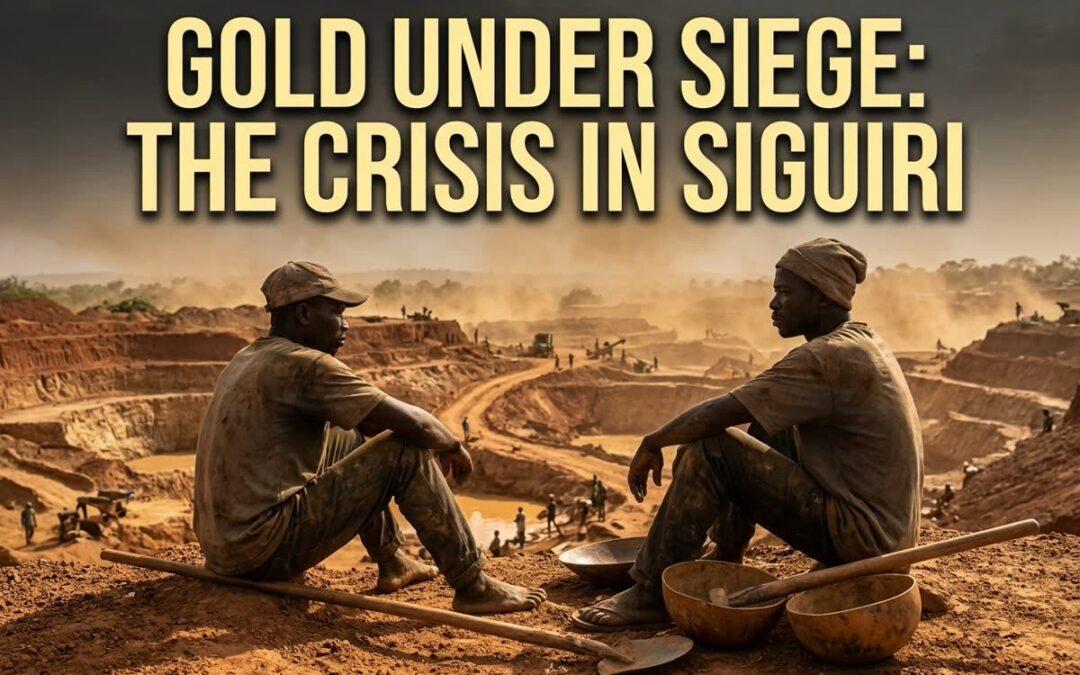
In early November 2026, armed security forces fanned out across northeastern Guinea. They swept through artisanal camps in the Siguiri prefecture, detaining at least 1,263 unlicensed miners (africanews.com, bedrocknews.com). The detainees included hundreds of migrant workers from Mali, Burkina Faso, Nigeria, Ghana, Togo, and Côte d’Ivoire (guinee360.com, aa.com.tr). The operation marked the start of an aggressive state campaign known as the Guinea Gold Crackdown (bedrocknews.com, africaguinee.com).
The sweep triggered armed clashes, mass judicial trials in Conakry, and a regional humanitarian crisis along the Malian border (liveuamap.com, mediaguinee.com). The sudden enforcement campaign took place days after the military government inaugurated its first domestic gold processing plant (africa-eye.com, allafrica.com). That facility is the Nimba Gold Refinery Launch in the capital city (africaguinee.com). Understanding these contemporary events requires examining long-standing regional migration patterns, colonial extraction models, and the historic gold basins of West Africa.
Bouré Goldfields History: Empire, Colonization, and Ancestral Panning
The modern administrative district of Siguiri is not an accidental mining zone. It sits at the geographic center of the ancient Bouré goldfields, which have produced precious metals for a thousand years (britannica.com, wikipedia.org). During the thirteenth and fourteenth centuries, the wealth of the Mali Empire rested upon the placers of Bouré and neighboring Bambouk (britannica.com). When Mansa Musa made his famous pilgrimage to Mecca in 1324, he brought camel trains carrying refined gold dust and ingots across the Sahara (wikipedia.org). His massive spending depressed the price of gold in Cairo for over a decade (britannica.com, wikipedia.org). Much of that imperial wealth originated in the alluvial soils of the Upper Niger basin (britannica.com).
For generations, Mandinka communities governed informal gold panning, known locally as orpaillage, through customary village institutions (africamuseum.be, aijr.org). Customary earth priests, known as tômon-tigi, regulated land access and managed mining seasons (aijr.org). Digging occurred primarily during the dry season between agricultural planting cycles. Because European borders did not exist, workers moved freely between river basins without passports or formal permits (thewilberforcesociety.co.uk, wikipedia.org). Customary law treated the land and its subterranean resources as collective ancestral patrimony.
French colonial conquest in the late nineteenth century disrupted these traditional practices. Colonial administrators sought to industrialize the placers under a policy of economic extraction termed mise en valeur (africamuseum.be). The French colonial state attempted to establish mining concessions and collect heavy taxes. However, local diggers routinely evaded colonial monopolies by utilizing cross-border networks to sell ore in British territories (africamuseum.be, wikipedia.org). European attempts to replace customary mining failed because colonial administrators could not police the vast rural interior. Many modern efforts to rethink natural resource control mirror broader movements toward African-centric education and institutional reform.
Following national independence in 1958, the Guinean government introduced state-run mining collectives. When state enterprises struggled, the government opened the sector to foreign corporations during the 1990s (mining.com.au, northernminer.com). In 1996, the state granted a large concession to the Société Aurifère de Guinée (SAG), an enterprise owned 85 percent by AngloGold Ashanti and 15 percent by the Republic of Guinea (mining.com.au, ejatlas.org). As the industrial open-pit operations expanded, ancestral panning fields were fenced off (ejatlas.org). Tensions between foreign corporate operators and local artisanal diggers have persisted ever since (mining.com.au, ejatlas.org).
Siguiri Artisanal Mining Crisis: Sahelian Turmoil and Environmental Rupture
Over the past decade, several economic and political shocks converged to produce the modern Siguiri Artisanal Mining Crisis. Beginning in 2012, armed jihadist insurgencies destabilized northern and central Mali (theguardian.com, adf-magazine.com). Conflict quickly expanded into neighboring Burkina Faso and Niger. The regional fighting destroyed rural agricultural livelihoods and shut down formal industrial operations across the Sahel (adf-magazine.com). At the same time, global economic turmoil pushed international gold prices to record highs (mining-technology.com, spglobal.com).
Tens of thousands of displaced young men migrated south toward Upper Guinea seeking survival. The United Nations Environment Programme estimates that artisanal gold mining in Guinea grew to support over 300,000 workers directly (adf-magazine.com). Informal mining ceased to be a simple dry-season village craft. Well-funded domestic and cross-border syndicates introduced heavy industrial machinery into the mining fields (guinee360.com, africaguinee.com). Backhoes, excavators, and motorized dredges were deployed directly into the riverbeds of the Niger and Tinkisso rivers (africaguinee.com).
This mechanization caused severe ecological damage across Upper Guinea. Miners dumped vast quantities of mercury and cyanide solutions into open trenches to separate gold flakes from raw ore (ejatlas.org, africaguinee.com). Toxic runoff poisoned municipal water supplies, devastated freshwater fish stocks, and contaminated regional aquifers (ejatlas.org). Huge open pits hollowed out farm fields, leaving fertile topsoil eroded and unstable. Unregulated vertical shafts collapsed frequently, killing dozens of young miners each year (geomechanics.io, africaguinee.com). The regional government faced growing public pressure over environmental destruction, child labor, and rising crime across informal settlements (guinee360.com, africaguinee.com).
Regional Humanitarian Impact: Displaced Miners (Nov 2026)
West Africa Gold Smuggling: Shadow Networks and Economic Sovereignty
The proliferation of informal mining fed a vast underground economy across the sub-region. Mineral experts estimate that up to 70 percent of artisanal gold mined in Guinea was smuggled out of the country without paying state royalties or export taxes (africa-eye.com, followingthemoney.org). Clandestine trading syndicates transported gold dust through border paths into Bamako, Mali, and Lomé, Togo (followingthemoney.org, adf-magazine.com). From there, commercial couriers flew the gold to international processing hubs in Dubai, Switzerland, and India (africa-eye.com, followingthemoney.org). The systemic nature of this trade reflects long-standing patterns of resource extraction dating back through colonial regimes and nineteenth-century post-war reconstruction policies.
West Africa Gold Smuggling deprived the Guinean treasury of vital foreign currency reserves (africa-eye.com, africaguinee.com). When General Mamadi Doumbouya assumed power following the September 2021 military coup, his administration adopted an aggressive economic platform (africa-eye.com, ledjely.com). Known as the Mamadi Doumbouya Mining Policy, this strategy emphasizes domestic resource sovereignty (africaguinee.com, ledjely.com). The military junta demanded that foreign bauxite and iron consortia build domestic alumina refineries to process raw materials inside Guinea (engineeringnews.co.za, miningweekly.com). In the precious metals sector, the government determined that the state must capture domestic gold revenue directly.
Under this policy framework, informal Artisanal Gold Mining Guinea was viewed as economic leakage rather than a local livelihood (guinee360.com, ledjely.com). Security officials argued that unregulated mining funded cross-border criminal cartels and threatened national sovereignty (guinee360.com). The state resolved to eliminate the informal gold trade, close down cross-border trafficking corridors, and bring all mineral extraction under centralized government authority (africaguinee.com, africaguinee.com).
Nimba Gold Refinery Launch: Processing Capacity Versus Informal Reality
The state enforcement strategy accelerated with the Nimba Gold Refinery Launch in late 2026. Constructed for $30 million near Conakry’s Gbessia International Airport, the facility represents the country’s first state-backed domestic refinery (africa-eye.com, allafrica.com, africaguinee.com). The refinery operates as a public-private partnership managed by an industrial precious-metals firm based in the United Arab Emirates (africa-eye.com, africaguinee.com). Under the operating agreement, the Central Bank of the Republic of Guinea (BCRG) retains the legal right to purchase up to 30 percent of all refined bullion directly (africaguinee.com). This reserve accumulation aims to stabilize the national currency and secure foreign exchange reserves (africa-eye.com, africaguinee.com).
However, the refinery created a massive industrial dilemma. The facility was designed with a processing capacity of 733 metric tons of gold per year (africa-eye.com, africaguinee.com). Yet Guinea produces only about 70 to 72 metric tons of gold annually across all industrial and documented informal sites combined (mining.com.au, spglobal.com). The refinery’s processing capacity exceeds total domestic production by more than ten to one (africa-eye.com, spglobal.com). To make the plant economically viable, the government needed to eliminate informal black markets and force every gram of artisanal gold into formal state custody (africaguinee.com, africaguinee.com).
Refining Capacity vs. Domestic Gold Yield (Metric Tons/Year)
The state enforcement campaign displayed a striking economic contradiction. Multinational corporations, such as AngloGold Ashanti at its large open-pit mine in Siguiri, operated without police interference (mining.com.au, northernminer.com). Corporate operators generate predictable tax revenues, formal royalty declarations, and legal documentation (mining.com.au). Instead of altering corporate concessions, the state directed its armed forces against undocumented West African laborers (guinee360.com, africaguinee.com). State sovereignty was applied through the criminalization of low-income migrant workers, while international corporate operations remained fully protected.
CRIEF Mass Miner Trials: Due Process Concerns in Conakry
On November 2, 2026, five government ministries issued a joint decree prohibiting all informal gold panning across Siguiri (guinee360.com). Joint brigades of the Guinean Army, National Gendarmerie, and National Police deployed across rural mining belts (africaguinee.com). In the mining settlement of Balato, tensions boiled over on November 11. Miners erected barricades to block security convoys, resulting in an exchange of gunfire that left 10 people dead, including five foreign nationals, and 13 wounded (guinee360.com, mediaguinee.com). Over 1,263 miners were arrested in the surrounding districts (africanews.com, bedrocknews.com).
Authorities transferred the detainees over 800 kilometers from Siguiri to Conakry. They were placed on trial before the Court for the Repression of Economic and Financial Offenses (CRIEF) (guinee360.com, mediaguinee.com). The military junta originally established CRIEF in late 2021 to prosecute high-level state corruption and official embezzlement. In this instance, special prosecutors expanded the court’s jurisdiction to include informal artisanal miners. Prosecutors categorized informal mining and environmental contamination as organized financial sabotage and transnational economic crimes (guinee360.com).
The CRIEF Mass Miner Trials raised serious legal and human rights concerns. Defense attorneys noted that mass proceedings were organized within days, leaving little opportunity to prepare legal defenses (guinee360.com, mediaguinee.com). Human rights advocates documented the presence of at least 12 minors prosecuted alongside adults without standard juvenile protections. Furthermore, defense lawyers staged boycotts when authorities summarily deported over 1,500 informal workers to border zones before their court cases concluded (guinee360.com, mediaguinee.com). This reliance on fast-track courtrooms highlights how justice systems can be mobilized for state control, echoing historical shifts documented in the history of mass incarceration.
On November 16 and 17, CRIEF delivered its first major verdicts (mediaguinee.com). The court convicted 202 foreign miners, sentencing them to three years in prison, imposing a collective fine of 10 billion Guinean francs ($1.1 million), and issuing 10-year bans on re-entering the country (mediaguinee.com). Simultaneously, the court sentenced 22 local administrators and prefectural officials to two years in prison for accepting bribes to allow illegal mining pits (mediaguinee.com). The trials demonstrated the state’s intent to use severe criminal penalties to deter informal extraction.
Siguiri Operation Legal Outcomes (First Tranche)
ECOWAS Free Movement Fallout: Border Tensions and Pan-African Limits
The campaign in Siguiri produced an immediate regional crisis that exposed the ECOWAS Free Movement Fallout. For decades, the 1979 ECOWAS Protocol on the Free Movement of Persons permitted West African citizens to move, reside, and work across member territories without entry visas. However, host countries retain the right to expel non-citizens for public safety, national security, or failure to comply with local labor regulations. Because artisanal miners possessed neither formal mining permits nor commercial residency registrations, Guinea treated them as undocumented workers subject to expulsion (guinee360.com, africaguinee.com).
As security forces cleared mining settlements, tens of thousands of families fled on foot toward the Malian border (liveuamap.com, linfodrome.com). Many were forced out without their personal belongings or saved gold earnings (linfodrome.com). The border town of Kourémalé, which is divided between Guinea and Mali, was overwhelmed by more than 60,000 stranded migrants (liveuamap.com, enqueteplus.com). An additional 100,000 displaced workers trekked onward to Bamako (liveuamap.com, enqueteplus.com). Humanitarian agencies reported squalid conditions at makeshift transit sites, and health workers confirmed at least 11 deaths from exhaustion and dehydration during the march (liveuamap.com, enqueteplus.com). Burkina Faso launched an emergency repatriation operation, evacuating 45,406 of its citizens (linfodrome.com, enqueteplus.com).
The expulsions ignited Mali Guinea Border Tensions and strained regional diplomacy (linfodrome.com, mondafrique.com). The military governments of Mali, Burkina Faso, and Niger—united under the Alliance of Sahel States Gold partnership (AES)—held emergency consultations in Ouagadougou (linfodrome.com, pulse.ci). While acknowledging Guinea’s legal authority to regulate its mining industry, AES officials denounced the mass evictions as inhumane and lacking consular coordination (linfodrome.com, pulse.ci). In response, General Doumbouya addressed the Simandou Mining Summit on November 11, declaring that Guinea had historically been too indulgent out of attachment to Pan-African solidarity (ledjely.com, lelynx.net). He asserted that state sovereignty and environmental protection would no longer be sacrificed for diplomatic goodwill (ledjely.com, lelynx.net).
The Siguiri crisis reveals a profound structural contradiction in contemporary West African politics. Military governments across the Sahel frequently invoke Pan-African unity to resist external intervention. Yet when national economic priorities collide with regional labor migration, domestic resource nationalism supersedes regional solidarity. Furthermore, expelling tens of thousands of impoverished young miners back into fragile Sahelian nations risks worsening regional instability (adf-magazine.com, enqueteplus.com). The ancient Bouré goldfields long functioned as an economic safety valve for regional youth (britannica.com, wikipedia.org). By shutting down that informal economic lifeline, the regional crackdown risks driving displaced laborers toward armed insurgent networks in the central Sahel (adf-magazine.com).
About the Author
Darius Spearman is a professor of Black Studies at San Diego City College, where he has been teaching for over 20 years. He is the founder of African Elements, a media platform dedicated to providing educational resources on the history and culture of the African diaspora. Through his work, Spearman aims to empower and educate by bringing historical context to contemporary issues affecting the Black community.
