
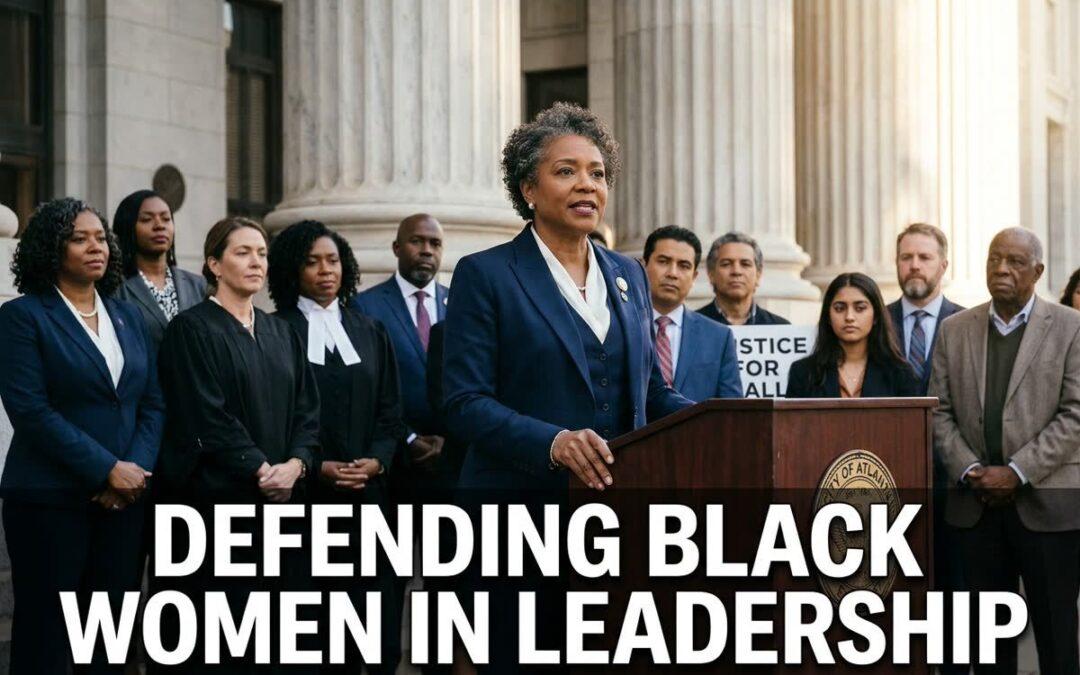

Why Civil Rights Groups Are Defending Black Women Leaders
By Darius Spearman (africanelements)
Support African Elements at patreon.com/africanelements and hear recent news in a single playlist. Additionally, you can gain early access to ad-free video content.
A unified coalition of prominent advocacy organizations issued a formal alert regarding systematic political intimidation in late 2024. More than fifty civil rights groups joined together to challenge an intensifying campaign directed at Black women holding public office (nwlc.org, independentsector.org). The alliance features leading legal defense organizations, voting rights networks, and public interest groups. Participants include the Lawyers’ Committee for Civil Rights Under Law, Common Cause, and the National Women’s Law Center (nwlc.org).
The joint statement warned that elected women of color face coordinated legislative, administrative, and personal attacks (theroot.com). These hostile actions threaten basic constitutional norms and public integrity. Understanding this moment requires looking beyond daily news cycles. The current hostility reflects an established American pattern. Whenever marginalized leaders secure formal legal authority, institutional opposition rapidly intensifies across the political landscape.
Civil Rights Coalition Warning Over Rising Retribution
The civil rights coalition warning highlighted an expanding series of retaliatory measures targeting prominent officials (nwlc.org). High-ranking figures have faced administrative harassment, formal ethics inquiries, and direct threats of prosecution (theroot.com). The targets include New York Attorney General Letitia James and Federal Reserve Governor Lisa Cook (nwlc.org). They also include United States Representatives Ilhan Omar and LaMonica McIver, alongside federal District Judge Ana Reyes (theroot.com, advocate.com).
Advocacy leaders documented how partisan actors systematically weaponize federal and state regulatory machinery (nwlc.org). These actors direct administrative inquiries at officials who enforce statutory protections or conduct constitutional oversight (theroot.com). The coalition explained that these maneuvers are designed to delegitimize women of color in positions of authority (nwlc.org). When legal oversight is redefined as partisan persecution, democratic institutions suffer lasting damage across every branch of government (independentsector.org).
The organizations called upon the United States Congress to take decisive protective action (nwlc.org). Their policy platform demands immediate public resolutions condemning identity-based political harassment (theroot.com). It also seeks statutory firewalls to stop the executive branch from directing retaliatory federal investigations (independentsector.org). Additionally, the coalition requested expanded security infrastructure to safeguard public servants facing physical threats (nwlc.org).
Online Abuse Disparity Facing Women Leaders
Relative risk of receiving abusive digital content among public officials (Amnesty International)
History of Civil Rights and the Struggle for Representation
The contemporary political climate cannot be separated from the longer history of civil rights struggles in the United States. From the founding period through Reconstruction, legal structures denied Black women basic political participation. The Fifteenth Amendment expanded male voting qualifications in 1870 while ignoring sex entirely. Half a century later, the Nineteenth Amendment banned gender restrictions on the ballot in 1920. Yet Jim Crow laws, literacy tests, and administrative hurdles continued to block Black women from voting.
These systemic exclusions forced Black women to build external movements to challenge state policy. In 1851, Sojourner Truth delivered her landmark address at the Ohio Women’s Rights Convention. She exposed how racial hierarchies denied Black women the basic protections afforded to white women. Decades later, investigative journalist Ida B. Wells-Barnett exposed racial terror throughout the American South. During the 1913 Woman Suffrage Procession in Washington, white march leaders ordered Wells-Barnett to walk in the back. She rejected the mandate and marched openly with her state delegation.
Mid-twentieth-century mobilizations expanded through decisive grassroots organizing efforts led by women organizers. Activists managed field offices, directed voter literacy workshops, and coordinated boycotts across the Deep South. When these organizers sought elective office, established party machines mobilized against them. In 1964, Fannie Lou Hamer traveled to Atlantic City with the Mississippi Freedom Democratic Party. She testified about severe physical beatings and economic evictions inflicted on Black voters. President Lyndon Johnson called a sudden national television briefing to bump her live testimony off network airwaves.
Four years later, Shirley Chisholm secured election to the United States House of Representatives from Brooklyn, New York. Chisholm campaigned under the motto “Unbought and Unbossed.” She launched an historic campaign for the presidency of the United States in 1972. Opponents filed lawsuits to bar her name from state primary ballots. Broadcasters denied her equal access to televised primary debates. Chisholm stated that throughout her career, gender bias created more political obstacles than racial bias. The Shirley Chisholm legacy established an enduring model for independent Black leadership inside federal institutions.
Targeting Black Elected Officials from Reconstruction to Today
The practice of targeting Black elected officials through state legal machinery possesses deep historical precedents. During the era of post-Civil War Reconstruction, formerly enslaved men won legislative seats across the American South. In September 1868, white lawmakers in Georgia organized the expulsion of thirty-three newly elected Black state representatives. Known historically as the “Original 33,” these legislators were expelled through procedural maneuvers. White lawmakers asserted that the state constitution permitted Black citizens to vote, but not to hold legislative office.
This Reconstruction-era expulsion demonstrated how political factions manipulate statutes to nullify democratic elections. When Black communities exercised their voting power, ruling hierarchies rewrote procedural rules to dismantle Black governance. The violent overthrow of the biracial local government in Wilmington, North Carolina, in 1898 showed similar dynamics. White supremacist networks destroyed Black businesses, murdered municipal residents, and forced elected aldermen to resign at gunpoint. Disenfranchisement conventions followed, codifying structural exclusion into state constitutions for generations.
Modern legislative bodies deploy parallel maneuvers against progressive local officials today. In states like Georgia and Missouri, lawmakers passed bills establishing centralized prosecutorial oversight commissions. These commissions claim the administrative power to discipline, sanction, or remove locally elected district attorneys. The primary targets of these preemption measures have been reform-minded Black prosecutors elected in metropolitan counties. By shifting authority away from local voters to state boards, legislatures recreate historic nullification tactics under modern administrative rubrics.
Representation Gaps in Public Governance
Comparison of population shares versus actual officeholding levels (U.S. Census Bureau and CAWP)
The Weaponization of DEI Attacks Against Qualified Officials
In recent political cycles, the weaponization of DEI attacks has become a common strategy to challenge Black leadership. Diversity, Equity, and Inclusion initiatives originated within corporate and academic settings to encourage fair employment practices. Over time, conservative commentators and political operatives systematically refashioned the phrase into a derogatory term. The label now operates as a rhetorical substitute for older racial dog whistles like “affirmative action hire” or “unqualified quota pick.”
This rhetorical tactic aims to delegitimize Black professionals who possess extensive credentials and lengthy records of public service. Opponents routinely label New York Attorney General Letitia James as an unqualified beneficiary of identity programs (theroot.com). Yet James served as a legal aid attorney, public defender, city councilor, and citywide Public Advocate before winning statewide office (theroot.com). Critics also directed similar attacks at Federal Reserve Governor Lisa Cook (bwbx.io). Cook completed degrees as a Marshall Scholar at Oxford University, earned an economics doctorate from UC Berkeley, and served on national advisory councils (bwbx.io).
Legal scholar Kimberle Crenshaw explained that Black women experience intersectional oppression where race and gender biases reinforce one another. Applying the derogatory label to qualified professionals dismisses their individual merit and personal labor. Furthermore, state legislatures have leveraged this rhetoric to enact restrictive administrative policies across multiple jurisdictions. Lawmakers introduce bills that eliminate diversity offices, restrict history curricula, and limit state agency oversight. By manufacturing public grievance around the acronym, political actors build ideological cover for stripping resources from minority-led agencies.
Attacks on Letitia James and Retaliatory Investigations
Public attacks on Letitia James intensified sharply after her office completed a civil fraud prosecution against Donald Trump and his businesses (apnews.com). The New York State Supreme Court found the defendants liable for persistent financial falsifications and inflated asset valuations (apnews.com). Following the judicial verdict, national political rhetoric shifted toward personal retribution against James (theroot.com, apnews.com). Public figures demanded federal investigations into her office and encouraged disciplinary complaints designed to revoke her law license (apnews.com).
Similar administrative pressures emerged against other prominent women of color serving in the federal government. In early 2025, federal authorities indicted United States Representative LaMonica McIver of New Jersey (house.gov, insidernj.com). The charges stemmed from an oversight inspection at the Delaney Hall federal immigration detention center (house.gov). McIver argued that she was exercising constitutionally protected legislative oversight regarding facility conditions (house.gov, house.gov). Nevertheless, the indictment prompted an automatic House Ethics Committee inquiry alongside partisan resolutions seeking her congressional censure (house.gov, house.gov).
United States District Judge Ana Reyes encountered parallel administrative harassment regarding her judicial duties (abajournal.com, advocate.com). The Department of Justice filed a formal judicial misconduct complaint against Reyes under Title 28 of the United States Code (abajournal.com, justice.gov). The filing accused Reyes of improper judicial conduct during litigation over military service policies (abajournal.com). Chief Judge Sri Srinivasan of the D.C. Circuit Court of Appeals reviewed the allegations and dismissed the complaint in its entirety (abajournal.com). Despite the formal dismissal, partisan commentators subjected Reyes to direct verbal hostility and personal intimidation (advocate.com).
Hostility and Retention Among Mayors of Color
Survey of political hostility and threat impacts on municipal executives (CAWP and Brennan Center)
Black Women in Politics and the Battle for Equal Justice
The contemporary standing of Black women in politics marks a profound structural transformation in American civic life. For generations, political observers categorized Black women primarily as the reliable base of the electorate. They consistently recorded high voter turnout percentages across major statewide and national elections (rutgers.edu, rutgers.edu). Yet their role was historically confined to campaign organizing and community mobilization. They operated as the foundation of political campaigns without holding constitutional authority to make executive determinations.
Over the past decade, Black women transitioned from community mobilization into the direct exercise of sovereign authority. They won elections as municipal chief executives, district attorneys, state attorneys general, and federal judges (rutgers.edu, rutgers.edu). This shift placed women of color in positions where they enforce regulatory compliance, direct criminal prosecutions, and interpret constitutional statutes. Rather than remaining outsiders appealing for justice, they became the public officials responsible for holding corporate entities and political figures accountable under the law.
This exercise of state power triggered the current wave of political and legal retribution (nwlc.org, theroot.com). Opponents no longer limit their resistance to routine electoral campaigns. Instead, they attempt to strip jurisdiction from minority-led offices, restrict prosecutorial discretion, and deploy criminal investigations against sitting officials (nwlc.org, independentsector.org). As historical studies indicate, there was an earlier shift in the political narrative that redefined social movements as threats to order. Modern retaliatory campaigns similarly seek to recast lawful legal oversight as partisan abuse.
The joint declaration from over fifty civil rights organizations establishes a line of defense for representative democracy (nwlc.org). The coalition affirmed that protecting public officials from racialized and gendered retribution is essential to protecting the rule of law (nwlc.org, independentsector.org). When sovereign legal authority is subordinated to political intimidation, the integrity of the judicial system fractures. Defending Black women leaders from coordinated administrative attacks is therefore essential to preserving the constitutional promise of equal justice under law (nwlc.org, theroot.com).
About the Author
Darius Spearman is a professor of Black Studies at San Diego City College, where he has been teaching for over 20 years. He is the founder of African Elements, a media platform dedicated to providing educational resources on the history and culture of the African diaspora. Through his work, Spearman aims to empower and educate by bringing historical context to contemporary issues affecting the Black community.
