



Why Is the Wage Gap for Black Women Still Costing Millions?
By Darius Spearman (africanelements)
Support African Elements at patreon.com/africanelements and hear recent news in a single playlist. Additionally, you can gain early access to ad-free video content.
A National Call for Economic Justice
On July 21, 2026, leading civil rights organizations mobilized across the United States to address a persistent economic challenge (pr.com). This specific date marks Black Women’s Equal Pay Day (pr.com). The day represents how far into the new year the average Black woman must work to match what a white, non-Hispanic man earned in the previous calendar year alone (pr.com, wordinblack.com).
The National Coalition on Black Civic Participation and the Mississippi Black Women’s Roundtable convened a national mobilization (pr.com, msbwr.org). Their goal is to fight federal legislative rollbacks and systemic wage disparities (pr.com). During the mobilization, organizers launched the tenth annual Power of the Sister Vote Poll (pr.com). This national effort comes at a critical time when federal policies threaten to erase workplace equity (nationalpartnership.org).
The Wage Gap in Real Terms (2026)
The Historic Legacy of Exploited Labor
To understand the modern wage gap, one must look at the history of labor exploitation in the United States. Under the system of American slavery, Black women performed forced physical and reproductive labor (wikipedia.org). In this historical context, reproductive labor refers to the forced bearing of children to generate wealth and expand the enslaver’s labor force (wikipedia.org). It also involved forced domestic caretaking and the wet-nursing of white children (wikipedia.org). This labor combined highly intimate bodily suffering with grueling domestic chores on plantations (wikipedia.org). Enslaved mothers were frequently separated from their own infants, resulting in profound maternal bereavement (wikipedia.org). Enslaved women actively resisted this commodification through methods such as pregnancy termination and using contraception (wikipedia.org).
After emancipation, systemic racism and Jim Crow policies trapped Black women in the lowest-paying job sectors. These policies established severe post-emancipation labor traps. Consequently, occupational segregation became the standard. Occupational segregation is the systemic overrepresentation or underrepresentation of specific demographic groups in particular occupations (equitablegrowth.org). It channels marginalized workers into low-wage, undervalued fields with few benefits (equitablegrowth.org). By 1930, over 60 percent of Black women were employed as domestic workers and maids, compared to only 20 percent of white women (nwlc.org, nwlc.org).
Grassroots Organizing and the Washerwomen of Atlanta
Black women did not simply accept these unfair economic structures. They actively organized to demand fair compensation. On July 19, 1881, a historic labor strike began in Atlanta, Georgia (dwherstories.com). Twenty Black domestic laundresses established the Washing Society of Atlanta (dwherstories.com).
Their daily work was incredibly grueling. They had to haul water over long distances and manufacture their own soap (dwherstories.com). In return, they received monthly wages as low as four dollars, which is less than thirty dollars a week in modern value (dwherstories.com). Through incredible door-to-door grassroots organizing, their membership grew to more than 3,000 workers in less than a month (dwherstories.com). Despite political backlash, police harassment, and heavy fines, the workers stood firm (dwherstories.com). They forced the wealthy white establishment to agree to a uniform rate of one dollar per dozen pounds of laundry (dwherstories.com). This strike represents the deep history of black women’s organizing power in Southern labor movements.
The Exclusionary Design of Federal Policies
Later federal policies failed to correct these deep inequalities. For example, the Fair Labor Standards Act of 1938 excluded domestic and agricultural sectors (nationalaglawcenter.org). This exclusion was a calculated political compromise by President Franklin D. Roosevelt’s administration (nationalaglawcenter.org). The administration wanted to appease powerful Southern Democratic congressmen (nationalaglawcenter.org). These Southern legislators demanded exclusions to protect their low-wage agricultural economy and deny federal labor rights to Black workers (nationalaglawcenter.org).
Because agricultural and domestic work was overwhelmingly performed by Black workers, these categories served as a cover to systematically deny them protections (nationalaglawcenter.org). Southern politicians openly spoke about their racial motivations (nationalaglawcenter.org). For instance, Florida Representative J. Mark Wilcox argued against federal wage mandates, stating that white and Black labor could not be treated on the exact same basis (nationalaglawcenter.org). Civil rights groups like the NAACP strongly opposed the bill, warning that the exclusions would act as a sieve through which the vast majority of Black workers would fall (nationalaglawcenter.org). Consequently, millions of Black workers remained without basic wage and hour protections (nationalaglawcenter.org).
Decades later, the Equal Pay Act of 1963 and the Civil Rights Act of 1964 attempted to address discrimination (wikipedia.org, senate.gov). However, the Equal Pay Act primarily focused on sex-based disparities and did not resolve the intersection of race and gender discrimination (wikipedia.org). Although the Civil Rights Act initially narrowed the gap, progress stalled by the mid-1970s (wikipedia.org).
Lifetime Economic Toll of the Wage Gap
What a Black woman loses over a 40-year career
This staggering loss robs Black families of generational wealth and basic financial security.
The Modern Era of Civil Service Reductions
The modern era is witnessing active rollbacks of critical workplace protections. Historically, the federal civil service was a key employer of Black women (ncbcp.org). It was one of the first major sectors to enforce desegregation mandates and affirmative action policies (wikipedia.org, ncbcp.org). These public sector jobs provided standardized salaries, predictable schedules, and union representation (ncbcp.org). They served as a major engine of economic mobility and wealth-building (ncbcp.org).
However, the second Trump administration has implemented massive civil service cuts driven by the Department of Government Efficiency (ncbcp.org). These cuts disproportionately harm Black women (ncbcp.org). In 2026, the administration intensified its campaigns against diversity, equity, and inclusion initiatives (ncbcp.org). On March 26, 2026, President Trump signed Executive Order 14398 (michaelbest.com, sidley.com). This order bans federal contractors from engaging in what the administration calls racially discriminatory DEI activities (michaelbest.com, sidley.com). It ties compliance directly to False Claims Act liability, directing the Department of Justice to investigate and prosecute contractors (sidley.com).
Furthermore, on June 29, 2026, the Equal Employment Opportunity Commission voted to rescind its 1979 Affirmative Action Interpretive Guidelines, effective July 6, 2026 (michaelbest.com, ktslaw.com). This move strips employers of a forty-year-old safe harbor defense for voluntary affirmative action (ktslaw.com). Federal agencies have closed internal DEI offices and terminated tens of thousands of jobs (ncbcp.org). This conflict highlights the ongoing struggle between state versus federal power.
State Battles and the Salary History Trap
These rollbacks are playing out with severe consequences at the state level. In Mississippi, the Black Women’s Roundtable is fighting on the ground (msbwr.org, msbwr.org). Mississippi passed an Equal Pay Law in 2022 (ms.gov). However, advocates point out that the law contains critical loopholes (msbwr.org, msbwr.org).
Specifically, the state law allows employers to use a worker’s salary history to determine their pay (msbwr.org, msbwr.org). This practice is highly problematic. Because Black women have historically been paid less, using salary history locks in and legalizes lower wages. It ensures that historical discrimination continues into the future.
In Mississippi, Black women lose more than 21,000 dollars annually to the wage gap (nwlc.org, nwlc.org). This loss has devastating generational consequences (nwlc.org, nwlc.org). Four out of five Black mothers in Mississippi are the primary breadwinners for their households (nwlc.org, nwlc.org). This pay gap directly compromises the stability and wealth of Black families.
Economic Anxiety and the Power of the Vote
The tenth annual Power of the Sister Vote Poll highlights how these policies affect real people. Released on Black Women’s Equal Pay Day, the poll surveyed 1,000 registered Black women voters (pr.com, theroot.com). It reveals widespread economic anxiety alongside high political resilience (theroot.com).
Wage discrimination remains highly common. Nearly half of all respondents, and 53 percent of those with college degrees, reported being paid less than a coworker for the same job (theroot.com). Additionally, 78 percent of surveyed Black women state that economic conditions are worsening (theroot.com). About 38 percent say their wages fail to keep up with the cost of living, and 44 percent have cut back on groceries (theroot.com).
Protecting Social Security and Medicare has risen to become the top priority for Black women (theroot.com). This marks a major shift from 2024, when general economic concerns were the main focus (theroot.com). Finally, 84 percent of respondents are worried about recent cuts to DEI programs, and 43 percent say these cuts have directly affected their close circles (theroot.com).
Organizations like the Service Employees International Union, or SEIU, are crucial in addressing these issues (seiu.org). The SEIU represents nearly 2 million workers in healthcare, public services, and property services (seiu.org). These fields employ a high concentration of Black women (seiu.org, seiu.org). Under leaders like SEIU President April Verrett, the union co-sponsors the poll to highlight these struggles (seiu.org, seiu.org). This organizing effort connects to larger intersectional liberation movements.
Power of the Sister Vote Poll Findings
Labor Disconnection and the Care Economy
The economic pressures of 2026 have contributed to a high rate of labor force disconnection. Labor force disconnection refers to individuals who are completely detached from the formal labor market (jff.org). They are not working and have stopped looking for employment due to systemic barriers like unpaid caregiving or chronic health issues (jff.org).
Currently, more than 600,000 Black women are disconnected from the workforce (pr.com, pr.com). Unpaid caregiving is a major driver of this disconnection (equitablegrowth.org). This issue is closely tied to the care economy. The care economy encompasses all paid and unpaid work that supports human and ecological well-being (zerotothree.org, equitablegrowth.org). It includes paid jobs like childcare and nursing, as well as unpaid housework and family care (zerotothree.org, equitablegrowth.org).
Unpaid care work is excluded from traditional measures like Gross Domestic Product, making it invisible to policymakers (ilo.org, equitablegrowth.org). At the same time, workers in the paid care economy are disproportionately Black, Latina, and immigrant women (nelp.org, equitablegrowth.org). These workers face severe wage suppression and low benefits (nelp.org, equitablegrowth.org). The lack of public investment in care infrastructure forces families to absorb high caregiving costs, pushing Black women out of the workforce entirely (zerotothree.org, equitablegrowth.org).
The Massive Lifetime Cost and the Path Forward
The wage gap is not a small statistical difference. It has massive lifetime consequences. In 2026, a Black woman working full-time makes only 65 cents for every dollar paid to a white, non-Hispanic man (pr.com, nationalpartnership.org). For all earners, including part-time workers, the gap is 63 cents on the dollar (pr.com, nationalpartnership.org).
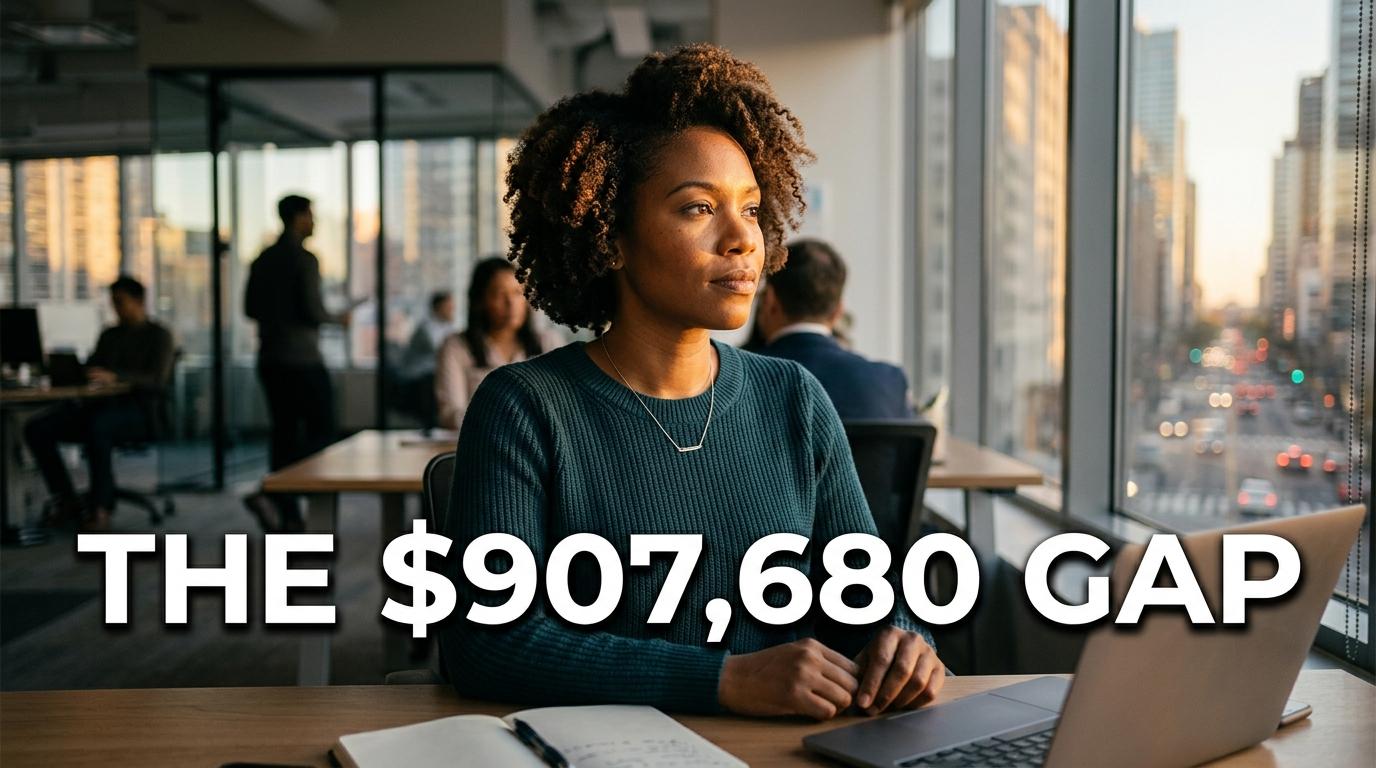
This gap represents a loss of 1,891 dollars per month, or 22,692 dollars per year (nationalpartnership.org, nwlc.org). Over a forty-year career, a Black woman loses approximately 907,680 dollars, which is nearly 1 million dollars (nationalpartnership.org, nwlc.org). If this wage gap were eliminated, the average Black woman would have enough money to cover 30 months of food, 23 months of childcare, or 12 months of mortgage payments (nationalpartnership.org, nwlc.org).
To correct these historic wrongs, civil rights organizations are demanding clear policy solutions. They call for passing the federal Paycheck Fairness Act to close loopholes and ban salary history inquiries (nationalpartnership.org). They demand the protection of federal anti-discrimination agencies to enforce workplace equal opportunity laws (nationalpartnership.org). Finally, they argue for robust public investments in the care economy to support working families (nationalpartnership.org, equitablegrowth.org). Paying Black women fairly is a necessary step to secure the wealth, health, and future of Black families (pr.com).
About the Author
Darius Spearman is a professor of Black Studies at San Diego City College, where he has been teaching for over 20 years. He is the founder of African Elements, a media platform dedicated to providing educational resources on the history and culture of the African diaspora. Through his work, Spearman aims to empower and educate by bringing historical context to contemporary issues affecting the Black community.
