



Mississippi Teen Death: What Did The Independent Autopsy Find?
By Darius Spearman (africanelements)
Support African Elements at patreon.com/africanelements and hear recent news in a single playlist. Additionally, you can gain early access to ad-free video content.
The Disappearance of Nolan Wells on Horn Island
On July 4, 2026, eighteen-year-old Nolan Xavier Wells traveled to Horn Island, Mississippi, for a holiday boat trip (pbs.org, chicagocrusader.com). Wells was a promising college freshman and football player at Southwest Mississippi Community College (magnoliatribune.com). He departed on the trip with three white companions (chicagocrusader.com, latimes.com). Among them was Warren Hudson, the stepson of a local circuit court judge (latimes.com, atlantablackstar.com). Later that evening, Wells vanished without a trace from the island (pbs.org, chicagocrusader.com).
The account provided by his companions immediately drew intense public scrutiny (chicagocrusader.com, latimes.com). They claimed their boat suffered bilge pump and electrical failures (latimes.com). Consequently, they called a tow boat and left Wells behind on the uninhabited island (latimes.com). They asserted that Wells chose to stay behind to speak with a girl named Katie McCormack (latimes.com). However, Katie McCormack directly contradicted their timeline (latimes.com). She stated that Wells told her he planned to ride back with his original group (latimes.com).
Furthermore, the companions returned to the mainland possessing the cell phone and car keys that belonged to Wells (latimes.com). They did not notify his mother immediately when he failed to arrive home (latimes.com). Later, his mother used a tracking app to locate his phone at a companion’s house (latimes.com). She discovered that several text messages and social media data had been deleted (latimes.com). Searchers recovered his body from Gulf Coast waters on July 6 (pbs.org, latimes.com). Local law enforcement quickly suggested an accidental drowning occurred without foul play (pbs.org, chicagocrusader.com).
Independent Autopsy Findings and Head Trauma
Dissatisfied with initial law enforcement claims, the family sought an independent medical examination (pbs.org, chicagocrusader.com). Dr. Roger Mitchell Jr., former Chief Medical Examiner of Washington, D.C., conducted a second autopsy on July 10, 2026 (pbs.org, chicagocrusader.com). Civil rights attorney Ben Crump and the Reverend Al Sharpton presented the findings on July 22, 2026, at the NAACP National Convention in Chicago (pbs.org, chicagocrusader.com).
Dr. Mitchell discovered a significant area of deep tissue red discoloration measuring 12-by-8 inches (pbs.org, chicagocrusader.com). This localized trauma was situated over the occipital bone at the back of the skull (pbs.org, chicagocrusader.com). The occipital bone is the saucer-shaped structure forming the lower base of the human skull (wikipedia.org). It protects the brainstem and connects the brain to the spinal cord (wikipedia.org).
In death investigations, trauma to the occipital area holds major forensic significance (theforensicdoc.com). It indicates a severe blunt force impact, a heavy physical blow, or an assault prior to death (theforensicdoc.com). Such injuries can render an individual unconscious before entering the water (theforensicdoc.com). This impairment prevents a victim from attempting to swim or survive (theforensicdoc.com). Ultimately, Dr. Mitchell designated the official cause and manner of death as undetermined (pbs.org, chicagocrusader.com).
Occipital Skull Trauma
12-by-8 inch area of deep tissue red discoloration at the back of the skull, indicating blunt force impact prior to death.
Manner of Death
Officially labeled “Undetermined” due to missing state-retained neck organs and bodily decomposition.
The Mystery of Missing Neck Structures and State Protocol
The independent autopsy remained incomplete because essential anatomical structures were absent from the body (pbs.org, chicagocrusader.com). The Mississippi State Medical Examiner’s Office retained the internal neck organs during their initial examination (pbs.org, chicagocrusader.com). These withheld organs included the hyoid bone, the larynx, and the trachea (pbs.org, chicagocrusader.com).
Without these vital neck tissues, Dr. Mitchell could not inspect the airway for water entry (pbs.org, chicagocrusader.com). Nor could he evaluate the delicate hyoid bone for fractures that indicate strangulation (pbs.org, chicagocrusader.com). State examiners retained these tissues to execute microscopic and toxicological testing (pbs.org, chicagocrusader.com, fpsllc.org).
Forensic pathologist Dr. Roger Mitchell explicitly noted that retaining internal neck structures is a standard forensic protocol during active investigations (pbs.org, chicagocrusader.com). State authorities utilize this procedure to rule out subtle internal trauma (theforensicdoc.com, fpsllc.org). However, this retention left the private pathologist with an incomplete body (pbs.org, chicagocrusader.com). Consequently, independent experts could not rule out manual strangulation or neck compression (pbs.org, chicagocrusader.com).
Legal Authority and the Feud of the Autopsies
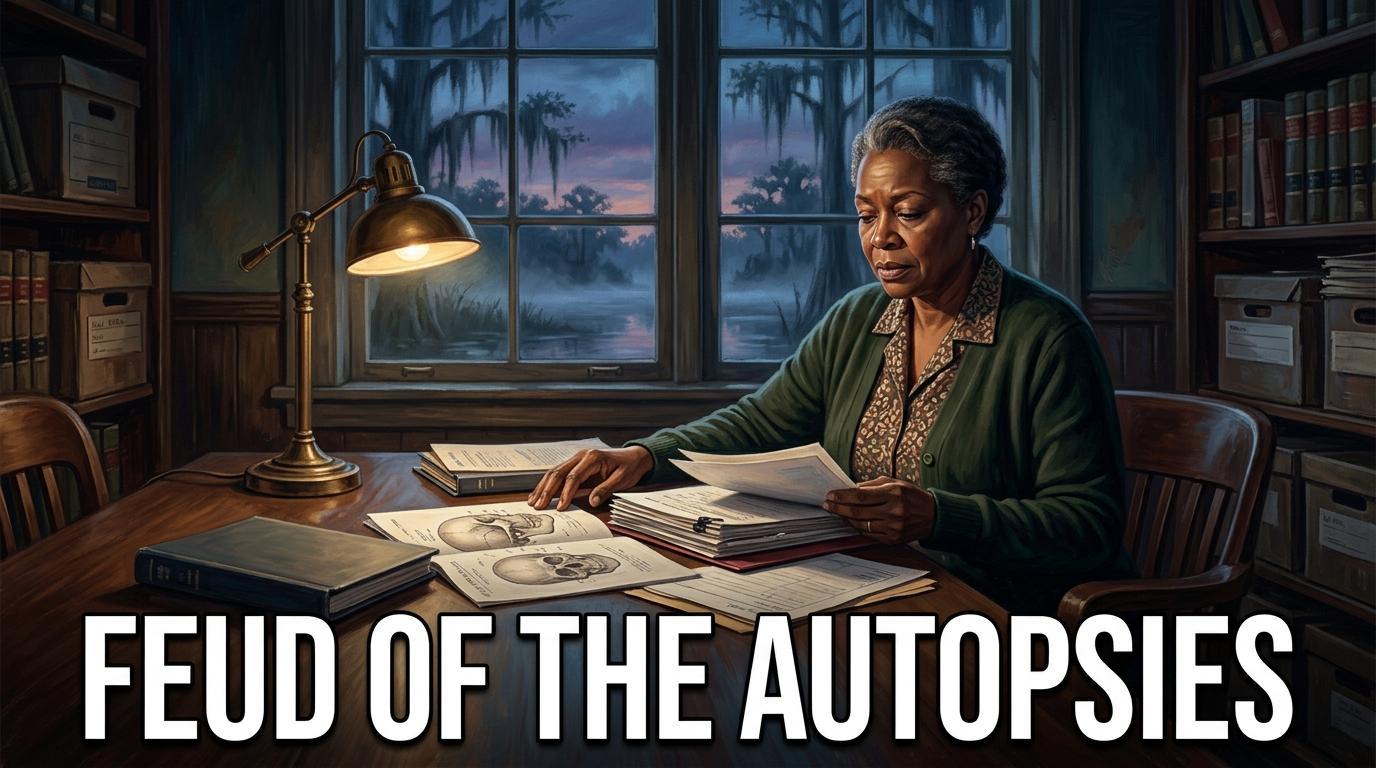
This case highlights a recurring phenomenon known in civil rights history as the feud of the autopsies (pbs.org, newsfromthestates.com, newsfromthestates.com). This phrase describes the scientific, legal, and public clash between state autopsies and private secondary autopsies (pbs.org, newsfromthestates.com). It reflects deep distrust in state forensic systems across the Deep South (pbs.org, newsfromthestates.com).
An independent autopsy does not possess the legal authority to alter an official death certificate (findlaw.com, theforensicdoc.com). Legally, only the state-appointed medical examiner or county coroner holds the power to issue or amend vital death records (findlaw.com, theforensicdoc.com). Therefore, a secondary report serves primarily as an investigative tool for public accountability and legal advocacy (findlaw.com, theforensicdoc.com).
Families utilize secondary findings to petition local courts or present objective medical evidence to grand juries (findlaw.com, theforensicdoc.com). These conflicting medical reports generate public pressure on local prosecutors (chicagocrusader.com, latimes.com). Furthermore, objective private findings provide the medical foundation needed to request intervention from federal agencies, such as the Federal Bureau of Investigation (pbs.org, chicagocrusader.com).
Historical Precedents: From Freedom Summer to Modern Lynchings
The practice of seeking independent medical reviews in Mississippi has deep roots in civil rights history (wikipedia.org, crmvet.org). During the 1964 Freedom Summer, civil rights workers James Chaney, Andrew Goodman, and Michael Schwerner were murdered in Neshoba County (wikipedia.org, crmvet.org). Local coroner Dr. William Featherston performed an initial autopsy that noted gunshot wounds but omitted evidence of brutal torture (wikipedia.org, crmvet.org, pbs.org).
In response, civil rights leaders commissioned an independent autopsy by pathologist Dr. David Spain (wikipedia.org, crmvet.org, pbs.org). Dr. Spain revealed that James Chaney, a Black activist, had suffered an extraordinary beating that shattered his bones before his death (wikipedia.org, crmvet.org, pbs.org). This counter-finding exposed the local cover-up and forced federal authorities to prosecute the perpetrators (wikipedia.org, crmvet.org, pbs.org).
This historic struggle connects directly to the long legacy of racial terror across the region (wikipedia.org). Modern cases reflect this ongoing pattern (atlantablackstar.com, thenation.com). In 2008, 17-year-old Billey Joe Johnson Jr. died from a shotgun blast during a traffic stop in Lucedale, Mississippi (snopes.com, thenation.com). Local authorities ruled his death accidental (snopes.com, thenation.com). Similarly, in 2025, college student Trey Reed was found hanging from a tree at Delta State University (revealnews.org, newsone.com). Police immediately claimed no foul play occurred, prompting his family to order a private autopsy (revealnews.org, newsone.com).
Systemic Trust Deficits and the Role of JULIAN
The systemic skepticism surrounding state autopsies is reinforced by recent cases of in-custody deaths (mississippifreepress.org, themarshallproject.org). In July 2021, 29-year-old Damien Cameron died after police officers knelt on his back for over twenty minutes (mississippifreepress.org, themarshallproject.org). Mississippi Chief Medical Examiner Dr. Staci Turner ruled the cause of death as undetermined (mississippifreepress.org, themarshallproject.org). However, three independent pathologists later examined the medical records and determined Cameron died from homicide caused by compression asphyxiation (mississippifreepress.org, themarshallproject.org).
Compression asphyxiation is a medical term for suffocation that occurs when external force is applied to the neck, chest, or back (themarshallproject.org, nih.gov, theforensicdoc.com). This physical restriction prevents the lungs from expanding normally (themarshallproject.org, nih.gov). Consequently, oxygen deprivation triggers cardiopulmonary arrest and rapid death (themarshallproject.org, nih.gov).
To combat these structural failures, civil rights organizations actively intervene in state death investigations (atlantablackstar.com, chicagocrusader.com). The non-profit organization JULIAN was founded in 2020 by civil rights attorney Jill Collen Jefferson (atlantablackstar.com, chicagocrusader.com, chicagocrusader.com). Named after legendary civil rights leader Julian Bond, JULIAN investigates modern lynchings and suspicious deaths across the Deep South (atlantablackstar.com, chicagocrusader.com). In 2026, JULIAN released a landmark report titled “Crimson Record,” documenting over seventy suspicious hanging deaths since 2000 across seven southern states, with Mississippi accounting for twenty cases (atlantablackstar.com, chicagocrusader.com, chicagocrusader.com). This ongoing advocacy represents a crucial aspect of the struggle between state and federal power (atlantablackstar.com, chicagocrusader.com).
The Rise of Counter-Forensics and the Kaepernick Initiative
The growing reliance on private autopsies reflects the modern development of counter-forensics (forensic-architecture.org, csalateral.org). Originally conceptualized by theorist Allan Sekula and popularized by research groups like Forensic Architecture, counter-forensics is a social justice framework (forensic-architecture.org, csalateral.org, e-flux.com). It is defined as civil attempts by citizens and activists to adopt, reclaim, and subvert state-controlled forensic tools (forensic-architecture.org, csalateral.org). Rather than accepting state narratives, counter-forensics constructs independent archives of accountability presented in alternative public forums (forensic-architecture.org, csalateral.org, e-flux.com).
This concept is actively embodied by the Know Your Rights Camp Autopsy Initiative, founded and funded by former NFL player Colin Kaepernick (pbs.org, chicagocrusader.com, bencrump.com, knowyourrightscamp.org). The initiative covers the high costs of secondary autopsies for families who lose loved ones to police custody or suspicious circumstances (pbs.org, chicagocrusader.com, bencrump.com, knowyourrightscamp.org). Kaepernick’s organization fully funded the independent autopsy performed on Nolan Wells (pbs.org, chicagocrusader.com, bencrump.com).
With the backing of attorney Ben Crump and Reverend Al Sharpton, the Wells family continues to demand a federal investigation (pbs.org, chicagocrusader.com). Additionally, Al Sharpton, filmmaker Tyler Perry, and former NFL athlete Terrell Owens offered a joint reward of $125,000 for information leading to an arrest (pbs.org, chicagocrusader.com). Their collective mobilization demonstrates how modern civil rights advocates use independent science to demand justice where local authorities fall short (pbs.org, chicagocrusader.com). This strategy builds upon historical lessons from earlier civil rights activism across the nation.
About the Author
Darius Spearman is a professor of Black Studies at San Diego City College, where he has been teaching for over 20 years. He is the founder of African Elements, a media platform dedicated to providing educational resources on the history and culture of the African diaspora. Through his work, Spearman aims to empower and educate by bringing historical context to contemporary issues affecting the Black community.
