



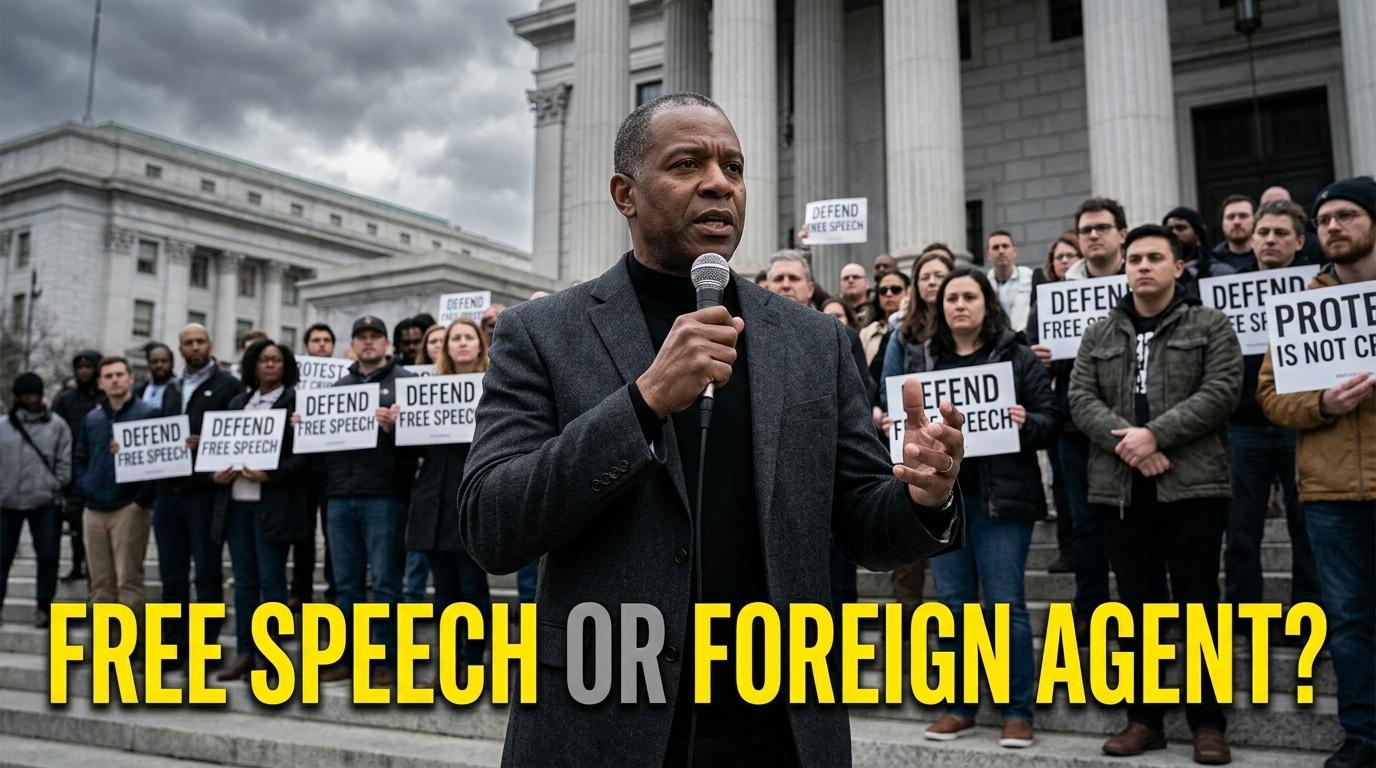
Why Is the FBI Targeting the Uhuru 3 Foreign Agent Case?
By Darius Spearman (africanelements)
Support African Elements at patreon.com/africanelements and hear recent news in a single playlist. Additionally, you can gain early access to ad-free video content.
On July 22, 2026, three federal judges at the 11th U.S. Circuit Court of Appeals in Atlanta gathered to hear oral arguments in a landmark legal battle (courthousenews.com). The appeal centers on African liberation advocate Chairman Omali Yeshitela and his co-defendants, a group collectively known as the Uhuru 3 (courthousenews.com). This pivotal appeal questions whether independent political speech critical of United States foreign policy loses constitutional protection if it mirrors the interests of a foreign government (courthousenews.com, courthousenews.com).
To fully understand the current legal battle, observers must look far past recent headlines. The prosecution of the Uhuru 3 represents a continuation of federal law enforcement strategies aimed at suppressing radical Black political dissent (blackagendareport.com, nlg.org). For over a century, federal agencies have frequently framed internal demands for racial equality as foreign-directed threats to national security (wikipedia.org, wikipedia.org). This trial brings foundational questions regarding understanding Black political power directly back into the legal spotlight.
The Split Verdict and the Battle in Atlanta
The legal saga began in July 2022 when armed federal agents raided offices and residences tied to the African People’s Socialist Party in Florida and Missouri (tampabay.com, orinocotribune.com). In April 2023, the Department of Justice indicted four individuals, claiming they operated as unregistered agents of the Russian government under 18 U.S.C. § 951 (justice.gov). The prosecution alleged that Russian national Aleksandr Ionov funded and directed local protests, travel, and political petitions (justice.gov, justice.gov).
In September 2024, a federal jury in Tampa returned a contradictory split verdict (tampabay.com, tampabay.com). The jury found African People’s Socialist Party Chairman Omali Yeshitela, along with white solidarity organizers Penny Hess and Jesse Nevel, not guilty of acting as foreign agents (courthousenews.com, tampabay.com). However, the jury convicted all three defendants on a lesser charge of conspiring to act as unregistered foreign agents (courthousenews.com, tampabay.com). Defense attorneys noted the paradox of convicting individuals for conspiring to commit a crime that the jury ruled they never actually committed (courthousenews.com, courthousenews.com).
A fourth defendant, Augustus Romain Jr., received separate convictions during the same proceeding (tampabay.com). Romain was formally expelled from the African People’s Socialist Party in late 2018 and subsequently founded the Atlanta-based Black Hammer Party (justice.gov, apscuhuru.org). Because Romain operated an independent group with distinct legal representation, the public defense campaign specifically maintained focus on the remaining party leaders as the Uhuru 3 (orinocotribune.com, handsoffuhuru.org). At the December 2024 sentencing, District Judge William Jung spared the defendants prison time, imposing three years of probation while acknowledging that their activities constituted protected political speech (courthousenews.com, tampabay.com).
Understanding the Charges: Section 951 vs. FARA
The prosecution of the Uhuru 3 relied heavily upon 18 U.S.C. § 951, a federal statute often categorized alongside national security and espionage laws (fara.us, thefederalcriminalattorneys.com). Federal prosecutors chose Section 951 rather than the traditional Foreign Agents Registration Act, commonly known as FARA (justice.gov, fara.us). Understanding the subtle legal distinctions between these two statutes is essential for evaluating the First Amendment implications raised on appeal (eff.org, thefederalcriminalattorneys.com).
FARA acts primarily as a regulatory disclosure standard requiring individuals who engage in lobbying or public relations on behalf of foreign principals to register with the government (fara.us). In contrast, Section 951 is a felony criminal statute targeting actions taken subject to the direction or control of a foreign government (thefederalcriminalattorneys.com). Legal criteria require a explicit agency agreement where an individual submits to the authority of a foreign state (thefederalcriminalattorneys.com, justia.com). Independent political activities that happen to align with a foreign nation’s geopolitical goals do not satisfy the legal threshold of direction or control (eff.org, thefederalcriminalattorneys.com).
- Enacted in 1938 for transparency.
- Focuses on political lobbying and PR.
- Triggered by actions at “request” of foreign entity.
- Requires registration with DOJ.
- Criminal felony statute.
- Targets covert intelligence operations.
- Requires strict “direction or control”.
- Carries up to 10 years in prison.
During the July 2026 oral arguments, appellate attorneys stressed that the government misapplied Section 951 to punish speech protected under the Constitution (courthousenews.com). Because the jury acquitted the defendants of acting as actual foreign agents, the conspiracy conviction relies entirely on shared political ideas (courthousenews.com, courthousenews.com). Defense counsel argued that allowing conspiracy charges to stand under these conditions sets a dangerous precedent for all domestic advocacy groups (courthousenews.com, nlg.org).
The Echoes of 1951: W.E.B. Du Bois and Foreign Influence
The trial of the Uhuru 3 directly parallels the historical prosecution of civil rights icon Dr. W.E.B. Du Bois in 1951 (blackagendareport.com, wikipedia.org). During the height of the Cold War, the United States Department of Justice ordered the 82-year-old scholar to register as a foreign agent (wikipedia.org). Du Bois served as chairman of the Peace Information Center, an organization promoting the Stockholm Peace Appeal to ban nuclear weapons globally (wikipedia.org).
Federal officials argued that the anti-war petition mirrored Soviet foreign policy and therefore constituted foreign propaganda (wikipedia.org). Du Bois refused to register, asserting that his opposition to nuclear conflict stemmed from independent moral convictions rather than foreign direction (wikipedia.org). Prosecutors indicted Du Bois under FARA, but a federal judge ultimately acquitted him due to a total lack of evidence demonstrating foreign direction or control (wikipedia.org). Despite the legal victory, the trial disrupted Du Bois’s organizing work during a crucial era of struggle (wikipedia.org, zinnedproject.org).
That same year, the Civil Rights Congress presented a historic petition to the United Nations titled “We Charge Genocide: The Crime of Government Against the Negro People” (zinnedproject.org). Led by Paul Robeson and William Patterson, the petition documented systemic violence and economic deprivation targeting Black Americans (zinnedproject.org). Federal officials quickly denounced the document as Soviet-backed anti-American propaganda (zinnedproject.org). In 2015, the Uhuru Movement drafted a similar UN petition regarding Black human rights abuses, which federal prosecutors later cited as evidence of conspiring with Russian influence (justice.gov, apspuhuru.org). The parallel demonstrates how charges of foreign influence have repeatedly been used to discredit anti-colonial critiques (blackagendareport.com, wikipedia.org).
COINTELPRO, BIE, and the Legacy of Surveillance
Federal efforts to monitor Black political organizations rely on a long history of national security programs (bostonreview.net, wikipedia.org). Between 1956 and 1971, the Federal Bureau of Investigation operated COINTELPRO, a secret counterintelligence program designed to disrupt political organizations (wikipedia.org). Under Director J. Edgar Hoover, the bureau targeted groups including the Black Panther Party and the Student Nonviolent Coordinating Committee (wikipedia.org). Intelligence agencies systematically attributed demands for domestic reform to foreign communist manipulation (bostonreview.net, wikipedia.org).
This historical pattern re-emerged in August 2017 when the FBI Counterterrorism Division created the internal designation “Black Identity Extremist” (nlg.org). The bureau claimed that protests against police brutality served as a catalyst for targeted violence against law enforcement officer (nlg.org). Civil rights groups strongly condemned the classification, arguing that it lacked empirical evidence and served to justify unlawful surveillance against peaceful organizations (nlg.org). Facing intense congressional scrutiny, the FBI officially retired the terminology in 2019, though civil liberties advocates note that surveillance of Black political movements continues under updated program designations (nlg.org).
Modern surveillance operations frequently intersect with discussions surrounding domestic colonialism (apscuhuru.org, spectrejournal.com). This framework posits that Black communities within United States borders function as internal colonies subject to economic exploitation and external governance (prolewiki.org, spectrejournal.com). Organizations operating under this analysis view federal surveillance as an effort to suppress movements seeking political self-determination and radical reform (blackagendareport.com, spectrejournal.com). Examining these institutional dynamics helps contextualize the intense legal scrutiny directed at the Uhuru Movement (blackagendareport.com, nlg.org).
African Internationalism and the Fight for Autonomy
To understand the defense presented by the Uhuru 3, one must examine the philosophical origins of their political party (blackagendareport.com, prolewiki.org). Chairman Omali Yeshitela, born Joseph Waller, founded the African People’s Socialist Party in 1972 (wikipedia.org, prolewiki.org). Yeshitela gained national prominence in December 1966 after tearing down a racist Jim Crow mural from the walls of St. Petersburg City Hall (wikipedia.org, wikipedia.org). The artwork portrayed Black people as subservient caricatures, and his act of civil disobedience led to a conviction and two years of imprisonment (wikipedia.org, wikipedia.org).
The party developed a theoretical framework known as African Internationalism (prolewiki.org). While sharing historical connections with broader political trends like Pan-Africanism, African Internationalism specifically argues that international capitalism developed through the enslavement of African people and foreign colonial expansion (prolewiki.org, spectrejournal.com). The party advocates for international anti-colonial solidarity, self-defense, and direct calls for reparations (apspuhuru.org, prolewiki.org).
During the Tampa trial, defense attorneys presented decades of party literature published in their newspaper, *The Burning Spear* (courthousenews.com, theburningspear.com). The records demonstrated that the political positions prosecuted by the government—including opposition to NATO expansion and critiques of United States foreign intervention—had been consistently published by the party since the 1970s (courthousenews.com, theburningspear.com). The defense maintained that these views emerged from a long tradition of political thought rather than foreign instruction (courthousenews.com, courthousenews.com). Navigating complex factions of Black nationalism remains a long-standing feature of domestic liberation movements (bostonreview.net, spectrejournal.com).
Constitutional Stakes for Black Political Dissent
The pending decision by the 11th Circuit Court of Appeals holds profound implications for First Amendment protections across the nation (courthousenews.com, nlg.org). If the appellate panel upholds the conspiracy convictions, legal experts warn that the ruling will expand federal authority to criminalize domestic dissent (courthousenews.com, eff.org). Under such a standard, activist groups advocating for radical policy changes could face criminal conspiracy charges if a foreign government publicly endorses their message (courthousenews.com, nlg.org).
Conversely, overturning the conviction would re-affirm historical legal precedents protecting independent political advocacy (courthousenews.com, wikipedia.org). Constitutional scholars emphasize that the right to criticize government policy remains a foundational component when defining political freedom (eff.org, aclu-wi.org). The legal tradition established in early civil rights trials established that alignment with foreign propaganda does not strip citizens of their constitutional rights (wikipedia.org, aclu-wi.org).
As the three-judge panel deliberate in Atlanta, civil rights observers continue to track the proceedings closely (courthousenews.com, courthousenews.com). The ultimate ruling will decide whether decade-old political organizations can maintain independent anti-colonial rhetoric without federal interference (courthousenews.com, nlg.org). The outcome will inevitably shape the future boundary between protecting national security and safeguarding constitutional political speech (courthousenews.com, eff.org).
About the Author
Darius Spearman is a professor of Black Studies at San Diego City College, where he has been teaching for over 20 years. He is the founder of African Elements, a media platform dedicated to providing educational resources on the history and culture of the African diaspora. Through his work, Spearman aims to empower and educate by bringing historical context to contemporary issues affecting the Black community.
