


Church of England Slavery Fund: The Shocking History Behind It
By Darius Spearman (africanelements)
Support African Elements at patreon.com/africanelements and hear recent news in a single playlist. Additionally, you can gain early access to ad-free video content.
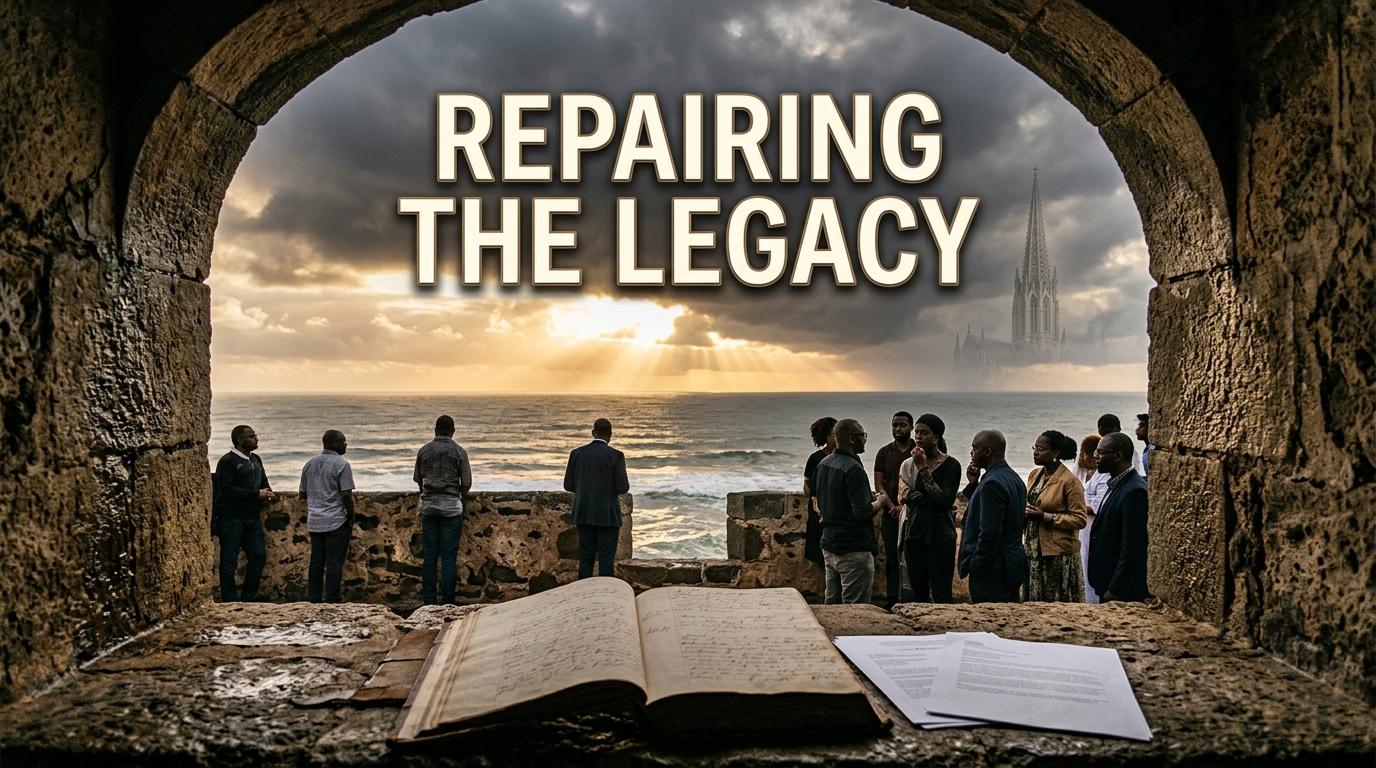
In July 2026, the leader of the Church of England made a historic journey to West Africa (theguardian.com, dioceseofnorwich.org). During a pastoral visit to Cape Coast Castle in Ghana, Archbishop Dame Sarah Mullally stood inside a former seventeenth-century slave fortress (theguardian.com, dioceseofnorwich.org). She addressed the dark legacy of European religious institutions in human trafficking (theguardian.com). Standing near the historic Door of Return, the Archbishop delivered a powerful sermon focused on repentance and action (theguardian.com, dioceseofnorwich.org). She formally reaffirmed the Church of England commitment to a one hundred million pound financial pledge (theguardian.com, churchofengland.org).
This financial allocation directly targets global African diaspora communities affected by transatlantic chattel slavery (churchofengland.org). Church leaders stressed that Christian repentance demands more than words of apology (theguardian.com, dioceseofnorwich.org). True repentance requires concrete financial action to repair past damage (theguardian.com). The initiative, known as Project Spire, funds long-term repair efforts through a dedicated endowment (churchofengland.org). The decision comes after intense public debate over the colonial origins of central Church wealth (theguardian.com, apnews.com).
Timeline: C of E Slavery Endowment Legacy
How Colonial Profits Built Modern Church Wealth
The roots of modern Church wealth connect directly to colonial financial institutions established centuries ago (wikipedia.org). In 1704, Queen Anne created a financial pool named Queen Anne Bounty (wikipedia.org). The primary goal was to supplement low incomes for poor Anglican clergy across England (wikipedia.org, wikipedia.org). To generate high financial returns, fund managers invested heavily in the South Sea Company during the early eighteenth century (wikipedia.org, theguardian.com).
The South Sea Company held a government-backed monopoly on human trafficking (wikipedia.org, wikipedia.org). Under the 1713 Treaty of Utrecht, the British Crown granted the company exclusive rights to supply enslaved Africans to Spanish colonies (wikipedia.org). Between 1714 and 1739, the company organized nearly one hundred forced slave voyages (theguardian.com). Historical records show that the company forcibly transported between thirty-four thousand and sixty-four thousand enslaved Africans across the Atlantic Ocean (theguardian.com).
The financial returns from these forced voyages built a strong foundation of Church capital (wikipedia.org, theguardian.com). Forensic researchers estimate that Queen Anne Bounty investments in South Sea securities equal roughly four hundred forty-three million pounds in modern values (theguardian.com, historyreclaimed.co.uk). Additionally, wealthy slave merchants like Edward Colston made major financial donations directly to the fund (theguardian.com). These investments created long-term financial growth for ecclesiastical structures while leaving descendant communities to face ongoing economic exploitation across former colonial territories.
Institutional Slavery on the Codrington Estates
Beyond stock market investments, Church missionary organizations directly owned forced-labor plantations in the Caribbean (uspg.org.uk, codringtonproject.org). In 1710, a plantation owner named Sir Christopher Codrington bequeathed two large sugar estates in Barbados to the Church (uspg.org.uk, codringtonproject.org). The estates covered over seven hundred acres of prime agricultural land (codringtonproject.org). The missionary branch, known as the Society for the Propagation of the Gospel in Foreign Parts, took direct control of the operations (uspg.org.uk, codringtonproject.org).
For more than a century, the missionary organization operated these Barbadian sugar estates where communities endured generations of forced labor under brutal overseers (uspg.org.uk, codringtonproject.org). Historical records document severe working conditions on the plantations (codringtonproject.org). Laborers suffered severe physical punishments and extreme daily work demands (codringtonproject.org). Church overseers even branded enslaved workers on their chests with the word “Society” to establish institutional ownership (codringtonproject.org). The revenues generated from sugar sales directly funded Anglican missionary work across the British Empire (uspg.org.uk, codringtonproject.org).
When the British Parliament passed the Slavery Abolition Act in 1833, the government provided massive payouts to enslavers rather than the victims (parliament.uk). The Church missionary society received eight thousand eight hundred twenty-three pounds in government compensation for losing four hundred ten enslaved laborers (uspg.org.uk, parliament.uk). This government payout represented millions of pounds in contemporary values (uspg.org.uk). In 1948, Parliament merged Queen Anne Bounty with ecclesiastical holdings to create the modern Church Commissioners (wikipedia.org, wikipedia.org). Consequently, these colonial profits became deeply integrated into a central endowment that now exceeds ten billion pounds (wikipedia.org, churchofengland.org).
Financial Valuation Comparison
Uncovering the History Through Forensic Accounting
The path toward financial repair began with an extensive internal review of historical ledger records (grantthornton.co.uk, theguardian.com). In 2019, the audit committee of the Church Commissioners hired specialized forensic accountants from Grant Thornton (grantthornton.co.uk, theguardian.com). Auditors spent years examining roughly twelve thousand handwritten transactions recorded between 1708 and the mid-nineteenth century (grantthornton.co.uk, theguardian.com).
The published audit report confirmed that Queen Anne Bounty had profited extensively from colonial human trafficking (theguardian.com, historyreclaimed.co.uk). In response to the findings, former Archbishop Justin Welby issued an official public apology in 2023 (theguardian.com, apnews.com). He acknowledged the deep moral failure of institutional participation in colonial slavery (theguardian.com, apnews.com). The Church Commissioners then announced an initial commitment of one hundred million pounds to establish a new reparative fund (theguardian.com, churchofengland.org).
To ensure proper administrative oversight, leaders established Project Spire to manage the initiative (churchofengland.org). An Independent Oversight Group composed of global scholars and advocates was formed to guide investment strategy (repaircampaign.org, theguardian.com). In early 2024, the oversight group recommended expanding the financial scope significantly (theguardian.com). They noted that one hundred million pounds represented a tiny fraction of central Church wealth (theguardian.com). The group suggested building a catalytic fund aiming for one billion pounds by partnering with external co-investors (theguardian.com, pioneerspost.com).
Understanding the Impact Investment Strategy
The operational framework of the Fund for Healing, Repair, and Justice differs significantly from direct cash reparations (pioneerspost.com, churchofengland.org). The initiative relies on a blended-finance impact investment model rather than individual monetary payouts (pioneerspost.com, churchofengland.org). This approach combines charitable seed capital with commercial investment mechanisms to build sustainable capital over time (pioneerspost.com).
Under this financial structure, Church funds serve as catalytic seed capital (pioneerspost.com, churchofengland.org). This capital reduces financial risks for third-party institutional co-investors, grantmakers, and sovereign funds (pioneerspost.com). The capital targets Black-led enterprise growth, technology funds, and social infrastructure across the United Kingdom, Africa, and the Caribbean (pioneerspost.com, churchofengland.org). Unlike traditional charitable grants that disburse funds as non-repayable gifts, impact investments yield financial returns (pioneerspost.com). These returns flow directly back into the main endowment to support future community programs (pioneerspost.com).
Project Spire: Blended-Finance Capital Model
The geographical scope focuses strictly on territories tied directly to British colonial slavery (churchofengland.org). While Black businesses in the United States do not receive direct capital allocations, African American financial leaders actively advise the project (pioneerspost.com). Experts like Roy Swan of the Ford Foundation have helped design investment selection criteria (pioneerspost.com). The overarching goal remains building an enduring asset base that continuously supports communities while honoring the enduring resilience of Black families across the diaspora.
Fiduciary Disputes and Parliamentary Opposition
Despite formal reaffirmations, the fund faces significant political and legal hurdles within the United Kingdom (brusselssignal.eu, historyreclaimed.co.uk). Conservative politicians and legal commentators have challenged the statutory authority of Church trustees (brusselssignal.eu, historyreclaimed.co.uk). Critics argue that using central endowment assets for historical repair violates fiduciary duties established by charity law (brusselssignal.eu, historyreclaimed.co.uk).
Opponents contend that Church Commissioners are legally required to reserve endowment income solely for Anglican ministry and clergy stipends (brusselssignal.eu, historyreclaimed.co.uk). Some critics assert that spending capital externally is ultra vires, or beyond legal powers (brusselssignal.eu, historyreclaimed.co.uk). Furthermore, parish advocates argue that financial resources should remain within local English communities experiencing economic hardship (brusselssignal.eu, psephizo.com).
These legal disputes have delayed formal fund registration with the Charity Commission for England and Wales (brusselssignal.eu, civilsociety.co.uk). While the General Synod acts as a legislative assembly for church policy, it lacks legal control over central endowment assets (parliament.uk, churchofengland.org). Fiduciary authority rests strictly with the Church Commissioners Board, which operates under statutory regulation (civilsociety.co.uk, churchofengland.org). Church officials continue consulting legal advisors to resolve challenges, reflecting wider historical debates over slavery and financial accountability (theguardian.com, churchofengland.org).
Pastoral Continuity and the Global Perspective
The transition of leadership within the Church of England has maintained operational momentum for the initiative (theguardian.com, churchofengland.org). Following Justin Welby’s tenure, Dame Sarah Mullally assumed office as Archbishop of Canterbury (theguardian.com). Her 2026 West African tour underscored full administrative backing for Project Spire during a critical legal review phase (theguardian.com, churchofengland.org).
Standing at the Cape Coast Castle Door of Return, church leaders highlighted the symbolic power of global African reunion (theguardian.com, dioceseofnorwich.org). Historically, slave fortresses marked the final point of departure for kidnapped Africans facing lifelong bondage (theguardian.com, dioceseofnorwich.org). Reclaiming these sites as spaces of return reflects broader movements toward economic restoration and ancestral connection (theguardian.com, dioceseofnorwich.org).
The Church of England efforts reflect growing international recognition of institutional accountability (repaircampaign.org, churchofengland.org). Across former colonial powers, academic institutions, banks, and religious bodies face mounting pressure to address historic slavery profits (repaircampaign.org, historyreclaimed.co.uk). By pairing formal apologies with substantial capital commitments, Church leaders aim to set a precedent for corporate and religious repair (pioneerspost.com, churchofengland.org).
About the Author
Darius Spearman is a professor of Black Studies at San Diego City College, where he has been teaching for over 20 years. He is the founder of African Elements, a media platform dedicated to providing educational resources on the history and culture of the African diaspora. Through his work, Spearman aims to empower and educate by bringing historical context to contemporary issues affecting the Black community.
