



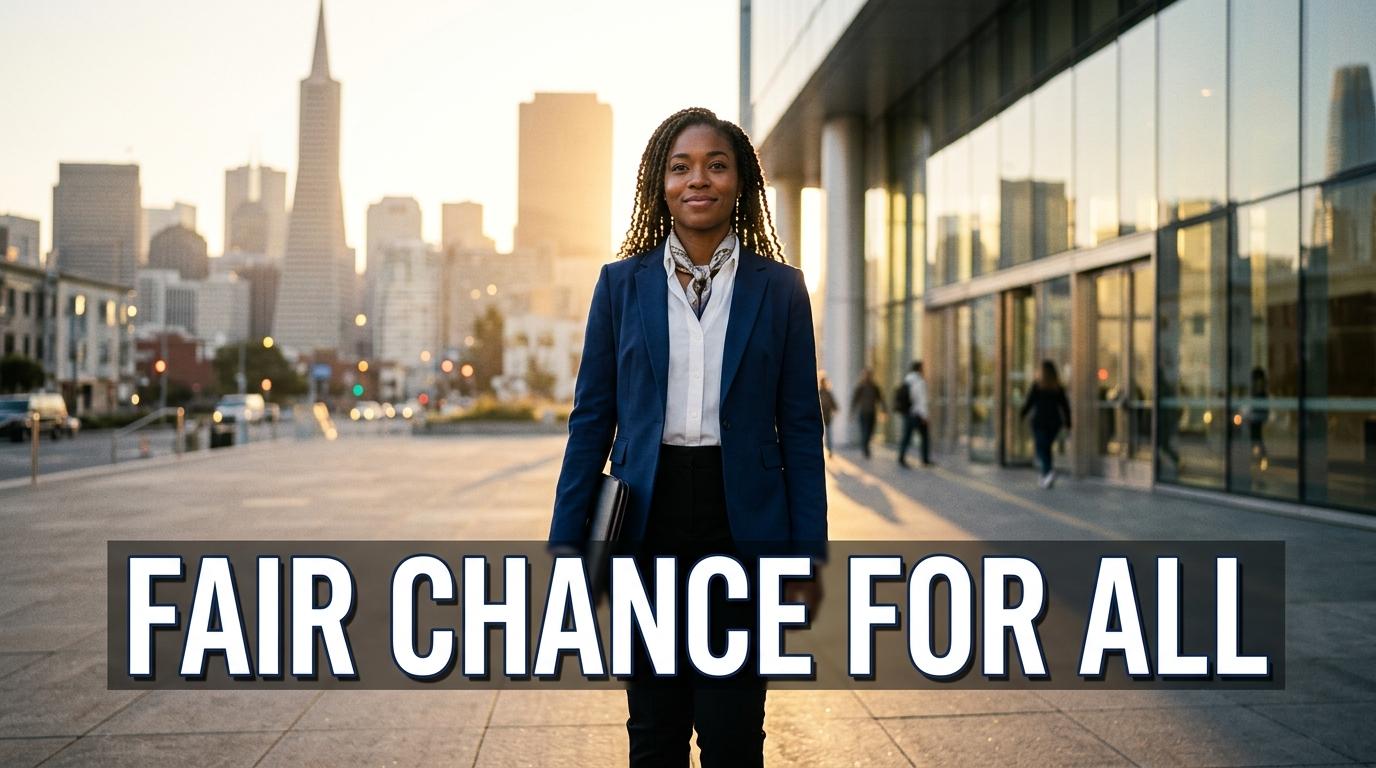
San Francisco Fair Chance Hiring Rules Now Shield Records
By Darius Spearman (africanelements)
Support African Elements at patreon.com/africanelements and hear recent news in a single playlist. Additionally, you can gain early access to ad-free video content.
The landscape of pre-employment screening in Northern California underwent a major legislative expansion. Municipal regulators began enforcing updated guidelines under San Francisco’s amended Fair Chance Ordinance (govdocs.com, reedsmith.com). Known as Ordinance Number 128-26, the updated city regulations enforce strict prohibitions barring employers from asking about or discriminating against workers based on out-of-state convictions related to reproductive healthcare, gender-affirming care, drag performances, and miscarriages (reedsmith.com, morganlewis.com).
This legal shift builds directly upon local statutory precedents aimed at dismantling structural barriers to gainful employment (littler.com, nelp.org). As state legislatures across the country pass laws criminalizing essential healthcare and personal expression, San Francisco has positioned itself as an economic sanctuary (morganlewis.com, weintraub.com). Understanding this expansion requires looking beyond the immediate statutory adjustments. The law connects directly to historical labor struggles, systemic racial disparities in the criminal legal system, and ongoing battles over bodily autonomy (nelp.org, nelp.org).
The Historical Evolution of San Francisco’s Fair Chance Framework
San Francisco emerged as an early municipal leader in the nationwide movement to ban the box on employment applications (nelp.org, nelp.org). Banning the box literally refers to removing the check-box on initial job application forms that asks applicants if they have an arrest or conviction history (nelp.org, nelp.org). Formerly incarcerated activists, led by organizations such as All of Us or None, spearheaded these civil rights campaigns (nelp.org). Their goal was simple: ensure candidates are evaluated on their skills before facing immediate disqualification due to prior justice involvement (nelp.org, nelp.org).
On February 11, 2014, the San Francisco Board of Supervisors passed Ordinance Number 131192, establishing the city’s initial Fair Chance Ordinance (littler.com, nelp.org). Mayor Ed Lee signed the measure on March 4, 2014, and it took effect on August 13, 2014 (littler.com, nelp.org). The original law applied to private employers with 20 or more workers, prohibiting criminal record inquiries until after a first live interview or conditional job offer (littler.com, nelp.org). The policy was designed to counter the political shift toward mass incarceration that disproportionately impacted Black workers (prisonpolicy.org, vera.org).
In April 2018, municipal leaders passed significant amendments that took effect on October 1, 2018 (littler.com, nelp.org). These updates expanded coverage to small businesses employing five or more workers globally, provided the position required at least eight hours of work per week in San Francisco (littler.com, nelp.org). Furthermore, the 2018 amendments barred employers from considering conduct that had been decriminalized at the state level (littler.com). This update aligned city policy with California’s Proposition 64, which legalized recreational cannabis and opened doors for past record expungements (littler.com, mpp.org).
The legislative expansion of 2026 responds directly to the federal legal shift following the 2022 Supreme Court ruling in Dobbs v. Jackson Women’s Health Organization (morganlewis.com, weintraub.com). As conservative state legislatures passed criminal prohibitions targeting healthcare providers, patients, and expressive artists, San Francisco lawmakers crafted Ordinance Number 128-26 (reedsmith.com, morganlewis.com). Passed by the Board of Supervisors on July 7, 2026, and signed by Mayor Daniel Lurie on July 10, 2026, the updated regulations officially became enforceable on August 10, 2026 (govdocs.com, reedsmith.com).
Dissecting Ordinance Number 128-26: Core Protections and Provisions
The August 2026 regulations introduce explicit prohibitions shielding job seekers from discrimination based on four newly specified categories of out-of-state records (reedsmith.com, morganlewis.com). Employers cannot ask about, require disclosure of, or consider out-of-state criminal records stemming from conduct that remains legal within California borders (reedsmith.com, morganlewis.com). This standard applies even if the conduct resulted in a criminal conviction or arrest in another state jurisdiction (reedsmith.com, weintraub.com).
First, the ordinance protects out-of-state records related to seeking, receiving, performing, or facilitating reproductive healthcare (reedsmith.com, morganlewis.com). This coverage explicitly includes abortion services, contraception, and treatment for spontaneous abortion, commonly known as miscarriage (reedsmith.com, morganlewis.com). Second, the law shields individuals with out-of-state criminal records tied to gender-affirming medical care, mental health support, or related advocacy (reedsmith.com, morganlewis.com). Third, protections extend to charges or convictions arising from drag performances or public artistic gender expression (reedsmith.com, weintraub.com).
Crucially, Ordinance Number 128-26 establishes a rigid legal standard known as the “never directly-related” rule (reedsmith.com, morganlewis.com). Under general fair chance law, employers can disqualify candidates if a conviction directly relates to specific job duties (reedsmith.com, littler.com). However, the 2026 amendments mandate that out-of-state convictions in these four protected categories can never qualify as job-related (reedsmith.com, morganlewis.com). Employers possess zero legal discretion to evaluate or disqualify an applicant based on these records (reedsmith.com, morganlewis.com).
The updated ordinance also strengthens enforcement penalties and procedural timelines (reedsmith.com, morganlewis.com). Employers must acknowledge receipt of an applicant’s evidence of mitigation within 14 calendar days (reedsmith.com, morganlewis.com). If taking final adverse action, employers must issue written notices within 30 calendar days (reedsmith.com, morganlewis.com). Administrative fines for violations have doubled, ranging from $1,000 for a first offense up to $4,000 for subsequent offenses (reedsmith.com, weintraub.com). Additionally, civil liquidated damages increased from $500 to $1,000 per affected individual per day (reedsmith.com).
Systemic Racial Disparities in Criminal Background Screening
The enforcement of fair chance policies addresses deep-seated racial inequities within the American labor market (nelp.org, nelp.org). Nationally, an estimated 70 million to 100 million adults possess an arrest or conviction record (nelp.org, nih.gov). Extensive research by civil rights organizations demonstrates that a criminal record cuts candidate callback rates by 50 percent (nelp.org, nelp.org). This structural hurdle severely impacts Black job seekers who endure compounding effects of racial discrimination and criminal record stigma (prisonpolicy.org, nih.gov).
The historical legacy of over-policing and discretionary charging created vast racial disparities in criminal record statistics (prisonpolicy.org, vera.org). Black Americans comprise roughly 13 percent of the national population but represent nearly 37 percent of state and federal prison populations (prisonpolicy.org, vera.org). Studies reveal that nearly 49 percent of Black men face arrest by age 23, compared to 38 percent of white men (nih.gov). Furthermore, approximately 33 percent of adult Black males carry a felony conviction record (prisonpolicy.org, nih.gov). These disproportionate outcomes stem from systemic policing choices rather than differences in actual behavior (prisonpolicy.org, vera.org).
When employers utilize pre-employment background checks prior to interviewing candidates, systemic criminal justice disparities automatically convert into hiring discrimination (nelp.org, nelp.org). Black workers historically transitioned from historic systems of forced labor into secondary labor markets with minimal worker protections (prisonpolicy.org, nelp.org). Removing initial screening barriers ensures that Black job seekers present their professional qualifications before a record is evaluated (nelp.org, nelp.org). This sequence is vital for establishing true economic justice for Black workers seeking stable employment (nelp.org, nelp.org).
The Intersection of Healthcare Bans and Marginalized Communities
Out-of-state healthcare bans intersect directly with social justice challenges facing marginalized communities (hhs.gov, publichealthpost.org). The criminalization of reproductive healthcare and gender-affirming medical treatments severely impacts working-class Black families (hhs.gov, publichealthpost.org). Black women in the United States face maternal mortality rates nearly three times higher than white women (hhs.gov, publichealthpost.org). Restricting access to miscarriage management and reproductive services increases health risks for Black pregnant individuals who already confront systemic healthcare disparities (hhs.gov, publichealthpost.org).
Simultaneously, Black transgender and gender-nonconforming individuals encounter intense discrimination across housing, employment, and medical care systems (prisonpolicy.org, nationalpartnership.org). State-level bans targeting gender-affirming care disproportionately harm low-wage Black trans workers who cannot afford private medical travel (prisonpolicy.org, nationalpartnership.org). By penalizing or investigating out-of-state healthcare access, hostile jurisdictions convert essential healthcare seeking into criminal records (morganlewis.com, weintraub.com). San Francisco’s amended ordinance directly counters this trend by shielding affected workers from workplace retaliation (reedsmith.com, morganlewis.com).
Protecting bodily autonomy in the workplace reinforces the structural resilience of African American families under economic stress (prisonpolicy.org, nationalpartnership.org). When an out-of-state conviction for healthcare access or artistic drag performance blocks a worker from employment, entire households suffer loss of income (nelp.org, prisonpolicy.org). San Francisco’s sanctuary regulations ensure that workers migrating from hostile legal environments can rebuild their lives without fear of employment blacklist tactics (reedsmith.com, morganlewis.com).
Conditional Offers and Background Screening Compliance
To comply with San Francisco’s updated ordinance, employers must adhere strictly to statutory hiring sequences (reedsmith.com, littler.com). A central requirement is the proper implementation of a conditional offer of employment (littler.com, nelp.org). A conditional offer is a formal job offer extended to an applicant that depends solely upon the successful completion of specific post-offer evaluations (littler.com, nelp.org). Under fair chance regulations, employers cannot run a background check or ask about criminal history until extending a genuine conditional offer (littler.com, nelp.org).
A genuine conditional offer means the employer has already completed all non-criminal evaluations (littler.com, nelp.org). This includes reviewing candidate resumes, evaluating skills, conducting interviews, and verifying professional references (littler.com, nelp.org). Employers cannot rescind a conditional offer for non-criminal reasons that could have been evaluated earlier in the process (littler.com, nelp.org). If an employer intends to revoke an offer based on a allowable past conviction, they must complete an individualized assessment connecting the conviction directly to job responsibilities (reedsmith.com, littler.com).
Employers utilize Consumer Reporting Agencies to conduct pre-employment background screening (ftc.gov, consumerfinance.gov). Consumer Reporting Agencies are third-party vendors regulated under the federal Fair Credit Reporting Act, codified at 15 U.S.C. Section 1681a(f) (ftc.gov, consumerfinance.gov). These vendors assemble public court records, driving registers, and criminal databases to produce consumer reports for employers (ftc.gov, consumerfinance.gov). Under San Francisco’s 2026 amendments, employers must explicitly instruct Consumer Reporting Agencies to filter out and remove out-of-state records tied to abortion, gender care, drag, or miscarriages prior to transmitting reports (reedsmith.com, morganlewis.com).
Worker Rights, Complaint Procedures, and Enforcement Mechanisms
The enforcement of San Francisco’s Fair Chance Ordinance falls under the jurisdiction of the Office of Labor Standards Enforcement (sf.gov, sf.gov). The Office of Labor Standards Enforcement investigates worker claims, performs random compliance audits, and levies administrative penalties against violating businesses (sf.gov, sf.gov). Job applicants and current employees who suspect an employer violated fair chance regulations possess clear legal avenues to file complaints (sf.gov, sf.gov).
Workers can submit administrative complaints directly to the Office of Labor Standards Enforcement by calling 415-554-5192 or sending an email to fce@sfgov.org (sf.gov, sf.gov). To support an investigation, job seekers should save evidence of non-compliance (sf.gov, sf.gov). Essential documentation includes non-compliant job announcements, initial application forms containing criminal record checkboxes, background screening authorization forms, and written notices of conditional offer revocations (reedsmith.com, sf.gov).
In addition to administrative complaint options, affected workers retain a private right of action under the ordinance (reedsmith.com). This provision allows job applicants and employees to consult employment attorneys and file civil lawsuits in state court (reedsmith.com). Courts can award successful plaintiffs back pay, reinstatement, mandatory policy modifications, legal fees, and statutory liquidated damages of up to $1,000 per individual per day of violation (reedsmith.com). These robust enforcement tools ensure that San Francisco’s fair chance mandates function as enforceable civil rights protections for all workers (reedsmith.com, sf.gov).
About the Author
Darius Spearman is a professor of Black Studies at San Diego City College, where he has been teaching for over 20 years. He is the founder of African Elements, a media platform dedicated to providing educational resources on the history and culture of the African diaspora. Through his work, Spearman aims to empower and educate by bringing historical context to contemporary issues affecting the Black community.
