


Why This Black Land Return Precedent Matters
By Darius Spearman (africanelements)
Support African Elements at patreon.com/africanelements and hear recent news in a single playlist. Additionally, you can gain early access to ad-free video content.
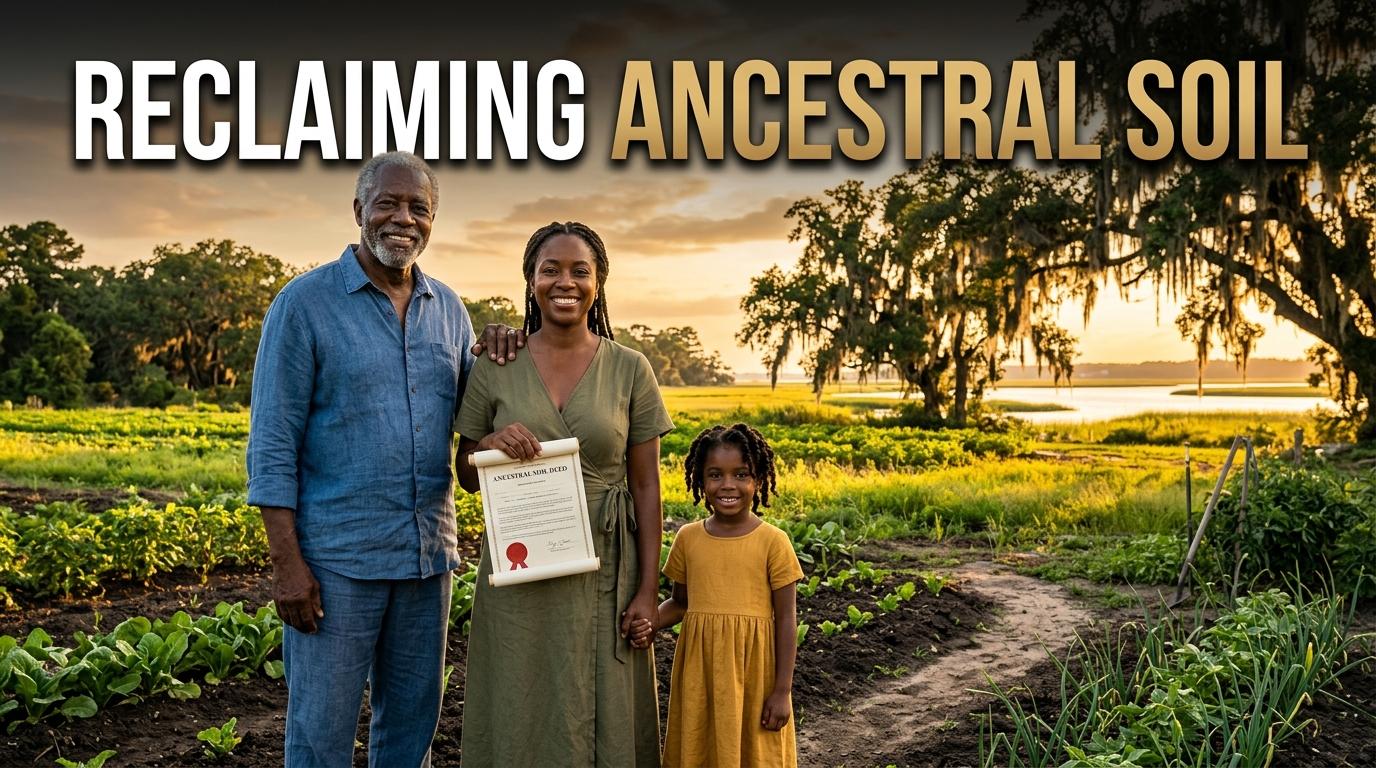
A federal judge issued a monumental ruling that ordered a coastal county to return prime acreage to a Black farming family. The local government seized this fertile land during the 1920s through eminent domain. For generations, the family fought to reverse that historic injustice. This landmark decision marks a transformative turning point for property law and reparative justice across the nation.
For more than a century, municipal condemnation laws functioned as a potent weapon against Black wealth. Local officials used legal pretexts to strip families of valuable agricultural and waterfront property. The new federal court ruling restores legal title directly to the rightful descendants. By returning the physical real estate, the court established a compelling judicial model for modern property restitution.
Broken Promises: From Forty Acres to Dispossession
The struggle for Black land tenure began immediately after the American Civil War. In January 1865, Union General William Tecumseh Sherman met with Black community leaders in Savannah, Georgia. Following those discussions, Sherman issued Special Field Orders No. 15 (abhmuseum.org). The order set aside 400,000 acres of confiscated coastal land for newly freed families in 40-acre allotments (abhmuseum.org).
Roughly 40,000 freed people quickly settled on those Sea Island plots to build autonomous communities (abhmuseum.org). President Andrew Johnson abruptly overturned Sherman directive in the autumn of 1865 (abhmuseum.org). Federal authorities evicted the settlers and returned the prime acreage to former Confederate enslavers (abhmuseum.org). This federal reversal forced millions of freed people into predatory sharecropping arrangements (abhmuseum.org).
The Golden Age of Black Land Ownership
Despite violent resistance and systemic economic disenfranchisement, Black Americans achieved remarkable property gains. Between 1870 and 1910, families pooled modest savings to purchase millions of agricultural acres (columbia.edu). They turned marshland and coastal tracts into productive farms, resorts, and commercial enterprises. These achievements reflected the ambitious vision of early Black entrepreneurs across the South.
By 1910, Black farmers held title to an estimated 16 to 19 million acres nationwide (columbia.edu, nrdc.org). The 1920 agricultural census recorded nearly 950,000 Black farm operators, representing 14 percent of all American farmers (columbia.edu, nrdc.org). This period represented the historic peak of Black independent landownership in the United States (nrdc.org).
Weaponizing Eminent Domain in the Jim Crow Era
White municipal leaders viewed Black economic autonomy and coastal property ownership as severe threats. Under the Fifth Amendment, governments can condemn private property for public use if they pay just compensation (arnoldsmithlaw.com). During the 1920s, southern and coastal municipalities weaponized this legal power against Black families (wikipedia.org, arnoldsmithlaw.com).
Local authorities manufactured public pretexts to confiscate prime real estate (wikipedia.org). Cities condemned Black-owned coastal land for parks, airfields, or civil works projects (wikipedia.org, harrisnecklandtrust.org). Segregated local courts denied families fair appraisals and legal representation (arnoldsmithlaw.com). The condemned acreage frequently sat undeveloped for decades before local governments transferred it to white commercial developers (wikipedia.org).
Bruce’s Beach and the Blueprint for Restoration
The modern legal framework for land return finds inspiration in the historic case of Bruce Beach (kqed.org, wikipedia.org). In 1912, Charles and Willa Bruce purchased beachfront property in Manhattan Beach, California (wikipedia.org). They built a thriving seaside resort that offered welcoming ocean access to Black patrons (wikipedia.org).
Facing pressure from hostile white residents, the Manhattan Beach City Council condemned the resort in 1924 (wikipedia.org). The city claimed it needed the beachfront land for a public park (wikipedia.org). Decades later, the state legislature passed Senate Bill 796 to authorize property restoration (ca.gov, ca.gov). In 2022, Los Angeles County transferred the deeds back to the Bruce heirs (theguardian.com, lacounty.gov). The family later sold the parcel back to the county for nearly twenty million dollars (theguardian.com).
The Stolen Coasts of Harris Neck
On the Georgia coast, another painful dispossession unfolded during World War II (theguardian.com, theguardian.com). In 1942, the federal government condemned 2,687 acres belonging to the Gullah Geechee community of Harris Neck (theguardian.com, harrisnecklandtrust.org). Federal officials gave more than one hundred Black farming families only days to vacate their ancestral land (theguardian.com, harrisnecklandtrust.org).
The War Department promised the families that they could return after the war ended (harrisnecklandtrust.org). Instead, the federal government declared the land surplus and deeded it to local county authorities (theguardian.com, harrisnecklandtrust.org). In 1962, the federal government converted the coastal property into the Harris Neck National Wildlife Refuge (fws.gov, harrisnecklandtrust.org). The descendants of Harris Neck continue to organize and seek restitution for their community (thecurrentga.org, thecurrentga.org).
The Quiet Crisis of Heirs’ Property
Beyond eminent domain abuses, discriminatory legal frameworks have stripped vast acreage from vulnerable families (americanbar.org, wustl.edu). The primary driver of modern rural land loss is the heirs property system (americanbar.org, landtrustalliance.org). When landowners pass away without executed wills, state laws divide property shares equally among surviving descendants (americanbar.org, wustl.edu).
Generations of undivided inheritance create complex fractional ownership structures among dozens of family members (americanbar.org, wustl.edu). These family co-tenants maintain deep kinship resilience rooted in their shared ancestral ground. Predatory real estate speculators locate distant heirs and purchase single fractional shares for minimal cash (americanbar.org). The outside buyer then petitions a court to force a public auction of the entire property (americanbar.org, wustl.edu).
The Long Shadow of Institutional Discrimination
Federal agencies also accelerated the loss of Black-owned agricultural acreage throughout the twentieth century (nrdc.org, pbs.org). Local committees within the United States Department of Agriculture systematically denied operating loans to Black farmers (pbs.org). These administrative delays caused widespread crop failures and devastating foreclosures across the rural South (pbs.org).
The landmark civil rights class action *Pigford v. Glickman* challenged this institutional lending bias (pbs.org). The lawsuit secured over one billion dollars in direct settlement relief for thousands of affected farmers (pbs.org). A subsequent congressional measure provided additional financial compensation to claimants who missed original filing deadlines (pbs.org). However, monetary compensation alone could not restore millions of acres of lost ancestral soil (nrdc.org, pbs.org).
-
Uniform Partition of Heirs Property Act: Mandates fair appraisals and family buyout rights.
-
Heirs’ Property Relending Program: Subsidized USDA loans for title resolution.
-
Pro Bono Legal Coalitions: University clinics resolving clouded deeds and probate disputes.
Reclaiming the Soil: Modern Legal Pathways
Civil rights attorneys and community coalitions have developed sophisticated legal strategies to challenge historic land loss (publiccounsel.org, publiccounsel.org). More than twenty states have enacted the Uniform Partition of Heirs Property Act (americanbar.org). This model legislation establishes mandatory appraisals and grants co-owners the legal right of first refusal (americanbar.org).
Advocacy organizations help low-income families clear clouded property titles and draft protective estate plans (landtrustalliance.org, publiccounsel.org). The USDA Heirs Property Relending Program provides low-interest capital to resolve probate disputes. Pro bono law clinics investigate archival records to prove municipal takings lacked legitimate public use (publiccounsel.org). These coordinated legal interventions provide essential protections for vulnerable generational landowners (americanbar.org, publiccounsel.org).
In Rem Restitution: Land Over Monetary Payouts
The recent federal court ruling relies on the powerful doctrine of *in rem* restitution (wikipedia.org, publiccounsel.org). Traditional civil rights litigation generally awards financial damages to redress past administrative misconduct (pbs.org). In contrast, *in rem* restitution operates directly upon the physical property itself (publiccounsel.org).
Financial payouts frequently fail to capture the exponential appreciation of valuable coastal real estate (theguardian.com). Returning deeded ownership allows descendants to build generational equity and preserve cultural heritage (publiccounsel.org, lacounty.gov). When government agencies retain stolen parcels, direct conveyance of title represents the most complete equitable remedy (publiccounsel.org).
A Turning Tide for Reparative Justice
This landmark federal ruling establishes an extraordinary judicial model for regional land restitution. Grassroots coalitions across the country are utilizing historical deeds and municipal minutes to audit early-twentieth-century condemnation proceedings (publiccounsel.org). These community efforts demonstrate the complicated dynamic of local authority and the broader exercise of federalism.
Restoring land ownership confronts the root causes of the racial wealth gap. Real estate remains the primary foundation for intergenerational wealth creation in the United States. By returning prime acreage to Black descendants, courts move beyond symbolic apologies toward tangible economic justice. The recent judicial order proves that historical injustices can find meaningful legal remedies in modern courtrooms.
About the Author
Darius Spearman is a professor of Black Studies at San Diego City College, where he has been teaching for over 20 years. He is the founder of African Elements, a media platform dedicated to providing educational resources on the history and culture of the African diaspora. Through his work, Spearman aims to empower and educate by bringing historical context to contemporary issues affecting the Black community.
