


Why Black Maternal Health Rallies Are Moving Congress
By Darius Spearman (africanelements)
Support African Elements at patreon.com/africanelements and hear recent news in a single playlist. Additionally, you can gain early access to ad-free video content.
The Modern Breaking Point on Capitol Hill
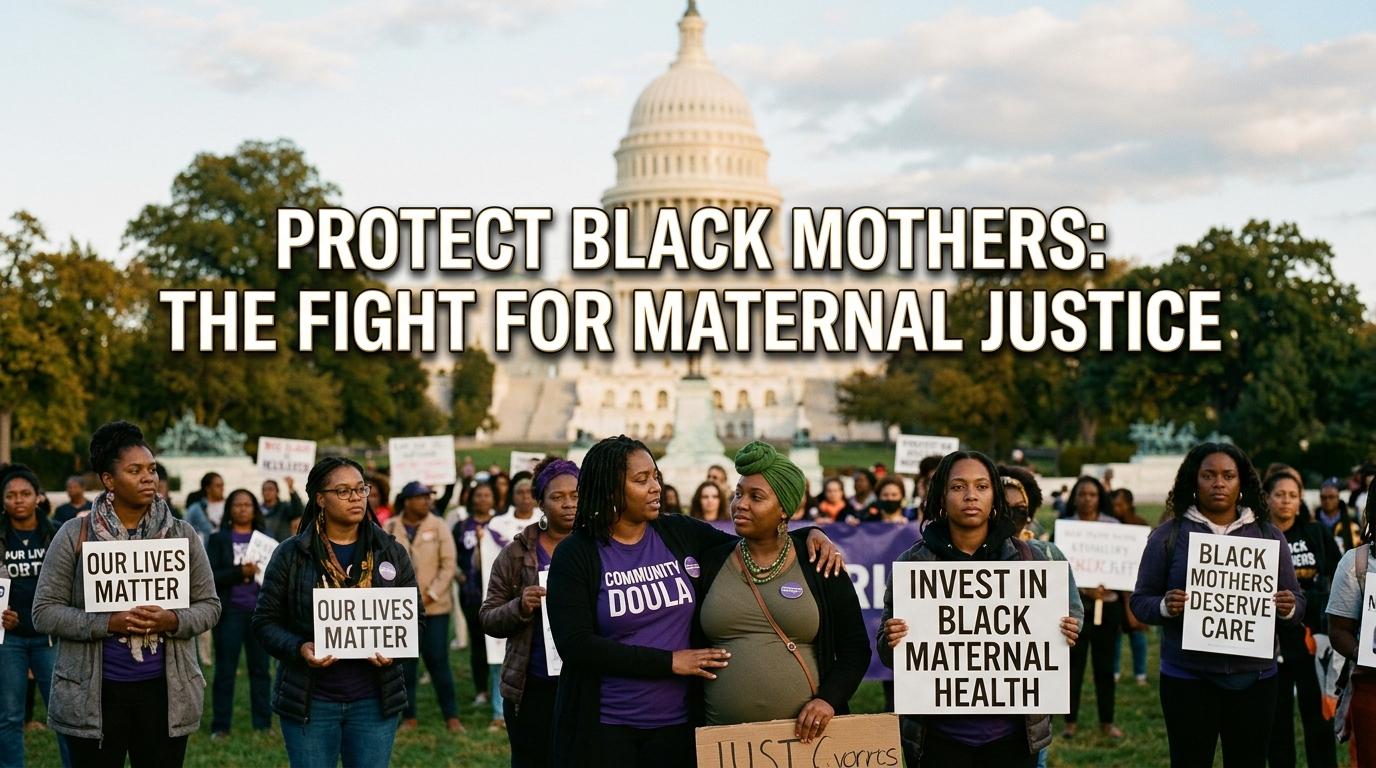
Hundreds of grassroots healthcare advocates recently gathered on the grounds of Capitol Hill in Washington, D.C. Their vocal presence broke a long legislative stalemate. Chanting slogans and carrying banners, these community leaders demanded immediate action from federal lawmakers. The direct mobilization successfully moved a comprehensive legislative package out of committee. This policy package mandates strict federal oversight across the American maternity care system to protect vulnerable families (senate.gov, house.gov).
The core of this legislative push centers on the Black Maternal Health Momnibus Act. Sponsored by lawmakers in the Black Maternal Health Caucus, the legislation tackles deep-rooted inequities in maternity care (house.gov, house.gov). For months, fiscal disagreements and partisan debates had stalled these bills in committee. However, community pressure altered the political calculation in the nation’s capital. Advocates demonstrated that clinical safety standards require decisive federal intervention rather than voluntary hospital guidelines (house.gov, senate.gov).
This breakthrough on Capitol Hill reflects generations of resistance against institutional neglect. The systemic mistreatment of Black mothers is not a recent complication of modern medicine. Instead, the crisis represents the continuation of an enduring historical pattern. Community organizers understand that legislative progress requires persistent public accountability (19thnews.org, truthout.org). Understanding today’s policy debates requires examining the long history of reproductive exploitation that preceded this moment.
Slavery and the Exploitative Roots of Modern Gynecology
The origins of racial disparity in reproductive healthcare trace directly back to American slavery. During the antebellum period, the childbearing capacity of enslaved women was commodified to sustain the plantation economy. Slaveholders viewed Black motherhood through the lens of financial profit rather than human dignity. Consequently, medical practitioners routinely treated enslaved women as experimental subjects without legal rights or bodily autonomy (nih.gov, nih.gov).
Between 1845 and 1849, Dr. J. Marion Sims performed repeated surgical experiments on enslaved women in Montgomery, Alabama. Sims operated on women suffering from vesicovaginal fistulas, a painful tear between the bladder and vaginal wall caused by obstructed labor. He conducted these experimental procedures without anesthesia on enslaved patients named Anarcha, Betsey, and Lucy (nih.gov, nih.gov). Although surgical anesthesia was newly available, Sims claimed that Black patients did not experience physical agony in the same manner as white patients (nih.gov).
These brutal procedures codified dangerous myths within American medical culture. Doctors rationalized horrific experiments by creating false biological claims about Black pain thresholds. These pseudoscientific beliefs asserted that Black bodies possessed thicker skin and less sensitive nervous systems. Such false assumptions survived long after emancipation, shaping the forms of involuntary servitude and medical bias that followed in subsequent decades (nih.gov, nih.gov).
The Systematic Eradication of Traditional Granny Midwives
Before the twentieth century, traditional Black midwives attended the vast majority of births in the American South. Known affectionately as “Granny Midwives,” these skilled women provided holistic antepartum, labor, and postpartum care. They preserved West African botanical, spiritual, and clinical traditions passed down through generations of community practice. Granny Midwives served both Black and rural white families who lacked access to physicians (blackmidwiferycollective.org, kimbritive.com).
During the early decades of the twentieth century, the medical establishment launched a coordinated campaign to eliminate community-based midwifery. The 1910 Flexner Report accelerated this shift by restructuring medical education to favor elite, hospital-based obstetrics. The report prompted the closure of five out of seven Black medical schools, severely restricting the future supply of Black physicians (kimbritive.com, tcf.org). Soon after, the Sheppard-Towner Act of 1921 provided states with funds that were often used to impose restrictive licensing barriers and prohibitive fees on traditional midwives (blackmidwiferycollective.org, truthout.org).
Public health officials characterized these experienced practitioners as unsanitary and unscientific relics of the past. As a result, childbirth shifted into racially segregated hospitals where Black women were relegated to underfunded basement wards. In the 1930s, community midwives attended roughly 80 percent of Black births in the South. By the early twenty-first century, midwives attended less than 10 percent of births nationwide (blackmidwiferycollective.org, tcf.org). This systematic displacement destroyed an essential foundation of community-controlled perinatal support.
Historical Timeline of Perinatal Disenfranchisement
The structural shifts that eroded community-based Black maternal care
The Anatomy of a Modern Epidemiological Crisis
Modern epidemiological data reveals that the maternal health crisis in the United States remains an urgent catastrophe. According to surveillance reports from the Centers for Disease Control and Prevention, maternal mortality rates in the United States far exceed those of other high-income nations (cdc.gov, cdc.gov). Within these national figures, racial disparities are stark. Non-Hispanic Black women die from pregnancy-related causes at rates nearly three times higher than non-Hispanic white women (cdc.gov, cdc.gov).
Official mortality data documents between 44.8 and 50.3 deaths per 100,000 live births among Black mothers, compared to approximately 14.2 to 14.5 deaths among white mothers (cdc.gov, cdc.gov). This staggering gap cannot be attributed to personal choices or genetic factors. State Maternal Mortality Review Committees have analyzed maternal deaths and reached a startling consensus. More than 80 percent of all pregnancy-related deaths across the country are entirely preventable through timely and quality clinical care (cdc.gov, cdc.gov).
Furthermore, research demonstrates that higher income and higher education do not shield Black birthing people from clinical danger. A Black woman with a college degree or higher faces a greater risk of pregnancy-related mortality than a white woman who never finished high school (cdc.gov, cdc.gov). This disturbing paradox underscores that racial bias within healthcare institutions operates independently of socioeconomic status. The structural nature of this crisis demands systemic solutions.
U.S. Maternal Mortality Rates by Demographic
Deaths per 100,000 live births (CDC Surveillance Data)
Obstetric Racism and Clinical Disregard Today
Public health researchers have coined specific terminology to describe how racial discrimination operates within modern hospital labor wards. Medical anthropologist Dr. Dána-Ain Davis introduced the concept of “obstetric racism” to explain the specific harms inflicted upon Black birthing people (nih.gov, healthaffairs.org). This framework describes how institutional policies and individual clinician behaviors intersect to compromise patient safety and violate patient autonomy (nih.gov).
Obstetric racism frequently manifests as diagnostic dismissiveness. Doctors and nurses routinely minimize or dismiss acute symptoms reported by Black patients, such as severe headaches, unmanageable pain, or difficulty breathing (nih.gov, healthaffairs.org). These symptoms often serve as warning signs of life-threatening complications, including preeclampsia, cardiovascular collapse, or internal hemorrhage. When clinicians ignore these warnings, standard emergency protocols are delayed, sometimes resulting in catastrophic medical outcomes (nih.gov, healthaffairs.org).
Additionally, medical paternalism compromises dignity and safety in delivery rooms. Black patients frequently report experiencing unconsented pelvic examinations, forced surgical inductions, and coercive cesarean sections (nih.gov, nih.gov). These practices echo the historic devaluation of Black bodily integrity. Even in world-class medical facilities, deep-seated cultural stereotypes prevent clinicians from treating Black mothers with standard clinical empathy and attentiveness (nih.gov, healthaffairs.org).
The Postpartum Cliff and Medicaid Battles
While labor and delivery receive significant attention, data reveals that the period following hospital discharge carries enormous health risks. National surveillance shows that between 37.8 percent and 50 percent of all pregnancy-related deaths occur between 43 days and one full year after delivery (cdc.gov, cdc.gov). Leading causes of late postpartum death include cardiomyopathy, pulmonary embolism, hypertensive crisis, and postpartum depression (mmhla.org, cdc.gov).
Historically, federal Medicaid policy exacerbated this postpartum risk by cutting off healthcare coverage exactly 60 days after birth. Because pregnancy-related Medicaid programs have higher income thresholds than standard adult Medicaid, thousands of low-income mothers abruptly lost health insurance during critical recovery months (wclp.org, georgetown.edu). This sudden loss of insurance created a perilous coverage cliff, leaving mothers without access to prescription medications, cardiovascular specialists, or mental health counseling (georgetown.edu, nashp.org).
In response, federal lawmakers created a pathway under the American Rescue Plan Act of 2021 allowing states to extend continuous postpartum Medicaid coverage to 12 months (nashp.org, networkforphl.org). Congress later made this option permanent through the Consolidated Appropriations Act of 2023 (wclp.org, networkforphl.org). While over forty-five states have adopted this life-saving extension, ongoing battles over federalism mean that some state governments still resist universal coverage mandates. These state-level holdouts continue to leave vulnerable mothers at severe risk (georgetown.edu, newsfromthestates.com).
When Do Pregnancy-Related Deaths Occur?
Distribution of maternal fatalities across the perinatal timeline (CDC Data)
The Reproductive Justice Movement Takes Center Stage
Grassroots maternal advocacy has been energized by the philosophy of Reproductive Justice. In June 1994, a caucus of Black women gathered in Chicago under the banner of Women of African Descent for Reproductive Justice (sistersong.net, time.com). Activists such as Loretta Ross recognized that the mainstream feminist movement focused too narrowly on abortion litigation and individual choice. This narrow focus ignored the social, economic, and institutional conditions that prevented marginalized women from safely parenting (time.com, tcf.org).
These visionary women created a holistic three-part human rights framework. Reproductive Justice establishes the fundamental right to have children, the right not to have children, and the right to parent children in safe, healthy, and sustainable environments (sistersong.net, nationalpartnership.org). In 1997, this foundational work led to the creation of the SisterSong Women of Color Reproductive Justice Collective (sistersong.net, tcf.org). The movement shifted public discourse by linking clinical outcomes directly to clean water, affordable housing, nutrition security, and neighborhood safety (nationalpartnership.org, tcf.org).
Modern coalitions like the Black Mamas Matter Alliance (BMMA) and the National Birth Equity Collaborative (NBEC) carry this tradition forward (nationalpartnership.org, truthout.org). They have sustained the ancestral resilience of Black families by asserting that clinical reform must be led by affected communities. By organizing national rallies, publishing community-led research, and educating congressional leaders, these advocates transformed a hidden public health crisis into a high-profile national policy movement (19thnews.org, truthout.org).
Overcoming Barriers in the Perinatal Workforce
Rebuilding a supportive birthing environment requires addressing acute shortages of culturally congruent healthcare providers. Substantial evidence proves that care provided by licensed midwives and certified doulas significantly improves maternal outcomes (weitzmaninstitute.org, mother.ly). While midwives are clinically licensed healthcare providers who deliver medical care and manage labor, doulas offer non-clinical emotional, physical, and informational guidance during pregnancy and recovery (mother.ly, drexel.edu). Both roles dramatically reduce cesarean deliveries and maternal complications (weitzmaninstitute.org, iwpr.org).
Despite these clear clinical benefits, severe structural barriers prevent Black practitioners from entering and sustaining careers in the maternal care workforce. Aspiring Black midwives encounter prohibitive tuition costs, substantial student debt, and a scarcity of racially concordant clinical preceptors willing to supervise required apprenticeship hours (blackmidwiferycollective.org, drexel.edu). Furthermore, credentialing exclusion and administrative friction within hospital systems routinely isolate independent birth workers from institutional support (blackmidwiferycollective.org, iwpr.org).
In addition, inadequate Medicaid reimbursement rates create severe financial instability for community-based doulas and independent midwives. In many jurisdictions, reimbursement processes are administratively burdensome, forcing providers to wait months for minimal payments (iwpr.org, drexel.edu). Advocacy groups argue that federal legislation must guarantee sustainable Medicaid payment rates and fund community-based training programs. Diversifying the maternal workforce represents an indispensable strategy for eliminating preventable mortality (weitzmaninstitute.org, iwpr.org).
The Legislative Blueprint for Federal Accountability
The legislative package moving through Congress offers a comprehensive strategy to reform American maternity care. Led by Representatives Lauren Underwood and Alma Adams alongside Senator Cory Booker, the Black Maternal Health Caucus organized the Momnibus Act into targeted legislative titles (house.gov, house.gov, senate.gov). This legislation directs vital investments toward Maternal Mortality Review Committees, anti-bias clinical training, and social determinants of health such as housing stability and nutritional access (senate.gov, govinfo.gov).
A crucial component of this reform package involves expanding the Special Supplemental Nutrition Program for Women, Infants, and Children, commonly known as WIC. WIC participation during pregnancy correlates directly with reduced rates of low birth weight and lower infant mortality (mmhla.org, nih.gov). The pending legislation extends postpartum WIC nutritional support from one year to two full years, providing crucial nutritional stability during extended postpartum recovery (house.gov, nih.gov).
While past legislative efforts met fierce institutional political resistance over federal spending and regulatory mandates, lawmakers have steadily achieved notable victories (newsfromthestates.com, kffhealthnews.org). Specific standalone components, such as the Protecting Moms Who Served Act for military veterans, have successfully passed into federal law (house.gov, house.gov). Nevertheless, advocates gathering in Washington emphasize that piecemeal reforms are not enough. Securing strict federal accountability remains essential to ensure that every mother survives childbirth and thrives for generations to come (19thnews.org, truthout.org).
About the Author
Darius Spearman is a professor of Black Studies at San Diego City College, where he has been teaching for over 20 years. He is the founder of African Elements, a media platform dedicated to providing educational resources on the history and culture of the African diaspora. Through his work, Spearman aims to empower and educate by bringing historical context to contemporary issues affecting the Black community.
