

African Union Climate Demands: The Global South Speaks
By Darius Spearman (africanelements)
Support African Elements at patreon.com/africanelements and hear recent news in a single playlist. Additionally, you can gain early access to ad-free video content.
A Historic Ultimatum from the Global South
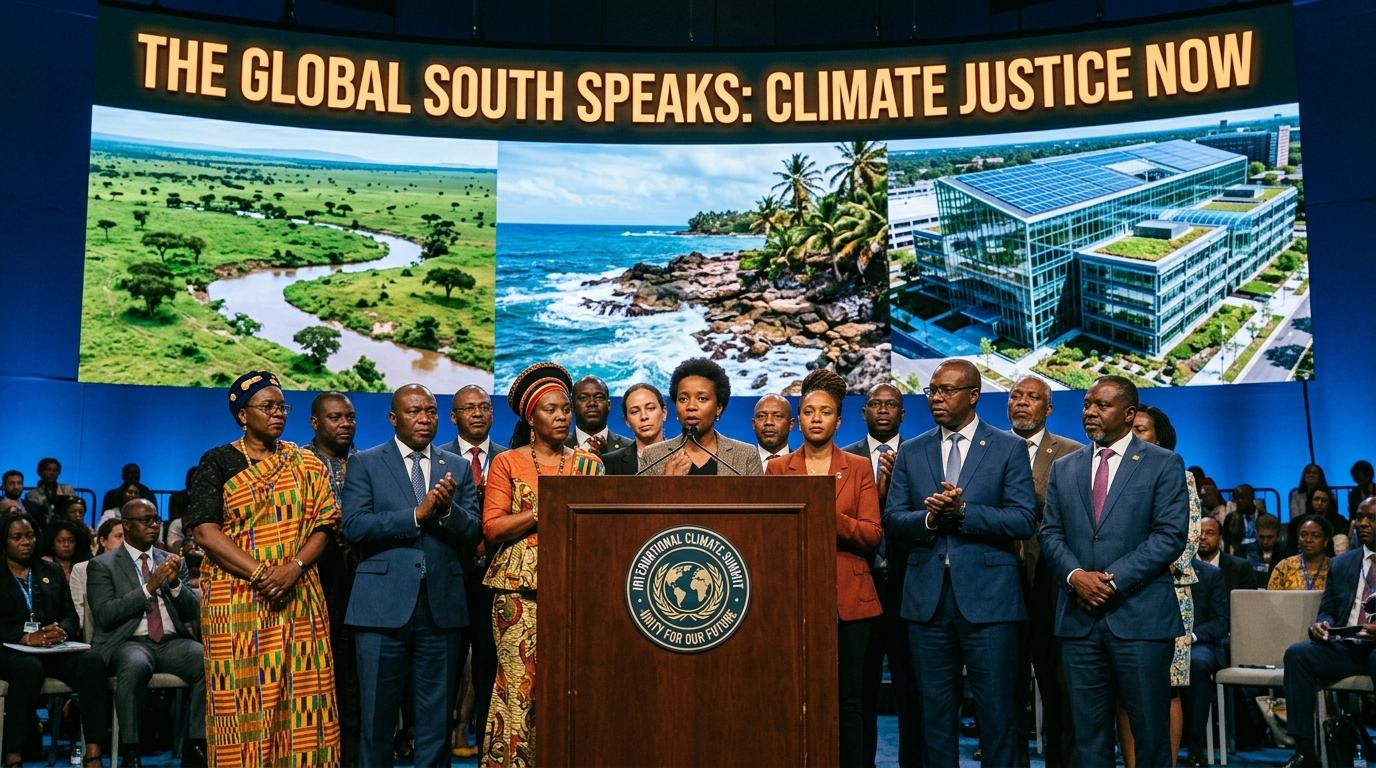
The African Union, joined by leaders across the Caribbean diaspora, delivered an uncompromising message to Western financial institutions. Continental leaders announced a unified ultimatum demanding the immediate capitalization of the international Loss and Damage Fund. This joint declaration represents a major turning point in global climate negotiations. Frontline nations refuse to accept empty diplomatic gestures while their homelands face catastrophic climate breakdown (issafrica.org, afripoli.org).
For decades, vulnerable nations have borne the worst consequences of environmental degradation. Leaders across Africa and the Caribbean Community emphasize that financial promises must become binding capital commitments. Decades of colonial extraction and struggles for self-determination have shaped this diplomatic unity. The African Union insists that high-income nations must finance recovery efforts through direct grants rather than exploitative debt instruments (afripoli.org, cadtm.org).
Figure 1: The Disproportionate Burden of Global Climate Impact
Data source: Verified Climate Analyses (Carbon Brief, African Union Data 2023-2024).
Three Decades of Resistance and Delayed Justice
The concept of loss and damage is distinct from traditional climate mitigation and adaptation strategies. Mitigation aims to lower atmospheric emissions, while adaptation focuses on building resilience against anticipated climate hazards (unep.org, climateanalytics.org). In contrast, loss and damage refers to the irreversible devastation caused by climate disasters, such as submerged coastlines and destroyed communities. Low-income nations have fought for recognition of these irreversible losses since the foundation of international climate summits (wikipedia.org, climateanalytics.org).
Small island nations first introduced this proposal in 1991 through the Alliance of Small Island States (wikipedia.org). High-income nations rejected the idea because they feared legal liability for global emissions. Negotiators established the Warsaw International Mechanism in 2013, yet wealthy nations refused to attach dedicated funding to the framework (wikipedia.org, unfccc.int). When governments drafted the Paris Agreement in 2015, high-income nations inserted explicit clauses to prevent liability or legal compensation claims (unfccc.int, theguardian.com).
The breakthrough finally arrived at the COP27 summit in Egypt. Developing countries united under the African Group of Negotiators and the G77 bloc to force the establishment of the Loss and Damage Fund (issafrica.org, unfccc.int). This collective victory proved that diplomatic unity could dismantle institutional resistance across global forums (globalpolicy.org, unfccc.int).
The Debt Trap and Bretton Woods Institutions
Western financial systems continue to trap vulnerable countries in unsustainable sovereign debt cycles. Multilateral lenders such as the International Monetary Fund and the World Bank were created in 1944 to govern the international monetary order (harvard.edu, harvard.edu). High-income nations hold decisive voting control within these institutions. For instance, the United States maintains a unilateral veto over major structural decisions due to its voting quota share (harvard.edu).
During the late twentieth century, these institutions imposed severe structural adjustment programs throughout the Global South (cadtm.org, harvard.edu). Recipient governments had to slash public spending on healthcare, education, and municipal infrastructure. Today, those same financial structures compel climate-ravaged nations to take out high-interest loans to rebuild damaged cities. Requiring nations to borrow money to survive climate disasters caused by foreign pollution is deeply unjust (globalpolicy.org, cadtm.org).
The African Union rejects commercial loans and non-concessional debt instruments for disaster recovery. African leaders demand non-repayable grants that safeguard domestic balance sheets. Climate disasters already cost African economies up to five percent of their annual gross domestic product (wmo.int). National treasuries must not be forced to divert vital resources from social welfare to pay foreign bondholders (wmo.int, cadtm.org).
Figure 2: The Severe Climate Finance Deficit
Wealthy nations continue to pledge millions while climate impacts inflict hundreds of billions in damages.
The Bridgetown Initiative and Transatlantic Solidarity
The alliance between continental Africa and the Caribbean diaspora draws strength from a shared historical experience. Barbados Prime Minister Mia Mottley galvanized global attention by launching the Bridgetown Initiative (weforum.org, bridgetown-initiative.org). This framework calls for a comprehensive overhaul of global financial governance. It demands disaster-pause clauses on sovereign debt and massive liquidity injections for developing economies (weforum.org, bridgetown-initiative.org).
African heads of state merged their diplomatic efforts with Caribbean initiatives during recent international summits (issafrica.org, afripoli.org). Both regions share structural vulnerabilities despite their minimal contribution to global greenhouse emissions. Millions of families in both regions face stronger hurricanes, prolonged droughts, and rising sea levels (wmo.int). This unified front challenges the broken financial promises of wealthy donor nations that mirror historic injustices (globalpolicy.org, cadtm.org).
This coalition also connects climate justice with the wider movement for reparative justice. The 2023 Accra Proclamation formalized an agreement between the African Union and Caribbean leaders regarding joint restitution claims (cadtm.org). Leaders insist that colonial exploitation created the economic inequality that makes the Global South so vulnerable today (cadtm.org). Environmental restoration is therefore an indispensable component of historical reparations (afripoli.org, cadtm.org).
Addressing Non-Economic Loss and Cultural Heritage
Climate devastation cannot be measured solely through damaged physical infrastructure and lost commercial revenue. Rising oceans and encroaching deserts permanently destroy ancestral homelands, burial grounds, and historical artifacts (unu.edu, lu.se). In indigenous and rural African communities, displacement shatters communal identities and social traditions passed down across generations (unu.edu).
International accounting frameworks struggle to calculate non-economic loss and damage (unu.edu, lu.se). When sea-level rise submerges coastal villages, communities lose their cultural geography and traditional livelihoods forever (unu.edu). The trauma of forced relocation undermines community stability and mental health. These deep human costs demand comprehensive restitution rather than simple disaster relief checks (unu.edu, frld.org).
The African Union demands that international funds support cultural preservation, psychological healing, and communal relocation programs (lu.se, frld.org). Communities that have demonstrated remarkable resilience against oppression should not be abandoned when climate disruptions erase their ancestral lands. International frameworks must respect local self-determination and protect indigenous cultural heritage (unu.edu, frld.org).
Figure 3: AU Direct Access Financing Framework
The AU framework eliminates administrative bottlenecks to deliver resources directly to the frontlines.
Direct Access over Bureaucratic Obstacles
Developing nations have long criticized the World Bank for its heavy bureaucratic requirements and slow fund distribution (globalpolicy.org, lossanddamagecollaboration.org). Although the World Bank serves as the interim trustee for the Loss and Damage Fund, vulnerable nations insisted on independent governance (lossanddamagecollaboration.org, frld.org). Developing nations secured a majority of seats on the governing board and selected the Philippines as the physical host country (frld.org, frld.org). This independent structure prevents Western donors from unilaterally dictating policy terms (frld.org).
African leaders are building on this momentum by implementing decentralized climate finance systems across the continent (undp.org). Devolved finance initiatives in Kenya and other African nations allocate funding directly to local county committees. Local residents determine which adaptation and restoration projects receive urgent backing (undp.org). This community-led strategy ensures that climate capital reaches vulnerable households without getting lost in central government bureaucracies (undp.org, lossanddamagecollaboration.org).
Direct access mechanisms are essential for decolonizing institutions that manage development aid. Frontline communities understand their local environments far better than foreign consultants. Direct financing allows indigenous leaders and women-led community groups to design durable recovery solutions (undp.org, wedo.org). True climate resilience requires returning economic autonomy to the people on the front lines (undp.org).
The Road to Climate Restitution
The African Union designated 2025 as the Year of Reparations and launched a Decade of Justice spanning from 2026 to 2035 (cadtm.org). This bold timeline integrates international climate finance directly into the broader reparatory justice movement. African and Caribbean nations are simultaneously pursuing legal clarity through advisory proceedings at the International Court of Justice and the International Tribunal for the Law of the Sea (lse.ac.uk). These international legal actions establish binding state responsibilities for transboundary environmental damage (lse.ac.uk).
The Global South possesses substantial collective leverage in international negotiations. Developing countries form the vast majority of the United Nations General Assembly and key climate negotiating blocs (issafrica.org, unfccc.int). By coordinating their votes at upcoming summits, these nations can block international carbon market rules until wealthy emitters deliver necessary grant financing (issafrica.org, unfccc.int). Moral appeals have given way to strategic diplomatic leverage (issafrica.org, afripoli.org).
The unified ultimatum issued by the African Union and Caribbean nations establishes a definitive boundary. Frontline nations will no longer accept symbolic gestures while experiencing catastrophic climate impacts. The struggle for climate reparations is now the central test of the global financial architecture. High-income nations must provide the resources required to repair the damage their emissions have caused (issafrica.org, cadtm.org).
About the Author
Darius Spearman is a professor of Black Studies at San Diego City College, where he has been teaching for over 20 years. He is the founder of African Elements, a media platform dedicated to providing educational resources on the history and culture of the African diaspora. Through his work, Spearman aims to empower and educate by bringing historical context to contemporary issues affecting the Black community.
