


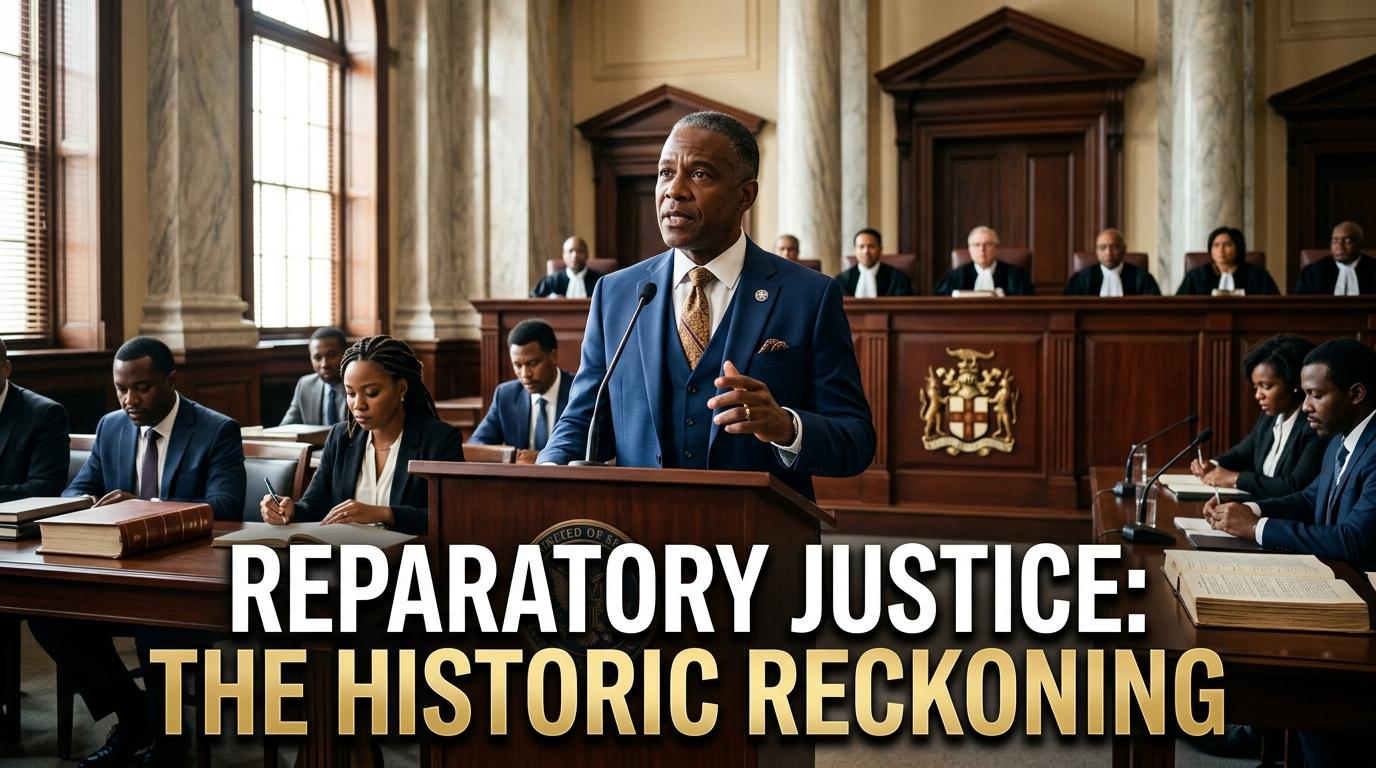
Caribbean Slavery Reparations: The Lawsuit Shaking Europe
By Darius Spearman (africanelements)
Support African Elements at patreon.com/africanelements and hear recent news in a single playlist. Additionally, you can gain early access to ad-free video content.
A New Battle for International Economic Justice
Caribbean leaders have launched an unprecedented legal initiative against European financial institutions (theguardian.com, caricomreparations.org). Member states of the Caribbean Community, known as CARICOM, are coordinating formal claims in international courts (caricom.org, caricom.org). This aggressive strategy marks a major shift in the global campaign for reparative justice (theguardian.com, caricom.org). Previous efforts relied on polite diplomatic appeals to former colonial governments (caricomreparations.org, caricomreparations.org).
Today, the focus expands directly to the corporate and financial architects of the transatlantic slave trade (theguardian.com, theguardian.com). Banks, insurance syndicates, and merchant houses generated massive fortunes from human trafficking (bankofengland.co.uk, lse.ac.uk). Caribbean nations now intend to hold these enduring commercial enterprises legally accountable (theguardian.com, caricomreparations.org). This litigation challenges centuries of institutional enrichment built upon stolen African labor (theguardian.com, brattle.com).
The Financial Architecture of Chattel Slavery
The transatlantic slave trade was an intricate commercial system backed by major European financial centers (historyguild.org, lse.ac.uk). Enslavement in the Americas was distinct from ancient forms of human servitude (historyguild.org). It introduced chattel slavery, classifying human beings as legal personal property (historyguild.org, historyreclaimed.co.uk). Under this brutal system, captives were bought, mortgaged, insured, and passed down to heirs (historyguild.org, nationalarchives.gov.uk).
The legal rule of partus sequitur ventrem ensured that child status followed the mother (historyguild.org). Consequently, enslavement became hereditary and perpetual for generations of African descendants (historyguild.org, d-nb.info). European merchant empires established corporate monopolies to dominate this lucrative traffic (historyguild.org, lse.ac.uk). The Royal African Company and the Dutch West India Company shipped millions across the Atlantic (historyguild.org, lse.ac.uk).
Financial powerhouses like Barclays, the Bank of England, and Lloyd’s of London underwrote these brutal voyages (theguardian.com, bankofengland.co.uk). They issued lines of credit and accepted enslaved human beings as collateral on plantation mortgages (bankofengland.co.uk, lse.ac.uk). These commercial activities laid the foundations for modern international banking and corporate wealth (historyguild.org, lse.ac.uk). Modern Caribbean litigants argue that these financial lineages remain unbroken today (theguardian.com, brattle.com).
Planters & Enslavers
State Cash Payout Awarded:
£20,000,00040% of national budget funded through debt repaid by the public until 2015.
Emancipated Africans
Direct Financial Restitution:
£0.00Forced into 4 years of unpaid mandatory labor under the Apprenticeship System.
The 1833 Payout: Compensating the Enslavers
When Great Britain abolished colonial slavery through the 1833 Slavery Abolition Act, it executed a historic injustice (bankofengland.co.uk, nationalarchives.gov.uk). The British imperial parliament allocated £20 million to compensate forty-six thousand slave owners (bankofengland.co.uk, nationalarchives.gov.uk). This monumental sum represented forty percent of the annual national budget of the United Kingdom (bankofengland.co.uk, historyguild.org). Planters received generous public cash for losing their human property (historyguild.org, nationalarchives.gov.uk).
To fund this payout, the British government secured massive loans organized by wealthy banking families (bankofengland.co.uk). The state issued Consolidated Annuities, widely known as consols (bankofengland.co.uk, lse.ac.uk). These debt securities paid regular interest indefinitely without fixed maturity dates (bankofengland.co.uk, lse.ac.uk). Consequently, British taxpayers serviced this sovereign debt for one hundred and eighty-two years (bankofengland.co.uk).
HM Treasury finally redeemed the remaining bonds in 2015 (bankofengland.co.uk). For generations, Caribbean descendants living in Britain unknowingly paid taxes to finance enslaver compensation (bankofengland.co.uk, theguardian.com). Meanwhile, liberated Black laborers received nothing for centuries of torture and uncompensated labor (historyguild.org, nationalarchives.gov.uk). Instead, parliament forced formerly enslaved people into a mandatory apprenticeship system (nationalarchives.gov.uk, historyreclaimed.co.uk).
The Trap of Forced Apprenticeship and Debt
The British apprenticeship system lasted from 1834 to 1838 across the plantation colonies (nationalarchives.gov.uk, historyreclaimed.co.uk). It forced emancipated workers to labor up to forty-five hours per week without wages (nationalarchives.gov.uk). Planters used state magistrates and severe punishments to enforce plantation discipline (nationalarchives.gov.uk, historyreclaimed.co.uk). Therefore, emancipation initially extended unpaid field exploitation under a deceptive legal name (nationalarchives.gov.uk, historyreclaimed.co.uk).
A similar economic tragedy struck the French colony of Saint-Domingue after the Haitian Revolution (theguardian.com, wikipedia.org). In 1825, French warships surrounded the young Black republic (theguardian.com, wikipedia.org). France demanded an indemnity of 150 million gold francs to compensate dispossessed colonial planters (theguardian.com, wikipedia.org). Haiti was forced to borrow money from French banks at exorbitant rates (theguardian.com, wikipedia.org).
This double debt stripped Haiti of critical capital for basic infrastructure and schools (theguardian.com, wikipedia.org). The resulting economic damage took more than a century to pay off completely (theguardian.com, wikipedia.org). European powers repeatedly enriched their own economies by extracting wealth from liberated Black populations (theguardian.com, lse.ac.uk). These historical debts directly explain modern poverty across the Caribbean basin (theguardian.com, wikipedia.org).
Source: The Brattle Group Reparations Report presented to the University of the West Indies (2023).
The Econometrics of Uncompensated Labor
Modern legal claims rely heavily on authoritative econometric evidence (theguardian.com, brattle.com). In June 2023, the Brattle Group published a comprehensive reparations assessment report (brattle.com, theguardian.com). This landmark study was directed alongside former International Court of Justice Judge Patrick Robinson (brattle.com, theguardian.com). It established rigorous economic measures for historical crimes against humanity (brattle.com, theguardian.com).
The report calculated global reparations obligations ranging between 100 trillion and 131 trillion dollars (brattle.com, theguardian.com). The United Kingdom alone faces an assessed liability of twenty-four trillion dollars (brattle.com, theguardian.com). These complex models account for unpaid plantation labor and stolen human liberty (brattle.com, theguardian.com). Furthermore, they calculate centuries of compounding economic wealth accumulated across European capitals (brattle.com, theguardian.com).
This empirical analysis transforms reparative justice from abstract rhetoric into concrete financial balance sheets (theguardian.com, brattle.com). European wealth did not appear through spontaneous industrial innovation alone (historyguild.org, lse.ac.uk). Enslaved African laborers generated the primary capital that built western commercial hegemony (historyguild.org, lse.ac.uk). Economists now offer clear data showing how colonial exploitation continues to distort global wealth (taxjustice.net, brattle.com).
Legal Doctrine and Overcoming Sovereign Immunity
Litigating centuries-old atrocities presents unique challenges under international law (theguardian.com, caricomreparations.org). European defendants frequently cite domestic statutes of limitations to escape liability (theguardian.com, caricomreparations.org). However, Caribbean legal scholars point to the legal principle of jus cogens (caricomreparations.org, caricomreparations.org). Peremptory norms represent supreme international standards that prohibit slavery, genocide, and torture without exception (caricomreparations.org).
Article 53 of the Vienna Convention on the Law of Treaties codifies these overriding principles (caricomreparations.org). Because chattel slavery constitutes a crime against humanity, conventional time limits do not apply (caricomreparations.org, caricomreparations.org). Moreover, international jurists utilize the common law doctrine of unjust enrichment (theguardian.com, caricomreparations.org). This doctrine prevents corporations from retaining profits derived directly from unlawful, coercive exploitation (theguardian.com, caricomreparations.org).
Litigators draw clear inspiration from Holocaust restitution settlements against Swiss and German banks (theguardian.com, caricomreparations.org). Corporate mergers and rebranding do not erase fundamental legal liability for human rights abuses (theguardian.com, caricomreparations.org). Historical archival records trace stolen assets directly to modern commercial entities (theguardian.com, bankofengland.co.uk). Consequently, CARICOM aims to bring these cases before the International Court of Justice (theguardian.com, caricom.org).
The CARICOM Ten-Point Reparations Plan
The regional movement is guided by the CARICOM Reparations Commission (caricom.org, caricomreparations.org). Historian Sir Hilary Beckles chairs this pioneering commission established in 2013 (caricomreparations.org, uwi.edu). The commission formulated a comprehensive Ten-Point Action Plan for reparatory justice (caricomreparations.org, caricomreparations.org). It demands formal state apologies rather than empty statements of regret (caricomreparations.org, caricomreparations.org).
Point Two explicitly calls for structured repatriation programs for African descendants (caricomreparations.org, caricomreparations.org). It asserts the legal right of return to ancestral homelands on the African continent (caricomreparations.org, caricomreparations.org). Furthermore, the plan requires European funding for regional public health infrastructure (caricomreparations.org, caricomreparations.org). Generations of forced servitude left devastating health burdens, including severe rates of hypertension and diabetes (caricomreparations.org, bmj.com).
The program also targets illiteracy eradication, clean technology transfers, and total sovereign debt cancellation (caricomreparations.org, caricomreparations.org). Funds will not be disbursed as direct individual cash checks (caricomreparations.org, caricomreparations.org). Instead, reparations will build schools, modern hospitals, and scientific institutions across the Caribbean (caricomreparations.org, caricomreparations.org). This collective model ensures long-term developmental repair for entire Caribbean societies (caricomreparations.org, caricomreparations.org).
Unconditional state apologies replacing diplomatic expressions of regret.
Legal and financial support for African resettlement and reintegration.
Interventions targeting inherited chronic disease epidemics like diabetes.
Canceling sovereign debt to expand regional fiscal space for growth.
Building a Unified Transatlantic Front
The Caribbean legal strategy now connects with a global Pan-African coalition (un.org, shabaka.org). In November 2023, world leaders convened at the historic Accra Reparations Conference in Ghana (un.org, shabaka.org). Delegates formally adopted the groundbreaking Accra Proclamation (shabaka.org, caricom.org). This agreement united fifty-five African Union nations with twenty CARICOM member states (caricom.org, shabaka.org).
The proclamation established a permanent Global Reparations Fund headquartered in Africa (shabaka.org). This unified diplomatic front strengthens ongoing Diaspora political strategy across the Atlantic (ibw21.org, shabaka.org). It bridges the gap between state-level litigation and grassroots community activism (ibw21.org, shabaka.org). African and Caribbean states now demand systemic accountability with a single, unified voice (un.org, shabaka.org).
This international momentum parallels domestic movements within the United States (ibw21.org, reparationscomm.org). American organizations like the National African American Reparations Commission model their programs on CARICOM (ibw21.org, reparationscomm.org). Meanwhile, municipal efforts and a pioneering state-level reparations task force have sparked national awareness (ibw21.org). Similar research initiatives, including a dedicated commission in New York, advance these critical conversations (ibw21.org). The global movement for reparative justice is rapidly expanding (theguardian.com, un.org).
Climate Vulnerability and the Cost of Extraction
Modern Caribbean leaders connect historical colonial extraction directly to contemporary climate vulnerability (theguardian.com, americasquarterly.org). Leaders like Prime Minister Mia Mottley of Barbados champion this critical perspective (americasquarterly.org). Small island developing nations face severe hurricanes, rising sea levels, and coastal destruction (americasquarterly.org). Yet, these nations carry heavy external debt burdens from their colonial past (theguardian.com, americasquarterly.org).
Extractive colonial economies built European infrastructure while leaving Caribbean colonies severely underfunded (historyguild.org, lse.ac.uk). Post-independence governments were forced to borrow heavily to build essential utilities and hospitals (theguardian.com, americasquarterly.org). When climate disasters strike, island nations must borrow even more money for basic reconstruction (americasquarterly.org). This vicious cycle traps developing states in perpetual financial distress (theguardian.com, americasquarterly.org).
Reparations represent an urgent ecological and economic necessity rather than a symbolic gesture (theguardian.com, americasquarterly.org). Restitution allows Caribbean states to build climate-resilient sea defenses and green energy grids (caricomreparations.org, americasquarterly.org). Compensatory finance restores the capital stolen through centuries of imperial exploitation (historyguild.org, brattle.com). By moving into international courtrooms, CARICOM demands a fair economic future for the African Diaspora (theguardian.com, caricomreparations.org).
About the Author
Darius Spearman is a professor of Black Studies at San Diego City College, where he has been teaching for over 20 years. He is the founder of African Elements, a media platform dedicated to providing educational resources on the history and culture of the African diaspora. Through his work, Spearman aims to empower and educate by bringing historical context to contemporary issues affecting the Black community.
