


Why Federal Scrutiny of Black History Is Surging
By Darius Spearman (africanelements)
Support African Elements at patreon.com/africanelements and hear recent news in a single playlist. Additionally, you can gain early access to ad-free video content.
The Modern Battle Over National Memory
Federal scrutiny of Black history in public classrooms and national museums has reached a historic turning point. Executive directives now seek to condition federal institutional funding on the removal or revision of materials that examine systemic racism, chattel slavery, and civil rights struggles (whitehouse.gov, whitehouse.gov). Consequently, museum directors, academic historians, and civil rights leaders are mounting a determined resistance to protect historical truth (historians.org, naacp.org).
While commentators often describe this dispute as a recent cultural skirmish, the contest over who controls the American historical narrative reaches back more than a century. The tension between state-sanctioned patriotism and honest historical reckoning touches the very core of democratic freedom. Today, federal pressure on cultural funding is creating unprecedented friction between executive officials and independent historical curators across the nation (apnews.com, wilmerhale.com).
What Are Museum Didactics and Why Do They Matter?
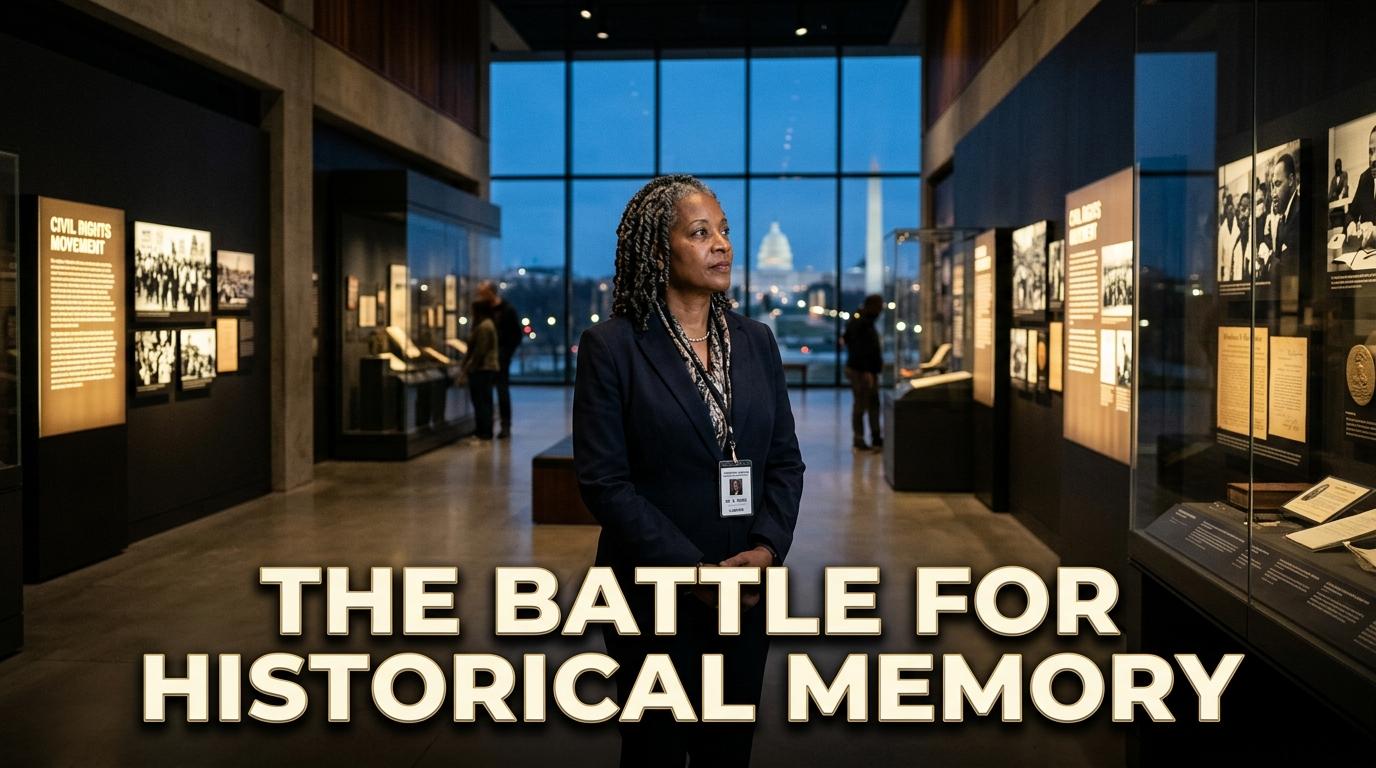
At the center of this federal review are museum didactics. In professional museum curation, didactics refers to the instructional and interpretive textual materials that accompany physical displays (journalpanorama.org, journalpanorama.org). These include wall text panels, descriptive object labels, informational brochures, and digital touchscreens that explain the context and provenance of historical artifacts (journalpanorama.org).
Without didactics, a display of iron shackles remains an uncontextualized metal object. When paired with scholarly labels, however, the object bears witness to the transatlantic trade and human resilience. Unlike raw artifacts, didactics deliver clear interpretive narratives (journalpanorama.org). For this reason, governmental authorities seeking to reshape historical messaging focus heavily on these written descriptions (apnews.com, journalpanorama.org).
The Long Road from the Lost Cause to the Mall
Attempts to sanitize the Black experience have deep historical roots. Following Reconstruction, southern heritage organizations led a decades-long campaign to spread the Lost Cause myth, which falsely framed the Civil War as a noble defense of states rights rather than human bondage (historians.org, wikipedia.org). In response, pioneering scholar Dr. Carter G. Woodson established the Association for the Study of Negro Life and History in 1915 and created Negro History Week in 1926 (abhmuseum.org, wikipedia.org). Woodson understood that suppressing the history of Black people was central to preserving racial inequality (abhmuseum.org).
The campaign to establish a dedicated national museum on the National Mall spanned an entire century. Black Civil War veterans first lobbied for a national memorial in 1915, yet significant legislative progress did not occur until the late twentieth century under the leadership of Representative John Lewis (si.edu, wikipedia.org). Critics pushed back for decades, warning against the “balkanization” of American identity. In cultural debates, balkanization describes the fragmentation of a nation into separate, hostile factions (closeup.org). Opponents claimed that creating dedicated cultural facilities would divide citizens (closeup.org, wikipedia.org). Nevertheless, bipartisan support ultimately established the National Museum of African American History and Culture in 2003, which opened to the public in 2016 (si.edu, wikipedia.org).
Chronology of the Struggle for Historical Memory
From the Lost Cause campaign to modern federal museum reviews
Executive Order 14253 and Targeted Exhibits
Federal scrutiny accelerated dramatically with the issuance of Executive Order 14253 (whitehouse.gov, whitehouse.gov). The directive instructs the Office of Management and Budget to examine federal appropriations to cultural institutions and identify displays that allegedly promote ideological divisions (apnews.com, whitehouse.gov). The order specifically singled out flagship cultural collections, including the Smithsonian American Art Museum and the National Museum of African American History and Culture (apnews.com, wfae.org).
At the Smithsonian American Art Museum, federal reviews targeted interpretive didactics within the exhibition The Shape of Power: Stories of Race and American Sculpture (apnews.com, wfae.org). Reviewers challenged wall text stating that societies have used racial categories to structure power relations throughout American history (apnews.com, wfae.org). Similarly, at the President’s House Site in Independence National Historical Park, federal directives prompted the removal of 34 educational panels and silenced videos documenting the nine enslaved individuals held by George Washington (19thnews.org, washingtonpost.com). In parallel actions, digital educational materials detailing the life of abolitionist Harriet Tubman were temporarily modified or withdrawn across National Park Service platforms (19thnews.org).
Defining Divisive Concepts and Critical Race Theory
The legal mechanism driving these federal interventions centers on the prohibition of so-called divisive concepts (pen.org, pen.org). Legislative measures known as educational gag orders prohibit public institutions from teaching that the United States is structurally oppressive or that individuals bear collective guilt for historic injustices (pen.org, humanrightsresearch.org). These restrictions carry severe consequences, including the loss of federal operational grants and administrative sanctions (pen.org, wilmerhale.com).
To justify these restrictions, critics have broadly invoked Critical Race Theory and racial determinism (apnews.com, mtsu.edu). Critical Race Theory is a specialized legal framework developed in the 1970s and 1980s by scholars such as Derrick Bell and Kimberle Crenshaw to analyze how racial inequities persist within legal codes and institutional systems (mtsu.edu, mtsu.edu). Racial determinism argues that race strictly dictates human capabilities and social outcomes (mtsu.edu). While professional historians study documented patterns of discrimination, federal policy directives frequently apply these theoretical labels to standard accounts of involuntary servitude and civil rights protests (historians.org, mtsu.edu).
The AP African American Studies Conflict
The classroom dimension of this struggle emerged during the national controversy surrounding Advanced Placement African American Studies (apnews.com, reason.com). State education officials objected to the course framework, focusing their challenges on lessons covering the Movement for Black Lives, modern reparations debates, and the civil rights struggle through an intersectional lens (reason.com, time.com).
State reviewers argued that readings by contemporary theorists introduced partisan political dogma into secondary education (reason.com, time.com). Following intense political scrutiny, the College Board released a revised framework that removed several disputed modern topics from required exam questions and reclassified them as optional research topics (reason.com, time.com). This shift demonstrated how governmental pressure can alter educational curricula across public school districts nationwide (pen.org, time.com).
Museum Trust and Federal Funding Vulnerability
Quantifying institutional reliance and public confidence
The Smithsonian as a Unique Trust Instrumentality
Federal efforts to control historical narratives at the Smithsonian face complex legal obstacles. Established by an act of Congress in 1846 through a bequest from James Smithson, the Smithsonian is legally classified as a trust instrumentality rather than an executive cabinet department (apnews.com, wilmerhale.com). It holds its collections in a charitable trust dedicated to the increase and diffusion of knowledge (wilmerhale.com).
Governance of the Institution is vested in a seventeen-member Board of Regents, which includes the Chief Justice of the United States, the Vice President, members of Congress, and distinguished private citizens (apnews.com, wilmerhale.com). In response to recent federal mandates, the Board of Regents and Secretary Lonnie Bunch III affirmed that curatorial, personnel, and display policies remain under the authority of the Board (apnews.com). This unique structure serves as a legal buffer against direct executive interference (apnews.com, wilmerhale.com).
Resistance from Historical and Cultural Organizations
Major professional scholarly bodies have mobilized against governmental speech restrictions. The American Historical Association and the Organization of American Historians have condemned funding conditionality as unconstitutional viewpoint discrimination (historians.org, historians.org). The AHA and OAH establish the professional research ethics and pedagogical standards that guide American historians across the globe (historians.org, historians.org).
Simultaneously, the Association of African American Museums has organized cultural professionals to protect narrative integrity (facebook.com, facebook.com). The AAAM works alongside federal grantmakers such as the Institute of Museum and Library Services and the National Endowment for the Humanities (facebook.com, aaslh.org). The IMLS and NEH distribute critical grant funds to preserve rare artifacts and sustain cultural education across the country (aaslh.org). Together, these professional networks insist that honest history requires presenting difficult truths about the American past (historians.org, facebook.com).
The Threat to Local and Grassroots Black Museums
While the Smithsonian maintains national prominence, non-federal Black museums face severe operational challenges under federal funding conditionality (aaslh.org). Community-based cultural centers and historic sites rely heavily on competitive federal awards, such as IMLS Museum Grants for African American History and Culture, to pay curatorial staff, maintain historic properties, and digitize archives (aaslh.org).
Unlike large national foundations, local institutions generally lack multi-million-dollar endowments. When executive guidelines condition basic operating support on removing discussions of white supremacy or racial terror, small museums face an agonizing choice (wilmerhale.com, aaslh.org). They must choose between compromising historical integrity or risking institutional closure. This financial pressure creates a profound chilling effect that threatens the survival of local preservation efforts (pen.org, aaslh.org).
National Scope of Historical Content Restrictions
Documented impacts across federal and state cultural systems
Legal Battles in Court: Defending Historical Truth
The struggle over historical memory has moved decisively into federal courtrooms. In the landmark case City of Philadelphia v. Burgum, municipal authorities and civil rights groups challenged the federal removal of slavery didactics at the President’s House Site in Independence National Historical Park (19thnews.org, washingtonpost.com). In February 2026, a federal district judge issued a preliminary injunction that halted the removals and ordered the immediate restoration of the educational panels (washingtonpost.com).
The court determined that the executive branch exceeded its statutory authority by dismantling historical installations without administrative review (washingtonpost.com). Furthermore, national preservation coalitions have challenged the constitutionality of agency actions under the First Amendment (wilmerhale.com, aaslh.org). As appeals proceed through the United States Court of Appeals for the Third Circuit, these legal challenges will determine whether the sharing of federal power allows presidential administrations to dictate the content of public history (wilmerhale.com, washingtonpost.com).
Preserving the Sacred Record of the Black Experience
The current confrontation over museum exhibits and school curricula is an urgent defense of democratic accountability. From the pioneering efforts of early Black entrepreneurs and educators to contemporary civil rights litigators, African Americans have consistently defended the right to document their lived realities (abhmuseum.org, naacp.org). Erasing the realities of slavery and segregation deprives future generations of the historical clarity needed to address ongoing inequities (historians.org, abhmuseum.org).
As legal battles proceed and public oversight intensifies, the dedication of museum curators and scholars remains unwavering. Preserving the unvarnished history of the African diaspora is not an act of political division. Instead, it is an essential step toward achieving true equality and civic understanding across the United States (historians.org, abhmuseum.org).
About the Author
Darius Spearman is a professor of Black Studies at San Diego City College, where he has been teaching for over 20 years. He is the founder of African Elements, a media platform dedicated to providing educational resources on the history and culture of the African diaspora. Through his work, Spearman aims to empower and educate by bringing historical context to contemporary issues affecting the Black community.
