


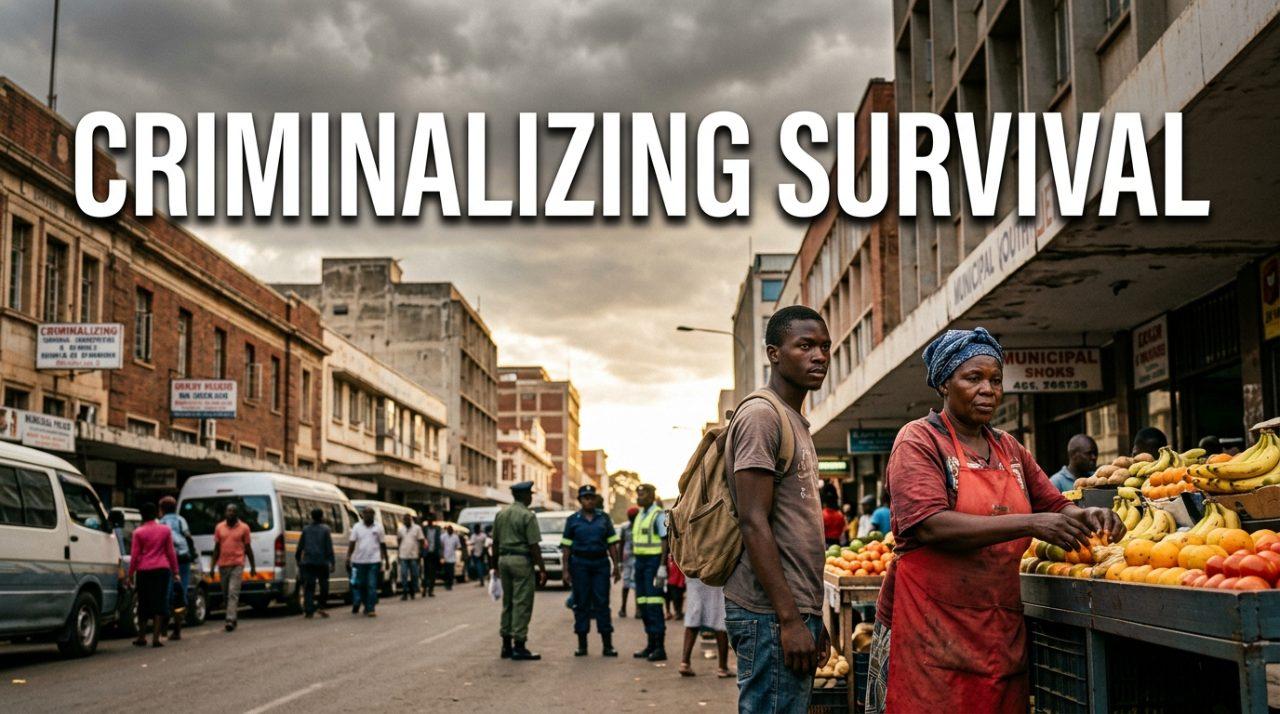
Why the Zimbabwe Street Vendor Crackdown Faces Revolt
By Darius Spearman (africanelements)
Support African Elements at patreon.com/africanelements and hear recent news in a single playlist. Additionally, you can gain early access to ad-free video content.
The Ultimatum on Harare Streets
In early September 2026, tension gripped the pavements of Harare. The Ministry of Local Government and Public Works issued a sudden directive to clear all informal traders. Local Government Minister Daniel Garwe announced a strict seven-day eviction ultimatum on September 2, 2026. The decree ordered tens of thousands of street vendors to abandon undesignated sites before September 9, 2026 (newzimbabwe.com, newzimbabwe.com).
State officials framed the sweeping cleanup as a vital measure to restore urban hygiene. They claimed that unregulated vendors blocked traffic, caused disorder, and hurt registered commercial storefronts (newzimbabwe.com, newzimbabwe.com). Multi-agency security teams and municipal police prepared to tear down informal wooden stalls across major urban centers (newzimbabwe.com, heraldonline.co.zw). However, ordinary citizens view the pavement stalls as lifelines during severe economic hardship.
Trade Unions Stand With the Sidewalks
Resistance to the municipal ultimatum formed rapidly. The Zimbabwe Congress of Trade Unions mobilized against the threatened demolitions (newzimbabwe.com). ZCTU Secretary-General Tirivanhu Marimo publicly condemned the state operation. He declared that clearing the stalls amounts to criminalizing urban survival in a broken economy (newzimbabwe.com).
The union argued that workers did not choose street vending out of preference. Instead, factory closures and high unemployment forced citizens into informal commerce (newzimbabwe.com). The defense reflects how African workers maintain historical fights for economic justice across changing labor environments. The ZCTU demanded that the government create viable jobs before evicting impoverished traders from public spaces (newzimbabwe.com).
Colonial Roots of Urban Segregation
Harare was once named Salisbury under British colonial rule. White authorities carefully designed the city around racial segregation and strict social division. Laws like the Vagrancy Act barred native Africans from urban areas unless white employers hired them (uky.edu). Black workers needed special documentation to enter white residential and business districts.
The African (Urban Areas) Accommodation and Registration Act outlawed independent trading in central thoroughfares (uky.edu). Colonial laws classified native street hawkers as vagrants. When Zimbabwe gained independence in 1980, the new government inherited these colonial municipal bylaws. The statutes remained largely unchanged for decades, leaving informal commerce vulnerable to arbitrary state crackdowns.
Structural Adjustment and Industrial Collapse
The informal economy exploded during the early 1990s. Zimbabwe adopted the Economic Structural Adjustment Programme under pressure from international lenders (tandfonline.com). The austerity program mandated deep cuts to social spending, rapid trade liberalization, and currency deregulation (tandfonline.com, american.edu). As cheap foreign products entered the market, local factories shuttered.
Thousands of skilled wage earners lost their manufacturing jobs in Harare and Bulawayo (tandfonline.com). With no formal safety net available, displaced factory workers turned to street corners. They used creative survival strategies to sustain their households. Pavements became bustling open markets for clothes, groceries, and handcrafted goods.
The Trauma of Operation Murambatsvina
The 2026 ultimatum brought back terrifying memories for urban vendors. In May 2005, the government launched Operation Murambatsvina, which translates to “Restore Order” or “Drive Out the Filth” (wikipedia.org, crisisgroup.org). Military and police forces bulldozed informal market stalls, backyard workshops, and homes across Zimbabwe (wikipedia.org, hrw.org).
A United Nations fact-finding mission led by Anna Tibaijuka exposed catastrophic destruction. The mission found that the operation directly deprived 700,000 citizens of homes or livelihoods (wikipedia.org, hrw.org). It disrupted the economic survival of 2.4 million people (wikipedia.org, crisisgroup.org). The campaign crushed urban livelihoods, but desperate vendors returned to the pavements within months because industrial jobs did not exist.
The Political Battle Over Urban Space
Urban streets in Zimbabwe have long carried deep political meaning. The ruling Zimbabwe African National Union-Patriotic Front party has governed the country since 1980. However, urban voters began electing opposition leaders during parliamentary and municipal elections in 2000 (crisisgroup.org). The Movement for Democratic Change gained control of major municipal councils like Harare and Bulawayo (wikipedia.org, crisisgroup.org).
This split created intense friction between local city councils and national authorities. ZANU-PF cabinet ministers routinely used ministerial authority to overturn local council decisions (newzimbabwe.com, heraldonline.co.zw). Furthermore, late union leader Morgan Tsvangirai originally led the ZCTU before founding the MDC opposition in 1999 (crisisgroup.org). Consequently, state authorities view trade unions and street vendors as potential political threats.
Space Barons and the Currency Crisis
The daily struggle of street vendors involves powerful cartels. Politically connected syndicates known as “space barons” control prime sidewalks near bus stops (heraldonline.co.zw, heraldonline.co.zw). These groups seize public land and subdivide pavements into unauthorized bays (heraldonline.co.zw). They extort between one and five US dollars per day from vendors who need spots to sell their wares (heraldonline.co.zw).
Transactions remain cash-based because the local currency suffered repeated hyperinflationary collapses. Vendors and syndicates avoid unstable domestic currencies like the Zimbabwe Gold unit (bulawayo24.com, newsday.co.zw). Instead, market participants rely on physical United States dollars for stability (bulawayo24.com, newsday.co.zw). Space barons pocket thousands of untaxed dollars daily while city councils lose vital public revenue (heraldonline.co.zw, heraldonline.co.zw).
The Human Face of Informal Survival
The people selling goods on urban sidewalks represent Zimbabwe’s most vulnerable populations. Most vendors are women, single mothers, retrenched workers, and unemployed young adults (zimstat.co.zw, pindula.co.zw). Recent university graduates also sell fruit, chargers, and household goods on sidewalks because corporate employers have no openings (pindula.co.zw).
Every dollar earned on the pavement supports essential family survival, covering daily meals, rent, and school tuition fees (pindula.co.zw). The historic market hub of Mbare Musika distributes food across Harare (heraldonline.co.zw). When police seize wares and demolish wooden kiosks, entire family networks lose their only source of food and shelter (pindula.co.zw).
Corporate Pressure and Vision 2030
The municipal campaign stems partly from corporate lobbying. Major retail supermarket chains like Pick n Pay and OK Zimbabwe complain about vendors setting up directly outside shop entrances (newzimbabwe.com, heraldonline.co.zw). Corporate leaders argue that street vendors avoid business taxes and commercial utility bills. This allows hawkers to sell goods at lower cash prices than formal stores (newzimbabwe.com).
Minister Garwe emphasized these corporate complaints while defending the eviction deadline (newzimbabwe.com). Furthermore, the central government aims to modernize cities under its Vision 2030 economic blueprint (heraldonline.co.zw). Authorities argue that crowded sidewalks damage the modern aesthetic required for national development (heraldonline.co.zw). Consequently, the state views street stalls as blights rather than as economic safety nets for the poor.
The Impasse and the 90-Day Demand
As the September 9, 2026 deadline arrived, vendor advocacy groups pushed back forcefully. The Vendors Initiative for Social and Economic Transformation joined rights groups to challenge the ministerial decree (newzimbabwe.com, pindula.co.zw). Even pro-government associations like Vendors for ED appealed to authorities for dialogue (pindula.co.zw). The groups demanded an immediate 90-day moratorium to negotiate fair solutions (zimbabwesituation.com).
Traders insisted they had nowhere else to earn a living. Municipal councils failed to build clean, serviced market bays before issuing eviction notices (zimbabwesituation.com). Street vendors publicly pledged to remain on the pavements despite the threat of police raids (pindula.co.zw). Razing wooden stalls removes physical structures from walkways, but it cannot eliminate the desperate hunger that built them.
About the Author
Darius Spearman is a professor of Black Studies at San Diego City College, where he has been teaching for over 20 years. He is the founder of African Elements, a media platform dedicated to providing educational resources on the history and culture of the African diaspora. Through his work, Spearman aims to empower and educate by bringing historical context to contemporary issues affecting the Black community.
