



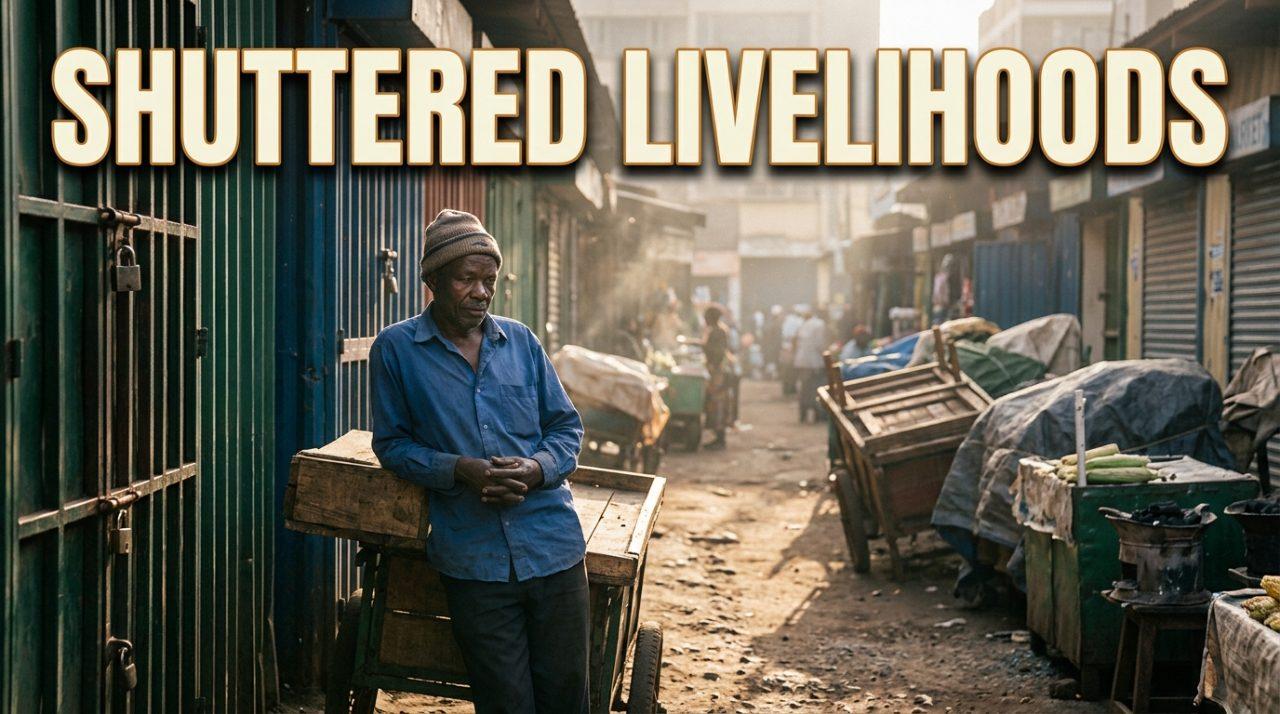
Kenya Immigrant Trade Crackdown: Why Hawkers Face Eviction
By Darius Spearman (africanelements)
Support African Elements at patreon.com/africanelements and hear recent news in a single playlist. Additionally, you can gain early access to ad-free video content.
The bustling open-air markets of Nairobi usually hum with the morning sounds of commerce. Vendors shout out daily prices for roasted maize, secondhand clothes, and fresh coffee beans. Yet in September 2026, an eerie silence settled over commercial districts like Eastleigh and Gikomba. Hundreds of small-scale stalls stood locked and shuttered. Panicked regional migrants gathered outside foreign embassies seeking protection from impending state eviction (eastleighvoice.co.ke, burunditimes.com).
This atmosphere of fear followed a swift executive directive that barred all non-citizens from operating small shops, market stalls, and street-hawking enterprises (aa.com.tr). While state officials framed the decree as an effort to protect local jobs, human rights defenders saw something far more dangerous. The Kenya National Commission on Human Rights formally challenged the state, warning that the policy fuels xenophobic violence across East Africa (eastleighvoice.co.ke, standardmedia.co.ke). To understand this sudden crisis, one must explore the deep history of economic nativism on the continent.
A Sudden Presidential Decree Shakes East Africa
The political storm began when President William Ruto addressed micro, small, and medium enterprise operators at State House in Nairobi (aa.com.tr, standardmedia.co.ke). During the meeting, the president issued an immediate five-day ultimatum to foreign merchants. He stated that low-capital retail trade, street vending, and petty hawking must belong exclusively to Kenyan citizens (aa.com.tr). Furthermore, he demanded that non-citizens immediately close their small commercial stalls or face police expulsion (eastleighvoice.co.ke, standardmedia.co.ke).
The president instructed government agencies to begin street-level enforcement immediately (eastleighvoice.co.ke). Concurrently, he urged lawmakers to pass the Local Content Bill of 2025 (standardmedia.co.ke). This proposed legislation aims to legally exclude foreign nationals from entry-level retail sectors (aa.com.tr). It also mandates that foreign enterprises hire local workers for eighty percent of their overall workforce (standardmedia.co.ke).
The announcement sent shockwaves through immigrant neighborhoods across the capital city. In response to the sudden decree, hundreds of small traders from neighboring Burundi rushed to their embassy on Dennis Pritt Road (burunditimes.com). Vendors who sold coffee, peanuts, and fabrics stood in long queues seeking emergency travel papers (burunditimes.com). Tensions rose sharply as local trader groups began confronting foreign stall owners in Nairobi markets (eastleighvoice.co.ke).
Historical Arc of Trade Nativism in Kenya
Trade Licensing Act Enacted: Non-citizens are barred from rural and peri-urban retail trade to force post-colonial economic transfer.
Africanization Push: State cancels work permits for Asian shopkeepers, causing tens of thousands to emigrate overseas.
Operation Usalama Watch: Security sweeps target Somali-dominated commercial hubs in Nairobi, disrupting informal urban commerce.
Market Protests: Local retail vendors hold demonstrations against Chinese merchants operating in wholesale centers like Nyamakima.
Executive Decree & Moratorium: The state bars regional migrants from street retail, prompting pushback from the national human rights commission.
The Kenya Human Rights Commission Sounds the Alarm
The state-backed campaign met immediate resistance from civil society watchdogs. On September 8, 2026, the Kenya National Commission on Human Rights denounced the executive directives (eastleighvoice.co.ke, standardmedia.co.ke). Commission Chairperson Claris Ogangah revealed that the commission received urgent petitions from immigrant communities across the country (eastleighvoice.co.ke). Migrant shopkeepers reported threats of arbitrary eviction, extortion by vigilante mobs, and harassment from municipal officers (eastleighvoice.co.ke, citizen.digital).
The rights commission warned that bypassing legal procedures violates Article 47 of the Kenyan Constitution, which guarantees fair administrative action (eastleighvoice.co.ke). Furthermore, the commission stated that the crackdown invites dangerous ethnic profiling (eastleighvoice.co.ke, standardmedia.co.ke). Executive declarations inevitably trigger vigilante violence against anyone perceived as foreign (eastleighvoice.co.ke). The East Africa Law Society also intervened, reminding national leaders that executive decrees cannot overturn regional treaties (thecitizen.co.tz).
Faced with escalating diplomatic tension and legal threats, the executive branch staged a tactical retreat. Government Spokesperson Charles Owino and State House Spokesperson Hussein Mohamed announced a ninety-day regularisation moratorium (citizen.digital, citizen.digital). The administration paused immediate street evictions, directing foreign traders to acquire legal documentation instead (citizen.digital). Nevertheless, the pause failed to resolve underlying legal contradictions (eastleighvoice.co.ke).
The Long Shadow of Post-Colonial Africanization
The 2026 trade conflict mirrors an older ideological script. Following national independence in 1963, the administration of President Jomo Kenyatta inherited an economy divided along racial lines (stanleymeisler.com, econstor.eu). White settlers controlled the best agricultural land, while Asian families dominated urban retail trade (stanleymeisler.com, smu.edu). Indigenous African citizens remained trapped in low-wage manual labor or subsistence farming (stanleymeisler.com, econstor.eu).
To break this colonial hierarchy, lawmakers passed the Trade Licensing Act of 1967 and the Immigration Act of 1967 (tandfonline.com, econstor.eu). The legislation barred non-citizens from trading outside designated commercial zones in major urban centers (tandfonline.com, africabib.org). It also established lists of basic commodities that only Black Kenyan citizens could sell (tandfonline.com, smu.edu). This aggressive push came to be known as Africanization (stanleymeisler.com, econstor.eu).
Consequently, the state refused to renew commercial licenses for thousands of South Asian shopkeepers (stanleymeisler.com, econstor.eu). For generations, these merchants had operated the corner retail shops known across East Africa as the duka economy (stanleymeisler.com, smu.edu). By the early 1970s, tens of thousands of Asian residents were forced to leave the country (stanleymeisler.com, cia.gov). Displaced traders appealed to international courts, creating landmark human rights precedents like East African Asians v. United Kingdom before the European Commission of Human Rights (coe.int, unimelb.edu.au). The episode proved that trade licensing could easily become a political tool during times of hardship (stanleymeisler.com).
Decolonization Versus Modern Intra-African Nativism
While the 1960s policies sought to undo colonial oppression, modern crackdowns serve a very different purpose. Historical Africanization was part of a larger global struggle against systemic racism (econstor.eu). In the African diaspora, communities engaged in intense ideological debates over Black economic nationalism to reclaim power from white supremacy. The early Kenyan laws intended to break colonial monopolies held by British subjects (stanleymeisler.com, econstor.eu).
In contrast, modern trade crackdowns direct economic hostility against fellow Black African migrants (eastleighvoice.co.ke, burunditimes.com). The street vendors targeted in Nairobi are not wealthy colonial elites. Instead, they are working-class refugees and cross-border migrants from countries like Burundi, the Democratic Republic of Congo, and Tanzania (eastleighvoice.co.ke, burunditimes.com). They sell modest goods such as hot coffee, peanuts, or clothing to sustain their families (burunditimes.com).
This shift represents a retreat from Pan-African solidarity. Rather than uniting the region, modern trade bans divide working people against each other. History shows that when political leaders face popular anger over rising food prices and job shortages, they often look for easy scapegoats (eastleighvoice.co.ke, standardmedia.co.ke). As documented in grassroots organizing among African workers, economic frustration frequently gets deflected away from corporate boardrooms and onto vulnerable migrant workers.
Inside the Jua Kali Sector and Modern Commercial Rivalries
To understand why local street vendors feel threatened, one must examine Kenya’s vast informal economy. Locally called the jua kali sector, the term translates from Swahili to “under the hot sun” (ilo.org, intechopen.com). The phrase originally described mechanics, metal artisans, and open-air hawkers who worked without formal shop roofs (ilo.org). Today, the informal sector is the primary economic engine of the nation (worldbank.org, ilo.org).
According to national economic surveys, the informal sector generates over eighty-three percent of total employment in Kenya (worldbank.org). Millions of young people who cannot find corporate or civil service jobs work in open markets (worldbank.org, worldbank.org). However, running a small stall is a precarious existence. Micro-traders face high license fees, constant police raids, and intense competition from imported factory goods (aljazeera.com, intechopen.com).
Tensions reached a boiling point in recent years due to changing trade patterns. In wholesale markets like Nyamakima and Gikomba, local vendors staged protests against foreign merchants (aljazeera.com, aa.com.tr). Kenyan traders complained about vertical integration (aljazeera.com). In this business model, foreign manufacturing firms control every step of the supply chain (aljazeera.com). They manufacture goods abroad, ship them in bulk, and sell them directly to street consumers (aljazeera.com, aa.com.tr). Local traders argued that this practice eliminates the traditional role of local retail middlemen (aljazeera.com).
Vulnerability and the Kenyan Informal Economy
Data sources: KNBS economic reviews and UNHCR urban refugee surveys (worldbank.org, unhcr.org).
The Impossible Hurdle of Work Permits and Legal Sweeps
Although the government granted a ninety-day pause, legal experts point out that compliance is virtually impossible for small traders (kazilegal.com). Under the Kenya Citizenship and Immigration Act, foreign merchants must secure a Class G Investor Work Permit (immigration.go.ke, kazilegal.com). By law, an applicant must demonstrate proof of one hundred thousand United States dollars in investment capital (immigration.go.ke, kazilegal.com). That equals over thirteen million Kenyan shillings (kazilegal.com).
In addition to capital requirements, the state charges a non-refundable processing fee of twenty thousand shillings (immigration.go.ke). If approved, the vendor must pay an annual permit fee of two hundred and fifty thousand shillings (immigration.go.ke). Clearly, an informal merchant selling fruit or tea from a roadside cart cannot satisfy these expensive demands. Consequently, the regularisation window functions as a deferred exit order (kazilegal.com).
Meanwhile, street-level enforcement remains aggressive and chaotic. Municipal enforcement officers, known locally as kanjo, regularly conduct sweeping market arrests (eastleighvoice.co.ke, kazilegal.com). Officers often profile individuals based on their accents or clothing (eastleighvoice.co.ke). Furthermore, police officers frequently ignore valid identification papers (kazilegal.com). This aggressive policing mirrors earlier patterns seen in urban communities, where unchecked enforcement leads directly to harsh shifts toward mass incarceration and systemic rights abuses.
The Legal Gap: Hawkers vs. Investor Permits
Broken Treaties and the Threat to Regional Integration
The trade crackdown also threatens the stability of the East African Community (thecitizen.co.tz). Under the 2010 EAC Common Market Protocol, partner states agreed to ensure the free movement of workers, goods, and services (masharikirpc.org, thecitizen.co.tz). Article 13 of the protocol explicitly guarantees the right of establishment (masharikirpc.org). This provision permits citizens of partner states to start businesses under conditions equal to local nationals (masharikirpc.org, thecitizen.co.tz).
By targeting traders from neighboring states, Kenya risks provoking severe diplomatic retaliation (burunditimes.com, thecitizen.co.tz). Burundian and Tanzanian officials warned that discriminatory treatment undermines bilateral relations (burunditimes.com, thecitizen.co.tz). The East African Court of Justice provides a venue to challenge these actions under Article 30 of the EAC Treaty (masharikirpc.org, lawcases.net). Rulings from this regional court take legal precedence over domestic executive orders (lawcases.net).
Moreover, the campaign collides with the domestic Refugees Act of 2021 (unhcr.org). That progressive law recognized the right of registered refugees to engage in gainful employment and commerce (unhcr.org). Kenya hosts over eight hundred and fifty thousand registered refugees (unhcr.org). Under the internationally acclaimed Shirika Plan, the nation promised to transition refugees into integrated economic municipalities (unhcr.org). Shutting down small trade violates the international principle of non-refoulement by driving vulnerable refugees into destitution (unhcr.org).
The Heavy Toll on Displaced Women and Families
The human cost of commercial evictions falls most heavily on women and children. Across the informal economy, women operate approximately fifty-five percent of micro-enterprises (worldbank.org). They work predominantly in low-capital niches such as street cooking, fresh produce vending, and garment sales (worldbank.org). When police dismantle market stalls, these families lose their daily subsistence income immediately (eastleighvoice.co.ke, burunditimes.com).
Unlike citizens, foreign vendors cannot rely on state welfare programs. Kenya’s national safety net, the Inua Jamii cash transfer system, requires a national identity card for access. Consequently, displaced immigrant families must depend entirely on communal solidarity. They rely on revolving credit circles, known as chamas, and church groups to survive evictions. This collective struggle reflects the enduring power of mutual aid networks and resilience seen across the Black world during times of state repression.
The Kenya National Commission on Human Rights performed an essential public service by challenging these executive directives (eastleighvoice.co.ke). Economic security cannot be built on the back of xenophobia and ethnic profiling (eastleighvoice.co.ke, standardmedia.co.ke). As the ninety-day regularisation moratorium expires, East African leaders face a defining historic choice. Kenya can choose the path of inward-looking economic nativism, or it can build a shared regional economy rooted in human dignity and the rule of law (eastleighvoice.co.ke, thecitizen.co.tz).
About the Author
Darius Spearman is a professor of Black Studies at San Diego City College, where he has been teaching for over 20 years. He is the founder of African Elements, a media platform dedicated to providing educational resources on the history and culture of the African diaspora. Through his work, Spearman aims to empower and educate by bringing historical context to contemporary issues affecting the Black community.
