


Memphis Disaster Neglect: How Black Mutual Aid Saves Lives
By Darius Spearman (africanelements)
Support African Elements at patreon.com/africanelements and hear recent news in a single playlist. Additionally, you can gain early access to ad-free video content.
When severe summer storms slam Shelby County, Tennessee, the electrical grid fails with predictable cruelty. Violent convective windstorms, known as derechos, pack straight-line winds exceeding seventy miles per hour (localmemphis.com). These storms repeatedly knock out electricity for more than one hundred thousand households at a time (capitalbnews.org). Consequently, the aftermath follows long-standing racial and economic lines.
As heat indexes climb past one hundred degrees, families in Black neighborhoods must survive inside suffocating homes. Power restoration often drags on for days, leaving residents to manage spoiled groceries, failing medical equipment, and dangerous indoor heat (capitalbnews.org). Because formal systems move slowly, local residents organize their own survival networks.
The Unequal Anatomy of Grid Breakdown
Memphis Light, Gas and Water represents the largest three-service municipal utility across the United States (capitalbnews.org). The utility procures all retail electrical power from the Tennessee Valley Authority (selc.org). Decades of delayed maintenance have left residential distribution lines fragile. Rotting wooden utility poles, outdated substations, and unmanaged tree canopies routinely collapse during severe summer storms.
This structural decay does not hit all neighborhoods equally. Affluent suburbs frequently enjoy buried electrical lines installed during modern suburban construction. In contrast, historic Black neighborhoods depend on legacy overhead wiring attached to unmaintained easements. When severe squall lines sweep through the Mid-South, low-income Black households face localized outages that persist long after wealthy corridors regain electrical service (capitalbnews.org).
Historical Roots: Boxtown and Disinvestment
The contemporary disaster landscape reflects deliberate zoning and geographic segregation. Following emancipation after the Civil War, freed Black citizens built self-sustaining settlements on the outskirts of Memphis. Communities like Boxtown took shape using salvaged timber and discarded shipping crates (capitalbnews.org, mlk50.com). Residents cultivated farmland, operated churches, and created autonomous support systems away from Jim Crow violence.
However, city officials systematically dismantled that autonomy. In 1947, municipal authorities annexed and rezoned Boxtown and Ensley Bottoms for heavy industrial use (capitalbnews.org). Refineries, chemical manufacturers, and fossil-fueled power stations soon enclosed residential streets (capitalbnews.org). This industrial expansion stripped away natural tree canopies, replaced green spaces with asphalt, and transformed historic Black enclaves into severe environmental sacrifice zones (capitalbnews.org, mlk50.com).
Environmental Racism and the Urban Heat Island
Industrial corridors directly intensify ground-level summer heat. Dense concentrations of concrete, metal roofs, and asphalt absorb solar radiation throughout the day and radiate thermal energy at night. Meanwhile, historically redlined neighborhoods suffer from a severe scarcity of cooling shade trees. Thermal measurements confirm that South Memphis neighborhoods remain five to ten degrees hotter than affluent, forested suburbs.
Consequently, heat waves pose an immediate public health emergency. When power grids collapse, homes in South Memphis heat up rapidly like ovens. Residents who already suffer from elevated rates of cardiovascular disease, pediatric asthma, and cancer bear the burden of these environmental hazards (capitalbnews.org). Decades of zoning discrimination have locked Black communities into localized heat traps without structural protection.
From the 1968 Sanitation Strike to Modern Resistance
Environmental justice activism in Memphis grew out of labor exploitation and racial neglect. In February 1968, sanitation workers Echol Cole and Robert Walker died inside a malfunctioning municipal garbage compactor (capitalbnews.org, ejhistory.com). Their deaths sparked the Memphis Sanitation Strike, where thirteen hundred Black municipal workers rallied under the slogan “I AM A MAN” (capitalbnews.org). The strike established that public infrastructure decisions remain inseparable from civil rights.
That legacy of collective mobilization continues today through contemporary environmental fights. Between 2020 and 2021, fossil fuel developers attempted to construct the Byhalia Connection crude oil pipeline through South Memphis (capitalbnews.org, selc.org). Corporate agents privately described these Black neighborhoods as the path of least resistance (capitalbnews.org, atmos.earth). Instead, grassroots leaders united through groups like Memphis Community Against Pollution, blocked eminent domain seizures, and forced the cancellation of the multi-million-dollar project (capitalbnews.org, selc.org, selc.org).
The Burden of Unbearable Utility Bills
Long before storms snap utility poles, Memphis residents contend with crushing utility costs. Energy burden represents the percentage of gross household income required to pay basic electric and gas bills (aceee.org). National equity standards define an energy burden over six percent as high, while burdens exceeding ten percent qualify as severe (aceee.org). Memphis ranks as the most energy-burdened major metropolitan area across the country (capitalbnews.org, aceee.org).
Low-income families spend an average of thirteen to twenty-five percent of their earnings on utility expenses (capitalbnews.org, aceee.org). African American households pay nearly three times more of their income toward power bills than white households (aceee.org). Aging housing structures leak cooled air through cracked window frames and uninsulated attics. For tens of thousands of families living paycheck to paycheck, a spoiled refrigerator full of food represents a devastating household loss.
Bureaucratic Failure and Institutional Gaps
Municipal and federal disaster relief programs rarely keep pace with urgent human needs. When extended blackouts spoil household groceries, low-income families cannot wait weeks for assistance. In response to recent outages, municipal authorities launched the Memphis Cares initiative, providing one hundred thousand dollars in emergency grocery replacement funds (capitalbnews.org). However, the program exhausted its entire financial allocation within hours of opening telephone intake lines (capitalbnews.org).
State and federal welfare programs introduce additional barriers. Low-income residents relying on food assistance must navigate cumbersome paperwork under complex state and federal policies. State regulations require individuals to submit replacement affidavits within a strict ten-day window following storm damage (capitalbnews.org, tn.gov, usda.gov). When cell towers lose power and public transit systems stall, low-income families find it nearly impossible to access state offices.
Industrial Power Versus Community Needs
The stark disparity between corporate access and community neglect appears clearly in local infrastructure choices. While residents in South Memphis suffer through blackouts, massive industrial users secure continuous utility support. The rapid construction of the xAI Colossus supercomputer facility in Southwest Memphis illustrates this inequality (capitalbnews.org). The tech facility consumes substantial electrical capacity while operating supplemental natural gas combustion turbines to power its hardware (capitalbnews.org, selc.org, protectouraquifer.org).
These combustion turbines operate without comprehensive selective catalytic reduction pollution controls (selc.org, protectouraquifer.org). Consequently, they release substantial volumes of nitrogen oxides, fine particulate matter, and hazardous volatile organic compounds (selc.org, protectouraquifer.org, breachcollective.org). Nearby families endure degraded air quality and grid stress while luxury tech firms secure steady power. This dynamic shows how institutional priorities favor corporate profit over public health.
Grassroots Mutual Aid: Survival and Solidarity
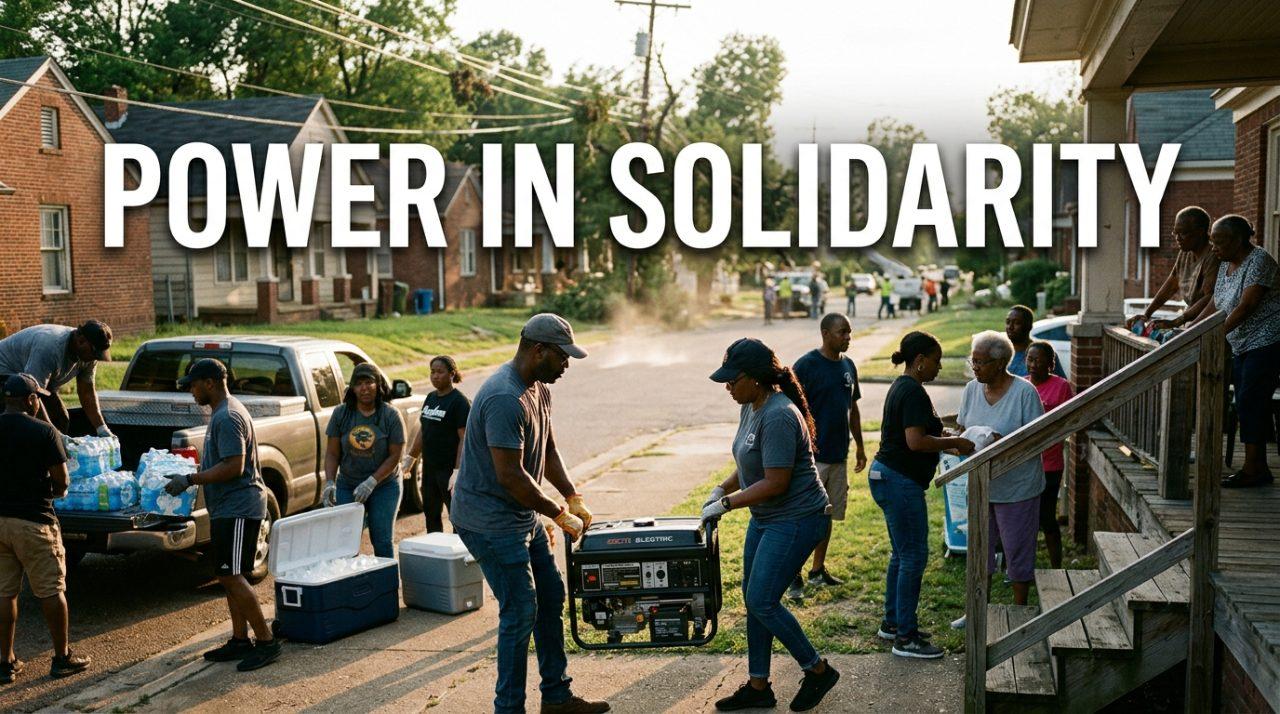
Because municipal and state institutions regularly fall short, Black community organizers have stepped in to save lives. Organizers, faith leaders, and local activists operate from the historic tradition of Black mutual aid (capitalbnews.org). Pastors like Reverend Dr. Earle J. Fisher of Abyssinian Missionary Baptist Church transformed church sanctuaries into neighborhood emergency relief hubs (capitalbnews.org). These centers distribute clean drinking water, hot meals, and power banks to residents who cannot leave their homes (capitalbnews.org).
Working alongside local organizers such as Amber Sherman, mutual aid networks reject the bureaucratic hurdles of traditional charities (capitalbnews.org). They coordinate through peer-to-peer digital networks to buy and transport portable generators for homebound seniors who depend on powered oxygen concentrators and refrigerated insulin (capitalbnews.org). This autonomous community care represents a powerful method of shaping political dynamics on the ground. Participants cooperate as equals, proving that collective solidarity remains vital to the broader struggle for liberation.
Building Long-Term Climate Resilience
Grassroots mutual aid provides an essential safety net, but community leaders recognize that charity cannot replace systematic public investment. Real climate resilience requires comprehensive, structural changes to municipal infrastructure. City leadership and utility administrators must prioritize the undergrounding of overhead power lines across older urban neighborhoods rather than limiting investments to wealthy suburban developments.
Furthermore, local governments must establish automated, universal relief systems that distribute replacement funds without burdensome paperwork. Comprehensive home weatherization programs, urban reforestation to combat heat islands, and binding environmental protections against industrial expansion are overdue. Until public agencies confront historical disinvestment, self-organized mutual aid will remain the primary defense protecting Black Memphis from corporate neglect and summer heat.
About the Author
Darius Spearman is a professor of Black Studies at San Diego City College, where he has been teaching for over 20 years. He is the founder of African Elements, a media platform dedicated to providing educational resources on the history and culture of the African diaspora. Through his work, Spearman aims to empower and educate by bringing historical context to contemporary issues affecting the Black community.
