



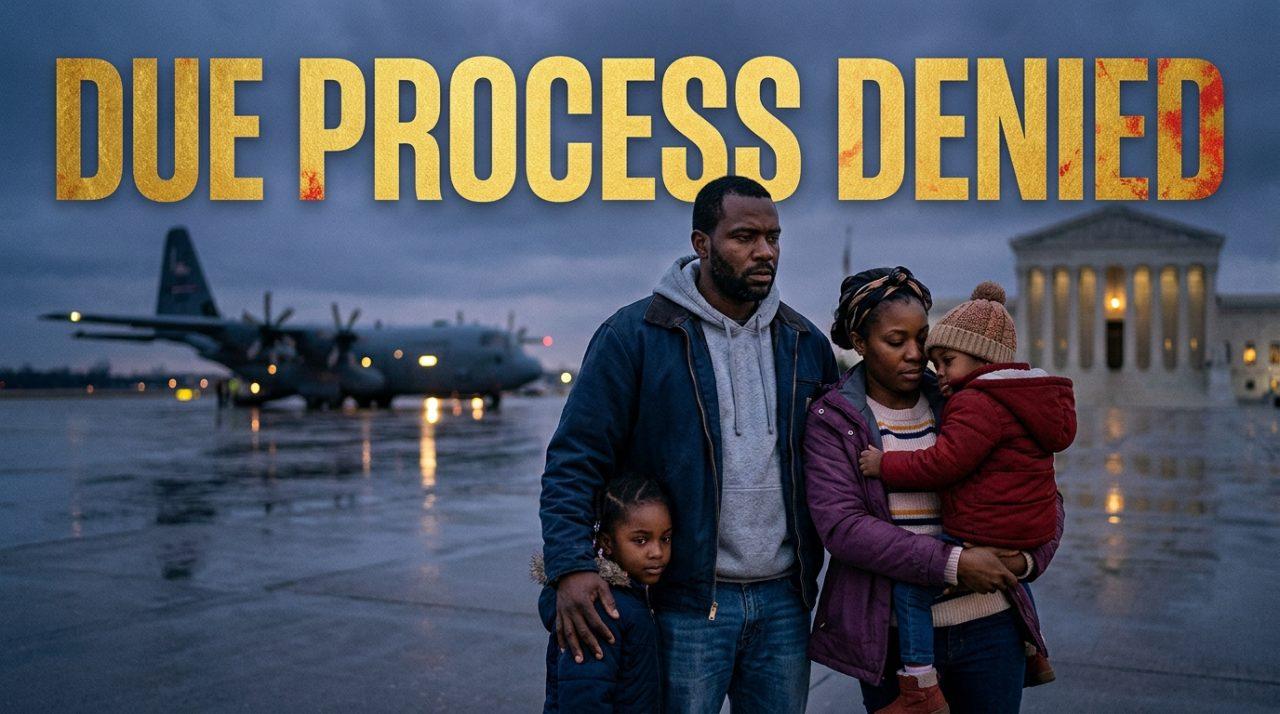
Why is Due Process Denied in Haitian Immigration Enforcement?
By Darius Spearman (africanelements)
Support African Elements at patreon.com/africanelements and hear recent news in a single playlist. Additionally, you can gain early access to ad-free video content.
In late August and early September 2026, chartered planes carrying hundreds of deported Haitian nationals began landing in the northern Haitian city of Cap-Haïtien (theguardian.com). Many of these individuals wore white garments and covered their faces (theguardian.com). They were terrified of being recognized in a nation suffering from severe gang violence, hunger, and political instability (theguardian.com). These deportations followed a major escalation in United States immigration enforcement (theguardian.com, haitianbridgealliance.org). On June 25, 2026, a landmark six-to-three Supreme Court decision in Mullin v. Doe, consolidated with Trump v. Miot, ruled that federal courts lack the authority to review the termination of Temporary Protected Status (theguardian.com, haitianbridgealliance.org). This ruling allowed the federal government to strip approximately 350,000 Haitians of their legal status and protection from deportation (theguardian.com, haitianbridgealliance.org).
For civil rights coalitions and immigrant defense groups, this shift is a profound humanitarian disaster (theguardian.com). Activists point to a glaring double standard (theguardian.com). The State Department issues high-level travel warnings advising Americans to avoid Haiti (theguardian.com). Meanwhile, the Department of Homeland Security continues to deport Haitian families to that very same crisis zone (theguardian.com). This policy is not a modern anomaly (haitianbridgealliance.org). It is the continuation of a decades-long historical system designed to exclude Haitian migrants from the American legal process (haitianbridgealliance.org). The history of these policies reveals a persistent double standard that continues to shape lives today (haitianbridgealliance.org).
Asylum Approval Rates by Nationality (2018-2021)
Source: Associated Press Analysis (theguardian.com)
The Modern Crisis of Deportation Flights
Historically, United States immigration enforcement has treated Haitian migrants with intense scrutiny (haitianbridgealliance.org). The current deportations are part of a rapid escalation following the Supreme Court decision in Mullin v. Doe (theguardian.com). Civil rights groups argue that the sudden termination of protections leaves thousands of families vulnerable (haitianbridgealliance.org). Many of those deported have spent decades in the United States, raising children and building lives (haitianbridgealliance.org). Under the current rules, these individuals are processed through expedited systems that bypass standard immigration judges (immigrantjustice.org, cis.org). This administrative process allows low-level officers to issue final orders of removal in a single day (americanimmigrationcouncil.org, immigrationlitigation.org). Consequently, families are torn apart without a meaningful opportunity to present their cases (haitianbridgealliance.org).
Furthermore, the humanitarian reception system in Haiti is almost non-existent (iom.int). The National Office of Migration in Haiti has openly stated that it lacks the resources to support the influx of weekly returnees (iom.int). Deportees are given minimal cash assistance and left to navigate a highly dangerous environment (haitianbridgealliance.org, iom.int). Gangs control major roadways, making travel from the airport a life-threatening journey (theguardian.com). This dangerous reality raises serious questions about the commitment of the United States to international human rights standards (haitianbridgealliance.org).
The Roots of Exclusion and the Duvalier Era
The systematic denial of due process for Haitian migrants is not a new development (haitianbridgealliance.org). This pattern dates back to the 1970s during the brutal regimes of François “Papa Doc” Duvalier and his son, Jean-Claude “Baby Doc” Duvalier (wikipedia.org, wikipedia.org). When thousands of Haitians began fleeing political violence in 1972, consecutive United States administrations refused to recognize them as refugees (wikipedia.org, wikipedia.org). Instead, officials labeled them “economic migrants” to justify denying their asylum claims (wikipedia.org). This label allowed the government to deport them swiftly without formal hearings (wikipedia.org).
This exclusionary practice stands in sharp contrast to the treatment of other migrant groups during the Cold War (wikipedia.org). For example, Cuban nationals fleeing the socialist Castro regime received expedited legal pathways and warm welcomes (wikipedia.org). The historical legacy of the Haitian Revolution and its impact on Western nations has often shaped how Haitian migrants are received (wikipedia.org). By framing Haitian asylum seekers as purely economic actors, the United States government established a legal precedent for swift exclusion (wikipedia.org). This framework has persisted across multiple administrations, shaping the foundation of modern border enforcement (haitianbridgealliance.org).
Economic Impact of Haitian Diaspora (2024)
$3.9 Billion
Annual remittances sent home by diaspora workers, representing nearly one-fifth of Haiti’s entire GDP.
Source: World Bank / Migration Policy Institute (iom.int, worldbank.org)
Offshore Deterrence and the Guantánamo Camps
In 1981, the Reagan administration codified a strategy of “offshore deterrence” through a formal agreement with the Haitian government (asil.org). Under this policy, the United States Coast Guard began intercepting Haitian vessels on the high seas and immediately returning passengers to Haiti (asil.org). By physically preventing Haitian migrants from touching American soil, the government avoided triggering domestic statutory rights to an asylum hearing before an immigration judge (asil.org). This tactic established a powerful legal precedent for extraterritorial exclusion (asil.org).
Furthermore, this strategy escalated dramatically in the early 1990s (gitmomemory.org). Following the 1991 military coup that ousted President Jean-Bertrand Aristide, tens of thousands of Haitians fled political violence (gitmomemory.org). To prevent them from reaching the mainland, the George H.W. Bush administration diverted intercepted refugees to the United States Naval Base at Guantánamo Bay, Cuba (gitmomemory.org). Over 12,000 Haitians were warehoused in crowded, razor-wire camps where they lacked access to legal counsel (gitmomemory.org). A subset of over 270 refugees who tested positive for HIV were isolated under deplorable conditions in Guantánamo’s Camp Bulkeley (gitmomemory.org). In 1993, a federal district court judge ordered the camp closed, ruling that this indefinite detention violated basic human rights (gitmomemory.org). This painful chapter demonstrated the lengths to which the government would go to deny due process to Black migrants (gitmomemory.org).
The Legal Machinery of Expedited Removal
To streamline deportations, Congress enacted the Illegal Immigration Reform and Immigrant Responsibility Act of 1996 (americanimmigrationcouncil.org). This legislation introduced “expedited removal,” which allows low-level immigration officers to summarily deport noncitizens without a hearing before an immigration judge (americanimmigrationcouncil.org, americanimmigrationcouncil.org). While designed as a border enforcement tool, subsequent administrations expanded its reach (immigrantjustice.org, cis.org). This expansion set the stage for the sweeping administrative removals that are observed today (immigrantjustice.org, cis.org).
The expansion of these fast-track policies is closely linked to the history of mass incarceration in the United States (americanimmigrationcouncil.org). Both systems rely on rapid processing, detention, and the limitation of judicial oversight to manage large populations of marginalized people (americanimmigrationcouncil.org, americanimmigrationcouncil.org). In January 2025, the executive branch implemented guidelines that authorized the nationwide use of expedited removal (immigrantjustice.org, cis.org). Under these guidelines, any undocumented individual who cannot prove two years of continuous presence in the country can be deported rapidly without a trial (immigrantjustice.org, cis.org). This policy strips migrants of basic due process, leaving them with no practical way to defend their rights (americanimmigrationcouncil.org).
U.S. Deportation Flight Rerouting (2026)
Former Route
Port-au-Prince
FAA Flight Ban / Heavy Gang Control
Active Hub
Cap-Haïtien
Weekly “Thursday Flights” via Alexandria, LA
Source: Human Rights First Flight Monitoring logs (theguardian.com, humanrightsfirst.org)
The Rise and Dismantling of Temporary Protected Status
The modern safety net for the Haitian diaspora was largely built in the aftermath of natural disasters (uscis.gov, uscis.gov). Following the catastrophic earthquake in January 2010, which killed over 100,000 people, the Obama administration designated Haiti for Temporary Protected Status (uscis.gov, uscis.gov). This humanitarian program allowed eligible undocumented Haitians in the United States to live and work legally (uscis.gov, uscis.gov). Over the next decade, this status enabled the diaspora to become an economic engine for their home country (iom.int, worldbank.org). By 2024, annual remittance flows to Haiti reached $3.9 billion, representing roughly 19 percent of the gross domestic product of the nation (iom.int, worldbank.org).
However, this crucial economic lifeline was dismantled in the courts (theguardian.com). In June 2026, the Supreme Court ruled in Mullin v. Doe that federal courts cannot review the termination of Temporary Protected Status (theguardian.com). Writing for the majority, the court asserted that the plain language of the statute shields these executive decisions from judicial oversight (theguardian.com). This ruling dissolved the legal protections for approximately 350,000 Haitian nationals, making them immediately vulnerable to deportation (theguardian.com, haitianbridgealliance.org). This sudden loss of status has disrupted African American families and mixed-status households across the country (haitianbridgealliance.org, firstfocus.org).
The Broken Road to Cap-Haïtien
Following the Supreme Court ruling, the federal government rapidly escalated deportation operations (theguardian.com). However, the traditional destination of Port-au-Prince became inaccessible due to intense gang warfare (theguardian.com, pbs.org). Gang coalitions secured control of most of the capital and targeted commercial aircraft with gunfire (theguardian.com, pbs.org). Consequently, the Federal Aviation Administration banned commercial flights to the capital, forcing the government to reroute chartered planes (theguardian.com, cbsnews.com).
The United States government established a new airbridge to the northern city of Cap-Haïtien (theguardian.com, iom.int). Flight logs show a sharp increase in operations, shifting from monthly flights to weekly “Thursday flights” originating from Alexandria, Louisiana (humanrightsfirst.org). Once deportees land, they face a severe lack of humanitarian infrastructure (haitianbridgealliance.org, iom.int). The National Office of Migration in Haiti provides only a small amount of cash, which is equivalent to less than eighty dollars, for travel expenses (haitianbridgealliance.org, iom.int). Many returnees cannot safely reach their home regions because armed gangs control the major highways leading out of the city (theguardian.com). These individuals are often left stranded in a hostile environment with no support (haitianbridgealliance.org, iom.int).
Anti-Black Bias and the Fight for Civil Rights
Civil rights organizations argue that the systemic denial of due process is fueled by deep-seated racial bias within the immigration system (haitianbridgealliance.org). Historically, migrants from Black-majority nations have faced disproportionately low asylum grant rates (theguardian.com). For example, between 2018 and 2021, only 4.62 percent of Haitian asylum seekers were granted relief (theguardian.com). This represents the lowest rate of any major nationality group (theguardian.com). Furthermore, Black asylum seekers face higher rates of negative credibility findings during their initial screenings (haitianbridgealliance.org).
In response to these conditions, immigrant defense coalitions are mobilizing to face these civil rights challenges directly (haitianbridgealliance.org). Activists are documenting violations and filing emergency challenges to stop the expedited flights (haitianbridgealliance.org). They argue that returning people to a country in active collapse violates the international legal principle of non-refoulement (haitianbridgealliance.org). This principle prohibits states from sending individuals back to territories where they face a high risk of persecution or death (unhcr.org). The struggle of the Haitian diaspora highlights the ongoing fight for racial justice and human rights within the American legal system (haitianbridgealliance.org).
About the Author
Darius Spearman is a professor of Black Studies at San Diego City College, where he has been teaching for over 20 years. He is the founder of African Elements, a media platform dedicated to providing educational resources on the history and culture of the African diaspora. Through his work, Spearman aims to empower and educate by bringing historical context to contemporary issues affecting the Black community.
