



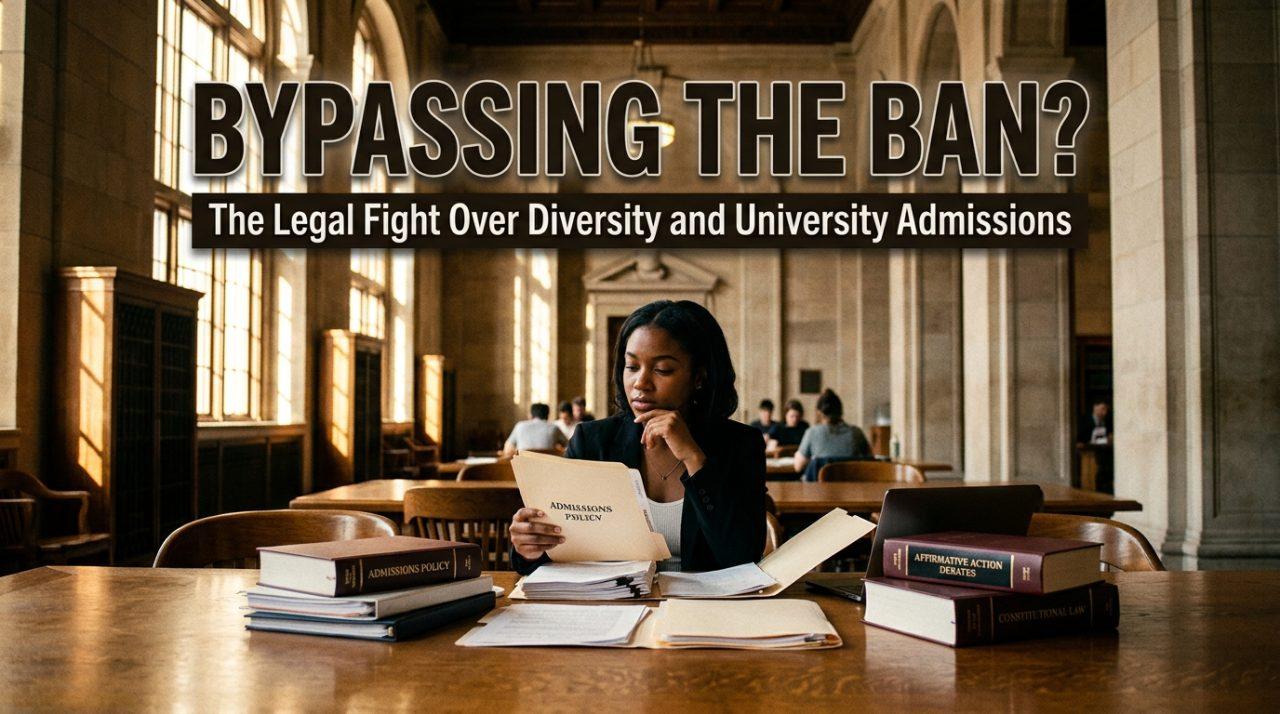
Is Berkeley Law Secretly Bypassing the Affirmative Action Ban?
By Darius Spearman (africanelements)
Support African Elements at patreon.com/africanelements and hear recent news in a single playlist. Additionally, you can gain early access to ad-free video content.
The Modern Conflict Over Diversity in Legal Education
The national conversation surrounding diversity in higher education reached a boiling point on September 9, 2026. On this date, the Civil Rights Division of the United States Department of Justice and the Office for Civil Rights within the Department of Education released formal investigative findings against the University of California, Berkeley School of Law (justice.gov, lawcommentary.com). Federal regulators alleged that the institution implemented admission practices that violated Title VI of the Civil Rights Act of 1964 (justice.gov, justice.gov). Specifically, the government claimed that Berkeley Law developed alternative procedures to systematically bypass federal and state bans on race-conscious admissions (lawcommentary.com, lawcommentary.com).
According to the federal findings letter, the law school utilized application essay prompts, demographic tracking mechanisms, and subjective evaluation systems to favor Black applicants over white and Asian candidates (justice.gov, lawcommentary.com). The school administration strongly denied these allegations, claiming full alignment with both state and federal laws (berkeley.edu, berkeley.edu). This confrontation represents a major clash in contemporary university governance. However, the root of this conflict extends far back into history, as the state of California has remained the center of the debate over affirmative action for decades (psu.edu, racism.org).
The Historical Precedent of the Bakke Decision
To understand the current federal investigation, one must look back to the late twentieth century. The legal framework for race-conscious admissions in the United States was largely established in California through the landmark case Regents of the University of California v. Bakke in 1978 (psu.edu, belmont.edu). In that decision, the United States Supreme Court ruled that explicit racial quota systems in public university admissions were unconstitutional (psu.edu, racism.org). Under that specific case, UC Davis Medical School could not set aside a fixed number of seats for minority applicants (belmont.edu).
At the same time, the Supreme Court ruled that public universities could still consider race as one factor among many in a holistic admissions process (psu.edu, belmont.edu). This allowed schools to use race as a positive element to cultivate a diverse student body, which the Court deemed a compelling state interest (psu.edu, aclu.org). For nearly four decades, this legal framework permitted public and private institutions to shape their incoming classes through race-conscious admissions, laying the groundwork for modern debates over affirmative action in education (aclu.org, stanford.edu).
The Evolution of Admission Policy Frameworks
Tracing the shifts in legal standards over five decades of legal education history.
Proposition 209 and the Demise of Black Enrollment
The political and legal landscape changed dramatically for California public universities in November 1996. Voters approved Proposition 209, a constitutional amendment prohibiting state agencies from discriminating against or granting preferential treatment to individuals based on race, sex, color, ethnicity, or national origin (latimes.com, aclu.org). This immediate statewide ban meant that public institutions, including the University of California Berkeley School of Law, could no longer use race-conscious admission policies (latimes.com, kqed.org).
The impact on enrollment was sudden and severe. In the fall of 1997, the first law class admitted under Proposition 209 restrictions entered Berkeley Law, which was historically known as Boalt Hall (latimes.com, kqed.org). Out of an entire entering class of 268 first-year students, known in legal circles as “1L” students, only one Black student enrolled (kqed.org, berkeleyside.org). Furthermore, this single student had deferred admission from the previous year, meaning not a single Black applicant was admitted and enrolled directly from the 1997 cycle (kqed.org). This enrollment crash triggered intense national outrage, student demonstrations, and debates regarding the future of minority representation in the legal pipeline (latimes.com, kqed.org).
The reduction in Black student enrollment had severe consequences for campus organizations and academic resources. For instance, the sudden lack of students forced the African-American Law & Policy Report, which is currently known as the Berkeley Journal of Black Law & Policy, to halt its independent annual publication schedule for several years (berkeleyside.org). The local legal pipeline was also disrupted, as fewer Black graduates entered civil rights organizations, public interest defense teams, and corporate law firms (berkeleyside.org). This historic drop demonstrated how state-level legal shifts could alter diversity within the profession, reflecting broader civil rights struggles in public institutions.
The Strategic Rise of Holistic Review
To rebuild student body diversity without violating the strict terms of Proposition 209, Berkeley Law pioneered new admission methods. Prior to 1996, the law school relied heavily on admissions indices, which are mechanical mathematical formulas combining an applicant’s Law School Admission Test score and cumulative undergraduate grade point average to automatically sort candidates (latimes.com, kqed.org). In the wake of the 1997 enrollment crash, the administration abolished these rigid index scores to prevent formulaic cutoffs that disproportionately disadvantaged underrepresented minority applicants (latimes.com, kqed.org).
Instead, the admissions office adopted a system of comprehensive qualitative review. The admissions committees introduced qualitative essay prompts that invited applicants to discuss socio-economic challenges, personal disadvantages, and unique cultural perspectives (latimes.com, kqed.org). Over the course of twenty years, these holistic methods succeeded in rebuilding minority enrollment levels without using explicit racial checkboxes (kqed.org, berkeley.edu). However, critics of affirmative action continued to argue that subjective qualitative reviews functioned as hidden proxies to achieve racial balance (pacificlegal.org, dailysignal.com).
Decoding the Supreme Court Ruling in SFFA v. Harvard
The national landscape shifted once more in June 2023. The U.S. Supreme Court decided Students for Fair Admissions, Inc. v. President and Fellows of Harvard College, declaring that race-conscious college admissions programs violated the Equal Protection Clause of the Fourteenth Amendment and Title VI of the Civil Rights Act (aclu.org, supremecourt.gov). This landmark ruling effectively extended California’s Proposition 209 restrictions to all universities across the nation (aclu.org, supremecourt.gov). However, a specific section of the majority opinion, written by Chief Justice John Court Roberts, became known as the “Roberts Exception” (supremecourt.gov).
Chief Justice Roberts clarified that nothing in the opinion prohibited universities from considering an applicant’s discussion of how race had affected their life, whether through discrimination, inspiration, or personal growth (supremecourt.gov). This discussion had to be tied directly to the individual student’s character, unique abilities, or personal experiences (supremecourt.gov). Following this ruling, universities across the country revised their application procedures (thecampusreview.com, highereddive.com). Many implemented new, short-answer essay prompts focused on personal challenges and individual resilience as a way to understand student backgrounds (thecampusreview.com, highereddive.com). This national tension relates directly to historic debates over sharing of power between federal authorities and local university administrators.
The SFFA “Roberts Exception” Framework
Understanding the boundary between legal individual context and illegal racial proxying.
The Federal Investigation and the Question of Proxy Discrimination
The joint investigation by the Department of Justice and the Department of Education launched on March 27, 2025, and expanded to Berkeley Law on April 18, 2025 (justice.gov, justice.gov). On September 9, 2026, federal investigators issued their formal findings, claiming that the law school crossed the legal boundaries established by the Supreme Court (justice.gov, justice.gov). Regulators argued that Berkeley Law used its application prompts as a backdoor to solicit and act upon applicants’ racial demographics, creating an illegal proxy system (justice.gov, lawcommentary.com).
The Department of Justice pointed to specific application prompts as evidence (justice.gov, lawcommentary.com). One essay question asked candidates: “How will you (your perspective, experience, voice) contribute diversity in our classrooms and community?” (justice.gov, lawcommentary.com). Investigators alleged that the law school instructed admissions reviewers to apply specific tags, such as “Diversity/Services” or first-generation status, to categorize candidate responses (justice.gov, lawcommentary.com). The government concluded that these tags allowed the admissions office to group applicants by primary racial identity, which violated the requirement to treat applicants purely as individuals (justice.gov, lawcommentary.com).
Analyzing the Data Behind the Claims of Favoritism
Statistical evidence forms the core of the federal case against the law school. To determine whether the admissions office was applying non-neutral racial weights, Department of Justice investigators reviewed complete applicant data files and admissions logs across the entering classes of 2024 and 2025 (justice.gov, lawcommentary.com). Using multivariable statistical regression modeling, investigators compared admission outcomes across racial groups while controlling for objective academic credentials, such as LSAT scores and undergraduate GPAs (justice.gov, lawcommentary.com).
The statistical models revealed substantial disparities. According to the DOJ, Black applicants had 5.8 times higher odds of admission than white applicants with similar qualifications in 2025, and 6.5 times higher odds in 2024 (justice.gov, lawcommentary.com). The LSAT is scored on a scale from 120 to 180, where a score of 167 places a student in the 93rd percentile, while a 172 reaches the 98th percentile. The federal findings highlighted that the median LSAT score for admitted Black applicants was 167, compared to a median score of 172 for white and Asian admits (lawcommentary.com, lawcommentary.com). Federal regulators argued that because half of the admitted Black students scored below 95 percent of white admits, the school was using non-neutral racial criteria to shape its classes (justice.gov, lawcommentary.com).
The Admitted Student LSAT Disparity
Comparing 2025 median LSAT scores across admitted demographic groups as cited by the DOJ.
The Financial Threat and Title VI Compliance
The federal investigation places Berkeley Law in a difficult legal position. Title VI of the Civil Rights Act of 1964 prohibits discrimination on the basis of race, color, or national origin in any program or activity receiving federal financial assistance (justice.gov, justice.gov). Because both public and private higher education institutions receive federal funds through student aid programs, research grants, and institutional subsidies, they are bound by these federal non-discrimination statutes (justice.gov, belmont.edu). This framework is tied directly to the history of the civil rights era, during which federal funding became a primary tool to enforce integration.
Failure to comply with Title VI guidelines can lead to severe consequences. The Department of Education had $369,122,992.35 in financial assistance allocated to UC Berkeley as of September 2026 (justice.gov, justice.gov). If a university is found to be in violation of Title VI and refuses to voluntarily reform its practices, federal regulators can initiate administrative proceedings to terminate all federal funding (justice.gov, justice.gov). This substantial financial threat serves as the primary leverage for federal civil rights enforcement, forcing universities to carefully balance their diversity goals with strict federal mandates (aclu.org, justice.gov).
The Long-Term Impact on Black Legal Professionals
The ongoing scrutiny of Berkeley Law carries significant implications for the future of Black legal professionals. Historically, top-tier law schools have served as the primary pipeline for prestigious judicial clerkships, academic appointments, and partnership tracks at major corporate law firms (berkeleyside.org). When enrollment drops occurred after Proposition 209 in 1997, the local legal system experienced a severe decline in Black representation (berkeleyside.org). This historic trend indicates that any further restriction on holistic admissions tools could restrict the pipeline of minority graduates entering leadership positions within the judiciary (berkeleyside.org).
As the DOJ investigation continues, institutions nationwide are watching the outcome of the Berkeley Law case (pacificlegal.org, highereddive.com). The federal findings suggest that simply shifting from check-boxes to subjective essay prompts may no longer protect universities from civil rights challenges (justice.gov, lawcommentary.com). The final resolution of this dispute will likely define how future generations of Black scholars gain access to elite legal education, representing a pivotal moment in the ongoing struggle for equity in American public life (aclu.org, supremecourt.gov).
About the Author
Darius Spearman is a professor of Black Studies at San Diego City College, where he has been teaching for over 20 years. He is the founder of African Elements, a media platform dedicated to providing educational resources on the history and culture of the African diaspora. Through his work, Spearman aims to empower and educate by bringing historical context to contemporary issues affecting the Black community.
