

Why Sudan Courts Are Targets in a Hidden Drone War
By Darius Spearman (africanelements)
Support African Elements at patreon.com/africanelements and hear recent news in a single playlist. Additionally, you can gain early access to ad-free video content.
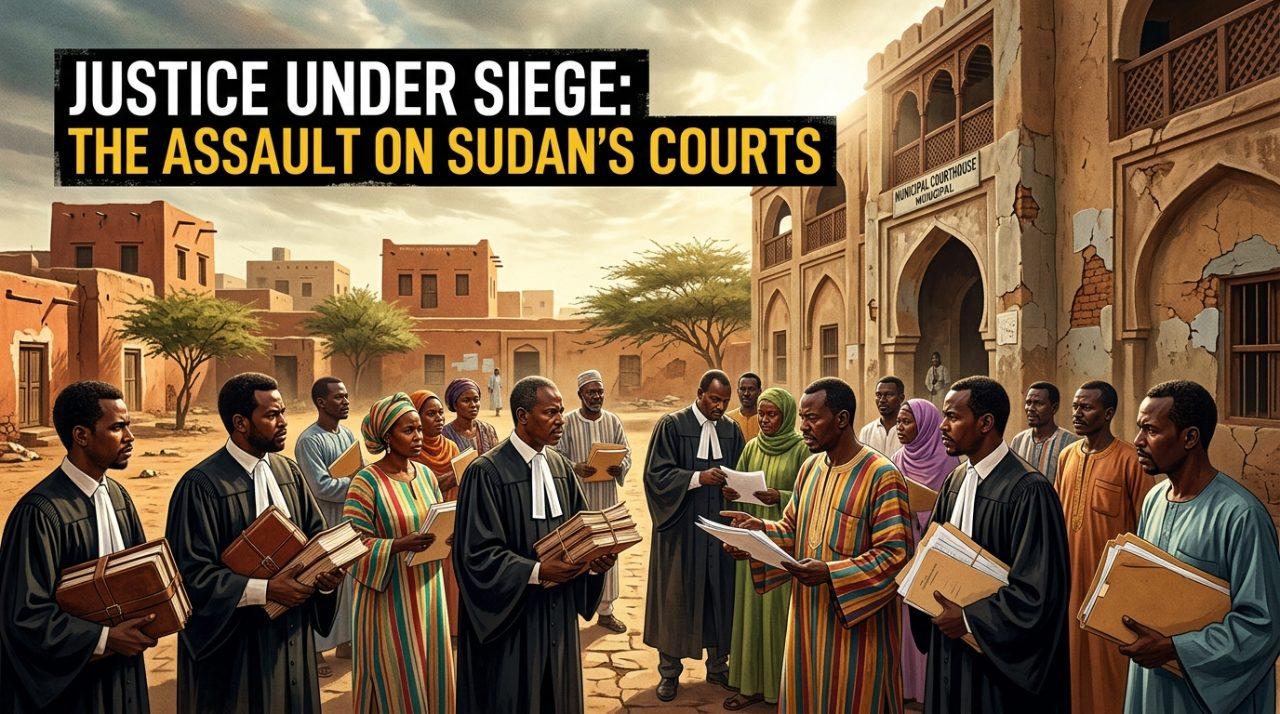
On a quiet Tuesday morning in North Kordofan, the sky turned deadly. A remote-controlled drone hummed over the busy town of Um Rawaba (sudantribune.com). It targeted the local courthouse during its busiest hours (sudantribune.com, radiotamazuj.org). Litigants, administrative workers, and lawyers packed the open courtyard (sudantribune.com, radiotamazuj.org). Within seconds, an explosion ripped through the crowd, killing at least thirteen civilians and injuring twenty-two others (sudantribune.com, radiotamazuj.org).
The Sudanese Doctors Network quickly condemned the strike, calling it a new massacre (sudantribune.com). Pro-democracy legal groups pointed out that the courthouse was actively serving local citizens (sudantribune.com, wordpress.com). It was not a military base. This brutal attack on September 8, 2026, highlights how the civilian justice system is under fire in Sudan (sudantribune.com, wordpress.com). Understanding this tragedy requires looking deeper at the history of those who pull the triggers.
The Rise of Drone Fatalities in 2026
Documented civilian casualties from unmanned aerial systems
The Terror in Um Rawaba: A Court Under Fire
Courts are supposed to be safe spaces even during wartime. The Um Rawaba court remained open because the local community desperately needed basic civil services (sudantribune.com, wordpress.com). Citizens gathered there daily to resolve disputes, file paperwork, and seek order amidst chaos (radiotamazuj.org, wordpress.com). Law professionals went to work despite the constant threat of violence. They believed in the rule of law.
The strike specifically injured six local lawyers who were inside the compound (sudantribune.com, radiotamazuj.org). Their names are Amer Daw al-Bayt, Ismail Muhammad, Azhari Bashir, Bashir Kamin, Bakheet al-Tayeb, and Islam al-Mu’min (sudantribune.com). Legal observers state that targeting courthouses is a deliberate strategy to destroy accountability (wordpress.com, lawyersforlawyers.org). When there are no courts left, the powerful can rule with complete impunity. This systematic destruction of legal institutions is a major blow to the population.
This violence represents a familiar pattern of targeting those who fight for fairness. In many African diaspora struggles, we see similar efforts to dismantle institutions that seek justice. For example, the political narrative changed over time to weaken community legal protections. In Sudan, the destruction of physical courthouses achieves this same dark goal by force.
The Janjaweed Roots: How the RSF Rose to Power
The group behind the drone strike is the Rapid Support Forces, or RSF (sudantribune.com). To understand their actions today, one must look back to the early 2000s in Darfur (wikipedia.org). During that time, the Sudanese government mobilized Arab nomadic militias known as the Janjaweed (wikipedia.org). The state used these forces to crush non-Arab rebel groups in the region (wikipedia.org). They did this by burning villages and taking lives.
These forces used scorched earth tactics to force entire populations to flee (wikipedia.org, genocidewatch.com). They poisoned water wells and burned crop fields to destroy any chance of survival (wikipedia.org). Eventually, the international community accused the Janjaweed of genocide and war crimes (wikipedia.org). In 2013, the dictator Omar al-Bashir formalized these militias into the RSF (wikipedia.org). He gave them legal status and official funding.
Under the leadership of General Mohamed Hamdan Dagalo, known as Hemedti, the RSF gained massive power (wikipedia.org). They seized gold mines in Darfur to build an independent financial empire (wikipedia.org). They were no longer just a local militia. The RSF became a state within a state, answerable to no one but their commander. Their history of unchecked violence continues to shape their actions today.
The Gateway of Kordofan: Why Geography Matters
The state of North Kordofan is a crucial prize in the current civil war (sudantribune.com). It sits directly between the RSF stronghold of Darfur and the capital city of Khartoum (sudantribune.com, wikipedia.org). Because of this position, the region acts as a major bridge for supply lines (sudantribune.com). Controlling North Kordofan means controlling the flow of food, fuel, and weapons.
Um Rawaba lies on a major highway that connects central Sudan to western territories (sudantribune.com, radiotamazuj.org). The Sudanese Armed Forces, or SAF, have managed to hold onto several urban centers in this area (sudantribune.com). However, the RSF has laid siege to these towns to cut them off (sudantribune.com, radiotamazuj.org). By using drone strikes, the RSF can attack fortified positions without risking their own troops.
This strategic corridor has become a primary zone of conflict. Local civilians are caught in the middle of these highway wars. The RSF uses remote terror to make life unlivable in SAF-controlled towns (sudantribune.com). By bombing public institutions like courts, they pressure the local population to surrender. This geographic struggle is tearing the social fabric of the country apart.
The Rise of Drone Warfare: Tech-Driven Brutality
The tragedy in Um Rawaba shows how remote technology has transformed the war. Both the SAF and the RSF now use advanced drones to strike civilian targets (sudantribune.com, sudantribune.com). These drones bomb marketplaces, hospitals, and schools with zero regard for human life (un.org, sudantribune.com). Remote warfare has made killing easier and more detached.
Foreign powers are fueling this technological escalation by supplying weapons (brookings.edu, usmission.gov). Reports indicate that the United Arab Emirates has provided substantial support to the RSF (usmission.gov). Meanwhile, other nations like Iran and Russia have supplied the SAF with drones and military equipment (sudantribune.com). This foreign interference keeps the conflict burning at the expense of Sudanese lives.
According to the United Nations, drone strikes are now a leading cause of civilian deaths in Sudan (un.org). In early 2026, drone strikes caused over eighty percent of civilian casualties in major conflict zones (un.org). The sky, which once brought rain to farmers, now brings sudden death from above. This unchecked proliferation of weaponized technology threatens the entire region.
The Kordofan Transit Corridor
The critical geographic link targeted by paramilitary forces
RSF Base
Um Rawaba
SAF Base
Emergency Lawyers: Fighting for Truth on the Ground
Amidst the falling bombs, brave citizens continue to fight for accountability. The Emergency Lawyers group is a grassroots network of human rights defenders (sudantribune.com, civicus.org). They first organized during the 2018 protests to defend peaceful demonstrators (lawyersforlawyers.org, civicus.org). Today, they risk their lives to document war crimes committed by both sides of the conflict (sudantribune.com, civicus.org).
These lawyers collect evidence under extremely dangerous conditions. They use encrypted messages to share verified photos, videos, and witness accounts (sudanesearchive.org). They collaborate with independent doctors to confirm casualty numbers (sudantribune.com). By doing this work, they keep the world informed about atrocities that would otherwise go unnoticed. Their work is a vital shield against complete lawlessness.
This struggle for human dignity mirrors other historical battles against oppression. Throughout history, marginalized groups have stood up to document systemic abuse. For example, people have launched an unapologetic call for racial justice to expose deep-seated crimes in the West. In Sudan, these brave legal monitors are keeping the hope of future justice alive.
The Human Toll: Statistics of a Fractured Nation
The numbers coming out of Sudan are staggering and hard to comprehend. Over two hundred thousand people have lost their lives since the war began in 2023 (pbs.org). Millions of families have been torn apart. More than ten million people have fled their homes, creating the largest displacement crisis on earth (un.org).
The economy has completely collapsed under the weight of the fighting. Unemployment has reached over sixty percent, and inflation is skyrocketing (wikipedia.org). Most families can no longer afford basic food or medicine (un.org). People are laboring under systemic oppression just to survive each day of this blockade. Nearly ninety percent of the population now lives below the poverty line.
This economic devastation is not an accident of war. It is a direct result of blockades and targeted attacks on infrastructure. When the RSF destroys markets and transport routes, they starve the people. This deliberate deprivation is a weapon of war that is just as deadly as any drone.
Global Inaction and the Long Road to Accountability
The international response to the crisis in Sudan has been slow and inadequate. While global powers focus on other conflicts, the Sudanese people suffer in relative silence. International bodies have issued statements of condemnation, but practical action is scarce (un.org, state.gov). The arms embargoes currently in place are routinely ignored by foreign arms dealers (usmission.gov).
However, some steps are being taken to hold perpetrators accountable. The International Criminal Court is actively investigating new war crimes in Darfur and Kordofan (un.org). United Nations fact-finding missions are gathering witness testimonies to build legal cases (un.org). Individual nations have placed targeted sanctions on key military commanders and their businesses (www.gov.uk, state.gov). These actions show that the world is watching, even if progress is slow.
True justice will require a complete halt to foreign arms shipments and a return to civilian rule. The people of Sudan have shown that they desire democracy and peace. By supporting local networks like the Emergency Lawyers, the international community can help lay the groundwork for recovery. Until then, the brave citizens of towns like Um Rawaba will continue to stand strong against the terror from the skies.
About the Author
Darius Spearman is a professor of Black Studies at San Diego City College, where he has been teaching for over 20 years. He is the founder of African Elements, a media platform dedicated to providing educational resources on the history and culture of the African diaspora. Through his work, Spearman aims to empower and educate by bringing historical context to contemporary issues affecting the Black community.
