

Caribbean Reparations: Why Leaders Demand Royal Restitution
By Darius Spearman (africanelements)
Support African Elements at patreon.com/africanelements and hear recent news in a single playlist. Additionally, you can gain early access to ad-free video content.
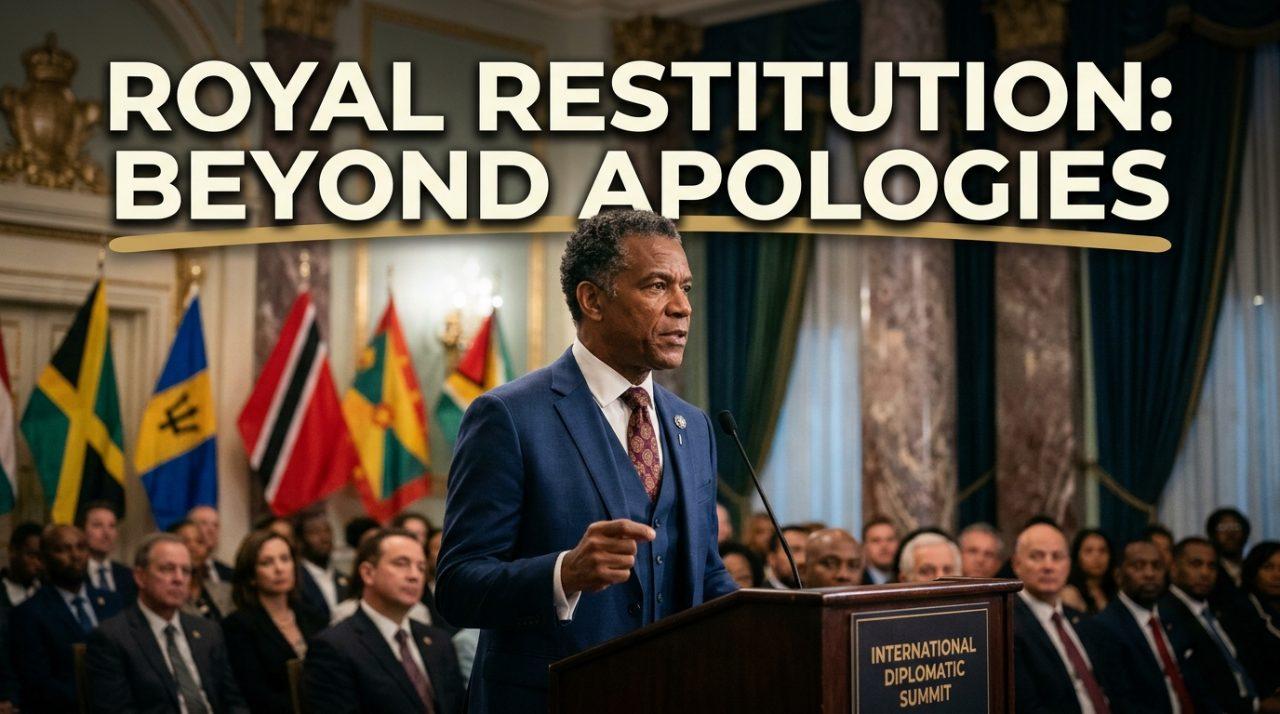
Caribbean leaders are escalating their demands for reparatory justice by directly confronting the British Crown. Ahead of major diplomatic gatherings, Sir Hilary Beckles, Chairman of the CARICOM Reparations Commission, delivered an unprecedented appeal to King Charles III. Beckles did not approach the monarch through conventional diplomatic protocol. Instead, he addressed the king directly as a fellow human being, a father, and a grandfather whose royal lineage accumulated immense private wealth from the transatlantic chattel slave trade (theguardian.com, youtube.com).
This public appeal marks a significant tactical shift in the global reparations movement. Caribbean leaders are moving past symbolic royal apologies and scripted expressions of sorrow. They are demanding formal, state-to-state negotiations to repair the structural devastation left behind by centuries of colonial exploitation (theguardian.com, uwi.edu). By focusing on the direct link between royal wealth and colonial extraction, advocates are connecting the current economic struggles of Caribbean island nations to their historical foundations.
CARICOM and the Machinery of Multilateral Diplomacy
The Caribbean Community, known as CARICOM, serves as the collective political and economic engine driving this modern campaign. Established in 1973 under the Treaty of Chaguaramas, CARICOM is an intergovernmental union consisting of fifteen member states and five associate members. For decades, reparations work existed primarily as a grassroots protest movement led by Pan-African activists, Rastafari communities, and academic scholars across the diaspora (kennesaw.edu, ibw21.org). However, CARICOM transformed this landscape in 2013 by establishing the CARICOM Reparations Commission (CRC) (caricom.org, reparationscomm.org).
This institutional backing elevated the reparations claim from informal civil society agitation into a unified multilateral diplomatic policy. Under the leadership of member states, the CRC coordinates regional legal, historical, and econometric research. Similar to how American advocates established reparations commission initiatives to study historical harms, CARICOM mobilized an entire geopolitical region under international law. By adopting the formal Ten-Point Plan for Reparatory Justice, Caribbean governments created a unified sovereign mandate to confront European powers directly rather than negotiating as isolated island states (caricomreparations.org, reparationscomm.org).
Transatlantic Slavery Trafficking Scale
The Crown and the Business of Human Trafficking
The historical record shows that the British monarchy was not an innocent bystander to the slave trade. Royal involvement in human trafficking was direct, chartered, and sponsored by the ruling dynasty. In 1618, King James I approved the initial royal charter establishing commerce along the West African coast (history.com). Following the restoration of the monarchy in 1660, King Charles II issued a charter creating the Company of Royal Adventurers Trading into Africa. This enterprise transformed in 1672 into the Royal African Company (RAC) (history.com, wikipedia.org).
The RAC was governed by Charles II’s brother, James, Duke of York, who later ruled England as King James II. Under royal leadership, the RAC transported more captured African men, women, and children across the Atlantic than any single corporation in human history (history.com). Royal agents branded captive human beings directly on their skin with the initials “DoY” or “RAC” before forcing them onto slave ships (history.com, aaregistry.org). Profits from these voyages flowed directly into royal bank accounts and funded the Stuart dynasty’s public institutions.
Sugar plantations in Barbados, Jamaica, and the Leeward Islands became the primary economic engines of the British Empire. Enslaved laborers sustained brutal conditions, developing intricate survival strategies under bondage as they resisted systemic dehumanization. As demonstrated by Caribbean historian Eric Williams in his foundational work Capitalism and Slavery, this forced labor financed Britain’s early banking networks, early industrial factories, and international shipping fleets (wikipedia.org, taxjustice.net). Modern royal wealth was built directly on this foundation of human commodification.
The 1833 Inversion of Justice and the Windrush Tax Burden
When the British Parliament finally passed the Slavery Abolition Act 1833, it carried out what Caribbean historians define as an inversion of legal justice. The legislation did not provide economic restitution, land, or resources to the approximately 800,000 freed people in the colonies. Instead, the British government paid £20 million exclusively to 46,000 slave owners to compensate them for the loss of their human property (parliament.uk, nationalarchives.gov.uk). This historic compensation package represented 40 percent of the British Treasury’s total annual budget at the time (parliament.uk).
The injustice intensified through a state-mandated apprenticeship scheme. Formerly enslaved workers were forced to perform an additional four to six years of uncompensated labor on the same plantations, ensuring uninterrupted white planter profits (kennesaw.edu, nationalarchives.gov.uk). To pay the £20 million compensation package to enslavers, the British Treasury secured massive commercial loans from private financiers. This enormous sovereign debt was rolled over across generations, meaning British taxpayers continued to service the interest on these loans for nearly two centuries (parliament.uk, historyreclaimed.co.uk).
This debt created a profound historical irony for the Windrush Generation. Between 1948 and 1973, hundreds of thousands of Caribbean citizens relocated to Great Britain to rebuild its infrastructure, manufacturing base, and National Health Service following World War II. As legal British subjects working in the metropole, these Caribbean migrants paid standard income taxes into the British Treasury. Consequently, Caribbean workers and their descendants spent decades paying taxes that funded the sovereign debt incurred to compensate the enslavers of their own ancestors, a financial obligation the British government only cleared in 2015 (parliament.uk, historyreclaimed.co.uk).
The 1833 Abolition Compensation Distribution
Constitutional Realities and the Privy Council Strategy
While advocates focus their rhetoric on King Charles III, the British constitutional structure severely restricts monarchical power. As a constitutional monarch, King Charles lacks the legal authority to open state negotiations, sign financial treaties, or disburse public funds. Under long-standing British constitutional conventions, the Royal Prerogative is exercised exclusively on the advice of the Prime Minister and Cabinet officials (jurist.org). Public expenditure and statutory redress require formal approval from the British Parliament.
Therefore, CARICOM’s appeals to the King serve as moral and symbolic leverage to compel the elected British government to act. Alongside this moral appeal, member nations are testing legal avenues within the imperial framework. Under the direction of Minister Olivia Grange, the Jamaican government prepared a formal petition requesting an advisory opinion from the Judicial Committee of the Privy Council (jurist.org, jamaicans.com). The Privy Council functions as the highest court of appeal for several independent Commonwealth nations.
The Jamaican legal petition presents three foundational questions to the court. First, it asks whether the transatlantic trafficking and enslavement of African people was unlawful under English common law during that era. Second, it questions whether these historical practices constituted crimes against humanity under emerging international legal norms. Finally, it asks whether the modern British state maintains an affirmative legal obligation to provide financial restitution (jurist.org, jamaicans.com). This strategy challenges the British legal establishment to examine the legitimacy of its own historic statutes.
The Econometric Case: The Brattle Group Findings
To substantiate their diplomatic and legal initiatives, CARICOM leaders moved beyond qualitative historical narratives to quantitative economic modeling. In June 2023, a comprehensive academic evaluation titled the Report on Reparations for Transatlantic Chattel Slavery in the Americas and the Caribbean was published. Produced by The Brattle Group in partnership with the University of the West Indies and former International Court of Justice Judge Patrick Robinson, the study provided comprehensive econometric assessments of colonial damage (brattle.com, brattle.com).
The report calculated global reparations obligations owed by former enslaving nations at between $100 trillion and $131 trillion. The authors evaluated unpaid labor, systemic deprivation of liberty, loss of life, and centuries of post-emancipation economic subjugation (brattle.com). According to the assessment, the United Kingdom bears a reparative liability of approximately $24 trillion across fourteen Caribbean nations. For Jamaica alone, the assessed restitution liability totals approximately $9.5 trillion (brattle.com, brattle.com).
These findings mirror modern empirical methodologies in the United States, where state-sponsored task force studies examining systemic harm systematically quantify generational wealth gaps. Rather than relying on abstract numbers, the Brattle Group study uses accepted international legal formulas regarding wrongful enrichment and personal injury damages. The resulting calculations demonstrate that the current economic instability of Caribbean nations is directly linked to imperial wealth extraction (brattle.com, brattle.com).
Assessed UK Reparations Liabilities
Structural Repair Over Individual Payouts: The CARICOM Manifesto
Public debates frequently mischaracterize reparations as demands for individual cash handouts. In contrast, CARICOM’s framework explicitly rejects individual checks in favor of long-term developmental investment. The CARICOM Ten-Point Plan for Reparatory Justice outlines an institutional blueprint to repair structural underdevelopment across the region (caricomreparations.org, reparationscomm.org). The plan targets specific sectors damaged by imperial governance.
A primary focus of the plan is public health intervention. Caribbean populations suffer from disproportionately high rates of chronic non-communicable diseases, particularly hypertension and type 2 diabetes. Medical historians trace these public health crises directly to the nutritional deprivation of chattel slavery and centuries of survival on high-sodium, low-nutrient plantation provisions (caricomreparations.org, reparationscomm.org). CARICOM demands European investment to construct modern medical infrastructure and fund specialized research centers.
The revised manifesto also targets structural debt cancellation, educational infrastructure, technology transfers, and psychological rehabilitation programs (caricom.org, reparationscomm.org). Caribbean economies face severe climate vulnerability and heavy foreign debt obligations because colonial powers extracted agricultural wealth without building durable domestic infrastructure. CARICOM argues that real reparatory justice requires institutional resources to secure regional economic independence.
Decolonization and the Horizon of Caribbean Sovereignty
The campaign for reparatory justice is inextricably linked to the unfinished process of regional decolonization. Sir Hilary Beckles and Caribbean heads of government frequently emphasize that the Caribbean remains one of the most colonized regions in the contemporary world (uwi.edu, voice-online.co.uk). European powers continue to maintain administrative dependencies throughout the Caribbean basin, including British Overseas Territories like Bermuda, the British Virgin Islands, and the Cayman Islands (voice-online.co.uk).
Recent diplomatic tours by members of the British royal family faced widespread protests and demands for accountability in Belize, the Bahamas, and Jamaica (theguardian.com, washingtonpost.com). Following Barbados’s decision to remove the British monarch as head of state and declare a republic in 2021, other regional governments have advanced constitutional reform agendas. Caribbean leaders view political independence and financial restitution as connected struggles for regional self-determination (theguardian.com).
Sir Hilary Beckles’ appeal to King Charles III challenges the British Commonwealth to redefine its mission in the modern era. The movement for reparatory justice rejects the premise that centuries of state-sanctioned human trafficking can be resolved through royal expressions of sorrow. Supported by coordinated legal petitions and rigorous econometric models, CARICOM has elevated reparations into a serious international diplomatic issue. By confronting the historical origins of modern imperial wealth, Caribbean nations are demanding a structural settlement rooted in genuine justice.
About the Author
Darius Spearman is a professor of Black Studies at San Diego City College, where he has been teaching for over 20 years. He is the founder of African Elements, a media platform dedicated to providing educational resources on the history and culture of the African diaspora. Through his work, Spearman aims to empower and educate by bringing historical context to contemporary issues affecting the Black community.
