


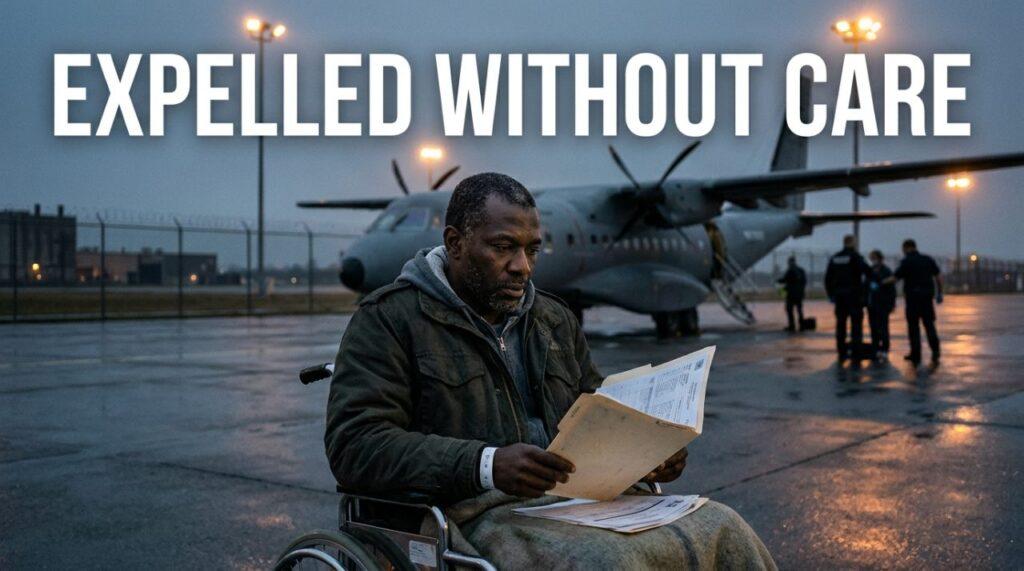
Why Is ICE Forcing Sick Detainees to Third Countries?
By Darius Spearman (africanelements)
Support African Elements at patreon.com/africanelements and hear recent news in a single playlist. Additionally, you can gain early access to ad-free video content.
Immigration authorities have intensified the transfer of noncitizens to distant third-party nations. Across federal detention facilities, legal defenders report that individuals face sudden removal to countries where they have no personal ties (hrw.org). Many of these individuals live with chronic medical conditions that require specialized daily care (theguardian.com, theguardian.com).
Civil rights groups have organized rapid legal responses to halt these flights. Immigrants from African and Caribbean nations face these expedited removals at disproportionate rates (freedomforimmigrants.org, icij.org). Understanding this developing crisis requires examining how federal removal statutes, carceral policies, and international migration enforcement have evolved over several decades.
The South Florida Medical Crisis Inside ICE Facilities
In late 2026, immigrant advocacy groups mobilized outside detention facilities in South Florida. Federal officers at the Krome North Processing Center and Broward Transitional Center scheduled critically ill individuals for deportation (theguardian.com, theguardian.com). Several detainees suffered from advanced cardiovascular disease, severe diabetes, and acute pancreatitis (theguardian.com, floridatrib.org).
When origin countries or transit hubs declined to accept medically compromised travelers, authorities selected alternative destinations (theguardian.com). Officers informed detainees of pending transfers to Central African nations, including the Central African Republic and Burundi (theguardian.com, hrw.org). These destinations lacked specialized clinical centers equipped to manage complicated illnesses (theguardian.com).
Conditions within the holding centers had already drawn critical oversight. A federal inspection report revealed that Krome North operated at 25 percent above its rated design capacity (floridatrib.org). The facility simultaneously maintained 15 unfilled clinical medical staff positions, leaving persistent gaps in diagnostic care and routine medication distribution (floridatrib.org).
Black Detainee Representation vs Abuse Reports
Civil Rights Intake Data Across ICE Facilities
The Statutory Roots of Removal Under 8 U.S.C. § 1231(b)
The modern removal process rests on statutory foundations created decades ago. Section 241(b) of the Immigration and Nationality Act, codified as 8 U.S.C. § 1231(b), sets the rules governing foreign expulsions (americanimmigrationcouncil.org, americanimmigrationcouncil.org). Under traditional practice, immigration statutes established an orderly step-by-step procedure:
- A country designated by the noncitizen during formal court hearings.
- The country where the individual holds citizenship or national origin.
- A country where the individual was born or maintained prior legal residence.
Sending a person to an unrelated third country was intended strictly as an emergency last resort (americanimmigrationcouncil.org). This fallback applied only when a home country refused repatriation or lacked functioning consular channels. Over time, administrative agencies inverted this statutory priority to streamline removals (americanimmigrationcouncil.org).
This reinterpretation created serious conflicts with humanitarian protections. Protections under Withholding of Removal and the Convention Against Torture historically barred deportation only to specific dangerous countries (hrw.org, americanimmigrationcouncil.org). When federal agents substitute an unvetted third nation at the final hour, individuals are expelled without an opportunity to present evidence of danger in that new location (americanimmigrationcouncil.org).
Historical Precedents: From Guantánamo to Central America
Offshoring immigration control is not a new government practice. During the early 1990s, federal authorities interdicted tens of thousands of Haitian refugees at sea (columbia.edu). The executive branch detained these asylum seekers at the Guantánamo Bay Naval Base in Cuba to block them from asserting constitutional protections on United States territory (columbia.edu).
Legislative changes soon codified these externalization practices. In 1996, Congress passed the Illegal Immigration Reform and Immigrant Responsibility Act, creating statutory authority for “Safe Third Country” agreements (americanimmigrationcouncil.org). While initially designed for reciprocal arrangements with nations like Canada, administrative agencies expanded these mechanisms into broader enforcement tools (americanimmigrationcouncil.org, humanrightsfirst.org).
By 2019, the executive branch signed Asylum Cooperative Agreements with Guatemala, Honduras, and El Salvador (americanimmigrationcouncil.org, humanrightsfirst.org). These compacts allowed border agents to transfer asylum seekers directly to Central American nations without adjudicating their initial claims (humanrightsfirst.org). This operational framework laid the direct institutional groundwork for contemporary intercontinental expulsions (hrw.org).
The 1990s Crimmigration System and the Detention Pipeline
The disproportionate detention of Black noncitizens reflects domestic carceral trends. During the 1990s, federal legislation linked criminal legal penalties directly to civil immigration enforcement (columbia.edu, splcenter.org). This historical intersection expanded the mass incarceration system into deportation processing across the country.
Because Black immigrant communities experience higher rates of municipal traffic stops and neighborhood surveillance, local police contacts funnel individuals rapidly into federal custody (splcenter.org). Programs such as 287(g) and federal biometric databases transmit arrest records directly to immigration field offices (splcenter.org). This interconnected system transforms minor local infractions into mandatory federal detention holds (americanimmigrationcouncil.org).
Inside detention facilities, Black noncitizens face documented institutional disparities. Studies by legal defense networks reveal that Black detainees receive higher bond amounts and lower rates of humanitarian parole (freedomforimmigrants.org, splcenter.org). Furthermore, investigative reports show that detainees from African and Caribbean nations are placed in solitary confinement at rates six times higher than the general detained population (icij.org).
Solitary Confinement Placement Multiplier
Relative Risk of Punitive Isolation in Custody
The Deterrence Doctrine and Bilateral African Agreements
Between 2025 and 2026, the Department of Homeland Security scaled up third-country removals (hrw.org). Administrative directives authorized flight schedules with notice windows as short as 6 to 24 hours (americanimmigrationcouncil.org, humanrightsfirst.org). Rather than conducting formal hearings on potential local risks, officials relied on generalized diplomatic assurances (hrw.org, humanrightsfirst.org).
A comprehensive investigation titled “To Scare People” documented that federal authorities secured removal agreements with at least 36 governments (hrw.org). These pacts included 14 sub-Saharan African nations, such as Eswatini, Burundi, Rwanda, and South Sudan (hrw.org). Testifying before congressional oversight committees, administration officials stated that the logistical operations aimed to deter others from pursuing asylum claims (hrw.org).
The diplomatic leverage used to secure these agreements relies on statutory and economic pressure. Under Section 243(d) of the Immigration and Nationality Act, the federal government can withhold visas from countries that decline deportees (hrw.org). Developing nations face suspensions of tourism, business, and educational visas until bilateral transfer compacts are signed (hrw.org).
Federal Litigation: The Constitutional Contest in D.V.D. v. DHS
Civil rights attorneys challenged fast-track third-country deportations through federal class-action litigation (americanimmigrationcouncil.org, humanrightsfirst.org). In D.V.D. v. DHS, legal advocates argued that giving noncitizens less than 24 hours of notice violated statutory safeguards and constitutional due process (americanimmigrationcouncil.org, humanrightsfirst.org). Attorneys had little time to file emergency habeas corpus petitions before flights crossed international boundaries (hrw.org, humanrightsfirst.org).
In February 2026, a federal district court in Massachusetts granted an injunction vacating the expedited transfer rules (americanimmigrationcouncil.org, humanrightsfirst.org). The First Circuit Court of Appeals affirmed the ruling in September 2026, holding that the government must provide adequate notice and an administrative screening process (americanimmigrationcouncil.org, humanrightsfirst.org). The appellate court emphasized that deportees must have a fair opportunity to show fear of torture in destination nations (humanrightsfirst.org).
However, the legal landscape shifted on September 29, 2026. The Supreme Court granted an emergency administrative stay of the appellate ruling (americanimmigrationcouncil.org, humanrightsfirst.org). This judicial order temporarily restored executive authority to conduct third-country removals, prompting a sharp increase in chartered flights (hrw.org, theguardian.com).
Documented Third-Country Removals & Case Closures
Federal Enforcement Actions Logged (2025–2026)
Chain Refoulement and Pretermitted Asylum Claims
Two legal concepts explain why human rights groups oppose fast-track third-country removals: “chain refoulement” and “asylum pretermission” (hrw.org, immigration-analytics.com). Under Article 33 of the 1951 Refugee Convention, non-refoulement forbids returning individuals to places where their lives face genuine threats (amnesty.org, humanrightsfirst.org). Chain refoulement occurs when an intermediary country receives a deportee and subsequently expels them back to their hostile home nation (hrw.org).
Asylum pretermission operates inside the domestic immigration court system (immigration-analytics.com). It allows administrative judges to dismiss an asylum claim on written papers without granting the applicant an evidentiary hearing (immigration-analytics.com). Between 2025 and 2026, immigration judges pretermitted over 31,000 asylum applications by invoking third-country presumptions (immigration-analytics.com).
These practices recall documented abuses from late 2020 involving Cameroonian asylum seekers (ccrjustice.org, projectsouth.org). Civil rights coalitions documented how officers coerced detainees into signing removal documents through physical restraint and solitary confinement (ccrjustice.org, democracynow.org). Many of those deportees were returned directly into an active civil conflict, where several were imprisoned or disappeared (ccrjustice.org).
Coalition Defense and Modern Civil Rights Mobilization
In response to third-country expulsions, immigrant defense organizations have aligned with historic Black legal networks (ccrjustice.org, splcenter.org). Coalitions including the Black Alliance for Just Immigration, Project South, and The Workers Circle have framed these transfers as urgent civil rights concerns (theguardian.com, projectsouth.org, splcenter.org). These organizations view modern enforcement practices through long-standing civil rights struggles that challenged arbitrary state power.
Legal defenders argue that detention policies mirror historical systems of involuntary servitude and post-Reconstruction penal leasing (columbia.edu, splcenter.org). In both eras, carceral structures relied on confinement and labor extraction while denying basic due process protections (columbia.edu). By highlighting medical vulnerabilities and lack of representation, these advocacy networks continue to demand systemic oversight of third-country expulsions (theguardian.com, hrw.org).
About the Author
Darius Spearman is a professor of Black Studies at San Diego City College, where he has been teaching for over 20 years. He is the founder of African Elements, a media platform dedicated to providing educational resources on the history and culture of the African diaspora. Through his work, Spearman aims to empower and educate by bringing historical context to contemporary issues affecting the Black community.
