


Why Is the Feds Fighting Evanston Reparations?
By Darius Spearman (africanelements)
Support African Elements at patreon.com/africanelements and hear recent news in a single playlist. Additionally, you can gain early access to ad-free video content.
In 2019, the suburban city of Evanston, Illinois, made history by establishing the first government-funded restitution initiative for Black Americans. The city created housing grants to repair decades of municipal segregation and economic harm (cityofevanston.org). Today, that historic program faces an intense federal legal battle that threatens local racial repair nationwide (wlrn.org).
A national investigation reported by WLRN Public Media shows how conservative litigators and federal civil rights authorities have stepped in to challenge these race-conscious grants (wlrn.org). The fight raises crucial constitutional questions about racial redress in the United States. To fully grasp this conflict, one must examine the deep historical roots behind the current headlines.
Segregation by Design in Evanston: 1919 to 1969
Black families arrived in Evanston in large numbers during the early twentieth century. Many sought stable lives away from the violent oppression of the Jim Crow South (luc.edu). These migrants sought domestic and industrial jobs along the affluent North Shore of Lake Michigan. In the early years, Black residents lived scattered across various neighborhoods in relative peace (northbynorthwestern.com).
That dynamic changed drastically after the First World War. In 1921, Evanston adopted a comprehensive municipal zoning plan created by urban planner Harland Bartholomew (luc.edu). The city used exclusionary zoning, real estate steering, and restrictive covenants to push Black residents into an isolated pocket known as the Fifth Ward (arcgis.com). Decades of intentional local policy denied Black families public investment and residential mobility (cityofevanston.org).
Local banks and municipal officials worked together to block Black families from securing mortgages outside the Fifth Ward (cityofevanston.org). Black mothers were turned away from local hospitals during childbirth (iowapublicradio.org). This municipal containment lasted until local fair housing legislation passed in 1967, which was followed by the federal Fair Housing Act of 1968 (luc.edu, archives.gov).
The Birth of Municipal Restitution
Decades of redlining stripped generations of Black families of their housing equity. In 2019, Fifth Ward Alderwoman Robin Rue Simmons took decisive legislative action to confront these historical realities (iowapublicradio.org). She examined local records and uncovered massive wealth disparities between Black and white households (wlrn.org). The wealth divide remained firmly rooted in historic neighborhood containment (cityofevanston.org).
Simmons organized community town halls and pushed the City Council to pass Resolution 126-R-19 (cityofevanston.org). The measure committed the city to ending structural racism and established a local reparations fund (cityofevanston.org). Evanston financed this repair through a local sales tax on newly legalized recreational cannabis (iowapublicradio.org, cityofevanston.org). Officials selected cannabis revenue because the War on Drugs had heavily harmed Black residents (iowapublicradio.org). This strategy connects directly to broader debates over mass incarceration policies that targeted urban Black communities.
In March 2021, the council enacted the Restorative Housing Program with an 8–1 vote (iowapublicradio.org). The initiative provides twenty-five thousand dollar grants to qualifying Black residents for mortgage payments, home improvements, or down payments (cityofevanston.org). Applicants must have lived in the city between 1919 and 1969 or be the direct descendant of a Black resident from that era (cityofevanston.org). Former Alderwoman Simmons later founded FirstRepair to help other cities build similar models (firstrepair.org). Similar efforts followed in Western states, leading to measures like California’s reparations task force (firstrepair.org).
Dissent Within: The 8–1 Vote and Internal Debates
The passage of the housing measure was celebrated around the world as a breakthrough (iowapublicradio.org). However, the program encountered notable debate within the local Black community itself. The lone dissenting vote on the council came from Black Alderwoman Cicely Fleming (iowapublicradio.org). Her dissent highlighted crucial discussions concerning the true definition and execution of restorative justice (iowapublicradio.org).
Fleming argued that the plan was essentially a municipal housing voucher disguised as reparations (iowapublicradio.org). She contended that the policy dictated where and how Black people could spend their funds (iowapublicradio.org). In her view, requiring banks and contractors to manage the funds showed municipal paternalism (iowapublicradio.org). She maintained that genuine repair requires direct cash restitution that respects Black autonomy (iowapublicradio.org). These internal debates echo historical arguments concerning Black nationalism and self-determination.
Despite these internal debates, the city expanded the program over subsequent years. Officials responded to resident feedback by allowing direct cash distributions to eligible seniors and descendants (cityofevanston.org). Over seven million dollars has been allocated, providing tangible restitution to hundreds of qualifying families (iowapublicradio.org, cityofevanston.org). Yet, just as the local initiative expanded, outside conservative legal groups initiated judicial challenges (wlrn.org, judicialwatch.org).
Funded by a 3% local adult-use cannabis sales tax and real estate transfer taxes on high-value properties.
Tied directly to fifty years of documented zoning manipulation and racial covenants in Cook County.
$25,000 disbursed per qualifying household for mortgages, renovations, or direct cash transfers.
The Lawsuit: Flinn v. City of Evanston
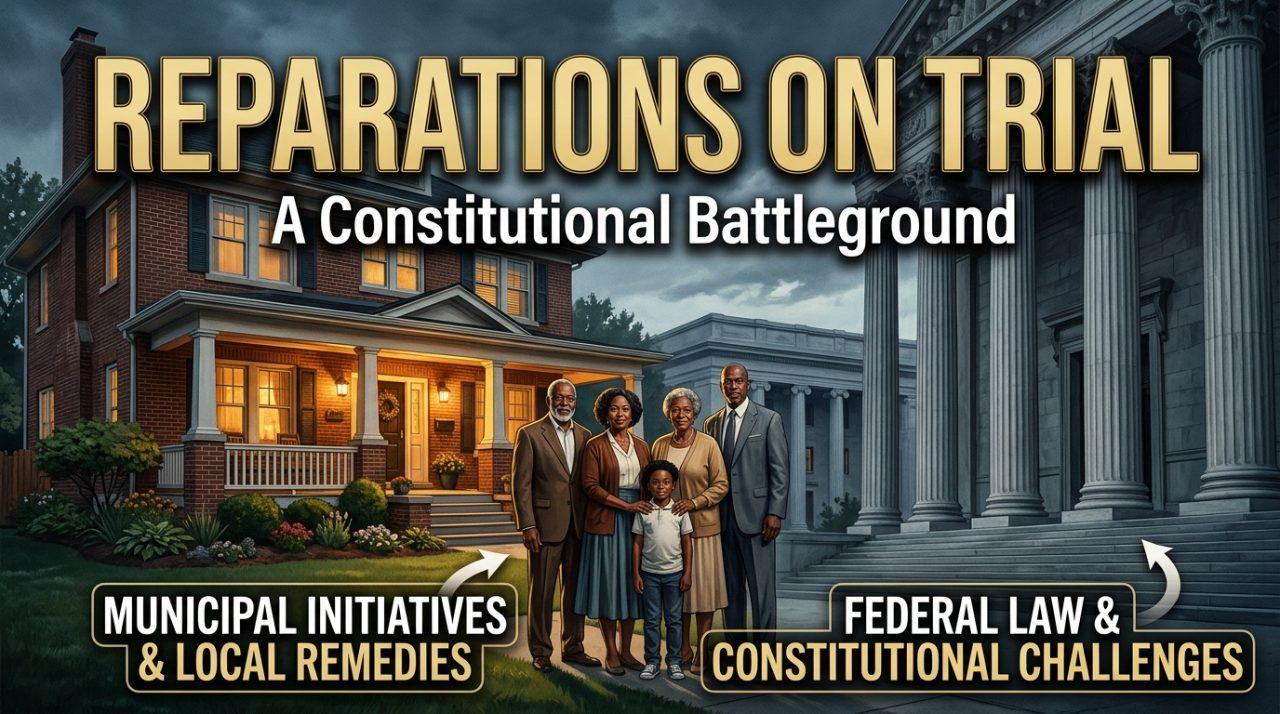
In May 2024, the conservative legal organization Judicial Watch filed a federal class-action lawsuit in the Northern District of Illinois (judicialwatch.org). The case is titled Flinn et al. v. City of Evanston (judicialwatch.org). The lawsuit was filed on behalf of six non-Black residents whose families lived in Evanston between 1919 and 1969 (judicialwatch.org). The plaintiffs argue that the housing initiative violates the United States Constitution (judicialwatch.org).
The lawsuit claims that the program violates the Equal Protection Clause of the Fourteenth Amendment (judicialwatch.org). The plaintiffs argue that because they are not Black, the city denies them the ability to apply for these public funds (judicialwatch.org). Evanston filed a motion to dismiss the lawsuit, asserting that the plaintiffs suffered no real injury because they never submitted formal grant applications (wlrn.org).
In March 2026, U.S. District Judge John F. Kness denied Evanston’s motion to dismiss (wlrn.org). The judge ruled that the non-Black plaintiffs possessed legal standing to proceed (wlrn.org). The court found that submitting an application would have been futile given the explicit eligibility criteria of the program (wlrn.org). Consequently, the federal courtroom became the primary battleground over municipal reparative authority (wlrn.org).
The Feds Intervene: Expanding the Battle
The legal stakes rose dramatically in June 2026. The Civil Rights Division of the United States Department of Justice formally filed a motion to intervene in the ongoing lawsuit against Evanston (wlrn.org, justice.gov). Federal civil rights attorneys challenged the housing remedy directly (wlrn.org). They claimed the race-conscious grants violate both the Fourteenth Amendment and Title VIII of the Civil Rights Act of 1968, commonly called the Fair Housing Act (wlrn.org).
Federal officials argue that the government cannot allocate public funds using race as a qualification (wlrn.org). Under long-standing federal doctrine, race-based government programs face strict scrutiny review (oyez.org, jacksonlewis.com). To survive this judicial test, the municipality must prove a compelling government interest and show that its policy is narrowly tailored (oyez.org, jacksonlewis.com). The Department of Justice asserts that Evanston’s criteria fail this standard because they rely entirely on racial identity (wlrn.org).
Civil rights leaders were shocked to see the Fair Housing Act used against a restorative initiative (wlrn.org). The 1968 statute was originally passed by Congress to protect Black Americans from predatory lenders and hostile white neighborhoods (huduser.gov, archives.gov). Now, federal authorities argue the statute forbids race-conscious housing remedies altogether (wlrn.org). This intervention reflects long-running conflicts over federal power and local governance, a theme deeply explored in federalism and Black politics.
Plaintiff & DOJ Argument
The Equal Protection Clause and Fair Housing Act prohibit race-exclusive distributions. Government programs must be colorblind, even when attempting to rectify historical injury.
Evanston Defense Argument
Meets strict scrutiny requirements under Croson by rectifying documented municipal segregation (1919–1969) rather than generalized societal discrimination.
The Pushback: Grassroots Defenders Mobilize
The intervention by federal authorities caused immediate outrage among Black organizers and legal scholars (wlrn.org). Robin Rue Simmons condemned the federal action as an intimidation tactic (wlrn.org). She argued that the lawsuit aims to discourage cities nationwide from making reparations for documented racial harms (wlrn.org). Local organizers maintain that the program does not discriminate against white residents, but simply repays an unpaid historical debt (wlrn.org).
Professor Justin Hansford, director of the Thurgood Marshall Civil Rights Center at Howard University, joined Evanston’s defense (wlrn.org). Hansford argues that Evanston’s program is fully constitutional (wlrn.org). In the 1989 landmark ruling City of Richmond v. J.A. Croson Co., the Supreme Court ruled that municipalities can use race-conscious remedies if they identify their own past discrimination (oyez.org, wikipedia.org). Evanston did exactly that by compiling an extensive, seventy-seven-page historical investigation detailing local governmental wrongdoing (cityofevanston.org).
Alvin Tillery, a political science professor at Northwestern University, described the intervention as an inversion of civil rights history (wlrn.org). Tillery pointed out that conservative groups are weaponizing laws written for Black liberation to dismantle restorative remedies (wlrn.org). Community organizers in Evanston refuse to retreat, arguing that stopping the program would validate historical property dispossession (wlrn.org).
National Implications for Local Redress
The outcome of Flinn v. City of Evanston carries profound consequences beyond the borders of Illinois (wlrn.org). Evanston was the pioneer that transformed reparations from an abstract idea into tangible policy (iowapublicradio.org, cityofevanston.org). Over one hundred municipal and state governments have consulted with Evanston officials to construct local initiatives (firstrepair.org). Cities across California, Minnesota, and North Carolina are watching the litigation closely (wlrn.org, firstrepair.org).
If federal courts strike down Evanston’s housing restitution program, municipal repair efforts across the country could stall (wlrn.org). The ruling could effectively close the door on race-conscious local remedies (wlrn.org). Conversely, if Evanston prevails, it will create a powerful legal blueprint for communities nationwide seeking to repair municipal discrimination within the bounds of the Constitution (wlrn.org). The fight for Evanston’s restorative housing grants is not an isolated local dispute, but a critical chapter in the ongoing struggle for civil rights (wlrn.org).
About the Author
Darius Spearman is a professor of Black Studies at San Diego City College, where he has been teaching for over 20 years. He is the founder of African Elements, a media platform dedicated to providing educational resources on the history and culture of the African diaspora. Through his work, Spearman aims to empower and educate by bringing historical context to contemporary issues affecting the Black community.
