

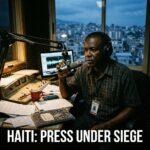


Haiti Press Freedom Crisis: Why Journalists Face Terror
By Darius Spearman (africanelements)
Support African Elements at patreon.com/africanelements and hear recent news in a single playlist. Additionally, you can gain early access to ad-free video content.
A Kidnapping in Delmas 31 Stuns Haiti
The street was quiet on a Sunday evening in Port-au-Prince before gunfire shattered the air. On September 6, 2026, veteran radio broadcaster Wesly Renaud Jean drove through the Delmas 31 neighborhood. Armed assailants ambushed his vehicle and dragged him away into the shadows (cpj.org, ctninfo.com). Jean has worked for more than a decade as a co-host on Radio-Télé Métropole. His voice has guided thousands of listeners through chaotic morning news cycles (cpj.org).
Following the ambush, the abductors contacted media managers to demand a heavy cash ransom. Richard Widmaier, the station director, confirmed that the captors provided proof of life over the telephone (cpj.org). Observers connected the operation to Viv Ansanm, a notorious coalition of armed gangs dominating the metropolitan capital (ctninfo.com). In response, the Committee to Protect Journalists issued an emergency appeal demanding his safe release (cpj.org). The attack demonstrates how armed criminal cartels target working reporters with complete disregard for civilian life (cpj.org, hrw.org).
From Dictatorship to Democracy: The Duvalier Scars
To understand the present crisis, one must examine the legacy of state repression in the Caribbean nation. The struggle connects directly to the Haitian Revolution and its ongoing quest for self-determination. During the brutal reign of François “Papa Doc” Duvalier and his son Jean-Claude “Baby Doc” Duvalier, state violence crushed political dissent (nypl.org). Between 1957 and 1986, independent media suffered continuous persecution. The regime deployed a dreaded paramilitary force known as the Tonton Macoutes to terrorize independent voices across the island (nypl.org).
Reporters faced arbitrary arrests, physical torture, and execution in secret dungeons like Fort Dimanche (umn.edu). Dictatorial decrees banned newspapers that questioned public officials. Editors who dared to print critical investigations fled into exile to preserve their lives (nypl.org). State censors monitored all printing houses and radio broadcast towers throughout the capital. This systematic terror silenced political discourse for nearly three decades (nypl.org, umn.edu). Although the dictatorship fell in 1986, the institutional habit of repressing journalists never vanished from public life (oas.org).
The 1987 Constitution and the Struggle for Free Speech
After a popular uprising toppled the Duvalier regime, civic leaders drafted the historic 1987 Constitution. Article 28 of the charter granted citizens the right to express their ideas freely without government censorship (oas.org). The document officially prohibited arbitrary arrests of journalists carrying out reporting assignments (oas.org). It promised an open era of democratic participation for rural and urban workers alike.
Independent radio stations quickly transformed the political landscape. Broadcasters challenged the historical practice of diglossia, which treated French as the language of the elite while suppressing Haitian Creole (haitidocs.org). Trailblazers such as Jean Léopold Dominique, the courageous director of Radio Haïti-Inter, began reporting the news directly in Haitian Creole (wikipedia.org). By broadcasting investigative reports in the native tongue of the general public, independent media empowered ordinary citizens (wikipedia.org, haitidocs.org). However, military coups and armed factions soon unleashed violent reprisals against outspoken newsrooms (oas.org).
Blood on the Microphone: Unsolved Assassinations
The dawn of the twenty-first century brought targeted violence against reporters. On April 3, 2000, unknown assassins shot Jean Léopold Dominique and station guard Jean-Claude Louissaint in the station courtyard (wikipedia.org). The double murder shocked the international community and dealt a devastating blow to investigative reporting. In the years that followed, judicial inquiries stalled as judges faced death threats and fled into exile (wikipedia.org).
Five years later, political turmoil following the 2004 coup led to further horror (wikipedia.org). In July 2005, armed captors kidnapped cultural editor Jacques Roche in Port-au-Prince (theguardian.com). Despite ransom negotiations, attackers tortured Roche, shot him multiple times, and abandoned his handcuffed body in an alleyway (theguardian.com). These killings created an atmosphere of absolute impunity. Perpetrators realized that the state possessed neither the will nor the capacity to punish violence against the press (cpj.org, cpj.org).
The Collapse of the State and the Rise of Viv Ansanm
The July 2021 assassination of President Jovenel Moïse obliterated the remaining foundations of constitutional authority (hrw.org). With no functional parliament and a paralyzed judicial bench, armed cartels seized municipal territories. Criminal factions that once fought each other formed a unified alliance named Viv Ansanm, meaning “Living Together” (ap.org). This criminal syndicate operates under the leadership of former police officer Jimmy “Barbecue” Chérizier (ap.org).
Rather than hiding from legal authorities, gang federations operate as regional rulers. They control critical transport routes and industrial sectors across Port-au-Prince (hrw.org, ap.org). Gunmen regularly attack independent broadcasting stations, burning down relay antennas and forcing media outlets to evacuate dangerous neighborhoods (cpj.org). Journalists cannot commute to work without risking armed extortion, sniper fire, or violent abduction (cpj.org, cpj.org).
Foreign Interventions and the Weapon Pipeline
Haitian sovereignty has suffered repeatedly from international meddling and historical exploitation over two centuries. In 2024, the United Nations authorized a Kenya-led Multinational Security Support mission to help police regain control (reliefweb.int, apnews.com). Yet, the deployment faced widespread criticism for failing to protect vulnerable residential corridors (reliefweb.int). The mission was further tarnished by disturbing reports of sexual violence involving international personnel (reliefweb.int).
Meanwhile, high-powered rifles continue to pour into Haitian ports. Because Haiti does not manufacture firearms, cartels depend entirely on foreign weapons smuggled through Florida shipping routes (state.gov). Assault rifles and ammunition clips arrive hidden in cargo crates to supply private gang arsenals (state.gov). Consequently, poorly paid Haitian police officers find themselves completely outgunned on the front lines (reliefweb.int, hrw.org).
The Disproportionate Burden on Local Reporters
Working conditions in Haiti expose a harsh double standard between foreign correspondents and local reporters. Foreign news crews enter the country temporarily with body armor, security drivers, and emergency evacuation insurance (cpj.org). In contrast, local reporters reside directly inside neighborhoods terrorized by gang militias. They travel through armed checkpoints every single day without protective equipment or institutional backing (cpj.org).
Despite mortal peril, platforms such as AyiboPost continue publishing vital investigations into corruption and human rights abuses (cpj.org). Staff members document civilian casualties even as armed squads issue explicit threats against their lives (cpj.org, cpj.org). This courage reflects the hard truth that genuine self-determination and an elusive freedom require unrelenting truth-telling. Without local reporters risking their lives on the ground, the international community would know nothing about the daily suffering of Haitian families (hrw.org, cpj.org).
Democratic Horizons and the Fight for Truth
Following the dissolution of the Transitional Presidential Council in early 2026, Prime Minister Alix Didier Fils-Aimé assumed executive leadership (apnews.com). The transitional government has pledged to restore basic street safety and prepare the country for general elections (apnews.com). However, civic organizations warn that fair elections remain impossible when criminal gangs control the streets and suppress independent reporting (cpj.org, hrw.org).
The Fourth Estate functions as an indispensable shield against authoritarianism and criminal rule. When gang members can snatch veteran broadcasters like Wesly Renaud Jean from busy metropolitan avenues without consequence, democracy cannot survive (cpj.org, ctninfo.com). Real peace requires disarming criminal cartels, stopping illegal weapons shipments, and prosecuting human rights violators (hrw.org, state.gov). Protecting working journalists is not merely an occupational concern; it is the absolute foundation of Haitian liberation (cpj.org, oas.org).
About the Author
Darius Spearman is a professor of Black Studies at San Diego City College, where he has been teaching for over 20 years. He is the founder of African Elements, a media platform dedicated to providing educational resources on the history and culture of the African diaspora. Through his work, Spearman aims to empower and educate by bringing historical context to contemporary issues affecting the Black community.
