



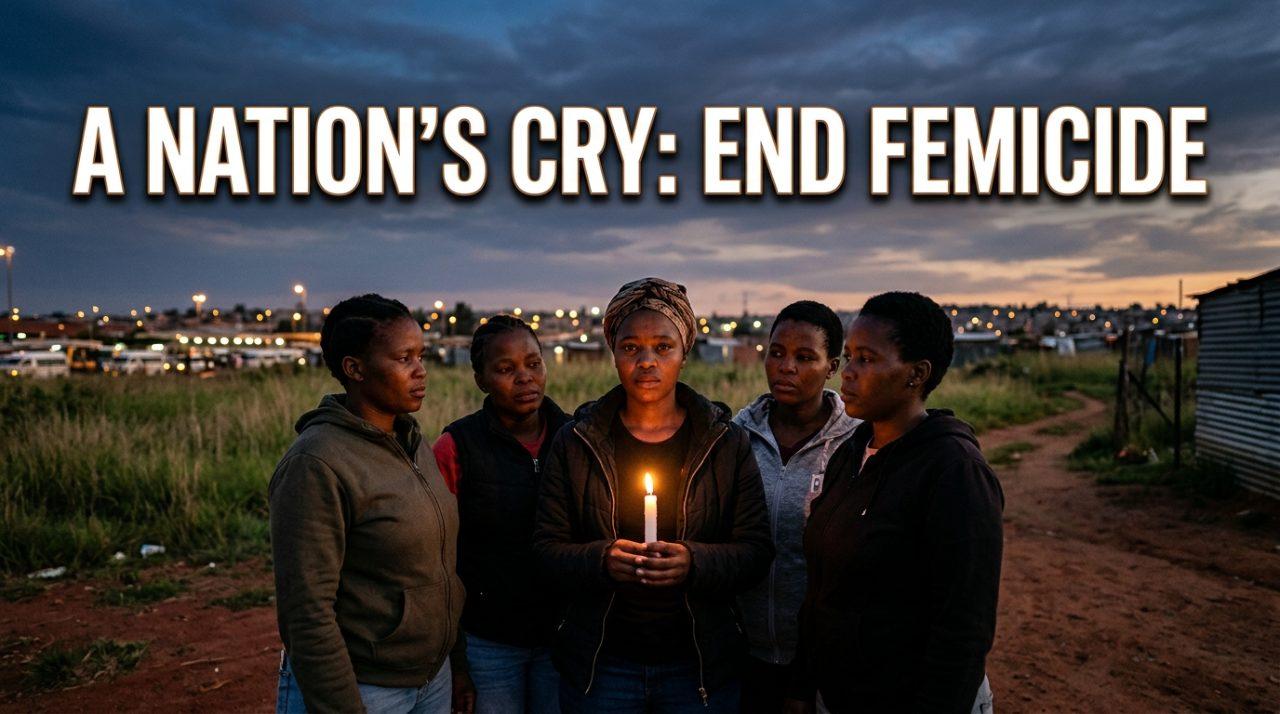
South Africa Femicide Crisis: Why Are Women Still Targeted?
By Darius Spearman (africanelements)
Support African Elements at patreon.com/africanelements and hear recent news in a single playlist. Additionally, you can gain early access to ad-free video content.
A Grim Discovery in Ekurhuleni
A string of horrific discoveries recently shattered communities across the Gauteng province. Between July and September, authorities recovered the bodies of eight women in Ekurhuleni, east of Johannesburg (washingtontimes.com). The victims were found dumped in desolate locations. Police located several bodies near highways, quiet riverbeds, and desolate open fields (washingtontimes.com, cbsnews.com). Many of the victims showed clear signs of severe physical trauma and sexual assault (washingtontimes.com).
One discovery involved thirty-eight-year-old Elizabeth Tsontso Moselakgomo (washingtontimes.com). She was an avid runner and mother who vanished during an evening jog in Kempton Park (washingtontimes.com). Days later, searchers located her bruised body in an open veld (washingtontimes.com). Her tragic death sparked deep grief across the nation. Other victims, aged between twenty and thirty-eight, met similar fates near Olifantsfontein and Kwa-Thema (washingtontimes.com). These horrifying crimes triggered immediate public marches and demands for accountability (washingtontimes.com, theguardian.com).
Mounting Outrage and the Investigation
The clustering of these murders spread profound panic among local residents. Citizens worried that a single predator targeted vulnerable women across the metropolitan area (washingtontimes.com). The South African Police Service quickly assembled a specialized multidisciplinary task team (washingtontimes.com). This team deployed experienced detectives, forensic experts, and criminal psychologists to analyze the crime scenes (washingtontimes.com, cbsnews.com). Despite these resources, authorities have stated that forensic links do not yet confirm a single serial killer (washingtontimes.com).
Public anger intensified when police officials advised women to avoid walking alone. Spokespersons suggested that female joggers modify their daily routines to maintain safety (washingtontimes.com). Activists and community members strongly condemned these remarks. They viewed the advice as state-sponsored victim blaming (washingtontimes.com, theguardian.com). Civil rights groups like Women for Change organized protests across urban centers (washingtontimes.com). Demonstrators carried signs emphasizing that South African women live as hunted prey (washingtontimes.com).
The Brutal Machinery of Pass Laws
Modern gender violence cannot be separated from the historical machinery of white minority rule (cornell.edu, tandfonline.com). Before European conquest, many pre-colonial African societies maintained balanced kinship networks and communal safeguards. Apartheid shattered those traditional institutions through deliberate state coercion (cornell.edu). The Natives Act of 1952 forced Black South Africans to carry biometric identity books known as the dompas (cornell.edu). Urban areas were reserved exclusively for white settlement and control (cornell.edu, tandfonline.com).
Pass laws criminalized the simple movement of Black citizens throughout their own country (cornell.edu). Under this brutal system, rural men signed temporary contracts to work in gold mines and factories (cornell.edu, tandfonline.com). The law strictly prohibited wives and children from joining these workers in the cities (cornell.edu). Generations of men lived inside squalid, single-sex mining hostels (cornell.edu, tandfonline.com). This enforced separation severely disrupted the traditional stability and social resilience of Black families. In these barracks, physical dominance became a primary survival strategy, entrenching violent forms of hyper-masculinity (tandfonline.com).
Spatial Engineering and Commuter Vulnerability
Apartheid urban planners engineered cities to enforce absolute racial segregation (byu.edu, tandfonline.com). They built Black townships far away from commercial hubs and industrial areas (byu.edu). Planners constructed vast buffer zones of empty grasslands, railways, and highways around townships like Kwa-Thema (byu.edu). These barren fields served as physical barriers to prevent Black residents from easily entering white neighborhoods (byu.edu). Decades after democratic transition, this oppressive geography continues to endanger working women daily (byu.edu).
Working-class women endure expensive, fragmented commutes between suburban jobs and township homes (byu.edu). High-capacity trains and municipal buses often do not reach local neighborhoods (byu.edu). Consequently, female commuters rely heavily on informal minibus taxis (byu.edu). These transit systems create hazardous last-mile journeys (byu.edu). Commuters walk long distances across unlit open fields before dawn and after dark (byu.edu). Predators exploit these isolated, unmonitored transit corridors as ambush zones and body-dumping locations (washingtontimes.com, byu.edu).
The Post-Apartheid Legal Paradox
South Africa adopted one of the most progressive national constitutions in the world in 1996 (cornell.edu). This founding document guarantees total gender equality and the universal right to bodily security (cornell.edu). Lawmakers enacted powerful measures like the Domestic Violence Act of 1998 (justice.gov.za). Parliament later passed the Criminal Law Amendment Act of 2007 to expand legal protections against sexual offenses (justice.gov.za). Furthermore, forensic laws mandated DNA collection to help solve violent cold cases (justice.gov.za).
Yet statutory guarantees have failed to secure daily physical safety on township streets (uct.ac.za, justice.gov.za). Much like historical eras where legal rights failed vulnerable communities, progressive legislation alone cannot stop violent predators. Severe institutional backlogs continually paralyze national forensic laboratories (uct.ac.za, africacheck.org). In addition, secondary trauma and social stigma prevent countless victims from reporting sexual assaults (africacheck.org). Many investigators lack specialized resources, which leads to tragic prosecution failures and low conviction rates (uct.ac.za, africacheck.org).
From Early Marches to Mass Mobilization
South African women have resisted systemic violence through organized collective action across multiple generations (theguardian.com, thisisafrica.me). On August 9, 1956, twenty thousand women marched boldly to the Union Buildings in Pretoria (thisisafrica.me). They protested against the humiliation of apartheid pass laws (thisisafrica.me). That courageous march established a vibrant tradition of female resistance (thisisafrica.me). Modern activists continue to draw immense inspiration from those legendary freedom fighters (thisisafrica.me, gbvf.org.za).
The brutal assault and murder of teenager Anene Booysen in 2013 revived nationwide fury (theguardian.com). In 2017, the murder of Karabo Mokoena by her abusive partner triggered fierce public outrage (theguardian.com). Thousands of demonstrators took to the streets on August 1, 2018, under the Total Shutdown movement (thisisafrica.me, gbvf.org.za). Clad in black and red, protesters marched across major cities to demand systemic interventions (thisisafrica.me, gbvf.org.za). Their organized pressure compelled the national government to convene a landmark presidential summit on femicide (thisisafrica.me, gbvf.org.za).
The National Struggle for Physical Safety
Public outrage reached a historic boiling point in August 2019 (theguardian.com). A postal worker assaulted and murdered nineteen-year-old university student Uyinene Mrwetyana inside a government facility (theguardian.com). Her horrifying death triggered nationwide university shutdowns and highway blockades (theguardian.com). Demonstrators mobilized under the viral banner of Am I Next (theguardian.com). They demanded sweeping policy changes and emergency funding to protect vulnerable women (theguardian.com, gbvf.org.za).
In 2020, authorities located the body of Tshegofatso Pule hanging from a tree while eight months pregnant (theguardian.com). This tragedy pushed President Cyril Ramaphosa to label gender-based violence South Africa’s second pandemic (theguardian.com). Government leaders established the National Strategic Plan on Gender-Based Violence and Femicide (gbvf.org.za). However, oversight watchdogs report chronic funding shortfalls and slow implementation (uct.ac.za, gbvf.org.za). Protesters insist that press conferences cannot replace genuine protection and institutional change (washingtontimes.com, theguardian.com).
Confronting the Deep Roots of Brutality
The tragedy in Ekurhuleni highlights a profound disconnect between legal theory and daily reality (washingtontimes.com, uct.ac.za). South African women continue to navigate physical spaces shaped by historic inequality and economic marginalization (byu.edu, tandfonline.com). Poverty, persistent joblessness, and poor municipal services heighten daily commuter danger (byu.edu). Working-class communities remain especially vulnerable as local leaders struggle against widespread social decay (byu.edu, tandfonline.com).
Ending this systemic nightmare requires far more than official condolences and temporary police crackdowns (washingtontimes.com, theguardian.com). Authorities must fix municipal infrastructure, illuminate transit routes, and eliminate massive DNA testing backlogs (byu.edu, uct.ac.za). In addition, patriarchal entitlement and normalized violence require aggressive community confrontation (cornell.edu, tandfonline.com). South Africa cannot realize its constitutional promise of liberation while women cannot navigate public streets without terror (washingtontimes.com, theguardian.com).
About the Author
Darius Spearman is a professor of Black Studies at San Diego City College, where he has been teaching for over 20 years. He is the founder of African Elements, a media platform dedicated to providing educational resources on the history and culture of the African diaspora. Through his work, Spearman aims to empower and educate by bringing historical context to contemporary issues affecting the Black community.
