


Did New DNA Analysis Prove Jefferson Fathered Hemings?
By Darius Spearman (africanelements)
Support African Elements at patreon.com/africanelements and hear recent news in a single playlist. Additionally, you can gain early access to ad-free video content.
A Defining Breakthrough in Early American History
Headlines recently proclaimed that advanced genetic testing connects Thomas Jefferson directly to the children of Sally Hemings. This announcement marks a turning point in early American historiography. For two centuries, historians debated whether the third president fathered children with an enslaved woman. Traditional scholars dismissed the claim for generations as political gossip (wikipedia.org, pbs.org).
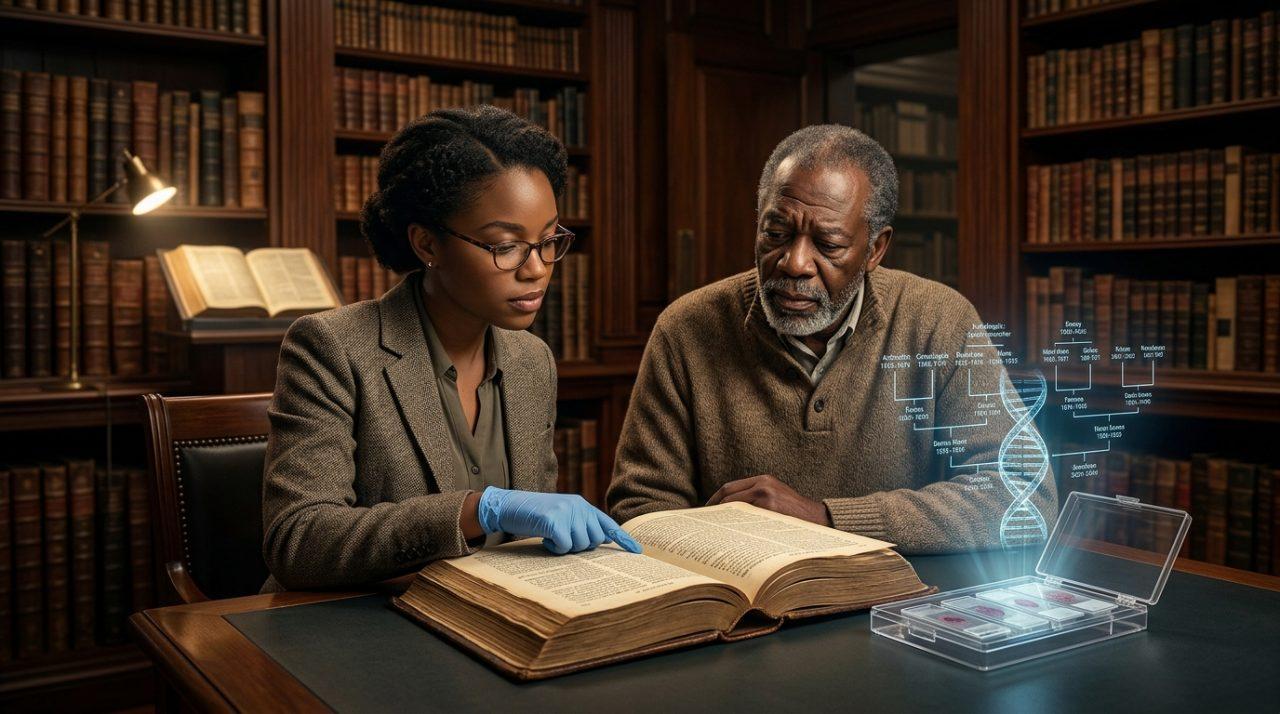
Modern scientists altered this narrative by examining historical strands of hair. Researchers extracted nuclear material preserved inside Jefferson’s personal Bible and estate collections. Their findings offer concrete biological corroboration for claims long preserved by Black descendants. Consequently, genomics has finally confirmed truths that oral tradition preserved across multiple generations (smithsonianmag.com, smithsonianmag.com).
The Paris Accord and Structural Power
Sally Hemings arrived in Paris in 1787 to escort Jefferson’s young daughter. At the time, Hemings was an enslaved teenager of about fourteen years. Jefferson was forty-four years old and served as the American minister to France. Under French law, slavery did not exist on domestic soil. Hemings could have legally petitioned local courts for her total freedom (wikipedia.org).
Hemings agreed to return to Virginia only after negotiating terms for her future children. Jefferson promised to legally liberate her progeny when they reached adulthood. However, modern legal scholars analyze this arrangement through the lens of absolute power asymmetry. Genuine consent remains impossible when one individual owns another as property. This profound vulnerability echoes broadly within shared struggles against oppression across global history (wikipedia.org, pbs.org).
Virginian statutes denied enslaved women all bodily autonomy and legal safety. Master status granted Jefferson complete authority over the household. Modern child welfare standards describe sexual acts between adult custodians and dependent minors as statutory rape. Therefore, romantic terms like “mistress” obscure the reality of systemic exploitation (wikipedia.org).
The 1802 Exposé and Public Silence
Political journalist James Thomson Callender exposed the relationship to the public in 1802. Callender previously supported Jefferson but turned hostile after Jefferson denied him a postmaster position. In the pages of the Richmond Recorder, Callender published detailed accusations. He alleged that Jefferson kept an enslaved concubine named Sally and fathered multiple children with her (wikipedia.org, pbs.org).
Federalist political opponents quickly seized upon Callender’s published report. They mocked Jefferson in print, producing satirical songs and derogatory essays. Jefferson chose complete public silence instead of issuing denials. He never addressed the claims in private correspondence either. This deliberate silence allowed his political allies to dismiss the story as partisan slander (wikipedia.org, pbs.org).
The Long Tradition of White Historian Denial
Following Jefferson’s death, his white grandchildren defended his personal reputation. Grandchildren Thomas Jefferson Randolph and Ellen Randolph Coolidge acknowledged the physical resemblance of Hemings’s children. However, they pointed suspicion toward Jefferson’s nephews, Peter and Samuel Carr. Prominent twentieth-century biographers accepted this Carr family defense without critical scrutiny (wikipedia.org, pbs.org).
Historians favored unverified white oral accounts while ignoring documented Black testimony. Madison Hemings gave a thorough interview to an Ohio newspaper in 1873. He explicitly detailed his family origins and confirmed Jefferson’s paternity. Mainstream academics dismissed his narrative as family folklore for over a century. Rigorous Black scholarship, like the research of pioneering Black educators and historians, later restored integrity to these forgotten accounts (wikipedia.org, pbs.org).
The Flawed Reality of Being Given Her Time
Thomas Jefferson died in 1826 leaving crushing debts exceeding one hundred thousand dollars. To satisfy creditors, his estate auctioned over one hundred and thirty enslaved people. Jefferson’s will formally emancipated Madison and Eston Hemings. Yet, Sally Hemings received no formal manumission in the document (wikipedia.org, pbs.org).
Jefferson’s daughter, Martha Jefferson Randolph, informally gave Hemings her time. This extralegal gesture allowed Hemings to live in Charlottesville with her adult sons. However, Hemings remained legally classified as enslaved property until her death. She lacked official freedom papers and faced potential seizure by estate creditors (wikipedia.org).
Formal manumission also carried severe obstacles under Virginia’s 1806 Removal Law. This statute mandated that newly freed individuals leave Virginia within twelve months. Violators faced capture and public sale by state authorities. By remaining informally liberated, Hemings avoided forced deportation but endured persistent legal precarity (wikipedia.org).
The 1998 Y-DNA Landmark and Remaining Loopholes
In 1998, pathologist Dr. Eugene Foster led an international genetic study. His team analyzed Y-chromosomes from living descendants of the Jefferson and Hemings lineages. The biological results confirmed that Eston Hemings carried the rare Jefferson family haplotype. Furthermore, the genetic testing completely cleared the Carr nephews of paternity (wikipedia.org, pbs.org).
Despite this evidence, skeptical organizations exploited remaining genetic ambiguities. Y-chromosomes pass down the male line virtually unchanged across generations. Thus, the 1998 test could not distinguish Thomas Jefferson from his brother Randolph. Skeptics formed the Thomas Jefferson Heritage Society to argue that Randolph fathered the children (tjheritage.org, tjheritage.org).
Moreover, the 1998 analysis excluded descendants of Madison Hemings. Madison’s line survived primarily through female descendants, making male Y-chromosome testing impossible. This structural limitation left a persistent biological opening for ongoing public denial (smithsonianmag.com, wikipedia.org).
Genomics Decodes the Physical Genome
The scientific debate changed between 2011 and 2026. Conservators discovered strands of hair pressed between the pages of Jefferson’s personal Bible. Specialists also secured authenticated hair clippings taken from Jefferson’s deathbed. These biological artifacts offered researchers an unexpected path toward direct genomic sequencing (smithsonianmag.com, smithsonianmag.com).
Scientists Beth Shapiro and Ed Green led DNA sequencing efforts at UC Santa Cruz. Using advanced extraction techniques for rootless hair shafts, researchers isolated nuclear DNA. Nuclear markers undergo recombination during each reproductive generation. Consequently, nuclear DNA easily distinguishes full brothers from one another (smithsonianmag.com, smithsonianmag.com).
Researchers compared Jefferson’s genetic profile against living fifth-generation descendants. Testing matched descendants of Martha Jefferson Randolph, Eston Hemings, and Madison Hemings. The biological data confirmed unique autosomal markers specific to Thomas Jefferson alone. This genetic milestone finally eliminated the alternative Randolph Jefferson hypothesis (smithsonianmag.com, smithsonianmag.com).
Graveyard Politics and Institutional Resistance
Biological evidence did not produce immediate social harmony among descendant groups. In 2000, the Thomas Jefferson Foundation acknowledged Jefferson’s paternity. This organization operates the historic Monticello estate as a public educational museum (wikipedia.org).
Conversely, the Monticello Association maintained fierce resistance against biological findings. This private organization owns and oversees the historic Monticello Graveyard. In 2001, the association commissioned an independent report rejecting genetic paternity. Then, in May 2002, members voted ninety-three to seventeen to deny Hemings descendants burial rights (wikipedia.org, pbs.org).
This institutional refusal exposed ongoing racial divides within historical memory. White lineage organizations preserved administrative gatekeeping despite strong scientific proof. Thus, genetic certainty did not automatically eliminate structural inequality or erase centuries of denial (wikipedia.org, pbs.org).
Descendant Agency and Genomic Ethics
Modern genetic breakthroughs also introduced difficult ethical questions regarding consent. Scientists announced the nuclear hair results through commercial trade books before peer-reviewed publication. This publicity model prompted internal dissent among some family members (smithsonianmag.com).
Mary Brady-Atkins, a ninety-eight-year-old descendant of Sally Hemings, formally withdrew her biological consent. She requested the permanent removal of her personal data from the public initiative. Brady-Atkins argued that scientific findings required rigorous peer review before public commercial promotion (smithsonianmag.com).
Her protest highlights the importance of autonomy in scientific testing. For many Black descendants, genetic proof was secondary to family memory. The persistent demand for DNA to validate oral history reveals deep institutional skepticism toward Black voices (smithsonianmag.com, wikipedia.org).
Restoring the Physical Presence of Sally Hemings
Archaeological digs at Monticello have reinforced the genetic findings. In 2017, excavators removed walls from a 1941 public restroom in the South Wing. Beneath the modern fixtures, archaeologists uncovered an original living space built in 1809 (smithsonianmag.com, wikipedia.org).
The rediscovered room measured roughly fifteen feet by thirteen feet. The quarters included an original brick fireplace, hearth, and finished floorboards. Notably, this room sat just steps away from Jefferson’s private bedroom suite (smithsonianmag.com, wikipedia.org).
Monticello unveiled a permanent exhibition within this space in 2018. The installation presents Hemings as an enslaved mother who negotiated enduring family protections. Physical spaces now communicate the historical reality of her domestic presence (smithsonianmag.com, wikipedia.org).
Reclaiming African American Testimony
The journey from 1802 political attacks to nuclear sequencing illustrates a broader cultural evolution. Scientific innovations in Genomics finally authenticated facts preserved by Black families for centuries. Madison Hemings spoke the truth in his recorded 1873 memoir (wikipedia.org, pbs.org).
Mainstream institutions resisted that truth because it disrupted founding mythology. Today, genomics reconciles early presidential biography with the documented experiences of enslaved people. Ultimately, modern science has validated the enduring power of Black oral history (smithsonianmag.com, wikipedia.org).
About the Author
Darius Spearman is a professor of Black Studies at San Diego City College, where he has been teaching for over 20 years. He is the founder of African Elements, a media platform dedicated to providing educational resources on the history and culture of the African diaspora. Through his work, Spearman aims to empower and educate by bringing historical context to contemporary issues affecting the Black community.
