


Inside the Landmark Tesla Racial Discrimination Trial
By Darius Spearman (africanelements)
Support African Elements at patreon.com/africanelements and hear recent news in a single playlist. Additionally, you can gain early access to ad-free video content.
The Dark Reality of the Fremont Factory Floor
In Oakland, California, an Alameda County courtroom has become the center of a historic civil rights confrontation. The California Civil Rights Department is prosecuting Tesla in a landmark bench trial (ndtvprofit.com, tbsnews.net). State prosecutors argue that the electric automaker permitted rampant racial hostility against Black workers at its massive Fremont assembly plant (tbsnews.net, ca.gov). The trial exposes how high-tech manufacturing can harbor deeply rooted patterns of racial abuse (kqed.org).
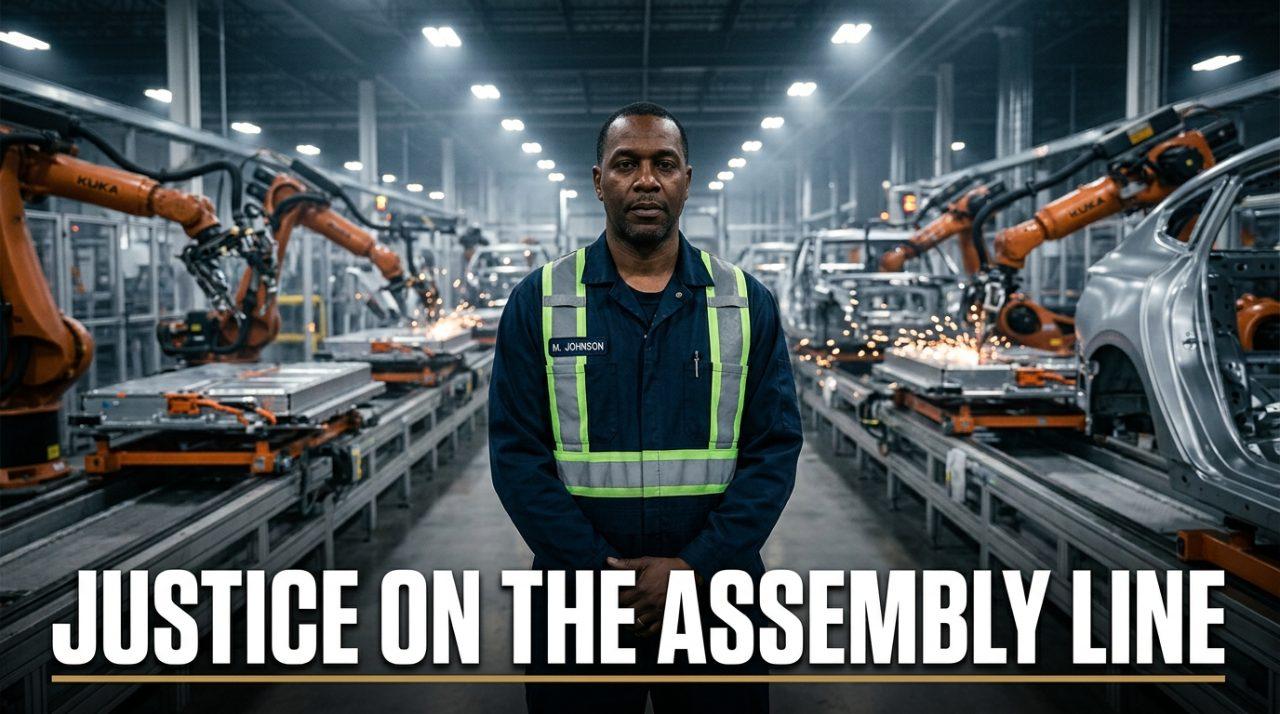
The Fremont facility was once hailed as a beacon of clean industrial innovation (electrek.co, wikipedia.org). However, state attorneys presented evidence revealing an assembly floor saturated with explicit racial animus (tbsnews.net). Witnesses documented daily racial slurs, swastikas, Ku Klux Klan symbols, and threats scrawled across break rooms and workstations (tbsnews.net, ca.gov). The testimony shows that the workplace culture treated African American laborers with direct cruelty (kqed.org). This trial represents the largest racial harassment prosecution ever brought by the state of California against an automotive manufacturer (ndtvprofit.com, ca.gov).
Echoes of the Past on the Modern Assembly Line
State evidence reveals that racial hostility inside the Fremont factory was not random. In fact, specific areas of the plant were segregated into punishment zones (tbsnews.net, ca.gov). Black personnel were disproportionately concentrated in the most physically grueling and dangerous sectors of the facility (ca.gov). Workers and floor supervisors routinely referred to these areas as “the plantation,” “the slaveship,” and the “dark side” (tbsnews.net, ca.gov). These assignments subjected Black workers to extreme heat, hazardous chemical vapors, and heavy physical strain (ca.gov).
Such degrading terminology connects modern corporate practices to historical forms of involuntary labor. Supervisors freely utilized this plantation imagery to remind workers of their vulnerable standing (ca.gov). Some employees reported hearing racial slurs fifty to one hundred times during a single shift (ca.gov). One supervisor even threatened a Black subordinate by asking if the worker wanted to hang from a tree (ca.gov). This abusive atmosphere operated in plain sight of management (tbsnews.net, kqed.org).
Factory Disparities: Compensation & Human Resources
Empirical data documented in state regulatory filings detailing institutional imbalances at Tesla’s Fremont facility (2018–2024).
The Systemic Wage Gap and Blocked Mobility
The harassment inside the factory was directly linked to material inequality. State payroll audits uncovered severe disparities between Black and white factory hands (scribd.com, ca.gov). Between June 2018 and June 2024, Black employees at Fremont earned an average of $1,533 less per month than white peers in identical roles (scribd.com, ca.gov). This persistent earnings gap drained wealth directly from Black households (ca.gov).
This economic disparity was maintained through biased supervisory reviews and uneven promotion systems (scribd.com, ca.gov). White leads held total discretion over factory assignments and promotions (ca.gov). Black workers who sought advancement were consistently passed over in favor of less experienced white colleagues (ca.gov). Furthermore, Black laborers faced disproportionately severe disciplinary write-ups for minor issues (ca.gov). These disciplinary marks created a paper trail that disqualified them from moving into higher-paying automated roles (ca.gov). Economic suppression operated as a core mechanism of plant governance (ca.gov).
The Subcontracted Trap of Staffing Agencies
To operate its relentless assembly lines, Tesla relied heavily on outside temp agencies (leverage.law, scribd.com). Firms such as CitiStaff and nextSource channeled thousands of contract workers onto the plant floor (leverage.law, scribd.com). This labor structure created a vulnerable secondary workforce (leverage.law, ca.gov). Subcontracted Black workers handled the dirtiest tasks but enjoyed none of the standard job protections (ca.gov). They lacked access to internal corporate human resources systems entirely (leverage.law, ca.gov).
When contract laborers reported racial harassment, Tesla management consistently attempted to evade responsibility (leverage.law). The corporation claimed it was not the legal employer of these temp laborers (leverage.law). However, federal and state judges rejected that argument under the joint employer doctrine (leverage.law). Tesla managers dictated daily tasks, controlled shift hours, and carried out floor discipline (leverage.law, ca.gov). When contract workers spoke out against slurs, supervisors simply requested their immediate termination from the agency (leverage.law, ca.gov). Third-party contracting functioned as a legal shield against workplace accountability (leverage.law).
Scale of Worker Exposure and Legal Action
Shielding Abuses Through Mandatory Arbitration
For years, the public remained unaware of factory conditions because of mandatory arbitration clauses (leverage.law, asyousow.org). Tesla required new hires to sign away their constitutional right to a trial as a condition of employment (leverage.law, asyousow.org). These private arbitration agreements forced disputes into closed-door hearings (leverage.law). Paid private arbitrators decided claims away from public eyes (leverage.law). This mechanism silenced individuals and prevented evidence from reaching regulatory bodies (leverage.law, asyousow.org).
Furthermore, these employment contracts prohibited workers from joining together in class-action lawsuits (leverage.law, asyousow.org). This atomization kept employees isolated and prevented collective resistance (leverage.law). When an individual settled a complaint, non-disclosure agreements kept the details buried (leverage.law). As a result, identical abuses continued uninterrupted on the shop floor (ca.gov). Corporate secrecy mechanisms protected the assembly line from outside legal scrutiny (leverage.law, asyousow.org).
The State Smashes the Secrecy Clause
The legal landscape shifted dramatically when the California Civil Rights Department intervened (ca.gov, ca.gov). Under state law, public enforcement agencies serve the broad public interest rather than private contracts (leverage.law, ca.gov). As a sovereign state entity, the civil rights agency is not bound by private arbitration pacts (leverage.law). The agency possesses the statutory power to bring large-scale corporate abuse into public courts (leverage.law, ca.gov).
This public enforcement exception dismantled Tesla’s standard defense tactics (leverage.law). State lawyers filed a comprehensive civil suit in Alameda County Superior Court on behalf of thousands of Black workers (ca.gov, ca.gov). Tesla attempted to stall the lawsuit by countersuing the agency and alleging regulatory overreach (leverage.law, ca.gov). However, California judges repeatedly dismissed Tesla’s counterclaims (leverage.law, ca.gov). As a result, the automaker is now forced to answer for its workplace environment in an open courtroom (ndtvprofit.com, tbsnews.net).
Chronology of Industrial Resistance
Whistleblowers Who Refused to Stay Silent
The road to this historic trial was paved by the bravery of individual workers who challenged company leadership (lawcommentary.com, theguardian.com). In 2017, assembly associate Marcus Vaughn submitted formal complaints to Human Resources and Chief Executive Officer Elon Musk (theguardian.com, jalopnik.com). Vaughn detailed routine racial slurs and aggressive hostility from coworkers (theguardian.com, jalopnik.com). Rather than remediating the conditions, the company terminated Vaughn for allegedly failing to maintain a positive attitude (theguardian.com, jalopnik.com). He subsequently filed a groundbreaking civil complaint (theguardian.com).
During that same period, Chief Executive Officer Elon Musk distributed an internal memo to all factory personnel (theguardian.com, theguardian.com). Musk advised workers that if someone was being a jerk and apologized, staff should be thick-skinned and accept the apology (theguardian.com, theguardian.com). Regulators argued this directive set a destructive tone from the very top (ca.gov). In 2021, another former contractor, Owen Diaz, secured a stunning $137 million jury verdict after testifying about rampant swastikas and verbal abuse (lawcommentary.com, irishexaminer.com). These individual victories systematically broke the company narrative (theguardian.com).
A High-Stakes Trial for Corporate Accountability
Superior Court Judge Peter Borkon is now presiding over the bench trial without a jury (tbsnews.net, kqed.org). Because this action proceeds under California’s Fair Employment and Housing Act, the legal consequences are severe (ca.gov). Federal statutes cap compensatory and punitive damages at $300,000 per claimant (ca.gov). California state law, however, provides zero statutory caps on damages (ca.gov). Tesla faces potentially massive monetary liabilities along with court-ordered systemic reforms (ca.gov, kqed.org).
In response, Tesla contends that it enforces a strict zero-tolerance policy against discrimination (tbsnews.net, tesla.com). Defense counsel argues that the state is highlighting isolated conflicts among a workforce exceeding twenty thousand people (tbsnews.net). Yet state prosecutors introduced extensive documentation showing an HR ratio as thin as one representative for every 740 workers (scribd.com, ca.gov). This understaffing made effective investigation functionally impossible (ca.gov). Judge Borkon must determine whether these failures constituted willful systemic neglect (tbsnews.net, kqed.org).
Silicon Valley and the Long Struggle for Labor Justice
This courtroom confrontation connects directly to broader Black labor struggles across American industrial history. Historically, the Fremont plant operated as a unionized GM and Toyota facility under United Auto Workers contracts (wikipedia.org). When Tesla took over the plant in 2010, it established the only non-union major automotive assembly plant in the nation (wikipedia.org). Without collective bargaining representation, line workers lacked institutional defenses against management abuse (ca.gov, wikipedia.org).
The trial challenges the traditional image of racial justice in California as an enlightened tech economy. Silicon Valley frequently markets itself as a progressive engine of the future (electrek.co). Yet the conditions described inside the Fremont factory reveal nineteenth-century racial dynamics operating within a twenty-first-century manufacturing plant (tbsnews.net, ca.gov). The outcome of this trial will resonate far beyond Alameda County (kqed.org). It will establish whether modern tech corporations can build wealth while ignoring fundamental civil rights protections (leverage.law, ca.gov).
About the Author
Darius Spearman is a professor of Black Studies at San Diego City College, where he has been teaching for over 20 years. He is the founder of African Elements, a media platform dedicated to providing educational resources on the history and culture of the African diaspora. Through his work, Spearman aims to empower and educate by bringing historical context to contemporary issues affecting the Black community.
