


Why Federal Police Oversight Deals Are Crumbling
By Darius Spearman (africanelements)
Support African Elements at patreon.com/africanelements and hear recent news in a single playlist. Additionally, you can gain early access to ad-free video content.
Recent public ceremonies uniting law enforcement executives with national political figures have ignited a fierce debate. Civil rights advocates, community organizers, and legal scholars watched these high-profile gatherings with deep unease (democracyforward.org, civilrights.org). For many Black Americans, these ceremonial displays look like political alliances that threaten federal civil rights enforcement.
The controversy goes far beyond symbolic photo opportunities on national stages. It touches the core question of whether the federal government will hold local police departments accountable for misconduct (americanoversight.org, democracyforward.org). To understand why these ceremonies sparked intense backlash, one must look at the long history of federal oversight and civil rights struggles in America.
The Reconstruction Roots of Police Accountability
Federal efforts to monitor local law enforcement began after the American Civil War. During Reconstruction, white supremacist violence terrorized newly freed Black citizens across the American South. Local sheriffs and municipal marshals often participated directly in these brutal attacks or refused to protect victims (aclu.org). In response, Congress passed the Ku Klux Klan Act of 1871, now codified as 42 U.S.C. Section 1983 (aclu.org).
This landmark statute allowed individual citizens to sue state and local officials who violated their constitutional rights under color of law (aclu.org). However, the early promise of this legislation quickly faded as post-Civil War Reconstruction failed to protect Black communities from systemic violence. For nearly a century, federal authorities rarely stepped in to stop widespread police abuses at the local level.
During the mid-twentieth century, the federal government made small steps forward. The Civil Rights Act of 1957 established the Civil Rights Division inside the Department of Justice (DOJ) (aclu.org). Even then, federal prosecutors faced immense legal barriers under criminal statutes like 18 U.S.C. Section 242 (aclu.org). To win a conviction, prosecutors had to prove an officer acted with willful criminal intent, which made guilty verdicts extraordinarily rare.
Fatal Police Encounters and Racial Disparities
Black Americans face disproportionate lethal outcomes relative to their share of the population.
Data reflects national police encounter tracking and demographic analysis (mappingpoliceviolence.org, policeviolencereport.org).
The Kerner Commission and Rodney King
In 1967, major civil unrest erupted in cities such as Newark and Detroit. President Lyndon B. Johnson created the National Advisory Commission on Civil Disorders, known widely as the Kerner Commission (aclu.org). The commission delivered a stark warning about racial division in the United States. Its 1968 report identified abusive police practices as a primary spark for urban uprisings across the country (aclu.org).
The Kerner Commission urged national standards, better training, and independent oversight of municipal police agencies (aclu.org). However, the federal government lacked any statutory authority to compel municipal departments to change their internal operations. Individual officers could occasionally face lawsuits, but unconstitutional police department cultures remained completely untouched by federal law.
The turning point arrived on March 3, 1991, when a bystander filmed Los Angeles police officers brutally beating Rodney King (aclu.org). The acquittals of the officers sparked the devastating 1992 Los Angeles rebellion (aclu.org). The national outcry exposed a massive legal flaw: the federal government could prosecute individual officers, yet it could not force the Los Angeles Police Department to overhaul its unconstitutional customs (aclu.org).
Section 14141 and Pattern-or-Practice Authority
Congress acted by passing the landmark Violent Crime Control and Law Enforcement Act of 1994 (aclu.org). Inside that legislation was Section 210401, originally codified as 42 U.S.C. Section 14141 and now known as 34 U.S.C. Section 12601 (justice.gov, aclu.org). This revolutionary statute gave the federal government clear legal standing to sue local law enforcement agencies (justice.gov).
Under Section 12601, the Department of Justice can investigate police departments for systemic civil rights violations (justice.gov, justice.gov). If federal investigators uncover an unconstitutional pattern or practice, the Attorney General can initiate civil lawsuits to demand institutional changes (justice.gov, aclu.org). This legislation shifted federal oversight from punishing single bad actors to dismantling broken institutional systems (aclu.org). It emerged during a broader era marked by the political shift toward mass incarceration across America.
Through this new statutory authority, the Department of Justice initiated investigations across the country. Over three decades, federal officials opened more than 70 pattern-or-practice probes into troubled police departments (justice.gov). These investigations often culminated in legally binding agreements that fundamentally reshaped big-city policing (justice.gov).
Understanding the Mechanics of a Consent Decree
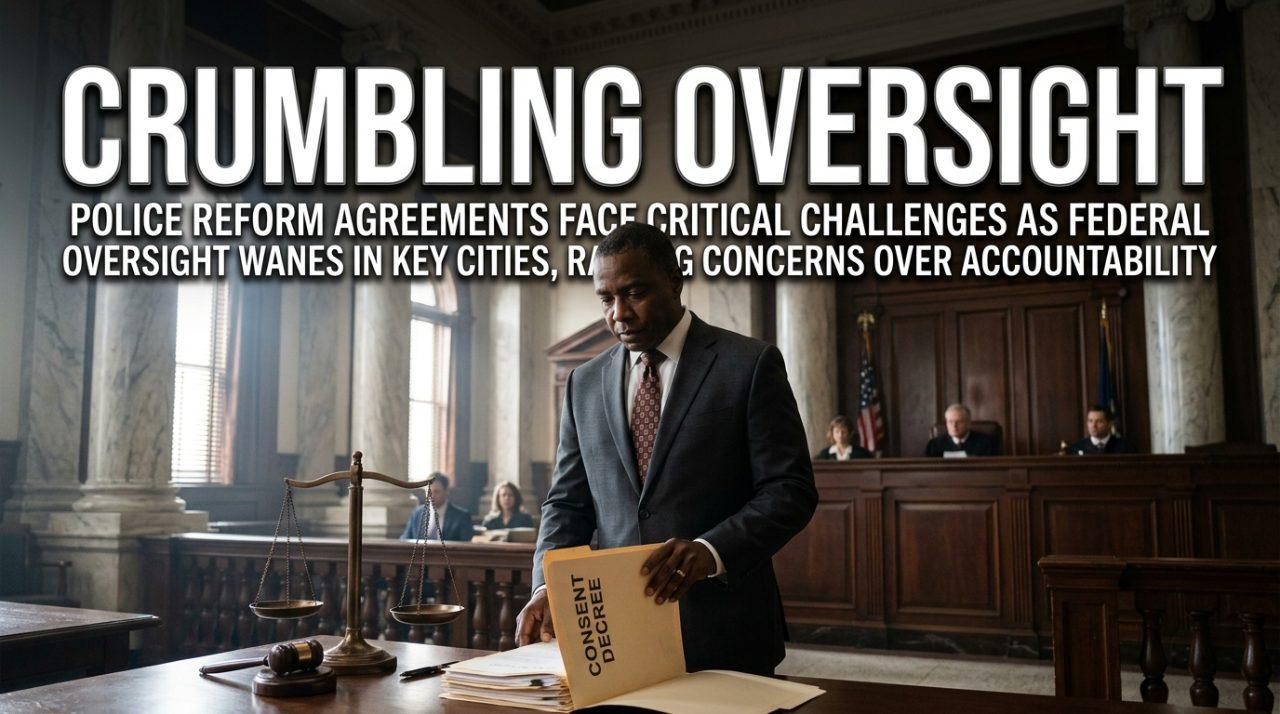
A police consent decree is a formal, court-approved settlement agreement between the federal government and a local jurisdiction (illinoisattorneygeneral.gov). It resolves allegations of systemic civil rights violations without forcing the city to admit legal liability (illinoisattorneygeneral.gov). Once signed by a federal judge, the decree carries the full binding force of a federal court order (illinoisattorneygeneral.gov).
Independent monitoring teams oversee these comprehensive reform programs on a day-to-day basis (illinoisattorneygeneral.gov). These independent monitors conduct detailed audits of officer use-of-force files, search patterns, and civilian complaints (illinoisattorneygeneral.gov). They report their audit findings directly to the federal judge rather than the mayor or police chief (illinoisattorneygeneral.gov). This unique structure prevents city leaders from quietly shelving mandatory reforms.
Consent decrees focus on structural institutional overhauls rather than voluntary suggestions (illinoisattorneygeneral.gov). They force police agencies to overhaul internal affairs divisions, update disciplinary tracking systems, and log detailed stop-and-search data (illinoisattorneygeneral.gov). Because a federal judge presides over the decree, failure to implement changes can lead to severe court sanctions or contempt citations (illinoisattorneygeneral.gov).
The Accountability Gap in Police Misconduct
Civilian legal hurdles and prosecutorial outcomes demonstrate significant barriers to judicial relief.
Rarity of legal accountability documented across national legal analyses (nationalpoliceaccountability.org, mappingpoliceviolence.org, policeviolencereport.org).
The Pendulum of Federal Civil Rights Enforcement
Federal intervention has never followed a straight path. Instead, oversight policies swing dramatically whenever a new presidential administration enters the White House (justice.gov, aclu.org). Under the Clinton administration, the Justice Department negotiated pioneering consent decrees in cities like Pittsburgh and Los Angeles (aclu.org). Those early agreements demonstrated that federal courts could successfully mandate municipal structural changes.
The George W. Bush administration reversed course, favoring voluntary technical assistance over court-enforced structural settlements (aclu.org). Later, the Obama administration sharply intensified federal oversight (justice.gov, aclu.org). It opened more than 25 pattern-or-practice investigations, securing historic consent decrees in Ferguson, Baltimore, Seattle, and Cleveland after prominent police killings sparked global demonstrations (justice.gov, aclu.org).
The first Trump administration halted this momentum when Attorneys General Jeff Sessions and William Barr restricted consent decrees, claiming they harmed officer morale (aclu.org). The Biden administration later restored federal pattern-or-practice inquiries across several states (justice.gov). Now, a second Trump administration has moved aggressively to dismantle consent decrees entirely, arguing they impose heavy costs on local governments (americanoversight.org, democracyforward.org).
Triggers of Federal Probes: Minneapolis, Louisville, and Memphis
To understand the profound community anger over terminating these decrees, one must review the specific tragedies that sparked them. In Minneapolis, the horrific murder of George Floyd under the knee of a police officer provoked global protests in 2020. The ensuing federal investigation documented a persistent pattern of unlawful force and racial discrimination against Black and Native American residents.
In Louisville, plainclothes officers serving a flawed no-knock warrant fatally shot Breonna Taylor inside her apartment in March 2020. The Justice Department subsequently uncovered widespread constitutional violations, including falsified warrant affidavits, unlawful searches, and aggressive racial disparities in traffic stops. In Memphis, the brutal fatal beating of Tyre Nichols in January 2023 prompted a federal probe into violent specialized proactive policing units, including the SCORPION unit.
Walking away from these proposed decrees directly harms the Black communities that bore the brunt of these abuses (americanoversight.org, democracyforward.org). Terminating federal oversight leaves reform in the hands of internal police units that previously shielded misconduct from public view (democracyforward.org, aclu.org). Black residents who courageously shared their painful testimonies with federal investigators now watch court-enforceable protections vanish overnight (democracyforward.org, civilrights.org).
The Immense Legal Barriers of Qualified Immunity and Monell
When the federal government retreats from pattern-or-practice oversight, victims of police violence must turn to civil litigation. Yet individual victims face an almost impossible battle in the courtroom (nationalpoliceaccountability.org). Two judicially created doctrines create nearly insurmountable barriers for regular citizens seeking justice (lawfaremedia.org, nationalpoliceaccountability.org, nationalpoliceaccountability.org).
The first barrier is qualified immunity, which shields individual officers from financial liability (lawfaremedia.org, nationalpoliceaccountability.org). To defeat this defense, a plaintiff must show the officer violated a clearly established constitutional right (lawfaremedia.org, nationalpoliceaccountability.org). Judges often interpret this requirement so strictly that plaintiffs must find an earlier court case involving nearly identical factual circumstances in the same jurisdiction (lawfaremedia.org, nationalpoliceaccountability.org). If no identical case exists, the officer receives immunity (lawfaremedia.org, nationalpoliceaccountability.org).
The second barrier is the Supreme Court’s 1978 *Monell* doctrine (nationalpoliceaccountability.org). Under *Monell v. Department of Social Services*, municipal governments cannot be held liable simply because they employed a violent officer (nationalpoliceaccountability.org). Instead, the victim must prove the abuse was caused by an official municipal policy, unwritten custom, or deliberate failure to train (nationalpoliceaccountability.org). Cities routinely escape legal accountability by claiming bad conduct was merely the isolated action of a single rogue cop (nationalpoliceaccountability.org).
Public Confidence in Police: The Racial Divide
Gallup polling reveals historical disparities in institutional trust between Black and white adults.
Historic 37-point spread documented following the 2020 racial justice protests (gallup.com, gallup.com).
The Symbolism of Public Ceremonies
Against this tense backdrop, public ceremonies uniting executive branch politicians with police union leadership carry enormous symbolic weight (fop.net, democracyforward.org). For political candidates and sitting executives, standing alongside uniform-clad officers projects strength, order, and institutional backing (fop.net). Police associations like the Fraternal Order of Police gain significant political influence through these public relationships (fop.net).
However, civil rights litigators argue that these cozy visual alignments erode institutional neutrality (democracyforward.org, civilrights.org). When federal leaders publicly celebrate police unions that actively resist independent monitors, it sends a clear signal to impacted communities (democracyforward.org, civilrights.org). It suggests that the Justice Department may prioritize political alliances over the impartial defense of constitutional rights (americanoversight.org, democracyforward.org).
Advocacy organizations like Democracy Forward and the National Police Accountability Project point out that these celebrations alienate communities harmed by police violence (democracyforward.org, nationalpoliceaccountability.org). Public events celebrating policing leadership during federal rollbacks deepen existing cynicism among Black Americans (civilrights.org). They reinforce historical feelings that national leaders care more about ceremonial photo ops than structural justice.
The Cost and Governance Arguments Against Decrees
Opponents of federal oversight offer a very different view of this ongoing legal battle (fop.net). Major police associations argue that federal consent decrees are excessively punitive, bureaucratic, and demoralizing to patrol officers (fop.net, aclu.org). They assert that lengthy federal investigations create an environment of second-guessing that hampers proactive policing and hurts department recruitment (dolanconsultinggroup.com).
City budget directors also point to the staggering financial costs associated with prolonged federal intervention. Independent monitoring teams and compliance infrastructure frequently cost cities millions of dollars annually (uic.edu). In Chicago, the city spent nearly $900 million on training, litigation, and compliance during the first six years of its consent decree (uic.edu).
Conservative legal theorists emphasize that municipal policing should remain under local democratic control rather than federal supervision. This debate reflects classic tensions surrounding state versus national centered power in American political history. Critics argue that unelected federal monitors hold excessive power without being accountable to local taxpayers or elected city councils.
The Future of Police Accountability
The sudden reversal of federal civil rights oversight has forced community advocates to reconsider their legal strategies (democracyforward.org, civilrights.org). With the Justice Department stepping back from pattern-or-practice lawsuits, the burden of police reform has shifted toward state attorneys general (illinoisattorneygeneral.gov). Some states have enacted their own statutory oversight authorities to investigate civil rights violations independently.
Simultaneously, grassroots organizers continue pushing for civilian oversight boards, local ballot measures, and state-level repeals of qualified immunity (nationalpoliceaccountability.org). The public ceremonies that recently ignited national headlines are merely the visible tip of an enormous constitutional iceberg. They expose a lasting divide between those who view policing through the lens of executive authority and those who demand institutional accountability (democracyforward.org, civilrights.org).
Until the legal doctrines that protect misconduct are fundamentally reformed, federal oversight will remain deeply politicized. Public events uniting political figures and law enforcement leadership will continue to spark intense controversy across Black America. True public safety requires justice, institutional transparency, and an enduring commitment to constitutional rights for every citizen.
About the Author
Darius Spearman is a professor of Black Studies at San Diego City College, where he has been teaching for over 20 years. He is the founder of African Elements, a media platform dedicated to providing educational resources on the history and culture of the African diaspora. Through his work, Spearman aims to empower and educate by bringing historical context to contemporary issues affecting the Black community.
