


Why Black College Students Rally for Nolan Wells
By Darius Spearman (africanelements)
Support African Elements at patreon.com/africanelements and hear recent news in a single playlist. Additionally, you can gain early access to ad-free video content.
The Horn Island Tragedy and Outrage Across Campuses
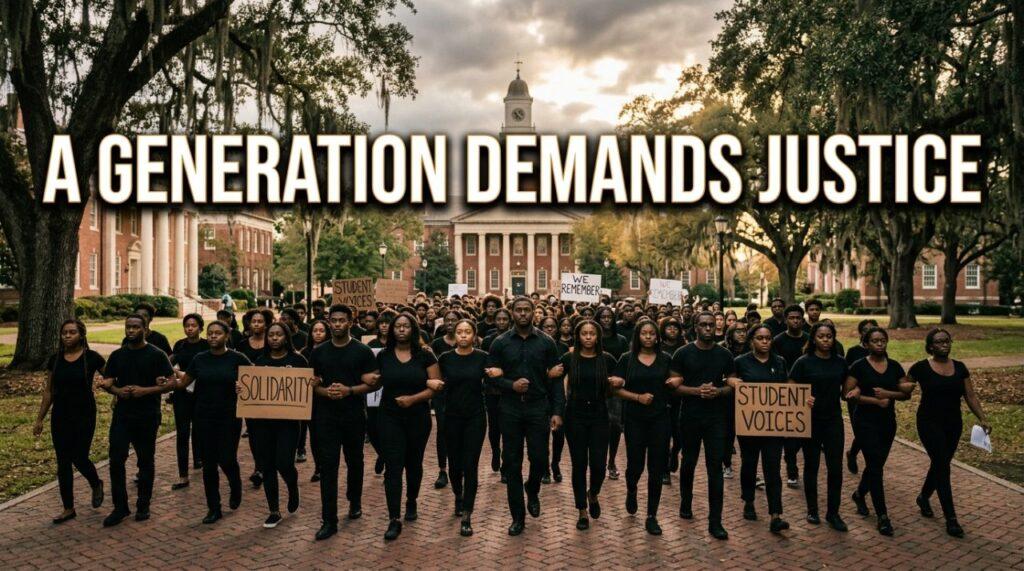
In early October 2026, hundreds of Black college students dressed in black marched across southern campuses. Demonstrators gathered at the Atlanta University Center in Georgia and Jackson State University in Mississippi. They filled streets and plazas while chanting demands for justice. Their collective outcry followed the controversial death of 18-year-old Nolan Xavier Wells (theguardian.com, peoplesworld.org).
On July 4, 2026, Wells traveled to Horn Island with several white acquaintances from high school (theguardian.com). Horn Island is an uninhabited barrier island off the Mississippi Gulf Coast. That evening, the boat returned to the mainland with the mobile phone of Wells on board. Wells was missing. Two days later, search teams recovered his body floating along the shoreline (theguardian.com, cbsnews.com).
In late September 2026, a Jackson County grand jury declined to issue criminal indictments (peoplesworld.org, magnoliatribune.com). Officials characterized the loss of life as an apparent accidental drowning. However, civil rights attorneys and the family of Wells questioned that official finding (theguardian.com). The decision triggered immediate walkouts and street protests across multiple southern universities (peoplesworld.org).
Forensic Contradictions and the Demand for Accountability
The state autopsy classified the final cause of death as undetermined while citing drowning factors (magnoliatribune.com). During the review, prosecutors presented statements from 43 witnesses and materials from 132 subpoenas (pbs.org, magnoliatribune.com). Investigators claimed that laryngeal spasms, often called dry drowning, explained why no water entered the airways (magnoliatribune.com). They also stated that two head contusions were superficial injuries rather than fatal blows (magnoliatribune.com).
Independent pathologists and family representatives offered a far more troubling interpretation (theguardian.com). They highlighted two distinct blunt-force wounds discovered on the back of his head. Furthermore, medical reports confirmed an absence of water or sediment within the lungs (theguardian.com, theguardian.com). This stark contradiction fueled fierce skepticism among community leaders and relatives (peoplesworld.org).
Civil rights attorney Benjamin Crump joined the family to demand direct federal intervention (theguardian.com). They petitioned the United States Department of Justice, the FBI, and the National Park Service. Family members insisted that local county officials withheld vital information for several months (theguardian.com). Consequently, activists declared that local authorities could no longer investigate themselves with credibility (peoplesworld.org).
Mississippi Violent Crime Clearance Gap
The Modern Mississippi Cases Fueling Student Distrust
The mobilizations at Jackson State University did not arise inside a vacuum. Students carried signs listing the names of other young Black Mississippians who died recently (peoplesworld.org). The banner proclaimed that Nolan Wells could have been any one of them. Demonstrators cited the death of Jaylen Lewis, who was shot by Capitol Police in 2022 (mississippifreepress.org). They also cited Kohen Wiley, an infant killed by police gunfire in Senatobia (mpbonline.org).
Public grief deepened further because of Demartravion Trey Reed (mississippifreepress.org). Reed was a 21-year-old student discovered hanging from a campus tree at Delta State University in 2025 (mississippifreepress.org). Although authorities quickly ruled that death a suicide, community members strongly doubted that narrative. The painful image of a Black youth hanging evoked terrible historical memories of lynchings across the region (mississippifreepress.org).
Trust in county law enforcement collapsed entirely following the Rankin County Goon Squad revelations (themarshallproject.org). That self-titled crew of white sheriff deputies broke into a home without a warrant in 2023. Officers subjected Michael Jenkins and Eddie Parker to horrific torture and racial abuse. Federal convictions sent those officers to prison in 2024, but the case confirmed deep institutional corruption (themarshallproject.org).
Historical Roots: HBCU Students as the Vanguard of Direct Action
Historically Black colleges and universities have long served as testing grounds for civil rights resistance. On February 1, 1960, four students from North Carolina A&T State University sat at a segregated lunch counter (wikipedia.org). Their peaceful action in Greensboro catalyzed similar sit-ins throughout the American South. College students proved that direct confrontation could break through racial barriers faster than courtroom appeals alone (wikipedia.org).
Two months later, legendary organizer Ella Baker convened a conference of young activists at Shaw University (wikipedia.org). That meeting produced the Student Nonviolent Coordinating Committee, known widely as SNCC. Baker encouraged these young people to avoid cautious bureaucratic methods. Instead, SNCC empowered local communities to lead their own voter registration and desegregation fights (wikipedia.org, wikipedia.org).
During the same period, undergraduates at the Atlanta University Center published an influential manifesto (wikipedia.org). Led by Julian Bond and Lonnie King, students issued An Appeal for Human Rights in 1960. They outlined systemic inequalities in housing, jobs, education, and law enforcement (wikipedia.org). In exploring how Black women contributed to the struggle, one discovers that female organizers consistently anchored these campus coalitions.
Mississippi Racial Incarceration Disparity
The Legacy of State Repression: Orangeburg and Jackson State
When student activists mobilized throughout the twentieth century, state authorities routinely replied with violence (wikipedia.org, pbs.org). In February 1968, South Carolina Highway Patrol officers confronted young people at South Carolina State University. Troopers opened fire into an unarmed crowd during bowling alley desegregation protests. That assault became known as the Orangeburg Massacre, leaving three youths dead and 27 wounded (wikipedia.org).
Tragedy struck Mississippi just two years later (pbs.org). On May 14, 1970, local police and state highway patrolmen surrounded Alexander Hall at Jackson State College. Without issuing a warning, officers fired over 460 rounds into the women’s dormitory across 28 violent seconds. Phillip Lafayette Gibbs and high school athlete James Earl Green died on the scene (pbs.org).
Not a single law enforcement officer was ever convicted for those fatal shootings (pbs.org). The memory of that injustice remains vivid across Mississippi campuses today. When modern students walked out for Nolan Wells, they marched past the COFO Civil Rights Education Center (peoplesworld.org). That building once anchored the 1964 Freedom Summer campaign (wikipedia.org). Students deliberately linked their current grief to an ongoing legacy of campus resistance.
Demanding Federal Protection Over Southern County Courts
The demand for federal oversight follows a protective strategy developed during the Jim Crow era (cjinstitute.org). Following emancipation, white southern leaders established harsh systems of penal labor (fulr.org). Examining how involuntary servitude continued after the Civil War explains this dynamic. All-white grand juries and local sheriffs historically shielded white perpetrators from accountability when Black citizens were killed (fulr.org).
Consequently, civil rights advocates learned that county courts rarely delivered impartial verdicts in racial disputes (naacp.org). Activists repeatedly petitioned the United States Department of Justice to bypass regional biases. The Civil Rights Act of 1957 established the Civil Rights Division within the federal government (cjinstitute.org). This change granted federal prosecutors power to investigate systemic local abuses (cjinstitute.org, naacp.org).
That precedent guided successful prosecutions during the famous 1964 Mississippi Burning murder trial (wikipedia.org). Federal agents intervened after local authorities refused to charge the killers of three civil rights workers (wikipedia.org). Today, legal advocates apply identical strategies. They understand that interpersonal ties among rural prosecutors, judges, and sheriff departments still create dangerous conflicts of interest (themarshallproject.org).
HBCU Higher Education Footprint
Systemic Realities Behind Modern Skepticism
Public skepticism regarding local investigations rests upon verifiable legal patterns. Mississippi maintains the highest incarceration rate across the United States (csgsouth.org). The state imprisonment rate sits nearly 60 percent above the national average (csgsouth.org). While Black citizens constitute 38 percent of Mississippi residents, they represent 60 percent of incarcerated individuals (csgsouth.org).
Disparities in police encounters remain severe across the state as well. Independent research from Police Scorecard indicates Black residents are 1.3 times more likely to be killed by police relative to population shares (policescorecard.org). Nationally, fatal encounters with law enforcement represent the sixth leading cause of death for young Black men aged 25 to 29 (naacp.org). These numbers reflect daily anxieties experienced across Black communities.
Furthermore, investigative outcomes in violent crimes remain low. State data demonstrates that roughly 67 percent of violent crimes remain unsolved in Mississippi (cjinstitute.org). This figure is five percentage points worse than national clearance numbers. Cases involving Black victims historically receive fewer resources and slower responses (cjinstitute.org). Student activists understand these statistics as lived experiences rather than abstract figures.
The Enduring Power of Black Campus Mobilization
Historically Black colleges continue to wield extraordinary influence in civil rights organizing (cbcfinc.org). HBCUs account for only three percent of all degree-granting colleges in the nation (bestcolleges.com, tmcf.org). Yet, these vital institutions enroll ten percent of all Black undergraduates (bestcolleges.com). Remarkably, they graduate nearly 20 percent of all Black degree holders nationwide (tmcf.org).
This academic footprint translates directly into collective political engagement. Research from the Campus Vote Project documented a 13 percent increase in HBCU voter turnout between 2016 and 2020 (campusvoteproject.org). Black campuses cultivate civic responsibility through intentional leadership development (cbcfinc.org). In earlier eras, studying conflicting ideologies within Black liberation movements helped students define their political tactics.
During the Atlanta walkouts, Clark Atlanta University sophomore Meyunna Montgomery captured the heart of the campaign (peoplesworld.org). She asserted that Black boys deserve the opportunity to grow up, become fathers, and become leaders (peoplesworld.org). The rallies demonstrated that student mobilization reaches far beyond legal paperwork. It affirms the inherent value of young Black lives against state indifference (peoplesworld.org).
An Unbroken Line of Student Resistance
The student demonstrations for Nolan Wells represent an ongoing generational commitment. When undergraduates organized at Spelman, Clark Atlanta, and Jackson State, they stood upon a profound legacy (peoplesworld.org). They transformed campus courtyards into open forums for accountability and political education. They honored the path opened by early organizers six decades earlier (wikipedia.org).
Local authorities often urge communities to accept official findings quietly. However, unresolved questions surrounding the death of Nolan Wells prevent easy closure. The presence of blunt head trauma and clear airways demands complete transparency (theguardian.com). Modern students understand that silence in the face of questionable rulings allows injustice to continue unchecked (peoplesworld.org).
As long as disparities in policing and criminal clearance persist, Black colleges will remain resistance sanctuaries. Young scholars continue to demonstrate remarkable resolve. They recognize that direct action remains their strongest tool when institutional systems fail to deliver equal justice under the law (peoplesworld.org, wikipedia.org).
About the Author
Darius Spearman is a professor of Black Studies at San Diego City College, where he has been teaching for over 20 years. He is the founder of African Elements, a media platform dedicated to providing educational resources on the history and culture of the African diaspora. Through his work, Spearman aims to empower and educate by bringing historical context to contemporary issues affecting the Black community.
