


Armed Polling Monitors: The Deadly Echoes at the Ballot Box
By Darius Spearman (africanelements)
Support African Elements at patreon.com/africanelements and hear recent news in a single playlist. Additionally, you can gain early access to ad-free video content.
A Modern Clash Rooted in Centuries of Struggle
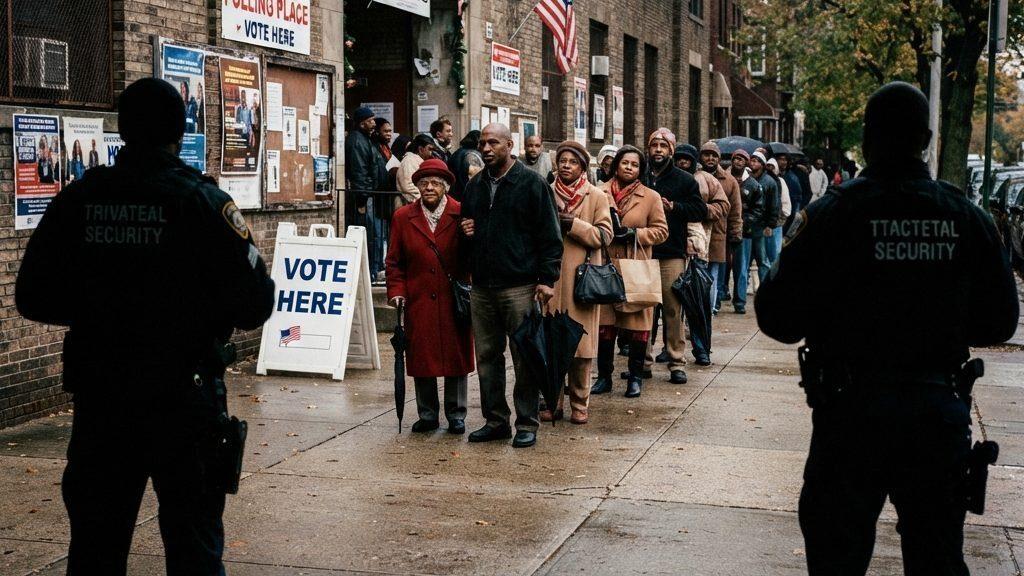
Recent headlines have alerted the nation to a pair of intense legal challenges ahead of the midterm elections. A major coalition of civil rights organizations and local election jurisdictions filed an expanded federal lawsuit (democracydocket.com). Their complaint challenges directives that position armed personnel near polling places located inside predominantly Black, Latino, and immigrant neighborhoods (protectdemocracy.org, democracydocket.com). The plaintiffs argue that these armed deployments create unlawful intimidation and suppress ballot access (democracydocket.com, democracydocket.com).
At the same time, civil rights watchdogs submitted formal complaints to the federal government (govexec.com). They target a multi-million-dollar media campaign financed with public tax dollars (govexec.com). The complaints assert that executive agencies are misdirecting public resources to suppress turnout among urban voters (osc.gov, govexec.com). These twin battles may appear modern, yet they reflect conflicts that have existed for generations.
The contemporary struggle over ballot access did not begin in this election cycle. Instead, it is part of a relentless pattern running throughout American history. For over a century, powerful factions have used physical force and bureaucratic power to keep Black citizens away from the ballot box. Understanding this modern dispute requires examining the historical roots that give these headlines their true meaning.
Troops at the Polls and Reconstruction Terror
The threat of armed state actors at voting centers reaches back to the Civil War. During that national conflict, Union military officers supervised voting in border states like Maryland and Missouri (lawfaremedia.org). Congress realized that armed military forces could easily control civilian elections (lawfaremedia.org). Therefore, lawmakers passed legislation in 1865 that strictly barred military officers from keeping armed troops at election places (lawfaremedia.org, cornell.edu).
That prohibition was updated in 1880 and remains active federal criminal law under 18 U.S.C. Section 592 (lawfaremedia.org, cornell.edu). The law makes dispatching armed federal personnel to polling places a felony (lawfaremedia.org). The only legal exception is repelling active foreign enemies of the country (lawfaremedia.org, cornell.edu). Following the post-Civil War era, Black citizens encountered severe armed opposition from white supremacist paramilitaries (protectdemocracy.org). Groups such as the Ku Klux Klan and the White League patrolled polling stations to violently strip Black men of their constitutional rights (protectdemocracy.org).
Local law enforcement frequently collaborated with these violent factions across the South. Congress intervened by passing the Enforcement Acts, which included the Ku Klux Klan Act of 1871 (protectdemocracy.org). Codified today at 42 U.S.C. Section 1985(3), this statute provides a federal remedy when conspirators use force or threats to obstruct voting (protectdemocracy.org, democracydocket.com). The law established a clear legal standard: citizens have a right to cast ballots free from state and private terror (protectdemocracy.org).
Voter Turnout Decline Under Armed Presence
The Psychological Scars of Jim Crow Policing
The sight of armed police officers outside polling precincts triggers deep historical trauma for Black communities. Throughout the Jim Crow era, Southern law enforcement officers operated as the primary guardians of white supremacy. Figures like Sheriff Jim Clark in Selma and Bull Connor in Birmingham directed dogs, clubs, and tear gas at peaceful Black marchers seeking the ballot. Armed uniforms did not signify safety. Instead, they signaled state-sanctioned violence and swift retribution for exercising democratic rights.
Southern police forces used pretextual traffic stops, arbitrary arrests, and armed surveillance outside courthouses to suppress Black political life. Consequently, law enforcement presence at the ballot box acts as powerful psychological deterrence. Empirical research validates these lingering realities. A study analyzing voter turnout in the 2017 Alabama special election showed that police presence outside voting sites resulted in an estimated 32 percent decline in Black voter participation (tandfonline.com). The uniform itself sends a message of exclusion.
Recognizing these systemic abuses, Congress passed the Voting Rights Act of 1965 (harvard.edu). While Sections 4 and 5 addressed voter tests and preclearance, Section 11(b) targeted intimidation (harvard.edu, democracydocket.com). Unlike standard criminal statutes, Section 11(b) does not require proving subjective intent to intimidate voters (harvard.edu, democracydocket.com). Instead, courts examine whether state conduct objectively intimidates ordinary citizens attempting to exercise the franchise (democracydocket.com).
The 1981 Ballot Security Task Force Precedent
Modern efforts to monitor voting sites have direct historical parallels in contemporary political history. The most notorious incident occurred during the 1981 New Jersey gubernatorial election between Thomas Kean and James Florio (wikipedia.org, njspotlightnews.org). In that contest, party organizers created a program called the National Ballot Security Task Force (wikipedia.org, njspotlightnews.org). The task force dispatched off-duty, armed police officers wearing visible armbands into predominantly Black and Latino neighborhoods in Newark and Trenton (wikipedia.org, njspotlightnews.org).
These armed monitors carried two-way radios and stood directly outside precinct entrances (wikipedia.org). They placed large warning signs at polling sites threatening criminal prosecution for voting violations (wikipedia.org, njspotlightnews.org). When the votes were counted, Thomas Kean won the election by a razor-thin margin of 1,797 votes out of three million cast (wikipedia.org, njspotlightnews.org). That tiny gap amounted to a mere 0.05 percent margin of victory (wikipedia.org).
The Democratic National Committee promptly filed a federal lawsuit alleging violations of the Voting Rights Act and the Ku Klux Klan Act (wikipedia.org, njspotlightnews.org). The lawsuit produced a historic 1982 federal consent decree (wikipedia.org, njspotlightnews.org). That decree strictly prohibited targeted ballot security initiatives in minority areas without prior federal court approval (wikipedia.org, njspotlightnews.org). The consent decree stood as a nationwide shield for 36 years until a federal judge allowed it to expire in January 2018 (wikipedia.org, njspotlightnews.org). Its termination reopened the door to aggressive polling surveillance.
Public Anxiety Over Armed Poll Presence
Taxpayer Dollars and the 1938 Roots of the Hatch Act
Physical intimidation represents only one half of the current legal battle. The companion administrative complaint addresses executive abuse of taxpayer dollars (govexec.com). This complaint traces its roots to political scandals during the Great Depression (senate.gov, wikipedia.org). In the 1938 midterm elections, President Franklin D. Roosevelt attempted to purge conservative southern Democrats who opposed New Deal policies (senate.gov, wikipedia.org). Federal investigations revealed widespread corruption within the Works Progress Administration (senate.gov, wikipedia.org).
Congressional inquiries showed that federal administrators used public relief funds to influence elections in Kentucky, Maryland, and Georgia (senate.gov, wikipedia.org). Relief workers were pressured to contribute money to favored candidates to keep their jobs (senate.gov, wikipedia.org). WPA supervisors coordinated partisan campaign efforts while on duty using government equipment (senate.gov, wikipedia.org). Public outrage over these revelations demanded immediate legislative reform to protect democratic elections (senate.gov, wikipedia.org).
In response, Senator Carl Hatch sponsored the Act to Prevent Pernicious Political Activities of 1939 (senate.gov, house.gov). Codified at 5 U.S.C. Sections 7321 through 7326, the Hatch Act established civil service neutrality (house.gov, wikipedia.org). It barred federal employees from using official authority to interfere with election outcomes (osc.gov, house.gov). The statute prohibited public funds from being converted into partisan campaign tools (osc.gov, wikipedia.org). That historic principle sits at the heart of the current campaign complaints (govexec.com).
Office of Special Counsel Hatch Act Cases
The Growth of Administrative Election Suppression
Government watchdogs report that political pressure on civil servants has expanded dramatically. The Office of Special Counsel received 694 new Hatch Act complaints in fiscal year 2025 (osc.gov). This marked a 51.5 percent jump over the 458 complaints received in 2024 (osc.gov). Today, suppression efforts often rely on calculated information operations rather than physical violence alone.
Modern campaigns deploy targeted disinformation to manipulate communities without firing a shot. During recent election cycles, political operatives directed deceptive robocalls into Detroit, Philadelphia, and Cleveland (cbc.ca). These automated calls falsely warned Black residents that voting by mail placed their records in public databases (cbc.ca). Callers claimed police would execute outstanding arrest warrants and collect old credit debts (cbc.ca). The operations aimed to drive eligible voters away through manufactured fear.
Similarly, state executives weaponize legal penalties through sensationalized announcements. In Florida, state officials formed the Office of Election Crimes and Security (floridacitizen.org). The agency staged early morning arrests of formerly incarcerated citizens who genuinely believed they were eligible to vote (floridacitizen.org). Officials distributed body-camera footage to television outlets to maximize publicity (floridacitizen.org). This exploitation of the system of mass incarceration created widespread terror, discouraging thousands of eligible citizens from casting ballots.
Federal Pretexts for Armed Presence at the Polls
When federal agencies attempt to position armed personnel near polling sites, they encounter strict legal boundaries. Because 18 U.S.C. Section 592 clearly criminalizes armed troops at elections, executive officials rely on administrative pretexts (lawfaremedia.org). Administrators frequently claim they are merely protecting nearby federal property (lawfaremedia.org). In other instances, agencies assert they are investigating alleged noncitizen voting or immigration violations.
These actions fuel the enduring struggle over federalism between local election boards and national leaders. In the ongoing lawsuit, civil rights coalitions challenge these administrative rationales under the Ku Klux Klan Act (protectdemocracy.org, democracydocket.com). Plaintiffs argue that staging federal personnel near minority precincts serves no genuine law enforcement objective (democracydocket.com). Instead, they maintain the deployments are designed to intimidate minority voters (democracydocket.com).
Recent polling documents widespread voter apprehension regarding armed surveillance. A national survey by Edge Research and the Global Project Against Hate and Extremism revealed deep concerns (globalextremism.org). Over 60 percent of Americans fear violence or armed individuals at polling locations (globalextremism.org). Furthermore, a University of California San Diego study found that 40 percent of voters expected armed federal or immigration officers near voting centers (globalextremism.org). This anxiety fall hardest on naturalized citizens and communities of color.
Synthesizing Past and Present at the Voting Booth
The contemporary lawsuits against armed monitors and public relation schemes demonstrate that historical battles never truly end. Rather, old strategies adapt to modern conditions. When armed monitors stand near ballot boxes, they replicate the intimidation that defined Reconstruction and the 1981 New Jersey campaign (wikipedia.org, protectdemocracy.org). When administrations redirect federal tax money into voter-suppression media campaigns, they mirror the 1938 relief scandals that produced the Hatch Act (senate.gov, wikipedia.org).
Generations of Black Americans fought against these tactics through continuous political resistance. Activists challenged violent intimidation during the civil rights movement and dismantled restrictive literacy tests through national organizing. The current federal litigation represents the latest chapter in that ongoing defense of democracy. Local election officials and civil rights organizations continue to push back against unlawful federal overreach (democracydocket.com).
The legal framework remains essential to this struggle. The Reconstruction-era Ku Klux Klan Act, the 1865 federal troop ban, and the 1965 Voting Rights Act remain the premier tools for protecting voters (protectdemocracy.org, lawfaremedia.org, democracydocket.com). These statutes establish that the right to vote must be shielded from state terror and coercion (protectdemocracy.org, democracydocket.com). As courts weigh these expanded legal challenges, they confront questions that shaped the American republic for over a century.
The Continuing Defense of Democratic Access
The struggle over voting access will not conclude with the resolution of these federal lawsuits. Ongoing disenfranchisement efforts demonstrate that the right to vote requires vigilant defense in every generation. Whether through armed monitors outside precincts or administrative disinformation on television, voter suppression constantly reappears under new labels.
These coordinated legal filings highlight the vital role of grassroots watchdog groups and civil rights coalitions. By exposing how modern deployments violate foundational federal statutes, advocates hold public officials accountable to established law (democracydocket.com, govexec.com). The history behind the headlines serves as a clear warning. When armed force and government coffers intrude upon elections, democratic representation suffers.
Protecting the franchise requires constant public attention and judicial vigilance. The statutes crafted after the Civil War, during the New Deal, and during the civil rights movement were designed for this exact purpose (senate.gov, protectdemocracy.org, democracydocket.com). They remind the nation that civilian elections belong to the people, not to armed agents or partisan executives.
About the Author
Darius Spearman is a professor of Black Studies at San Diego City College, where he has been teaching for over 20 years. He is the founder of African Elements, a media platform dedicated to providing educational resources on the history and culture of the African diaspora. Through his work, Spearman aims to empower and educate by bringing historical context to contemporary issues affecting the Black community.
